
• About
  • Masthead
  • License Content
  • Advertise
  • Press Releases
  • Newsroom
  • RSS/Email List
  • 2MM Podcast
  • Write for us
  • Contact Us
2 Minute Medicine
No Result
View All Result

No products in the cart.

Sign in
SUBSCRIBE
  • About
  • Specialties
    • All Specialties, All Recent Reports
    • Cardiology
    • Chronic Disease
    • Dermatology
    • Emergency
    • Endocrinology
    • Gastroenterology
    • Imaging and Intervention
    • Infectious Disease
    • Nephrology
    • Neurology
    • Obstetrics
    • Oncology
    • Ophthalmology
    • Pediatrics
    • Pharma
    • Preclinical
    • Psychiatry
    • Public Health
    • Pulmonology
    • Rheumatology
    • Surgery
    • Rewinds
    • The Scan
  • EvidencePulse™
  • HypeCheck™
  • AI News
  • Classics™
    • 2MM+ Online Access
    • Paperback and Ebook
  • Tools
    • NPI Registry Lookup
    • RVU Search
    • Physician Pay by Specialty
    • ICD-10 Code Lookup
    • FDA Drug Approvals
    • Drug Safety for Breastfeeding/Pregnancy
    • Clinical Guidelines
    • Medical Calculators
    • ECG Reference
      • QTc Calculator
      • Sgarbossa Criteria
      • ECG Axis Calculator
      • AV Block Helper
  • Rankings
    • Medical School Rankings
    • Residency Rankings
  • Partners
    • License Content
    • Advertise with Us
2 Minute Medicine
  • About
  • Specialties
    • All Specialties, All Recent Reports
    • Cardiology
    • Chronic Disease
    • Dermatology
    • Emergency
    • Endocrinology
    • Gastroenterology
    • Imaging and Intervention
    • Infectious Disease
    • Nephrology
    • Neurology
    • Obstetrics
    • Oncology
    • Ophthalmology
    • Pediatrics
    • Pharma
    • Preclinical
    • Psychiatry
    • Public Health
    • Pulmonology
    • Rheumatology
    • Surgery
    • Rewinds
    • The Scan
  • EvidencePulse™
  • HypeCheck™
  • AI News
  • Classics™
    • 2MM+ Online Access
    • Paperback and Ebook
  • Tools
    • NPI Registry Lookup
    • RVU Search
    • Physician Pay by Specialty
    • ICD-10 Code Lookup
    • FDA Drug Approvals
    • Drug Safety for Breastfeeding/Pregnancy
    • Clinical Guidelines
    • Medical Calculators
    • ECG Reference
      • QTc Calculator
      • Sgarbossa Criteria
      • ECG Axis Calculator
      • AV Block Helper
  • Rankings
    • Medical School Rankings
    • Residency Rankings
  • Partners
    • License Content
    • Advertise with Us
Sign in
SUBSCRIBE
2 Minute Medicine
Sign in
Subscribe
2 Minute MedicineFree on Google PlayGet
✦EvidencePulse™by 2 Minute Medicine3 reportsYou askedtop stroke trials 2026Synthesizing medical evidence...Top 2026 stroke trial results:OCEANIC — ischemic stroke: 6.2% vs 8.4%OPTION* — mRS 0–1: 43.6% vs 34.2%ORIENTAL* — mRS 0–2: 58.6% vs 46.6%*Higher sICH in intervention armsParticipants randomizedNOCEANIC12,327OPTION570ORIENTAL564Ask about guidelines or landmark trials...↑Try EvidencePulse™Ask the evidence. Get the signal.Try it now →
Home Health A to Z

Patient Basics: Electromyography and Nerve Conduction Studies (EMG)
by2 Minute Medicine
October 30, 2026
in Health A to Z
Reading Time: 5 mins read
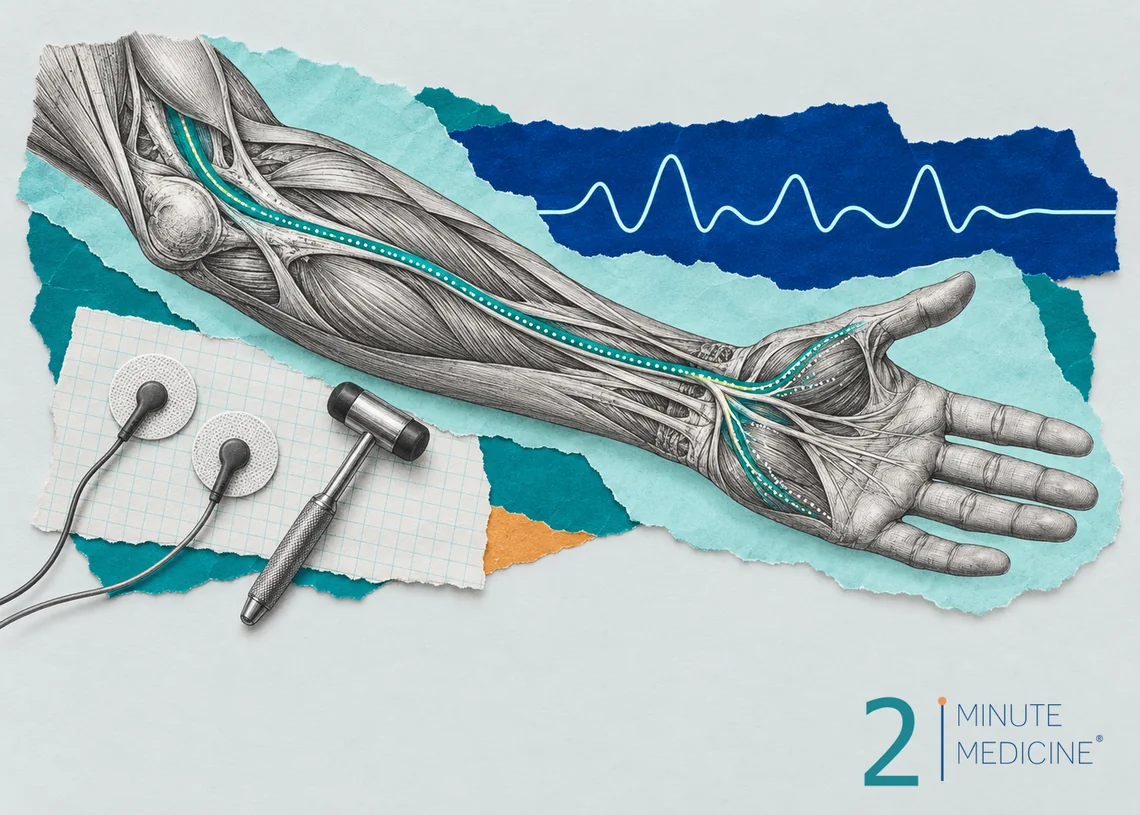
EMG test collage: an engraved arm nerve running to the hand muscles, round electrode pads, a reflex hammer and a wave trace
Share on FacebookShare on TwitterShare on LinkedIn

An EMG test (electromyography) records the electrical signals in your muscles. It is almost always done together with nerve conduction studies, which measure how fast and how well signals travel along your nerves. Together, these tests help find the cause of numbness, tingling, weakness or muscle cramps. The tests can be uncomfortable, but they are low risk, and most people go back to normal activities right afterward.

Key points

  • Nerve conduction studies use small stickers on the skin and brief electrical pulses that feel like a quick snap or tingle.
  • The EMG part uses a very thin needle placed in a few muscles. It feels like a pinch or a cramp.
  • Common reasons for testing are carpal tunnel syndrome, a pinched nerve in the neck or back, and nerve damage from diabetes.
  • Don’t put lotion or oil on your skin the day of the test.
  • The whole visit usually takes 30 to 90 minutes.

Why an EMG test is done

Nerves carry signals from the brain and spinal cord to your muscles, and carry feeling back. When something goes wrong, the problem could be in the nerve root near the spine, in a nerve in the arm or leg, where nerve meets muscle, or in the muscle itself. These tests help tell those apart. A neurologist or a physiatrist (a rehabilitation doctor) usually does them. Common reasons include:

  • Carpal tunnel syndrome, a squeezed nerve at the wrist, and other trapped nerves, such as at the elbow
  • A pinched nerve root in the neck or lower back (radiculopathy), often from a disc problem
  • Peripheral neuropathy, nerve damage in the feet and hands, often from diabetes
  • Nerve injury after an accident or surgery
  • Muscle diseases (myopathies) that cause weakness
  • Problems where nerve meets muscle, such as myasthenia gravis
  • Motor neuron disease, such as ALS
  • Guillain-Barré syndrome, a sudden attack on the nerves by the immune system

An MRI shows the structure of the spine or a nerve. An EMG shows how the nerve and muscle are working, so the two tests often answer different questions.

How to prepare for an EMG test

  • Shower or bathe that day, and don’t use lotion, cream, oil or powder on your arms or legs. They keep the stickers from sticking.
  • Wear loose clothes that let the doctor reach your arms or legs. You may change into a gown.
  • Eat and take your usual medicines unless told otherwise.
  • Tell the doctor if you take a blood thinner, have a bleeding problem, or have a pacemaker or implanted defibrillator. Most people can still have the test, but the doctor may change how it’s done.
  • If you take pyridostigmine for myasthenia gravis, ask whether to skip a dose before the test.
  • Bring a list of your symptoms and which side of the body they affect.

During the test

Nerve conduction studies

The doctor or technologist places sticky pads (electrodes) on the skin over a nerve and a muscle. A small device then gives short electrical pulses over the nerve. Each pulse feels like a quick snap or a static shock and may make your muscle twitch. A computer measures how fast the signal travels and how strong it is. Cold skin slows nerve signals, so your hands or feet may be warmed first.

Needle electromyography

Next, the doctor places a very thin needle electrode, about the size of an acupuncture needle, into several muscles one at a time. No electricity is sent through the needle. It only listens. You’ll be asked to relax the muscle and then tighten it gently while the machine records the signals. You may hear crackling or popping sounds from a speaker, which are your muscle signals. The doctor moves the needle a little within each muscle and uses a new needle for each person.

After the test

You can drive yourself home and go back to work or normal activities. The muscles that were tested may feel sore for a day or two, and you may see small bruises or pinpoint bleeding spots. A cold pack and an over-the-counter pain reliever can help.

RELATED REPORTS

No Content Available

Possible risks

Serious problems are rare. Small bruises and brief soreness are common. Infection where the needle went in is uncommon. When muscles of the chest wall or near the ribs are tested, there is a very small chance of a collapsed lung, so tell the doctor right away if you feel short of breath afterward.

Your results

The doctor who performs the test often shares the main findings before you leave. A full report goes to the doctor who ordered it, usually within a few days. Results may show slowed signals from a trapped nerve, damage to the nerve fibers, or patterns that point to a muscle disease. Normal results are also useful, because they can rule out some causes of your symptoms.

When to call your doctor

  • Swelling, redness, warmth or pus where a needle went in
  • Soreness that gets worse after 2 days
  • Shortness of breath or chest pain after the test (call 911 if severe)

Common questions about EMG tests

Does an EMG test hurt?

It is uncomfortable more than painful for most people. The nerve pulses feel like quick snaps, and the needle feels like a pinch or a brief cramp when the muscle tightens. You can ask for a short break at any time. Any soreness usually fades within a day or two.

Can an EMG show a pinched nerve?

Yes, often. An EMG can show which nerve root in the neck or lower back is affected and how badly. It works best a few weeks after symptoms start, because muscle changes take time to appear. It is often paired with an MRI, which shows what is pressing on the nerve.

How long does an EMG and nerve conduction study take?

Most visits take 30 to 90 minutes. Testing one arm for carpal tunnel syndrome is quicker. Testing both arms and legs for nerve damage throughout the body takes longer. Plan for some extra time to change and talk with the doctor afterward.

Questions to ask your doctor

  • What are you looking for with this test?
  • Do I need both the nerve test and the needle test?
  • Should I stop any of my medicines beforehand?
  • When and how will I get my results?
  • What happens next if the results are normal?

Learn more

  • Electromyography (MedlinePlus, U.S. National Library of Medicine)
  • Nerve conduction velocity (MedlinePlus, U.S. National Library of Medicine)

This guide is general information and doesn’t replace advice from your own doctor. Last updated October 2026.

Tags: Electromyography
Previous Post

Patient Basics: Echocardiogram

Next Post

Patient Basics: Colposcopy and Cervical Biopsy

RelatedReports

No Content Available
Next Post
Colposcopy collage of an engraved colposcope on a stand, a clinic gown on a hook, a blank specimen jar and a swab

Patient Basics: Colposcopy and Cervical Biopsy

Back CT scan collage: a ring-shaped CT scanner with its table, a stack of lower back vertebrae and a blank film sheet

Patient Basics: Computed Tomography (CT Scan) for Back Problems

Cystourethrogram collage: an engraved bladder and kidneys with a teal ribbon, a glass of water and a teddy bear

Patient Basics: Cystourethrogram (VCUG)

✦ EvidencePulse™ by 2 Minute Medicine 3 reports You asked top stroke trials 2026 Synthesizing medical evidence... Top 2026 stroke trial results: OCEANIC — ischemic stroke: 6.2% vs 8.4% OPTION* — mRS 0–1: 43.6% vs 34.2% ORIENTAL* — mRS 0–2: 58.6% vs 46.6% *Higher sICH in intervention arms Participants randomizedN OCEANIC 12,327 OPTION 570 ORIENTAL 564 Ask about guidelines or landmark trials... Try EvidencePulse™ Get the signal. Try it now → Physician-trained medical AI by 2 Minute Medicine

2MM+ All Access

Full details →
$4.99 /month

3-day free trial · cancel anytime

  • ✓100+ physician-written reports
  • ✓EvidencePulse™ + HypeCheck™
  • ✓Ad-free reading + newsletters
Start 3-day free trial

Then $4.99/month. Manage renewal in your account.

2 Minute Medicine® is an award winning, physician-run, expert medical media company. Our content is curated, written and edited by practicing health professionals who have clinical and scientific expertise in their field of reporting. Our editorial management team is comprised of highly-trained MD physicians. Join numerous brands, companies, and hospitals who trust our licensed content.

Recent Reports

  • Pelacarsen lowers lipoprotein(a) but does not reduce major cardiovascular events in patients with established cardiovascular disease
  • Durvalumab plus enfortumab vedotin was approved for perioperative treatment of muscle-invasive bladder cancer
  • CDC reports 5,412 confirmed measles cases in the United States in 2026
License Content
Terms of Use | Disclaimer
Cookie Policy

Get the app

Read 2 Minute Medicine on iPhone, iPad and Android.

Download on the App StoreGet it on Google Play
QR code for www.2minutemedicine.com/app
On a computer? Scan this with your phone’s camera.
2MM+ All Access Full details →

The medical literature, distilled daily.

Monthly plan selected: $4.99 /month.

$4.99/month

3-day free trial · cancel anytime

Start 3-day free trial

Then $4.99/month. Manage renewal in your account.

Yearly plan selected: $49.90 /year.

$49.90/year

2 months free

Start 3-day free trial

Then $49.90/year.

Membership benefits

  • ✓100+ new physician-written study summaries monthly, 12,000+ searchable
  • ✓AI EvidencePulse™ + HypeCheck™
  • ✓Ad-free reading + newsletters
  • ✓FDA drug approvals + clinical calculators

Already a member? Sign in

  • Get the app
  • About
  • Specialties
    • All Specialties, All Recent Reports
    • Cardiology
    • Chronic Disease
    • Dermatology
    • Emergency
    • Endocrinology
    • Gastroenterology
    • Imaging and Intervention
    • Infectious Disease
    • Nephrology
    • Neurology
    • Obstetrics
    • Oncology
    • Ophthalmology
    • Pediatrics
    • Pharma
    • Preclinical
    • Psychiatry
    • Public Health
    • Pulmonology
    • Rheumatology
    • Surgery
    • Rewinds
    • The Scan
  • EvidencePulse™
  • HypeCheck™
  • AI News
  • Classics™
    • 2MM+ Online Access
    • Paperback and Ebook
  • Tools
    • NPI Registry Lookup
    • RVU Search
    • Physician Pay by Specialty
    • ICD-10 Code Lookup
    • FDA Drug Approvals
    • Drug Safety for Breastfeeding/Pregnancy
    • Clinical Guidelines
    • Medical Calculators
    • ECG Reference
      • QTc Calculator
      • Sgarbossa Criteria
      • ECG Axis Calculator
      • AV Block Helper
  • Rankings
    • Medical School Rankings
    • Residency Rankings
  • Partners
    • License Content
    • Advertise with Us
No Result
View All Result

© 2026 2 Minute Medicine, Inc. - Physician-written medical news.


