

Patient Basics: Hemophilia

Hemophilia is an inherited bleeding disorder in which the blood doesn’t clot properly because it is low in a clotting protein called a clotting factor. People with hemophilia don’t bleed faster than others, but they bleed for longer, and bleeding can start inside joints and muscles without an obvious injury. It mostly affects males. Modern treatment lets most people with hemophilia live active lives with a near-normal lifespan.
Key points
- Hemophilia A means low factor VIII. Hemophilia B means low factor IX. Type A is about four times as common.
- Severe hemophilia causes bleeding into joints and muscles with little or no injury. Mild hemophilia may only show up after surgery, dental work or a bad injury, sometimes not until adulthood.
- Treatment usually means regular preventive injections of clotting factor or newer medicines given under the skin.
- Care at a hemophilia treatment center leads to fewer bleeds and healthier joints.
- A head injury or signs of bleeding in the head are an emergency, even if the person seems fine.
What happens in hemophilia
When a blood vessel is cut, platelets rush to the spot and form a soft plug. Then a chain of clotting factors works together to build a tough mesh (fibrin) that holds the plug in place. In hemophilia, one link in that chain is weak, so the plug forms but doesn’t hold. Bleeding stops slowly, or starts again hours later.
The level of clotting factor sets the severity:
- Severe: less than 1 percent of normal. Bleeding into joints and muscles happens often, even without injury.
- Moderate: 1 to 5 percent. Bleeding usually follows minor injuries.
- Mild: 5 to 40 percent. Bleeding problems mostly happen with surgery, tooth removal or serious injury.
People with hemophilia were once called “hemophiliacs.” Many now prefer “person with hemophilia.”
What causes hemophilia
Hemophilia A and B come from a change in a gene on the X chromosome. Males have one X chromosome, so one changed copy causes hemophilia. Females have two, so they are usually carriers. A carrier mother has a 1 in 2 chance of passing the gene to each child. About 1 in 3 people with hemophilia have no family history, because the gene change is new.
Some female carriers have low factor levels and bleeding symptoms of their own. They are now diagnosed with hemophilia too.
Rarely, adults with no family history develop acquired hemophilia. The immune system makes antibodies that block factor VIII. It is most common in older adults and sometimes follows childbirth. It causes sudden large bruises and bleeding into muscles, and needs urgent specialist care.
Signs and symptoms of hemophilia
- Large, deep or lumpy bruises from small bumps
- Bleeding into joints, most often the knees, elbows and ankles. It starts with tingling or tightness, then warmth, swelling, pain and stiffness.
- Bleeding into muscles, causing a painful, swollen area
- Bleeding that lasts a long time or restarts after cuts, tooth removal, surgery or shots
- Nosebleeds or gum bleeding that are hard to stop
- Blood in the urine or stool
- In babies, unusual bleeding after circumcision or bruising when they start to crawl
- In girls and women, heavy periods and heavy bleeding after childbirth
In adults with mild hemophilia, the first sign may be bleeding that won’t stop after a dental extraction or an operation.
Over years, repeated joint bleeds damage the cartilage and cause arthritis. Preventing bleeds protects the joints.
How it’s diagnosed
Blood tests show a normal platelet count and a normal PT, with a slow result on a clotting test called the aPTT. A factor test measures the exact level of factor VIII or IX. Genetic testing finds the gene change and can check female relatives who may be carriers. When there is a family history, testing can be done on a newborn’s cord blood or before birth.
How hemophilia is treated
Treatment aims to prevent bleeds and stop them quickly when they happen. Most people with moderate or severe hemophilia use preventive treatment (prophylaxis).
- Clotting factor replacement. Factor VIII or IX made in a lab, or from donated plasma, is injected into a vein. Longer-acting products need fewer injections, some only once a week. Many people learn to give it themselves at home.
- Emicizumab. For hemophilia A, this shot under the skin does the job of factor VIII. It is given once a week to once a month.
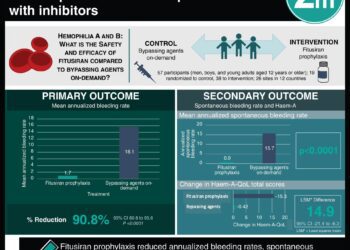
- Other shots under the skin. Newer medicines, such as concizumab, marstacimab and fitusiran, help blood clot by lowering the body’s natural anti-clotting proteins. Some work for both types of hemophilia.
- Gene therapy. A one-time infusion is approved for some adults with hemophilia A or B. It can raise factor levels for years, but it doesn’t suit everyone and long-term effects are still being studied.
- Desmopressin. In mild hemophilia A, this nasal spray or injection releases the body’s stored factor VIII.
- Tranexamic acid. A medicine that helps clots hold, often used for mouth, nose and heavy menstrual bleeding.
Some people, mostly with severe hemophilia A, develop antibodies (inhibitors) that stop replacement factor from working. Emicizumab and other special products treat bleeds in people with inhibitors.
Comprehensive care from a hemophilia treatment center brings doctors, nurses, physical therapists, dentists and social workers together in one place.
Living with hemophilia
- Treat bleeds early. If you think a bleed has started, give treatment first and call your care team.
- For pain, use acetaminophen. Avoid aspirin, ibuprofen and naproxen unless your team says otherwise.
- Stay active. Swimming, cycling and walking keep the muscles around joints strong. Skip sports like football, hockey and boxing, and wear a helmet for biking.
- Brush and floss daily and see a dentist regularly to avoid gum bleeding and extractions.
- Wear a medical ID, and tell every dentist, surgeon and new doctor that you have hemophilia.
- Keep a log of bleeds and treatments to help your team adjust your plan.
When to see a doctor
- A bleed that doesn’t stop with your usual treatment
- A swollen, painful joint or muscle
- Unexplained large bruises, or bleeding after dental work that won’t stop, especially if a relative has a bleeding disorder
Get emergency care for any head injury, or for a severe headache, vomiting, sleepiness, confusion, neck pain or vision changes. Also get help right away for bleeding in the throat or neck, severe belly pain, or heavy bleeding. Call 911.
Common questions about hemophilia
Why is bleeding time normal in hemophilia?
Bleeding time measures how quickly platelets plug a tiny cut. In hemophilia, platelets work normally, so the first plug forms on time. The problem comes next, when clotting factors should strengthen the plug. That is why the aPTT test is slow and why bleeding can restart hours later.
Can women have hemophilia?
Yes. Women and girls who carry the gene can have low factor levels, and some have levels as low as men with hemophilia. Heavy periods, bleeding after childbirth or surgery, and easy bruising are common signs. Female relatives of someone with hemophilia should have their factor levels checked.
Can hemophilia be diagnosed in adults?
Yes. Mild hemophilia may not cause problems until an adult has surgery, a tooth pulled or a serious injury. Acquired hemophilia, caused by antibodies against factor VIII, starts in adulthood with no family history. Both are found with clotting tests and factor levels.
Is there a cure for hemophilia?
Gene therapy can raise factor levels for years after one treatment, and some people no longer need regular injections. Doctors don’t call it a cure yet, because levels can fall over time and it isn’t suitable for everyone. For most people, preventive treatment keeps bleeding well controlled.
Questions to ask your doctor
- What type and severity of hemophilia do I have?
- Which preventive treatment fits my life best?
- Do I have inhibitors, and how often should I be tested?
- What should I do at home when a bleed starts?
- Should family members be tested?
Learn more
- About hemophilia (Centers for Disease Control and Prevention)
- Hemophilia (MedlinePlus, U.S. National Library of Medicine)
This guide is general information and doesn’t replace advice from your own doctor. Last updated October 2026.
RelatedReports








 Get the app