• About
  • Masthead
  • License Content
  • Advertise
  • Press Releases
  • Newsroom
  • RSS/Email List
  • 2MM Podcast
  • Write for us
  • Contact Us
2 Minute Medicine
No Result
View All Result

No products in the cart.

Sign in
SUBSCRIBE
  • About
  • Specialties
    • All Specialties, All Recent Reports
    • Cardiology
    • Chronic Disease
    • Dermatology
    • Emergency
    • Endocrinology
    • Gastroenterology
    • Imaging and Intervention
    • Infectious Disease
    • Nephrology
    • Neurology
    • Obstetrics
    • Oncology
    • Ophthalmology
    • Pediatrics
    • Pharma
    • Preclinical
    • Psychiatry
    • Public Health
    • Pulmonology
    • Rheumatology
    • Surgery
    • Rewinds
    • The Scan
  • EvidencePulse™
  • HypeCheck™
  • AI News
  • Classics™
    • 2MM+ Online Access
    • Paperback and Ebook
  • Tools
    • NPI Registry Lookup
    • RVU Search
    • Physician Pay by Specialty
    • ICD-10 Code Lookup
    • FDA Drug Approvals
    • Drug Safety for Breastfeeding/Pregnancy
    • Clinical Guidelines
    • Medical Calculators
    • ECG Reference
      • QTc Calculator
      • Sgarbossa Criteria
      • ECG Axis Calculator
      • AV Block Helper
  • Rankings
    • Medical School Rankings
    • Residency Rankings
  • Partners
    • License Content
    • Advertise with Us
2 Minute Medicine
  • About
  • Specialties
    • All Specialties, All Recent Reports
    • Cardiology
    • Chronic Disease
    • Dermatology
    • Emergency
    • Endocrinology
    • Gastroenterology
    • Imaging and Intervention
    • Infectious Disease
    • Nephrology
    • Neurology
    • Obstetrics
    • Oncology
    • Ophthalmology
    • Pediatrics
    • Pharma
    • Preclinical
    • Psychiatry
    • Public Health
    • Pulmonology
    • Rheumatology
    • Surgery
    • Rewinds
    • The Scan
  • EvidencePulse™
  • HypeCheck™
  • AI News
  • Classics™
    • 2MM+ Online Access
    • Paperback and Ebook
  • Tools
    • NPI Registry Lookup
    • RVU Search
    • Physician Pay by Specialty
    • ICD-10 Code Lookup
    • FDA Drug Approvals
    • Drug Safety for Breastfeeding/Pregnancy
    • Clinical Guidelines
    • Medical Calculators
    • ECG Reference
      • QTc Calculator
      • Sgarbossa Criteria
      • ECG Axis Calculator
      • AV Block Helper
  • Rankings
    • Medical School Rankings
    • Residency Rankings
  • Partners
    • License Content
    • Advertise with Us
Sign in
SUBSCRIBE
2 Minute Medicine
Sign in
Subscribe
2 Minute MedicineFree on Google PlayGet
✦EvidencePulse™by 2 Minute Medicine3 reportsYou askedtop stroke trials 2026Synthesizing medical evidence...Top 2026 stroke trial results:OCEANIC — ischemic stroke: 6.2% vs 8.4%OPTION* — mRS 0–1: 43.6% vs 34.2%ORIENTAL* — mRS 0–2: 58.6% vs 46.6%*Higher sICH in intervention armsParticipants randomizedNOCEANIC12,327OPTION570ORIENTAL564Ask about guidelines or landmark trials...↑Try EvidencePulse™Ask the evidence. Get the signal.Try it now →
Home Health A to Z

Patient Basics: Non-Small Cell Lung Cancer
by2 Minute Medicine
October 30, 2026
in Health A to Z
Reading Time: 6 mins read
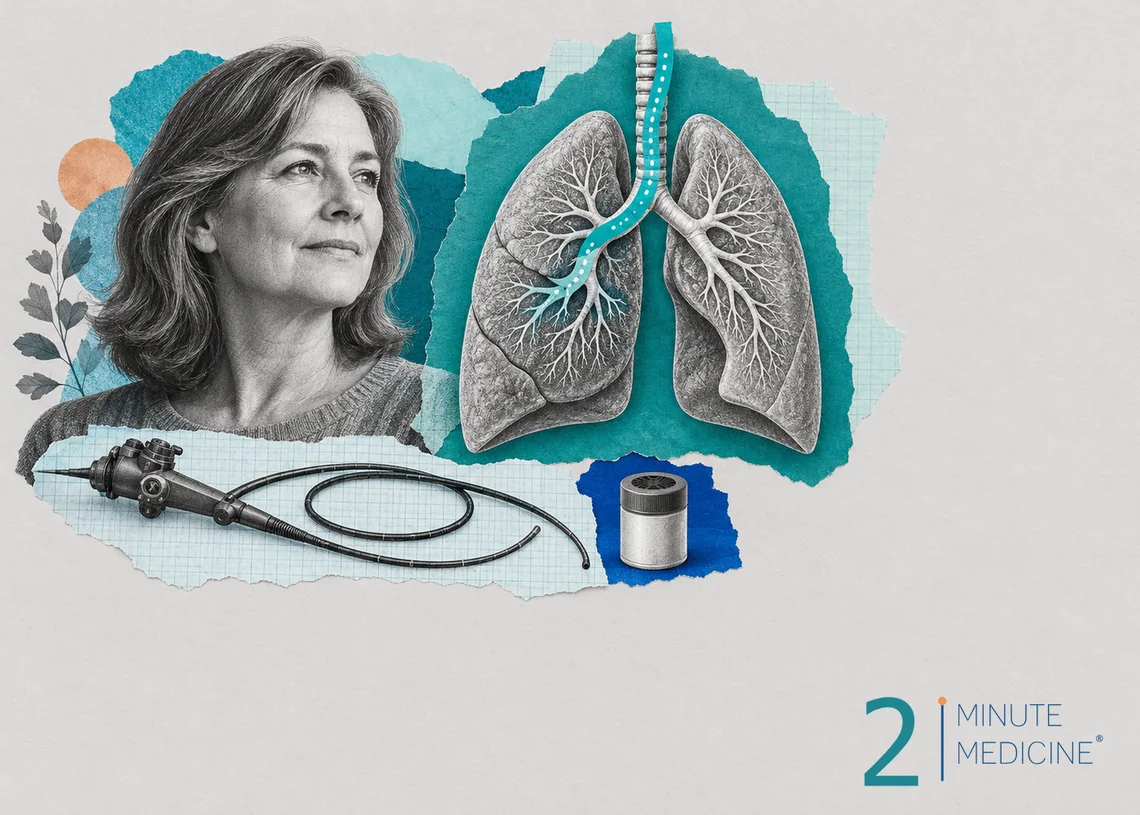
Non-small cell lung cancer collage: a middle-aged woman, an engraved pair of lungs, a bronchoscope and a radon test kit
Share on FacebookShare on TwitterShare on LinkedIn

Non-small cell lung cancer (NSCLC) is the most common kind of lung cancer, making up about 85 in 100 cases. Its main types are adenocarcinoma and squamous cell carcinoma. It often causes no symptoms until it has grown, which is why screening matters for people at high risk. After diagnosis, testing the tumor for gene changes is a key step, because it can point to pills or immune treatments that work better than chemotherapy alone.

Key points

  • Smoking causes most cases, but people who never smoked can get it too, often the adenocarcinoma type.
  • A yearly low-dose CT scan is recommended for many current and former heavy smokers aged 50 to 80.
  • Diagnosis needs a biopsy. The tissue is tested for type, gene changes and a protein called PD-L1.
  • Early stages are treated with surgery or focused radiation, often with added drugs. Later stages are treated with targeted drugs, immunotherapy, chemotherapy or a mix.

Types of non-small cell lung cancer

  • Adenocarcinoma. The most common type. It usually starts in the outer parts of the lung, in cells that make mucus. It is the type most often found in people who never smoked, and in women and younger adults.
  • Squamous cell carcinoma. It starts in the flat cells lining the larger airways near the center of the chest. It is closely linked to smoking.
  • Large cell carcinoma and other less common types. These can grow anywhere in the lung.

Doctors often group adenocarcinoma and large cell carcinoma together as non-squamous NSCLC. The split matters because some chemotherapy drugs, such as pemetrexed, work only for non-squamous cancer, and gene changes that targeted drugs act on are much more common in non-squamous tumors.

Small cell lung cancer is a separate disease. It grows faster, is treated differently, and makes up the other 15 in 100 lung cancers.

Causes and risk factors

  • Smoking cigarettes, cigars or pipes
  • Radon, a natural radioactive gas that can build up in homes. After smoking, it causes more lung cancer in the US than anything else.
  • Secondhand smoke
  • Asbestos and some other workplace exposures
  • Air pollution
  • Past radiation to the chest, and a family history of lung cancer

Symptoms

  • A new cough that lingers, or a change in a smoker’s usual cough
  • Coughing up blood or rust-colored mucus
  • Shortness of breath or wheezing
  • Chest pain that is worse with deep breaths or coughing
  • Hoarseness
  • Pneumonia or bronchitis that keeps coming back
  • Weight loss and tiredness without a clear reason

How non-small cell lung cancer is diagnosed

Diagnosis usually moves in steps: imaging finds a spot, a biopsy confirms cancer and its type, then more tests set the stage and guide treatment.

Imaging

  • CT scan of the chest shows the size and place of a tumor and nearby lymph nodes.
  • PET-CT scan uses a small amount of radioactive sugar to show active cancer in the body.
  • Brain MRI checks for spread to the brain, mainly in stage II and higher.

Biopsy

  • Bronchoscopy. A thin, flexible tube passes through the mouth into the airways. An ultrasound probe on the tube (EBUS) lets the doctor sample lymph nodes in the chest at the same time.
  • Needle biopsy through the chest wall, guided by CT, for spots in the outer lung.
  • Fluid sample taken with a needle if fluid has built up around the lung.
  • Surgery when other methods can’t reach the spot.

Biomarker testing

The lab tests the tumor, or sometimes a blood sample (liquid biopsy), for gene changes such as EGFR, ALK, ROS1, KRAS, BRAF, MET, RET, HER2 and NTRK. It also measures PD-L1, which helps predict how well immunotherapy may work. These results now shape treatment at nearly every stage, so ask whether your tumor has been fully tested.

Breathing tests show whether your lungs could handle surgery.

RELATED REPORTS

Lung cancer screening models show variable performance across populations

Guideline-based lymph node sampling is not associated with increased postoperative complications in lung cancer

Stages

Stage depends on the size of the tumor, which lymph nodes are involved, and whether cancer has spread.

  • Stage I: a tumor up to 4 centimeters (about 1.5 inches) with no spread to lymph nodes.
  • Stage II: a larger tumor, or spread to lymph nodes inside the lung on the same side. Stage IIA usually means a tumor 4 to 5 centimeters across with no lymph node spread. Stage IIB covers bigger tumors, or smaller ones with nearby lymph node spread.
  • Stage III: spread to lymph nodes in the middle of the chest, or a tumor that has grown into nearby structures.
  • Stage IV: spread to the other lung, the lining around the lungs or heart, or distant organs such as the brain, bones, liver or adrenal glands.

Non-small cell lung cancer treatment by stage

  • Stage I. Surgery to remove the lobe of the lung that holds the cancer, or a smaller section for small tumors. People who can’t have surgery may get stereotactic radiation, a few high, precise doses.
  • Stage II and some stage III. Surgery, usually with chemotherapy. Immunotherapy, such as pembrolizumab or nivolumab, is often added before and after surgery. If the tumor has an EGFR change, osimertinib pills after surgery lower the chance of return. Alectinib does the same for ALK changes.
  • Stage III that can’t be removed. Chemotherapy and radiation together, followed by a year of the immunotherapy durvalumab, or by osimertinib for EGFR changes.
  • Stage IV. Targeted pills for tumors with a matching gene change. Otherwise, immunotherapy alone or with chemotherapy. Radiation can ease pain or other symptoms.

Palliative care, which treats symptoms such as breathlessness and pain, helps at any stage and can be given alongside cancer treatment. Clinical trials are open at many cancer centers.

Lowering your risk

  • Don’t smoke. Quitting helps at any age, even after a cancer diagnosis. For free help, call 1-800-QUIT-NOW (1-800-784-8669).
  • Test your home for radon. Kits are cheap, and high levels can be fixed.
  • Ask about screening if you are 50 to 80, have a 20 pack-year smoking history (for example, a pack a day for 20 years), and smoke now or quit within the past 15 years.

When to see a doctor

See a doctor for a cough lasting more than 3 weeks, coughing up blood, ongoing chest pain, or unexplained weight loss. Call 911 for severe trouble breathing or coughing up more than a small amount of blood.

Common questions about non-small cell lung cancer

What is the difference between small cell and non-small cell lung cancer?

They are named for how the cells look under a microscope. Small cell lung cancer grows and spreads fast and is almost always linked to smoking. Non-small cell lung cancer is far more common, usually grows more slowly, and is more often found early enough for surgery.

Is squamous or adenocarcinoma lung cancer worse?

Neither is clearly worse on its own. Stage matters far more. Adenocarcinoma more often has gene changes that targeted pills can treat, which has improved results for many people. Squamous cell cancer has fewer targeted options but responds to immunotherapy and chemotherapy.

Can stage 2 non-small cell lung cancer be cured?

Yes, often. Stage II is usually treated with surgery and added drugs with the goal of cure. Many people live for many years without the cancer coming back. Follow-up CT scans for several years watch for any return.

Questions to ask your doctor

  • What type and stage of lung cancer do I have?
  • Has my tumor been tested for all the important gene changes and PD-L1?
  • Is the goal of treatment cure or control?
  • Would I benefit from treatment before surgery?
  • Are there clinical trials for me?

Learn more

  • Non-small cell lung cancer treatment (National Cancer Institute)
  • Lung cancer (MedlinePlus, U.S. National Library of Medicine)

This guide is general information and doesn’t replace advice from your own doctor. Last updated October 2026.

FDA approvedFor non-small cell lung cancer: Jideytro (zidesamtinib), Jul 22, 2026→
Tags: lung cancer
Previous Post

Patient Basics: Aging Overview

Next Post

Patient Basics: Acute Lymphocytic Leukemia (ALL) in Children

RelatedReports

Lung cancer screening collage: a smiling white-haired man beside engraved lungs with a magnifying glass over the upper lobe
Oncology

Lung cancer screening models show variable performance across populations

June 29, 2026
Lung cancer collage: engraved lungs with the trachea and branching bronchi above a knitted wool scarf and a pine sprig
Chronic Disease

Guideline-based lymph node sampling is not associated with increased postoperative complications in lung cancer

June 9, 2026
Diabetes collage: a lidded sugar bowl inside a blue paper circle, with a whole apple and a bunch of leafy greens
Weekly Rewinds

2 Minute Medicine Rewind June 8, 2026

June 8, 2026
Lung disease collage: engraved alveoli clusters wrapped in capillaries, coiled oxygen tubing with nasal prongs and a feather
Oncology

Positive lung cancer screens frequently receive suboptimal follow-up

December 15, 2025
Next Post
Non-Hodgkin lymphoma collage: a chain of lymph nodes, a single lymphocyte cell, a blank notebook and a calm man

Patient Basics: Non-Hodgkin Lymphoma

Neurofibromatosis collage: a DNA strand, a nerve with small smooth swellings, a cup of milky coffee and a reflex hammer

Patient Basics: Neurofibromatosis

CLL collage: a cluster of round lymphocytes, a drawing of the spleen, a blank calendar page and a closed pocket watch

Patient Basics: Chronic Lymphocytic Leukemia (CLL)

✦ EvidencePulse™ by 2 Minute Medicine 3 reports You asked top stroke trials 2026 Synthesizing medical evidence... Top 2026 stroke trial results: OCEANIC — ischemic stroke: 6.2% vs 8.4% OPTION* — mRS 0–1: 43.6% vs 34.2% ORIENTAL* — mRS 0–2: 58.6% vs 46.6% *Higher sICH in intervention arms Participants randomizedN OCEANIC 12,327 OPTION 570 ORIENTAL 564 Ask about guidelines or landmark trials... Try EvidencePulse™ Get the signal. Try it now → Physician-trained medical AI by 2 Minute Medicine

2MM+ All Access

Full details →
$4.99 /month

3-day free trial · cancel anytime

  • ✓100+ physician-written reports
  • ✓EvidencePulse™ + HypeCheck™
  • ✓Ad-free reading + newsletters
Start 3-day free trial

Then $4.99/month. Manage renewal in your account.

2 Minute Medicine® is an award winning, physician-run, expert medical media company. Our content is curated, written and edited by practicing health professionals who have clinical and scientific expertise in their field of reporting. Our editorial management team is comprised of highly-trained MD physicians. Join numerous brands, companies, and hospitals who trust our licensed content.

Recent Reports

  • Pelacarsen lowers lipoprotein(a) but does not reduce major cardiovascular events in patients with established cardiovascular disease
  • Durvalumab plus enfortumab vedotin was approved for perioperative treatment of muscle-invasive bladder cancer
  • CDC reports 5,412 confirmed measles cases in the United States in 2026
License Content
Terms of Use | Disclaimer
Cookie Policy

Get the app

Read 2 Minute Medicine on iPhone, iPad and Android.

Download on the App StoreGet it on Google Play
QR code for www.2minutemedicine.com/app
On a computer? Scan this with your phone’s camera.
2MM+ All Access Full details →

The medical literature, distilled daily.

Monthly plan selected: $4.99 /month.

$4.99/month

3-day free trial · cancel anytime

Start 3-day free trial

Then $4.99/month. Manage renewal in your account.

Yearly plan selected: $49.90 /year.

$49.90/year

2 months free

Start 3-day free trial

Then $49.90/year.

Membership benefits

  • ✓100+ new physician-written study summaries monthly, 12,000+ searchable
  • ✓AI EvidencePulse™ + HypeCheck™
  • ✓Ad-free reading + newsletters
  • ✓FDA drug approvals + clinical calculators

Already a member? Sign in

  • Get the app
  • About
  • Specialties
    • All Specialties, All Recent Reports
    • Cardiology
    • Chronic Disease
    • Dermatology
    • Emergency
    • Endocrinology
    • Gastroenterology
    • Imaging and Intervention
    • Infectious Disease
    • Nephrology
    • Neurology
    • Obstetrics
    • Oncology
    • Ophthalmology
    • Pediatrics
    • Pharma
    • Preclinical
    • Psychiatry
    • Public Health
    • Pulmonology
    • Rheumatology
    • Surgery
    • Rewinds
    • The Scan
  • EvidencePulse™
  • HypeCheck™
  • AI News
  • Classics™
    • 2MM+ Online Access
    • Paperback and Ebook
  • Tools
    • NPI Registry Lookup
    • RVU Search
    • Physician Pay by Specialty
    • ICD-10 Code Lookup
    • FDA Drug Approvals
    • Drug Safety for Breastfeeding/Pregnancy
    • Clinical Guidelines
    • Medical Calculators
    • ECG Reference
      • QTc Calculator
      • Sgarbossa Criteria
      • ECG Axis Calculator
      • AV Block Helper
  • Rankings
    • Medical School Rankings
    • Residency Rankings
  • Partners
    • License Content
    • Advertise with Us
No Result
View All Result

© 2026 2 Minute Medicine, Inc. - Physician-written medical news.