• About
  • Masthead
  • License Content
  • Advertise
  • Submit Press Release
  • RSS/Email List
  • 2MM Podcast
  • Write for us
  • Contact Us
2 Minute Medicine
No Result
View All Result

No products in the cart.

SUBSCRIBE
  • Specialties
    • All Specialties, All Recent Reports
    • Cardiology
    • Chronic Disease
    • Dermatology
    • Emergency
    • Endocrinology
    • Gastroenterology
    • Imaging and Intervention
    • Infectious Disease
    • Nephrology
    • Neurology
    • Obstetrics
    • Oncology
    • Ophthalmology
    • Pediatrics
    • Pharma
    • Preclinical
    • Psychiatry
    • Public Health
    • Pulmonology
    • Rheumatology
    • Surgery
  • Tools
    • EvidencePulse™
    • RVU Search
    • NPI Registry Lookup
  • Pharma
  • AI News
  • The Scan+
  • Classics™+
    • 2MM+ Online Access
    • Paperback and Ebook
  • Rewinds
  • Partners
    • License Content
    • Submit Press Release
    • Advertise with Us
  • Account
    • Subscribe
    • Sign-in
    • My account
2 Minute Medicine
  • Specialties
    • All Specialties, All Recent Reports
    • Cardiology
    • Chronic Disease
    • Dermatology
    • Emergency
    • Endocrinology
    • Gastroenterology
    • Imaging and Intervention
    • Infectious Disease
    • Nephrology
    • Neurology
    • Obstetrics
    • Oncology
    • Ophthalmology
    • Pediatrics
    • Pharma
    • Preclinical
    • Psychiatry
    • Public Health
    • Pulmonology
    • Rheumatology
    • Surgery
  • Tools
    • EvidencePulse™
    • RVU Search
    • NPI Registry Lookup
  • Pharma
  • AI News
  • The Scan+
  • Classics™+
    • 2MM+ Online Access
    • Paperback and Ebook
  • Rewinds
  • Partners
    • License Content
    • Submit Press Release
    • Advertise with Us
  • Account
    • Subscribe
    • Sign-in
    • My account
SUBSCRIBE
2 Minute Medicine
Subscribe
Home All Specialties Oncology

Positive lung cancer screens frequently receive suboptimal follow-up

byAdrian WongandMichaela Dowling
December 15, 2025
in Oncology, Public Health, Pulmonology
Reading Time: 3 mins read
0
Share on FacebookShare on Twitter

1. In this retrospective cohort study, most patients with a positive lung cancer screening result received guideline-concordant follow-up, though nearly one-third received less-than-recommended care.

2. Invasive procedures were performed in a small proportion of patients who did not ultimately receive a lung cancer diagnosis.

Evidence Rating Level: 2 (Good)

Study Rundown: Low-dose computed tomography (LDCT) screening reduces lung cancer mortality, yet uptake remains low due to concerns about effectiveness, resource requirements, and benefit-harm tradeoffs. Follow-up of positive screening results in clinical practice is not well characterized. This study examined diagnostic testing and adherence to guideline-recommended care in a Medicare cohort after positive LDCT results. Most participants received guideline-concordant follow-up, but a substantial proportion received less-intensive care, particularly those with lower-risk Lung-RADS scores, while a smaller subset received more-intensive follow-up than recommended. Racial and ethnic disparities were evident: non-Hispanic Black, Asian, and Hispanic participants were more likely than non-Hispanic White participants to receive less-intensive care, and Hispanic participants were also more likely to receive more-intensive follow-up. The most common invasive procedures were bronchoscopy, needle biopsy, and lung resection, which were performed in a small subset of participants. The rates of invasive procedures among those without an eventual lung cancer diagnosis were overall low. Limitations include restriction to fee-for-service Medicare participants and lack of data on institutional or socioeconomic factors. Despite these limitations, the findings suggest that while most patients receive guideline-concordant follow-up after positive LDCT screening, a notable proportion continue to receive less-than-intensive care, highlighting opportunities to improve both the consistency and equity of lung cancer diagnostic management.

Click to read this study in AIM

Relevant Reading: Use of Imaging and Diagnostic Procedures After Low-Dose CT Screening for Lung Cancer

RELATED REPORTS

Duration-based lung cancer screening may reduce racial disparities in eligibility

Age-based screening for lung cancer may be more cost-effective and improve detection compared to current screening criteria in the United States

2 Minute Medicine Rewind November 24, 2025

In-Depth [retrospective cohort]: This retrospective cohort study examined guideline-concordant follow-up and diagnostic procedures among Medicare beneficiaries with positive low-dose computed tomography (LDCT) results from the Lung Cancer Screening Registry of the American College of Radiology. Eligible patients were aged ≥65, had a positive screening result (Lung-RADS 3, 4A, 4B, or 4X), no prior positive result before 65, and fee-for-service Medicare coverage for 12 months after the result. Outcomes included rates of guideline-concordant, less-intensive, and more-intensive follow-up by Lung-RADS category, and cumulative procedure rates within 12 months, excluding procedures after lung cancer diagnosis. Among 64,555 participants, 52% were men, 90.8% non-Hispanic White, and 53% current smokers. Lung-RADS distribution was 52.6% category 3, 28.4% 4A, 14.2% 4B, and 4.8% 4X; the 1-year lung cancer rate was 12.4%. Chest CT was the main initial procedure for category 3, while PET scans were most common for 4A–4X. Overall, 59.7% received guideline-concordant follow-up, 32.3% less-intensive care, and 7.9% more-intensive care, with adherence increasing with higher Lung-RADS category (49.2% for 3, 68.6% for 4A, 74.1% for 4B, 79.5% for 4X). For Lung-RADS 3, participants aged ≥75 were more likely than those 65–69 to receive less-intensive (odds ratio [OR], 1.08; 95% confidence interval [CI], 1.01–1.16) or more-intensive follow-up (OR, 1.29; 95% CI, 1.17–1.43). Non-Hispanic Black (OR, 1.26; 95% CI, 1.12–1.41), Asian (OR, 1.66; 95% CI, 1.28–2.14), and Hispanic (OR, 1.56; 95% CI, 1.30–1.88) participants were more likely to receive less-intensive follow-up; Hispanic participants were also more likely to receive more-intensive follow-up (OR, 1.45; 95% CI, 1.10–1.91). Invasive procedures occurred in 16.2% of participants and 7.3% of those without an eventual cancer diagnosis. Most patients received guideline-concordant care, but nearly one-third received less-than-intensive follow-up, highlighting opportunities to improve both consistency and equity in lung cancer diagnostic management.

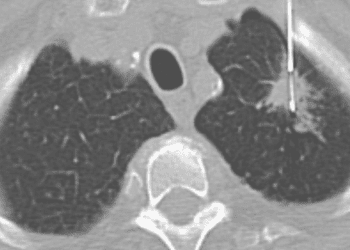
Image: PD

©2025 2 Minute Medicine, Inc. All rights reserved. No works may be reproduced without expressed written consent from 2 Minute Medicine, Inc. Inquire about licensing here. No article should be construed as medical advice and is not intended as such by the authors or by 2 Minute Medicine, Inc.

Tags: lung cancerlung cancer screening
Previous Post

Duration-based lung cancer screening may reduce racial disparities in eligibility

Next Post

Reducing saturated fat decreases mortality in high-risk individuals

RelatedReports

Rapid growth of medical artificial intelligence technology usage identified from insurance claims analysis, yet major barriers to widespread adoption remain
Oncology

Duration-based lung cancer screening may reduce racial disparities in eligibility

December 15, 2025
Severity of emphysema on pulmonary CT may predict lung cancer location
Chronic Disease

Age-based screening for lung cancer may be more cost-effective and improve detection compared to current screening criteria in the United States

January 13, 2026
Elective colectomy associated with improved survival in ulcerative colitis
Weekly Rewinds

2 Minute Medicine Rewind November 24, 2025

November 24, 2025
Half of parents aware of CT radiation cancer risk
AI Roundup

AI scans detect pancreatic cancer years before clinical diagnosis

July 30, 2025
Next Post
Dietary variety linked to greater increase in childhood BMI

Reducing saturated fat decreases mortality in high-risk individuals

Parental nonmedical prescription opioid use linked to adolescent use

Bisphosphonates may reduce short-term pain in complex regional pain syndrome 

Combined gastric electrical stimulation and pyloroplasty may be superior to pyloroplasty alone in refractory gastroparesis

2 Minute Medicine® is an award winning, physician-run, expert medical media company. Our content is curated, written and edited by practicing health professionals who have clinical and scientific expertise in their field of reporting. Our editorial management team is comprised of highly-trained MD physicians. Join numerous brands, companies, and hospitals who trust our licensed content.

Recent Reports

  • Ethosuximide may not be effective for the treatment of abdominal pain in irritable bowel syndrome
  • Edaravone dexborneol improves functional independence in patients with acute ischaemic stroke following endovascular thrombectomy
  • Yartemlea (narsoplimab-wuug) improves platelets hemolysis organ function hematopoietic stem cell transplant–associated thrombotic microangiopathy transplant patients
License Content
Terms of Use | Disclaimer
Cookie Policy
Privacy Statement (EU)
Disclaimer

© 2025 2 Minute Medicine, Inc. - Physician-written medical news.

  • Specialties
    • All Specialties, All Recent Reports
    • Cardiology
    • Chronic Disease
    • Dermatology
    • Emergency
    • Endocrinology
    • Gastroenterology
    • Imaging and Intervention
    • Infectious Disease
    • Nephrology
    • Neurology
    • Obstetrics
    • Oncology
    • Ophthalmology
    • Pediatrics
    • Pharma
    • Preclinical
    • Psychiatry
    • Public Health
    • Pulmonology
    • Rheumatology
    • Surgery
  • Tools
    • EvidencePulse™
    • RVU Search
    • NPI Registry Lookup
  • Pharma
  • AI News
  • The Scan
  • Classics™
    • 2MM+ Online Access
    • Paperback and Ebook
  • Rewinds
  • Partners
    • License Content
    • Submit Press Release
    • Advertise with Us
  • Account
    • Subscribe
    • Sign-in
    • My account
No Result
View All Result

© 2025 2 Minute Medicine, Inc. - Physician-written medical news.