
• About
  • Masthead
  • License Content
  • Advertise
  • Press Releases
  • Newsroom
  • RSS/Email List
  • 2MM Podcast
  • Write for us
  • Contact Us
2 Minute Medicine
No Result
View All Result

No products in the cart.

Sign in
SUBSCRIBE
  • About
  • Specialties
    • All Specialties, All Recent Reports
    • Cardiology
    • Chronic Disease
    • Dermatology
    • Emergency
    • Endocrinology
    • Gastroenterology
    • Imaging and Intervention
    • Infectious Disease
    • Nephrology
    • Neurology
    • Obstetrics
    • Oncology
    • Ophthalmology
    • Pediatrics
    • Pharma
    • Preclinical
    • Psychiatry
    • Public Health
    • Pulmonology
    • Rheumatology
    • Surgery
    • Rewinds
    • The Scan
  • EvidencePulse™
  • HypeCheck™
  • AI News
  • Classics™
    • 2MM+ Online Access
    • Paperback and Ebook
  • Tools
    • NPI Registry Lookup
    • RVU Search
    • Physician Pay by Specialty
    • ICD-10 Code Lookup
    • FDA Drug Approvals
    • Drug Safety for Breastfeeding/Pregnancy
    • Clinical Guidelines
    • Medical Calculators
    • ECG Reference
      • QTc Calculator
      • Sgarbossa Criteria
      • ECG Axis Calculator
      • AV Block Helper
  • Rankings
    • Medical School Rankings
    • Residency Rankings
  • Partners
    • License Content
    • Advertise with Us
2 Minute Medicine
  • About
  • Specialties
    • All Specialties, All Recent Reports
    • Cardiology
    • Chronic Disease
    • Dermatology
    • Emergency
    • Endocrinology
    • Gastroenterology
    • Imaging and Intervention
    • Infectious Disease
    • Nephrology
    • Neurology
    • Obstetrics
    • Oncology
    • Ophthalmology
    • Pediatrics
    • Pharma
    • Preclinical
    • Psychiatry
    • Public Health
    • Pulmonology
    • Rheumatology
    • Surgery
    • Rewinds
    • The Scan
  • EvidencePulse™
  • HypeCheck™
  • AI News
  • Classics™
    • 2MM+ Online Access
    • Paperback and Ebook
  • Tools
    • NPI Registry Lookup
    • RVU Search
    • Physician Pay by Specialty
    • ICD-10 Code Lookup
    • FDA Drug Approvals
    • Drug Safety for Breastfeeding/Pregnancy
    • Clinical Guidelines
    • Medical Calculators
    • ECG Reference
      • QTc Calculator
      • Sgarbossa Criteria
      • ECG Axis Calculator
      • AV Block Helper
  • Rankings
    • Medical School Rankings
    • Residency Rankings
  • Partners
    • License Content
    • Advertise with Us
Sign in
SUBSCRIBE
2 Minute Medicine
Sign in
Subscribe
2 Minute MedicineFree on Google PlayGet
✦EvidencePulse™by 2 Minute Medicine3 reportsYou askedtop stroke trials 2026Synthesizing medical evidence...Top 2026 stroke trial results:OCEANIC — ischemic stroke: 6.2% vs 8.4%OPTION* — mRS 0–1: 43.6% vs 34.2%ORIENTAL* — mRS 0–2: 58.6% vs 46.6%*Higher sICH in intervention armsParticipants randomizedNOCEANIC12,327OPTION570ORIENTAL564Ask about guidelines or landmark trials...↑Try EvidencePulse™Ask the evidence. Get the signal.Try it now →
Home Health A to Z

Patient Basics: Pneumothorax (Collapsed Lung)
by2 Minute Medicine
October 30, 2026
in Health A to Z
Reading Time: 5 mins read
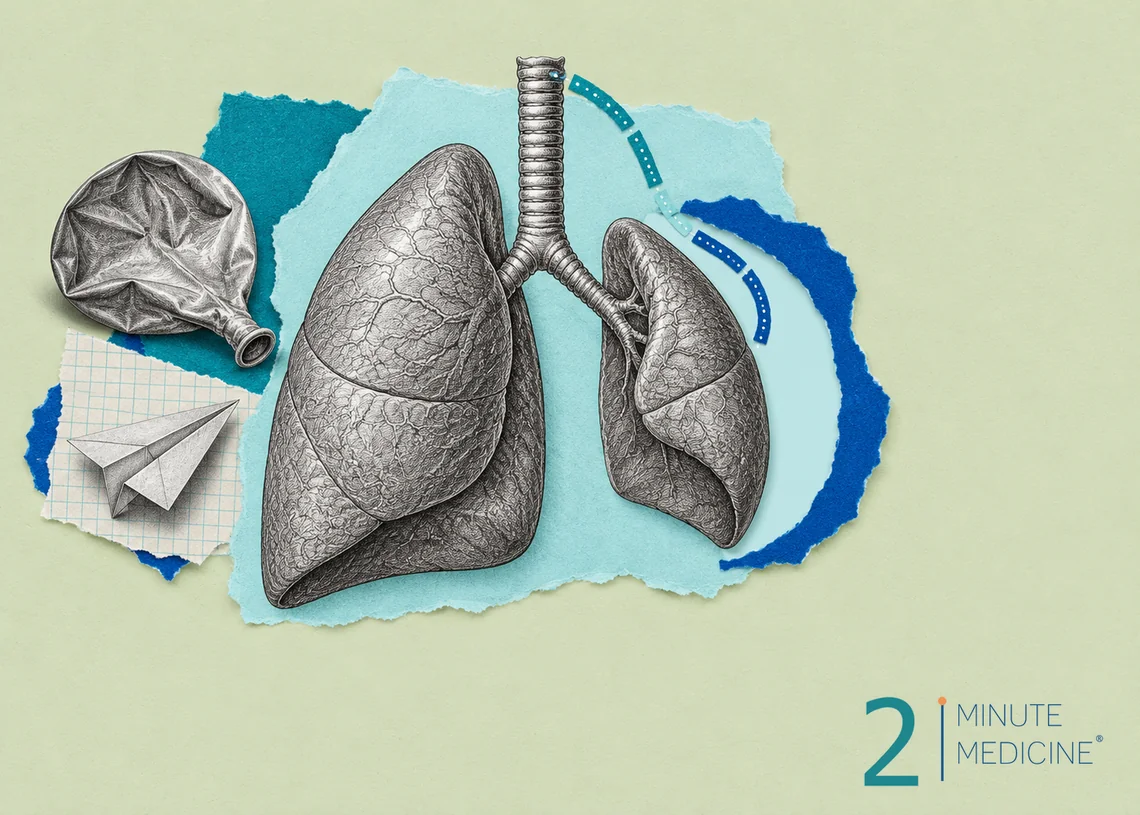
Collapsed lung collage of engraved lungs with one lung smaller, a half-deflated balloon and a folded paper airplane
Share on FacebookShare on TwitterShare on LinkedIn

A collapsed lung, or pneumothorax, happens when air leaks into the space between the lung and the chest wall. The trapped air presses on the lung so it can’t fully fill, and part or all of it collapses. The usual signs are sudden, sharp chest pain on one side and shortness of breath. Some small ones heal on their own, but you need to be checked in an emergency department to find out.

Key points

  • It can happen with no clear reason, most often in tall, thin young people and in people who smoke. Lung disease and chest injuries are other causes.
  • A chest X-ray is the main test.
  • Treatment ranges from close watching to removing the air with a needle or a chest tube. Surgery helps when it keeps coming back.
  • About 1 in 3 people who have one with no known cause will have another, most often within the first few years.
  • Stopping smoking lowers the chance of it happening again. Don’t fly until your doctor says it’s safe.

What causes a collapsed lung

The lungs sit inside the chest wrapped in a thin, slippery lining called the pleura. Normally there is no air between the lung and the chest wall, which keeps the lung stretched open. If air gets into that space, the lung shrinks away from the chest wall.

Spontaneous pneumothorax

  • In people without lung disease. Tiny air blisters (blebs) at the top of the lung can burst for no clear reason, often while at rest. This is most common in tall, thin young men. Smoking tobacco or cannabis raises the risk a great deal. A few inherited conditions, such as Marfan syndrome, also raise the risk.
  • In people with lung disease. COPD (including emphysema), cystic fibrosis, severe asthma, some lung infections and lung cancer can weaken the lung and let air leak. Because the lungs are already damaged, this type is often more serious.

Injury and medical procedures

A broken rib, a stab or gunshot wound, or a hard blow in a car crash can tear the lung. A pneumothorax can also follow some medical procedures, such as a lung biopsy, placing a large IV line near the neck or collarbone, or being on a breathing machine.

When a wound opens the chest wall to the outside air, doctors call it an open pneumothorax. Most others are closed, meaning the chest wall is intact and the air leaks out of the lung itself.

Tension pneumothorax

Sometimes air keeps entering the chest with each breath but can’t get out. Pressure builds and pushes on the heart and the other lung. This is life-threatening and needs treatment within minutes.

Signs of a collapsed lung

  • Sudden, sharp or stabbing pain on one side of the chest, often worse when you breathe in. It may spread to the shoulder.
  • Shortness of breath
  • A fast heartbeat and fast breathing
  • A dry cough or feeling very tired

A small pneumothorax may cause only mild pain that people put up with for a day or two. Severe breathlessness, blue or gray lips, a racing heart, feeling faint or confusion are signs of a large or tension pneumothorax.

RELATED REPORTS

No Content Available

How it’s diagnosed

A doctor listens to your chest and may hear fewer breath sounds on one side. A clip on your finger measures your oxygen level. A chest X-ray usually shows the edge of the collapsed lung and the air around it. In emergency departments, an ultrasound at the bedside can also find it quickly. A CT scan can show small leaks, air blisters or other lung disease.

Treatment

Treatment depends on how big the pneumothorax is, how you feel and whether you have lung disease.

  • Watching and waiting. If the leak is small and you feel fairly well, the body can absorb the air over days to weeks. You may get oxygen, which helps the air go away faster, and a repeat X-ray. Recent guidelines allow more people to be watched closely in this way instead of having a tube.
  • Needle aspiration. After numbing the skin, a doctor passes a thin needle or tube between the ribs and draws out the air.
  • Chest tube. A tube placed between the ribs connects to a one-way valve or drain. It lets air out but not back in. It stays in until the lung is open again and the leak has stopped, often a few days. Some people go home with a small valve device.
  • Surgery. Usually done through small cuts with a camera (VATS). The surgeon removes or staples the air blisters and makes the lining of the lung stick to the chest wall (pleurodesis) so the lung can’t collapse again. It’s offered after a second pneumothorax, when a leak won’t stop, or for people in jobs such as flying or diving.
  • Tension pneumothorax. A needle or small cut is used right away to release the pressure, followed by a chest tube.

Recovery

Pain and breathlessness usually ease over several days. You’ll have a follow-up X-ray to make sure the lung has fully re-expanded.

  • Air travel. Changes in air pressure on a plane can make trapped air expand. Don’t fly until an X-ray shows the lung has healed, and ask your doctor how long to wait after that.
  • Scuba diving. Doctors usually advise never diving again unless you’ve had surgery to prevent another collapse.
  • Exercise. Avoid heavy lifting and contact sports for several weeks, or until your doctor says it’s safe.
  • Smoking. Quitting is the best way to lower your chance of another collapse. Ask your doctor about medicines and programs that help.

When to get help

Call 911 for sudden chest pain with shortness of breath, blue or gray lips, a racing heart, fainting or confusion.

Call your doctor after you go home if:

  • Breathlessness or chest pain comes back or gets worse
  • You get a fever
  • The place where a chest tube was becomes red, swollen or starts to drain

Common questions about a collapsed lung

Can a collapsed lung heal on its own?

Yes, if it is small. A small collapse in someone who feels fairly well often heals over 1 to 2 weeks as the body absorbs the air, with X-rays to check. A larger one, or one in a person with lung disease, usually needs the air removed with a needle or a chest tube.

Is a collapsed lung life-threatening?

It can be. A small collapse in a healthy young person is rarely dangerous with proper care. A large collapse, one in a person with lung disease, or a tension pneumothorax can be fatal without fast treatment. Sudden chest pain with shortness of breath always needs to be checked in an emergency department.

Can a collapsed lung happen again?

Yes. About 1 in 3 people who have a collapse with no known cause have another, usually within a few years. The risk is higher in people who keep smoking. Surgery that seals the lung to the chest wall lowers the chance of another collapse to a few in 100.

Questions to ask your doctor

  • How big is the collapse, and what caused it?
  • Can it heal on its own, or do I need a tube?
  • How likely is it to happen again?
  • When can I fly, exercise or go back to work?
  • Should I think about surgery to stop it from coming back?

Learn more

  • Collapsed lung (pneumothorax) (MedlinePlus, U.S. National Library of Medicine)

This guide is general information and doesn’t replace advice from your own doctor. Last updated October 2026.

Tags: Pneumothorax (Collapsed Lung)
Previous Post

Patient Basics: Polymyalgia Rheumatica

Next Post

Patient Basics: Polio

RelatedReports

No Content Available
Next Post
Collage for paraphimosis and phimosis: a loosened metal ring, a blank ointment tube, an ice pack and a clinic gown on a hook

Patient Basics: Phimosis and Paraphimosis

Pleurisy collage: an older man in calm profile, a pair of lungs outlined by a thin lining, and a stethoscope on graph paper

Patient Basics: Pleurisy and Pleural Effusion

Pneumoconiosis collage: a pair of lungs with fine speckles, a man in a work jacket with a respirator and lumps of coal

Patient Basics: Pneumoconiosis

✦ EvidencePulse™ by 2 Minute Medicine 3 reports You asked top stroke trials 2026 Synthesizing medical evidence... Top 2026 stroke trial results: OCEANIC — ischemic stroke: 6.2% vs 8.4% OPTION* — mRS 0–1: 43.6% vs 34.2% ORIENTAL* — mRS 0–2: 58.6% vs 46.6% *Higher sICH in intervention arms Participants randomizedN OCEANIC 12,327 OPTION 570 ORIENTAL 564 Ask about guidelines or landmark trials... Try EvidencePulse™ Get the signal. Try it now → Physician-trained medical AI by 2 Minute Medicine

2MM+ All Access

Full details →
$4.99 /month

3-day free trial · cancel anytime

  • ✓100+ physician-written reports
  • ✓EvidencePulse™ + HypeCheck™
  • ✓Ad-free reading + newsletters
Start 3-day free trial

Then $4.99/month. Manage renewal in your account.

2 Minute Medicine® is an award winning, physician-run, expert medical media company. Our content is curated, written and edited by practicing health professionals who have clinical and scientific expertise in their field of reporting. Our editorial management team is comprised of highly-trained MD physicians. Join numerous brands, companies, and hospitals who trust our licensed content.

Recent Reports

  • Use of colchicine is not associated with reduced cardiovascular events among Chinese adults starting urate-lowering therapy
  • ARO-DIMER-PA can Significantly Lower LDL-C and Triglycerides in Patients with Mixed Hyperlipidemia
  • CCTA-guided PCI noninferior to IVUS-guided PCI for target-vessel failure
License Content
Terms of Use | Disclaimer
Cookie Policy

Get the app

Read 2 Minute Medicine on iPhone, iPad and Android.

Download on the App StoreGet it on Google Play
QR code for www.2minutemedicine.com/app
On a computer? Scan this with your phone’s camera.
2MM+ All Access Full details →

The medical literature, distilled daily.

Monthly plan selected: $4.99 /month.

$4.99/month

3-day free trial · cancel anytime

Start 3-day free trial

Then $4.99/month. Manage renewal in your account.

Yearly plan selected: $49.90 /year.

$49.90/year

2 months free

Start 3-day free trial

Then $49.90/year.

Membership benefits

  • ✓100+ new physician-written study summaries monthly, 12,000+ searchable
  • ✓AI EvidencePulse™ + HypeCheck™
  • ✓Ad-free reading + newsletters
  • ✓FDA drug approvals + clinical calculators

Already a member? Sign in

  • Get the app
  • About
  • Specialties
    • All Specialties, All Recent Reports
    • Cardiology
    • Chronic Disease
    • Dermatology
    • Emergency
    • Endocrinology
    • Gastroenterology
    • Imaging and Intervention
    • Infectious Disease
    • Nephrology
    • Neurology
    • Obstetrics
    • Oncology
    • Ophthalmology
    • Pediatrics
    • Pharma
    • Preclinical
    • Psychiatry
    • Public Health
    • Pulmonology
    • Rheumatology
    • Surgery
    • Rewinds
    • The Scan
  • EvidencePulse™
  • HypeCheck™
  • AI News
  • Classics™
    • 2MM+ Online Access
    • Paperback and Ebook
  • Tools
    • NPI Registry Lookup
    • RVU Search
    • Physician Pay by Specialty
    • ICD-10 Code Lookup
    • FDA Drug Approvals
    • Drug Safety for Breastfeeding/Pregnancy
    • Clinical Guidelines
    • Medical Calculators
    • ECG Reference
      • QTc Calculator
      • Sgarbossa Criteria
      • ECG Axis Calculator
      • AV Block Helper
  • Rankings
    • Medical School Rankings
    • Residency Rankings
  • Partners
    • License Content
    • Advertise with Us
No Result
View All Result

© 2026 2 Minute Medicine, Inc. - Physician-written medical news.


