• About
  • Masthead
  • License Content
  • Advertise
  • Press Releases
  • Newsroom
  • RSS/Email List
  • 2MM Podcast
  • Write for us
  • Contact Us
2 Minute Medicine
No Result
View All Result

No products in the cart.

Sign in
SUBSCRIBE
  • About
  • Specialties
    • All Specialties, All Recent Reports
    • Cardiology
    • Chronic Disease
    • Dermatology
    • Emergency
    • Endocrinology
    • Gastroenterology
    • Imaging and Intervention
    • Infectious Disease
    • Nephrology
    • Neurology
    • Obstetrics
    • Oncology
    • Ophthalmology
    • Pediatrics
    • Pharma
    • Preclinical
    • Psychiatry
    • Public Health
    • Pulmonology
    • Rheumatology
    • Surgery
    • Rewinds
    • The Scan
  • EvidencePulse™
  • HypeCheck™
  • AI News
  • Classics™
    • 2MM+ Online Access
    • Paperback and Ebook
  • Tools
    • NPI Registry Lookup
    • RVU Search
    • Physician Pay by Specialty
    • ICD-10 Code Lookup
    • FDA Drug Approvals
    • Drug Safety for Breastfeeding/Pregnancy
    • Clinical Guidelines
    • Medical Calculators
    • ECG Reference
      • QTc Calculator
      • Sgarbossa Criteria
      • ECG Axis Calculator
      • AV Block Helper
  • Rankings
    • Medical School Rankings
    • Residency Rankings
  • Partners
    • License Content
    • Advertise with Us
2 Minute Medicine
  • About
  • Specialties
    • All Specialties, All Recent Reports
    • Cardiology
    • Chronic Disease
    • Dermatology
    • Emergency
    • Endocrinology
    • Gastroenterology
    • Imaging and Intervention
    • Infectious Disease
    • Nephrology
    • Neurology
    • Obstetrics
    • Oncology
    • Ophthalmology
    • Pediatrics
    • Pharma
    • Preclinical
    • Psychiatry
    • Public Health
    • Pulmonology
    • Rheumatology
    • Surgery
    • Rewinds
    • The Scan
  • EvidencePulse™
  • HypeCheck™
  • AI News
  • Classics™
    • 2MM+ Online Access
    • Paperback and Ebook
  • Tools
    • NPI Registry Lookup
    • RVU Search
    • Physician Pay by Specialty
    • ICD-10 Code Lookup
    • FDA Drug Approvals
    • Drug Safety for Breastfeeding/Pregnancy
    • Clinical Guidelines
    • Medical Calculators
    • ECG Reference
      • QTc Calculator
      • Sgarbossa Criteria
      • ECG Axis Calculator
      • AV Block Helper
  • Rankings
    • Medical School Rankings
    • Residency Rankings
  • Partners
    • License Content
    • Advertise with Us
Sign in
SUBSCRIBE
2 Minute Medicine
Sign in
Subscribe
2 Minute MedicineFree on Google PlayGet
✦EvidencePulse™by 2 Minute Medicine3 reportsYou askedtop stroke trials 2026Synthesizing medical evidence...Top 2026 stroke trial results:OCEANIC — ischemic stroke: 6.2% vs 8.4%OPTION* — mRS 0–1: 43.6% vs 34.2%ORIENTAL* — mRS 0–2: 58.6% vs 46.6%*Higher sICH in intervention armsParticipants randomizedNOCEANIC12,327OPTION570ORIENTAL564Ask about guidelines or landmark trials...↑Try EvidencePulse™Ask the evidence. Get the signal.Try it now →
Home Health A to Z

Patient Basics: Polio
by2 Minute Medicine
October 30, 2026
in Health A to Z
Reading Time: 5 mins read
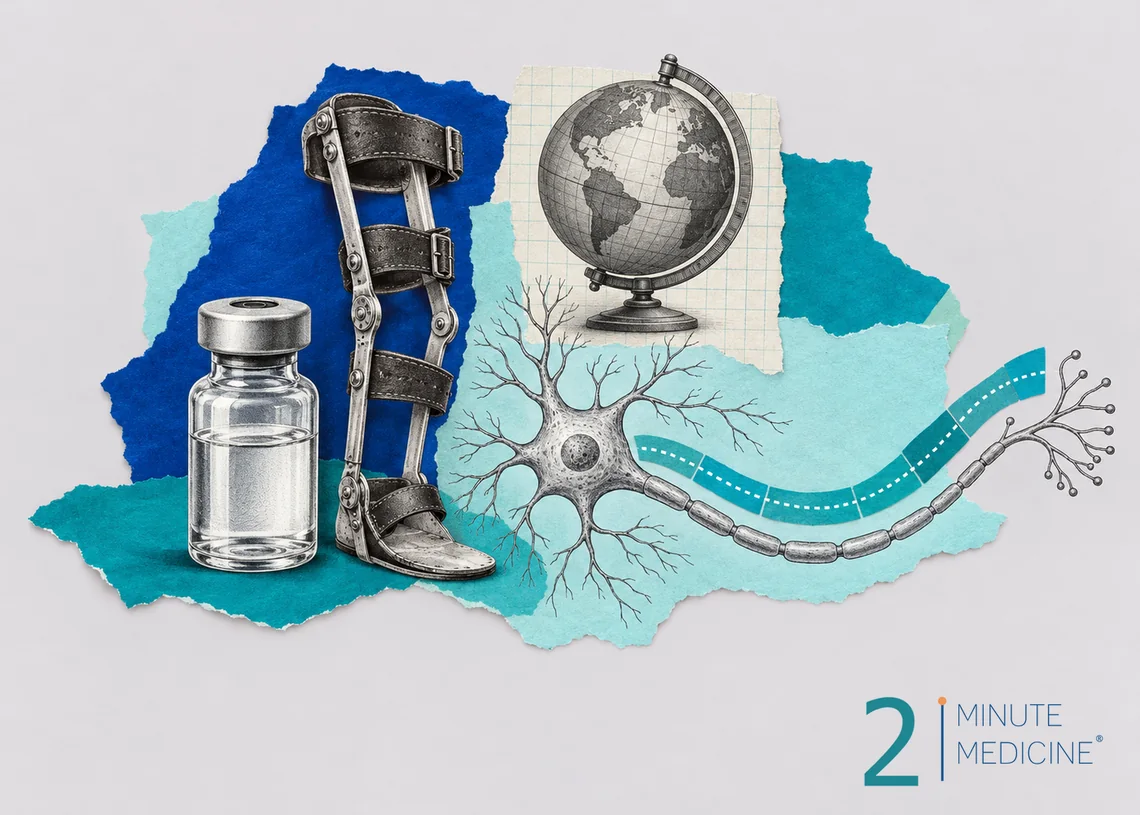
Polio collage: a capped vaccine vial, a vintage leg brace, a drawing of a motor nerve cell and a small globe
Share on FacebookShare on TwitterShare on LinkedIn

Polio (poliomyelitis) is an infection caused by poliovirus. Most people who catch it have no symptoms or a mild illness, but in a small number the virus attacks the nerves in the spinal cord and causes paralysis that can be permanent. There’s no cure. Vaccination prevents it and has wiped polio out of most of the world.

Key points

  • Polio spreads mainly through contact with the stool of an infected person, often on unwashed hands, and less often through coughs and sneezes.
  • About 1 in 200 infected people develops paralysis, usually in the legs.
  • The polio vaccine is very effective. In the US, children get 4 shots between 2 months and 6 years of age.
  • Polio still circulates in a few countries, and it can return wherever vaccination rates fall.
  • Many years after the illness, some survivors develop new weakness and tiredness (post-polio syndrome).

What causes polio

Poliovirus lives in the throat and gut. An infected person sheds it in their stool for weeks, even without feeling sick. The virus spreads when tiny amounts get into another person’s mouth, through unwashed hands, food, water or objects. Places without clean water and good sanitation see the most spread.

In most people the virus stays in the gut. In a few, it enters the bloodstream and attacks the nerve cells in the spinal cord and brainstem that control muscles (motor neurons). When those cells die, the muscles they control go limp and weak.

Polio symptoms

Symptoms usually start 3 to 21 days after infection. Out of every 100 people infected:

  • About 70 to 75 have no symptoms at all. They can still spread the virus.
  • About 1 in 4 has a flu-like illness for 2 to 5 days, with sore throat, fever, tiredness, headache, nausea and stomach pain.
  • A smaller number develops meningitis (infection of the lining around the brain and spinal cord), with a stiff neck, back pain and headache.

About 1 in 200 develops paralysis. It often starts after the flu-like illness seems to be getting better. Warning signs include:

  • Severe muscle pain and spasms
  • Sudden weakness that leaves a limb floppy, most often one or both legs
  • Loss of reflexes in the weak limb
  • Trouble breathing or swallowing, if the virus attacks nerves for the chest or throat

Some people regain much of their strength over weeks to months. Others have lifelong weakness. When breathing muscles are paralyzed, polio can be fatal.

RELATED REPORTS

The 2 Minute Medicine Podcast Episode 21

Novel OPV2-c1 and OPV2-c2 vaccines offer promising safety, tolerability, and immunogenicity in healthy adults

How polio is diagnosed

Doctors suspect polio when someone, especially a person who isn’t vaccinated, has sudden limb weakness. They test stool samples, throat swabs and sometimes spinal fluid for the virus. An MRI of the spine may also help. Sudden paralysis is reported to public health officials so they can trace contacts and check for spread.

Other illnesses can cause similar weakness, including acute flaccid myelitis (caused by other viruses) and Guillain-Barré syndrome.

Polio treatment

No medicine kills poliovirus or reverses paralysis. Care focuses on comfort and recovery:

  • Bed rest and pain relievers during the early illness
  • Warm packs for muscle pain and spasms
  • A breathing machine (ventilator) in the hospital if breathing muscles are weak
  • Physical therapy to keep joints moving and rebuild strength
  • Braces, crutches or a wheelchair when weakness remains

Polio vaccine

In the US, children get the inactivated polio vaccine (IPV) as a shot. Babies get the first two shots at ages 2 and 4 months. The third comes between ages 6 and 18 months, and a last booster at age 4 to 6, before school starts. It’s often combined with other childhood vaccines. IPV contains killed virus, so it can’t cause polio.

  • Adults who never had the vaccine should get the full series of 3 shots.
  • Adults who were vaccinated as children may need one lifetime booster if they travel to a country with polio or work with the virus.

Many other countries use an oral polio vaccine given as drops. It’s cheap and easy to give, and it stops spread well. Rarely, the weakened virus in oral vaccine spreads in communities where few people are vaccinated and changes into a form that can paralyze (vaccine-derived poliovirus). Full vaccination with either vaccine protects against it.

Is polio still around?

Before vaccines, polio paralyzed thousands of children in the US every year. The last cases spread from person to person in the US were in 1979. Worldwide, cases have dropped by more than 99% since 1988.

Wild poliovirus still spreads in Pakistan and Afghanistan. Vaccine-derived outbreaks occur in parts of Africa, Asia and the Middle East. In 2022, an unvaccinated young adult in New York State was paralyzed by vaccine-derived polio, and the virus was found in local wastewater. As long as polio exists anywhere, unvaccinated people everywhere are at risk.

Post-polio syndrome

Years or decades after recovering, many polio survivors notice new problems:

  • New muscle weakness, even in muscles that seemed unaffected
  • Deep tiredness
  • Muscle and joint pain
  • Trouble breathing, swallowing or sleeping
  • Feeling cold more easily

Post-polio syndrome is not a return of the infection, and it isn’t contagious. It’s thought to come from nerve cells that were overworked for years wearing out. It usually gets worse slowly. Pacing activities, rest breaks, braces, gentle exercise planned with a physical therapist, and treatment of breathing or sleep problems help.

When to see a doctor

  • You or your child missed polio shots, or you aren’t sure
  • You plan to travel to a country where polio spreads
  • You had polio and notice new weakness, tiredness or breathing trouble

Get emergency care for sudden weakness or floppiness in an arm or leg, trouble breathing or swallowing, or a stiff neck with fever.

Common questions about polio

Is there a cure for polio?

No. Medicines can’t kill poliovirus or undo nerve damage. Treatment supports the body while the infection runs its course, and physical therapy helps people regain strength. Some recover fully, while others have lifelong weakness. That’s why prevention with the vaccine matters so much.

Can you get polio if you’ve been vaccinated?

It’s very unlikely. A full series of polio shots protects about 99 out of 100 children. Protection lasts for many years, likely for life. Adults heading to places with polio may get one booster for extra protection.

Do adults need a polio vaccine?

Most US adults were vaccinated as children and don’t need more shots. Adults who were never vaccinated, or don’t know, should get the series. A single lifetime booster is advised for vaccinated adults at higher risk, such as travelers to countries with polio and some lab and health care workers.

Questions to ask your doctor

  • Is my child up to date on polio shots?
  • Do I need a polio vaccine or booster before my trip?
  • How can I find out if I was vaccinated as a child?
  • Could my new weakness be post-polio syndrome?
  • Which therapists or clinics help with post-polio problems?

Learn more

  • About polio in the United States (CDC)
  • Polio vaccination (CDC)

This guide is general information and doesn’t replace advice from your own doctor. Last updated October 2026.

Tags: polio
Previous Post

Patient Basics: Pneumothorax (Collapsed Lung)

Next Post

Patient Basics: Phimosis and Paraphimosis

RelatedReports

The 2 Minute Medicine Podcast Episode 15
2MM Podcast

The 2 Minute Medicine Podcast Episode 21

August 10, 2023
Infectious Disease

Novel OPV2-c1 and OPV2-c2 vaccines offer promising safety, tolerability, and immunogenicity in healthy adults

January 13, 2021
Infectious Disease

Quick Take: The safety and immunogenicity of two novel live attenuated monovalent (serotype 2) oral poliovirus vaccines in healthy adults

June 17, 2019
Weekly Rewinds

2 Minute Medicine Rewind June 10, 2018

June 20, 2019
Next Post
Collage for paraphimosis and phimosis: a loosened metal ring, a blank ointment tube, an ice pack and a clinic gown on a hook

Patient Basics: Phimosis and Paraphimosis

Pleurisy collage: an older man in calm profile, a pair of lungs outlined by a thin lining, and a stethoscope on graph paper

Patient Basics: Pleurisy and Pleural Effusion

Pneumoconiosis collage: a pair of lungs with fine speckles, a man in a work jacket with a respirator and lumps of coal

Patient Basics: Pneumoconiosis

✦ EvidencePulse™ by 2 Minute Medicine 3 reports You asked top stroke trials 2026 Synthesizing medical evidence... Top 2026 stroke trial results: OCEANIC — ischemic stroke: 6.2% vs 8.4% OPTION* — mRS 0–1: 43.6% vs 34.2% ORIENTAL* — mRS 0–2: 58.6% vs 46.6% *Higher sICH in intervention arms Participants randomizedN OCEANIC 12,327 OPTION 570 ORIENTAL 564 Ask about guidelines or landmark trials... Try EvidencePulse™ Get the signal. Try it now → Physician-trained medical AI by 2 Minute Medicine

2MM+ All Access

Full details →
$4.99 /month

3-day free trial · cancel anytime

  • ✓100+ physician-written reports
  • ✓EvidencePulse™ + HypeCheck™
  • ✓Ad-free reading + newsletters
Start 3-day free trial

Then $4.99/month. Manage renewal in your account.

2 Minute Medicine® is an award winning, physician-run, expert medical media company. Our content is curated, written and edited by practicing health professionals who have clinical and scientific expertise in their field of reporting. Our editorial management team is comprised of highly-trained MD physicians. Join numerous brands, companies, and hospitals who trust our licensed content.

Recent Reports

  • Pelacarsen lowers lipoprotein(a) but does not reduce major cardiovascular events in patients with established cardiovascular disease
  • Durvalumab plus enfortumab vedotin was approved for perioperative treatment of muscle-invasive bladder cancer
  • CDC reports 5,412 confirmed measles cases in the United States in 2026
License Content
Terms of Use | Disclaimer
Cookie Policy

Get the app

Read 2 Minute Medicine on iPhone, iPad and Android.

Download on the App StoreGet it on Google Play
QR code for www.2minutemedicine.com/app
On a computer? Scan this with your phone’s camera.
2MM+ All Access Full details →

The medical literature, distilled daily.

Monthly plan selected: $4.99 /month.

$4.99/month

3-day free trial · cancel anytime

Start 3-day free trial

Then $4.99/month. Manage renewal in your account.

Yearly plan selected: $49.90 /year.

$49.90/year

2 months free

Start 3-day free trial

Then $49.90/year.

Membership benefits

  • ✓100+ new physician-written study summaries monthly, 12,000+ searchable
  • ✓AI EvidencePulse™ + HypeCheck™
  • ✓Ad-free reading + newsletters
  • ✓FDA drug approvals + clinical calculators

Already a member? Sign in

  • Get the app
  • About
  • Specialties
    • All Specialties, All Recent Reports
    • Cardiology
    • Chronic Disease
    • Dermatology
    • Emergency
    • Endocrinology
    • Gastroenterology
    • Imaging and Intervention
    • Infectious Disease
    • Nephrology
    • Neurology
    • Obstetrics
    • Oncology
    • Ophthalmology
    • Pediatrics
    • Pharma
    • Preclinical
    • Psychiatry
    • Public Health
    • Pulmonology
    • Rheumatology
    • Surgery
    • Rewinds
    • The Scan
  • EvidencePulse™
  • HypeCheck™
  • AI News
  • Classics™
    • 2MM+ Online Access
    • Paperback and Ebook
  • Tools
    • NPI Registry Lookup
    • RVU Search
    • Physician Pay by Specialty
    • ICD-10 Code Lookup
    • FDA Drug Approvals
    • Drug Safety for Breastfeeding/Pregnancy
    • Clinical Guidelines
    • Medical Calculators
    • ECG Reference
      • QTc Calculator
      • Sgarbossa Criteria
      • ECG Axis Calculator
      • AV Block Helper
  • Rankings
    • Medical School Rankings
    • Residency Rankings
  • Partners
    • License Content
    • Advertise with Us
No Result
View All Result

© 2026 2 Minute Medicine, Inc. - Physician-written medical news.