• About
  • Masthead
  • License Content
  • Advertise
  • Press Releases
  • Newsroom
  • RSS/Email List
  • 2MM Podcast
  • Write for us
  • Contact Us
2 Minute Medicine
No Result
View All Result

No products in the cart.

Sign in
SUBSCRIBE
  • About
  • Specialties
    • All Specialties, All Recent Reports
    • Cardiology
    • Chronic Disease
    • Dermatology
    • Emergency
    • Endocrinology
    • Gastroenterology
    • Imaging and Intervention
    • Infectious Disease
    • Nephrology
    • Neurology
    • Obstetrics
    • Oncology
    • Ophthalmology
    • Pediatrics
    • Pharma
    • Preclinical
    • Psychiatry
    • Public Health
    • Pulmonology
    • Rheumatology
    • Surgery
    • Rewinds
    • The Scan
  • EvidencePulse™
  • HypeCheck™
  • AI News
  • Classics™
    • 2MM+ Online Access
    • Paperback and Ebook
  • Tools
    • NPI Registry Lookup
    • RVU Search
    • Physician Pay by Specialty
    • ICD-10 Code Lookup
    • FDA Drug Approvals
    • Drug Safety for Breastfeeding/Pregnancy
    • Clinical Guidelines
    • Medical Calculators
    • ECG Reference
      • QTc Calculator
      • Sgarbossa Criteria
      • ECG Axis Calculator
      • AV Block Helper
  • Rankings
    • Medical School Rankings
    • Residency Rankings
  • Partners
    • License Content
    • Advertise with Us
2 Minute Medicine
  • About
  • Specialties
    • All Specialties, All Recent Reports
    • Cardiology
    • Chronic Disease
    • Dermatology
    • Emergency
    • Endocrinology
    • Gastroenterology
    • Imaging and Intervention
    • Infectious Disease
    • Nephrology
    • Neurology
    • Obstetrics
    • Oncology
    • Ophthalmology
    • Pediatrics
    • Pharma
    • Preclinical
    • Psychiatry
    • Public Health
    • Pulmonology
    • Rheumatology
    • Surgery
    • Rewinds
    • The Scan
  • EvidencePulse™
  • HypeCheck™
  • AI News
  • Classics™
    • 2MM+ Online Access
    • Paperback and Ebook
  • Tools
    • NPI Registry Lookup
    • RVU Search
    • Physician Pay by Specialty
    • ICD-10 Code Lookup
    • FDA Drug Approvals
    • Drug Safety for Breastfeeding/Pregnancy
    • Clinical Guidelines
    • Medical Calculators
    • ECG Reference
      • QTc Calculator
      • Sgarbossa Criteria
      • ECG Axis Calculator
      • AV Block Helper
  • Rankings
    • Medical School Rankings
    • Residency Rankings
  • Partners
    • License Content
    • Advertise with Us
Sign in
SUBSCRIBE
2 Minute Medicine
Sign in
Subscribe
2 Minute MedicineFree on Google PlayGet
✦EvidencePulse™by 2 Minute Medicine3 reportsYou askedtop stroke trials 2026Synthesizing medical evidence...Top 2026 stroke trial results:OCEANIC — ischemic stroke: 6.2% vs 8.4%OPTION* — mRS 0–1: 43.6% vs 34.2%ORIENTAL* — mRS 0–2: 58.6% vs 46.6%*Higher sICH in intervention armsParticipants randomizedNOCEANIC12,327OPTION570ORIENTAL564Ask about guidelines or landmark trials...↑Try EvidencePulse™Ask the evidence. Get the signal.Try it now →
Home Health A to Z

Patient Basics: Uterine Cancer

by2 Minute Medicine
October 30, 2026
in Health A to Z
Reading Time: 5 mins read
Uterine cancer collage: a drawing of the uterus and ovaries, a calm woman in her 60s, a teacup and a sprig of flowers
Share on FacebookShare on TwitterShare on LinkedIn

Uterine cancer is cancer that starts in the uterus (womb). Most cases begin in the inner lining, called the endometrium, so it is often called endometrial cancer. The most important warning sign is bleeding after menopause. Because that sign shows up early, most uterine cancers are found before they spread, when surgery alone often cures them.

Key points

  • About 70,000 people in the US learn they have it each year. That makes it the gynecologic cancer found most often.
  • Any vaginal bleeding or spotting after menopause should be checked, even if it is light or happens once.
  • Extra weight, estrogen without progesterone, diabetes and some inherited conditions raise the risk.
  • Taking estrogen-only hormone therapy (HRT) raises the risk if you still have a uterus. Adding a progestogen lowers it.
  • Surgery to remove the uterus is the main treatment. Radiation, chemotherapy, immunotherapy or hormone therapy may be added.

Types of uterine cancer

  • Endometrial cancer makes up more than 9 in 10 uterine cancers. The most common kind (endometrioid) tends to grow slowly. Less common kinds, such as serous and clear cell, grow faster.
  • Uterine sarcoma is rare. It starts in the muscle wall of the uterus or the tissue that supports it, and it is harder to find early.

What causes uterine cancer

The lining of the uterus responds to two hormones. Estrogen makes it grow, and progesterone balances that growth and lets it shed with a period. Years of estrogen without enough progesterone can make the lining overgrow, first as a thickened lining (endometrial hyperplasia) and sometimes as cancer.

Things that raise the risk:

  • Extra weight. Fat tissue makes estrogen. Obesity is one of the strongest risk factors.
  • Estrogen-only hormone therapy in a woman who still has her uterus.
  • Irregular ovulation, as with polycystic ovary syndrome (PCOS).
  • More years of periods, from starting periods early or reaching menopause late, and never having been pregnant.
  • Type 2 diabetes and high blood pressure.
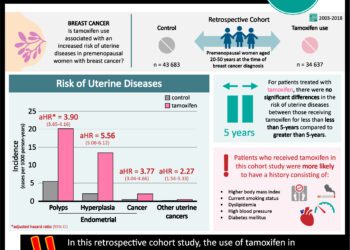
  • Tamoxifen, a breast cancer medicine that acts like estrogen on the uterus.
  • Lynch syndrome, an inherited condition that also raises the risk of colon and other cancers.
  • Age. Most cases are found after menopause, often in the early 60s.

Combined birth control pills, a hormonal IUD, pregnancy and regular exercise all lower the risk. Rates of uterine cancer have been rising in the US, and Black women are more likely to be diagnosed with fast-growing types and to die of the disease.

Uterine cancer symptoms

  • Bleeding or spotting after menopause
  • Bleeding between periods, or periods that become much heavier or longer after age 40
  • A watery, pink or brown discharge
  • Pain or pressure in the pelvis
  • Pain during sex
  • Weight loss without trying, in later stages

Most bleeding after menopause turns out to have a harmless cause, such as thin, dry vaginal tissue. About 1 in 10 people with it has cancer, which is why every episode needs a check.

How it’s diagnosed

  • Pelvic exam to check the uterus, ovaries and vagina.
  • Transvaginal ultrasound. A slim probe placed in the vagina measures how thick the lining is.
  • Endometrial biopsy. A thin, flexible tube takes a small sample of the lining in the office. It causes cramping for a few minutes.
  • Hysteroscopy and D&C. A thin camera looks inside the uterus, and tissue is gently scraped out for testing. This is done if a biopsy can’t be done or doesn’t give an answer.

The tumor is also tested for certain gene changes, including mismatch repair (MMR) and p53. These results help plan treatment and show whether you should have genetic testing for Lynch syndrome. CT, MRI or PET scans may check for spread.

RELATED REPORTS

Contaminated drinking water is associated with increased risk of uterine cancer

2 Minute Medicine Rewind July 27th, 2026 

A Pap test checks the cervix. It is not a screening test for uterine cancer.

How uterine cancer is treated

Surgery

Most people have a hysterectomy, which removes the uterus and cervix. The surgeon usually also takes out the ovaries and fallopian tubes and checks nearby lymph nodes, often by removing just the first one or two that the cancer would reach (sentinel nodes). Many operations are done through small cuts with a camera or robot, which means a shorter hospital stay. Surgery also gives the stage, from 1 (only in the uterus) to 4 (spread to distant organs).

Radiation

Radiation to the top of the vagina (brachytherapy) lowers the chance of the cancer coming back there. Radiation to the whole pelvis may be used when the risk is higher.

Medicine

  • Chemotherapy, usually carboplatin with paclitaxel, for cancers that have spread or are likely to come back.
  • Immunotherapy, such as pembrolizumab or dostarlimab, which helps the immune system attack cancer. It is now added to chemotherapy for many advanced cancers, especially those with MMR changes.
  • Hormone therapy, such as a progestin pill or a progestin IUD. A small number of younger women with very early, slow-growing cancer use this to try to keep the ability to get pregnant.
  • Targeted drugs for certain tumor types, such as trastuzumab for HER2-positive serous cancer.

Life after treatment

Removing the ovaries brings on menopause right away if you haven’t reached it, with hot flashes and vaginal dryness. Your team can help with both. Some people get swelling in a leg after lymph nodes are removed (lymphedema). Follow-up visits are usually every 3 to 6 months for the first few years. Report any new bleeding, pelvic pain, cough or weight loss between visits.

When to see a doctor

  • Any bleeding or spotting after menopause
  • Bleeding between periods, or periods that change a lot after 40
  • Bleeding while taking hormone therapy that isn’t the expected pattern
  • Ongoing pelvic pain or unusual discharge
  • A family history of uterine, colon or ovarian cancer, which may point to Lynch syndrome

Common questions about uterine cancer

Does taking HRT cause uterine cancer?

Estrogen taken alone raises the risk of uterine cancer if you still have your uterus. Adding a progestogen, as in combined HRT, protects the lining and removes most of that extra risk. Low-dose vaginal estrogen has little effect. Report any unexpected bleeding while on HRT.

Is uterine cancer curable?

Often, yes. About 2 in 3 uterine cancers are found while still inside the uterus, and about 95% of those people are alive 5 years later. Cancer that has spread is harder to cure, but newer treatments, including immunotherapy, are helping people live longer.

Is uterine cancer the same as endometrial cancer?

Mostly. Endometrial cancer starts in the lining of the uterus and makes up more than 9 in 10 uterine cancers, so the terms are often used for the same thing. Uterine sarcoma also counts as uterine cancer, but it starts in the muscle wall and is treated differently.

Questions to ask your doctor

  • What type and stage is my cancer?
  • Do I need treatment after surgery?
  • Did my tumor test show MMR changes, and should I have genetic testing?
  • Will I go into menopause, and how can we manage it?
  • Who should I call if I have bleeding or new symptoms later?

Learn more

  • Uterine cancer (National Cancer Institute)
  • Uterine cancer (MedlinePlus, U.S. National Library of Medicine)

This guide is general information and doesn’t replace advice from your own doctor. Last updated October 2026.

Tags: uterine cancer
Previous Post

Patient Basics: Sick Sinus Syndrome

Next Post

Patient Basics: Polycystic Kidney Disease (PKD)

RelatedReports

Targeted interventions effective in teaching children to swallow pills
Chronic Disease

Contaminated drinking water is associated with increased risk of uterine cancer

July 30, 2026
Breast cancer care collage: a calm woman in a turtleneck sweater beside a folded paper crane and a small white pill bottle
Weekly Rewinds

2 Minute Medicine Rewind July 27th, 2026 

July 27, 2026
StudyGraphics

#VisualAbstract: Tamoxifen increases the risk of endometrial cancer in premenopausal women with breast cancer

January 24, 2023
Cardiology

2 Minute Medicine Rewind November 24 – December 1, 2013

December 3, 2013
Next Post
Wilms tumor collage: a single child's kidney with a teal ribbon, a soft teddy bear, wooden toy blocks and a paper star

Patient Basics: Wilms Tumor

Yaws collage: a magnifying lens over a corkscrew-shaped germ, broad tropical leaves, a single tablet and a bar of soap

Patient Basics: Yaws

Plague collage of an engraved prairie dog, a flea under a magnifying glass, a desert mesa and a small medicine vial

Patient Basics: Plague (Yersinia Pestis)

✦ EvidencePulse™ by 2 Minute Medicine 3 reports You asked top stroke trials 2026 Synthesizing medical evidence... Top 2026 stroke trial results: OCEANIC — ischemic stroke: 6.2% vs 8.4% OPTION* — mRS 0–1: 43.6% vs 34.2% ORIENTAL* — mRS 0–2: 58.6% vs 46.6% *Higher sICH in intervention arms Participants randomizedN OCEANIC 12,327 OPTION 570 ORIENTAL 564 Ask about guidelines or landmark trials... Try EvidencePulse™ Get the signal. Try it now → Physician-trained medical AI by 2 Minute Medicine

2MM+ All Access

Full details →
$4.99 /month

3-day free trial · cancel anytime

  • ✓100+ physician-written reports
  • ✓EvidencePulse™ + HypeCheck™
  • ✓Ad-free reading + newsletters
Start 3-day free trial

Then $4.99/month. Manage renewal in your account.

2 Minute Medicine® is an award winning, physician-run, expert medical media company. Our content is curated, written and edited by practicing health professionals who have clinical and scientific expertise in their field of reporting. Our editorial management team is comprised of highly-trained MD physicians. Join numerous brands, companies, and hospitals who trust our licensed content.

Recent Reports

  • Pelacarsen lowers lipoprotein(a) but does not reduce major cardiovascular events in patients with established cardiovascular disease
  • Durvalumab plus enfortumab vedotin was approved for perioperative treatment of muscle-invasive bladder cancer
  • CDC reports 5,412 confirmed measles cases in the United States in 2026
License Content
Terms of Use | Disclaimer
Cookie Policy

Get the app

Read 2 Minute Medicine on iPhone, iPad and Android.

Download on the App StoreGet it on Google Play
QR code for www.2minutemedicine.com/app
On a computer? Scan this with your phone’s camera.
2MM+ All Access Full details →

The medical literature, distilled daily.

Monthly plan selected: $4.99 /month.

$4.99/month

3-day free trial · cancel anytime

Start 3-day free trial

Then $4.99/month. Manage renewal in your account.

Yearly plan selected: $49.90 /year.

$49.90/year

2 months free

Start 3-day free trial

Then $49.90/year.

Membership benefits

  • ✓100+ new physician-written study summaries monthly, 12,000+ searchable
  • ✓AI EvidencePulse™ + HypeCheck™
  • ✓Ad-free reading + newsletters
  • ✓FDA drug approvals + clinical calculators

Already a member? Sign in

  • Get the app
  • About
  • Specialties
    • All Specialties, All Recent Reports
    • Cardiology
    • Chronic Disease
    • Dermatology
    • Emergency
    • Endocrinology
    • Gastroenterology
    • Imaging and Intervention
    • Infectious Disease
    • Nephrology
    • Neurology
    • Obstetrics
    • Oncology
    • Ophthalmology
    • Pediatrics
    • Pharma
    • Preclinical
    • Psychiatry
    • Public Health
    • Pulmonology
    • Rheumatology
    • Surgery
    • Rewinds
    • The Scan
  • EvidencePulse™
  • HypeCheck™
  • AI News
  • Classics™
    • 2MM+ Online Access
    • Paperback and Ebook
  • Tools
    • NPI Registry Lookup
    • RVU Search
    • Physician Pay by Specialty
    • ICD-10 Code Lookup
    • FDA Drug Approvals
    • Drug Safety for Breastfeeding/Pregnancy
    • Clinical Guidelines
    • Medical Calculators
    • ECG Reference
      • QTc Calculator
      • Sgarbossa Criteria
      • ECG Axis Calculator
      • AV Block Helper
  • Rankings
    • Medical School Rankings
    • Residency Rankings
  • Partners
    • License Content
    • Advertise with Us
No Result
View All Result

© 2026 2 Minute Medicine, Inc. - Physician-written medical news.