

• About
  • Masthead
  • License Content
  • Advertise
  • RSS/Email List
  • 2MM Podcast
  • Write for us
  • Contact Us
2 Minute Medicine
No Result
View All Result

No products in the cart.

Sign in
SUBSCRIBE
  • About
  • Specialties
    • All Specialties, All Recent Reports
    • Cardiology
    • Chronic Disease
    • Dermatology
    • Emergency
    • Endocrinology
    • Gastroenterology
    • Imaging and Intervention
    • Infectious Disease
    • Nephrology
    • Neurology
    • Obstetrics
    • Oncology
    • Ophthalmology
    • Pediatrics
    • Pharma
    • Preclinical
    • Psychiatry
    • Public Health
    • Pulmonology
    • Rheumatology
    • Surgery
    • Rewinds
    • The Scan
  • EvidencePulse™
  • HypeCheck™
  • AI News
  • Classics™
    • 2MM+ Online Access
    • Paperback and Ebook
  • Tools
    • NPI Registry Lookup
    • RVU Search
  • Partners
    • License Content
    • Advertise with Us
2 Minute Medicine
  • About
  • Specialties
    • All Specialties, All Recent Reports
    • Cardiology
    • Chronic Disease
    • Dermatology
    • Emergency
    • Endocrinology
    • Gastroenterology
    • Imaging and Intervention
    • Infectious Disease
    • Nephrology
    • Neurology
    • Obstetrics
    • Oncology
    • Ophthalmology
    • Pediatrics
    • Pharma
    • Preclinical
    • Psychiatry
    • Public Health
    • Pulmonology
    • Rheumatology
    • Surgery
    • Rewinds
    • The Scan
  • EvidencePulse™
  • HypeCheck™
  • AI News
  • Classics™
    • 2MM+ Online Access
    • Paperback and Ebook
  • Tools
    • NPI Registry Lookup
    • RVU Search
  • Partners
    • License Content
    • Advertise with Us
Sign in
SUBSCRIBE
2 Minute Medicine
Sign in
Subscribe
✦ EvidencePulse™ by 2 Minute Medicine 2026 evidence scan 3 reports You asked top stroke trials 2026 Synthesizing medical evidence... Top 2026 stroke trial results: OCEANIC — ischemic stroke: 6.2% vs 8.4% OPTION* — mRS 0–1: 43.6% vs 34.2% ORIENTAL* — mRS 0–2: 58.6% vs 46.6% *Higher sICH in intervention arms Participants randomizedN OCEANIC 12,327 OPTION 570 ORIENTAL 564 Ask about guidelines or landmark trials... ↑ Try EvidencePulse™ Ask the evidence.
Get the signal.
Try it now → Physician-trained medical AI by 2 Minute Medicine
Home StudyGraphics

#VisualAbstract: Elagolix for Heavy Menstrual Bleeding in Women with Uterine Fibroids
byConstance Wu
February 14, 2020
in StudyGraphics
Reading Time: 2 mins read
#VisualAbstract: Elagolix for Heavy Menstrual Bleeding in Women with Uterine Fibroids
Share on FacebookShare on TwitterShare on LinkedIn

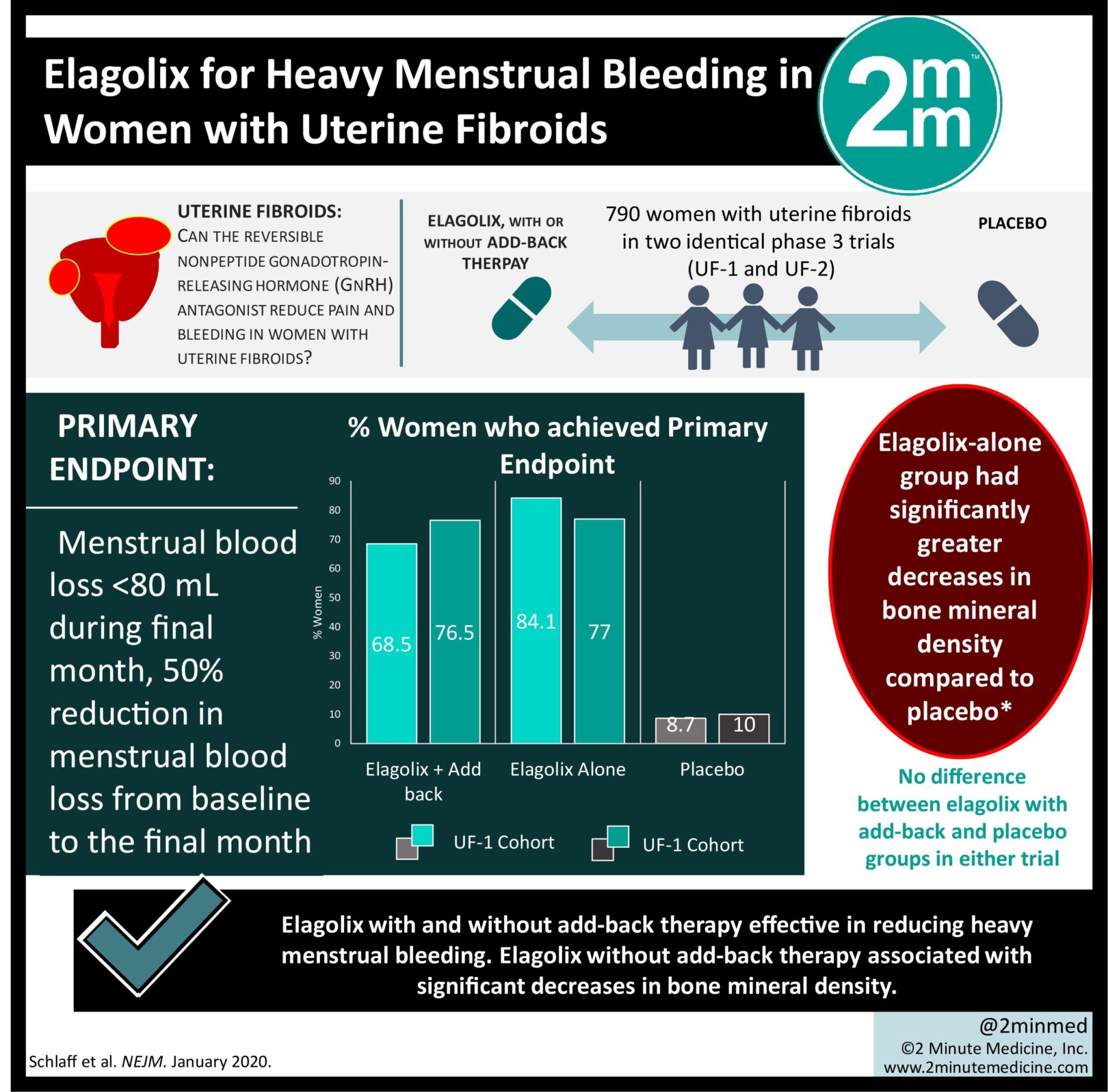
1. In this pair of identical phase 3 trials involving premenopausal women with uterine fibroids, both elagolix with and without add-back therapy was more effective in reducing heavy menstrual bleeding than placebo.

2. Significant decreases in bone mineral density were observed in the group that received elagolix without add-back therapy, but the hypoestrogenic effects of elagolix were successfully attenuated in the treatment group that also received add-back therapy.

Evidence Rating Level: 1 (Excellent)

Study Rundown: Uterine fibroids can cause heavy menstrual bleeding along with a host of symptoms including pelvic pain, gastrointestinal upset, and infertility. Current non-surgical options including progestins, tranexamic acid, and uterine-artery embolization have demonstrated only limited effectiveness and can carry long-lasting hypoestrogenic side effects such as decreased bone density and vasomotor symptoms. Elagolix is a reversible nonpeptide gonadotropin-releasing hormone (GnRH) antagonist that is currently approved for endometriosis-associated pain and was also efficacious in reducing menstrual bleeding in a phase 2b trial involving women with uterine fibroids. This study combined two identical phase 3 trials with the objective of assessing the safety and efficacy of elagolix as well as the impact of add-back hormone therapy on hypoestrogenic effects. Menstrual blood loss was found to be significantly lower in women who received elagolix with add-back therapy than in those who received placebo, with suppression of bleeding in the final month in over half of the group. Patients who received elagolix without add-back therapy also reaped these benefits but faced greater decreases from baseline in bone mineral density. Most adverse events in both elagolix groups were mild or moderate, the most common being hot flushes, and all serious events were resolved by the end of the trial.

Click here to read the study in NEJM

©2019 2 Minute Medicine, Inc. All rights reserved. No works may be reproduced without expressed written consent from 2 Minute Medicine, Inc. Inquire about licensing here. No article should be construed as medical advice and is not intended as such by the authors or by 2 Minute Medicine, Inc.

RELATED REPORTS

Intravaginal conjugated oestrogen does not improve continuation rate of ring pessary use

Fezolinetant significantly reduces vasomotor symptoms in post-menopausal women

Tags: elagolixestradiolestrogenfibroidgonadotropinnorethindroneuterine bleeding
Previous Post

Despite regular visits to pediatrician, few adolescent men having sex with men tested for HIV

Next Post

#VisualAbstract: Teprotumumab for the Treatment of Active Thyroid Eye Disease

RelatedReports

American Academy of Pediatrics recommends standards for adverse event disclosures
Chronic Disease

Intravaginal conjugated oestrogen does not improve continuation rate of ring pessary use

July 3, 2025
Patient Basics: Hot Flashes
Chronic Disease

Fezolinetant significantly reduces vasomotor symptoms in post-menopausal women

April 11, 2023
Simvastatin associated with slowed fibroid growth in mice
Chronic Disease

Linzagolix significantly reduces heavy menstrual bleeding in women with uterine fibroids

September 28, 2022
Chronic Disease

Relugolix combination therapy is efficacious for endometriosis-associated pain

June 30, 2022
Next Post
#VisualAbstract: Teprotumumab for the Treatment of Active Thyroid Eye Disease

#VisualAbstract: Teprotumumab for the Treatment of Active Thyroid Eye Disease

Quick Take: Intravenous patient-controlled analgesia versus thoracic epidural analgesia after open liver surgery

Fibrinogen concentrate noninferior to cryoprecipitate after cardiac surgery in patients with excessive bleeding and hypofibrinogenemia

Delays in surgical intervention do not increase odds of appendiceal perforation

Thoracoscopic Talc Poudrage vs Talc Slurry via Chest Tube have similar outcomes

✦ EvidencePulse™ by 2 Minute Medicine 2026 evidence scan 3 reports You asked top stroke trials 2026 Synthesizing medical evidence... Top 2026 stroke trial results: OCEANIC — ischemic stroke: 6.2% vs 8.4% OPTION* — mRS 0–1: 43.6% vs 34.2% ORIENTAL* — mRS 0–2: 58.6% vs 46.6% *Higher sICH in intervention arms Participants randomizedN OCEANIC 12,327 OPTION 570 ORIENTAL 564 Ask about guidelines or landmark trials... Try EvidencePulse™ Get the signal. Try it now → Physician-trained medical AI by 2 Minute Medicine

2MM+ All Access

Full details →
$4.99 /month

3-day free trial · cancel anytime

  • ✓100+ physician-written reports
  • ✓EvidencePulse™ + HypeCheck™
  • ✓Ad-free reading + newsletters
Start 3-day free trial

Then $4.99/month. Manage renewal in your account.

NPI Lookup · Free

Look up any US clinician

Search by name or NPI number, live from the CMS NPI Registry.

  • OIG exclusion check
  • Licenses and specialties
  • No account needed
Open NPI Lookup →

2 Minute Medicine® is an award winning, physician-run, expert medical media company. Our content is curated, written and edited by practicing health professionals who have clinical and scientific expertise in their field of reporting. Our editorial management team is comprised of highly-trained MD physicians. Join numerous brands, companies, and hospitals who trust our licensed content.

Recent Reports

  • Children with autism spectrum disorder may have reduced fecal microbial diversity
  • Variable homicide mortality rates among women aged 15-44 years depending on state abortion policy
  • An artificial intelligence model demonstrates the potential for improving the efficiency of structural heart disease screening using electrocardiograms
License Content
Terms of Use | Disclaimer
Cookie Policy
2MM+ All Access Full details →

The medical literature, distilled daily.

Monthly plan selected: $4.99 /month.

$4.99/month

3-day free trial · cancel anytime

Start 3-day free trial

Then $4.99/month. Manage renewal in your account.

Yearly plan selected: $49.90 /year.

$49.90/year

2 months free

Start 3-day free trial

Then $49.90/year.

Membership benefits

  • ✓100+ physician-written reports
  • ✓AI EvidencePulse™ + HypeCheck™
  • ✓Ad-free reading + newsletters
  • ✓NPI watchlist + bulk NPI verification

Already a member? Sign in

  • About
  • Specialties
    • All Specialties, All Recent Reports
    • Cardiology
    • Chronic Disease
    • Dermatology
    • Emergency
    • Endocrinology
    • Gastroenterology
    • Imaging and Intervention
    • Infectious Disease
    • Nephrology
    • Neurology
    • Obstetrics
    • Oncology
    • Ophthalmology
    • Pediatrics
    • Pharma
    • Preclinical
    • Psychiatry
    • Public Health
    • Pulmonology
    • Rheumatology
    • Surgery
    • Rewinds
    • The Scan
  • EvidencePulse™
  • HypeCheck™
  • AI News
  • Classics™
    • 2MM+ Online Access
    • Paperback and Ebook
  • Tools
    • NPI Registry Lookup
    • RVU Search
  • Partners
    • License Content
    • Advertise with Us
No Result
View All Result

© 2026 2 Minute Medicine, Inc. - Physician-written medical news.