• About
  • Masthead
  • License Content
  • Advertise
  • Submit Press Release
  • RSS/Email List
  • 2MM Podcast
  • Write for us
  • Contact Us
2 Minute Medicine
No Result
View All Result

No products in the cart.

SUBSCRIBE
  • Specialties
    • All Specialties, All Recent Reports
    • Cardiology
    • Chronic Disease
    • Dermatology
    • Emergency
    • Endocrinology
    • Gastroenterology
    • Imaging and Intervention
    • Infectious Disease
    • Nephrology
    • Neurology
    • Obstetrics
    • Oncology
    • Ophthalmology
    • Pediatrics
    • Pharma
    • Preclinical
    • Psychiatry
    • Public Health
    • Pulmonology
    • Rheumatology
    • Surgery
  • Tools
    • EvidencePulse™
    • RVU Search
    • NPI Registry Lookup
  • Pharma
  • AI News
  • The Scan+
  • Classics™+
    • 2MM+ Online Access
    • Paperback and Ebook
  • Rewinds
  • Partners
    • License Content
    • Submit Press Release
    • Advertise with Us
  • Account
    • Subscribe
    • Sign-in
    • My account
2 Minute Medicine
  • Specialties
    • All Specialties, All Recent Reports
    • Cardiology
    • Chronic Disease
    • Dermatology
    • Emergency
    • Endocrinology
    • Gastroenterology
    • Imaging and Intervention
    • Infectious Disease
    • Nephrology
    • Neurology
    • Obstetrics
    • Oncology
    • Ophthalmology
    • Pediatrics
    • Pharma
    • Preclinical
    • Psychiatry
    • Public Health
    • Pulmonology
    • Rheumatology
    • Surgery
  • Tools
    • EvidencePulse™
    • RVU Search
    • NPI Registry Lookup
  • Pharma
  • AI News
  • The Scan+
  • Classics™+
    • 2MM+ Online Access
    • Paperback and Ebook
  • Rewinds
  • Partners
    • License Content
    • Submit Press Release
    • Advertise with Us
  • Account
    • Subscribe
    • Sign-in
    • My account
SUBSCRIBE
2 Minute Medicine
Subscribe
Home StudyGraphics

#VisualAbstract: Sentinel-node biopsy only is noninferior to completion of axillary lymph node dissection in breast cancer with sentinel-node metastases
byMinjee Kim
April 24, 2024
in StudyGraphics
Reading Time: 3 mins read
0
Share on FacebookShare on Twitter

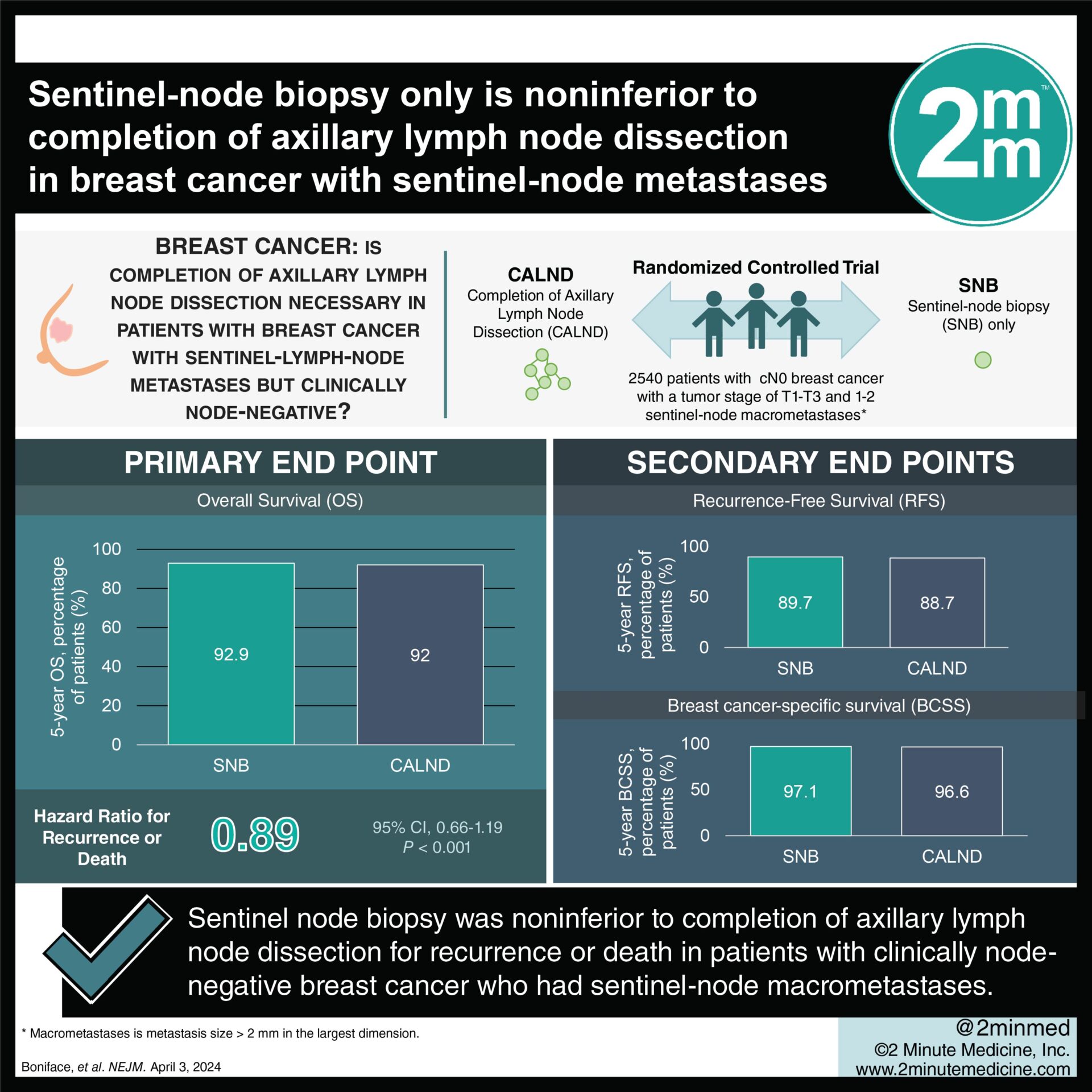
1. The hazard ratio for recurrence or death comparing sentinel node biopsy only to completion axillary lymph node dissection was non-significant (0.89) and below the noninferiority margin.

2. The overall survival rates at 5 years were similar between both groups, 92.9% vs 92%.

Evidence Rating Level: 1 (Excellent)

Study Rundown: Previous studies have challenged the necessity of completion axillary lymph node dissection in breast cancer treatment in certain patients. This trial aimed to validate these findings while expanding eligibility criteria. The primary endpoint was overall survival (OS), and secondary endpoints included recurrence-free survival (RFS), breast cancer-specific survival (BCSS), and patient reported outcomes. The 5-year OS was 92.9% in the SNB group and 92.0% in the CALND group. The 5-year BCSS was 97.1% in the SNB group and 96.6% in the CALND group. The 5-year RFS was 89.7% in the SNB group and 88.7% in the CALND group, with an HR of 0.89 (non-significant, p<0.001 below the noninferiority margin). Subgroup analyses were consistent with the above except in ER-positive, HER2–positive disease (13 patients total), in which SNB (HR 0.26, significant). The strength of this study included the large trial size, and the limitations included the unknown effect of differences in adjuvant therapy between the two arms. Overall, this study found that there is evidence supporting the safety of omitting CALND in patients with clinically node-negative T1-T3 breast cancer and one or two sentinel-node macrometastases.

Click to read the study in NEJM

RELATED REPORTS

New model enhances prediction of prostate cancer-specific mortality

The addition of a carboplatin to standard of care adjuvant chemotherapy improves survival outcomes in patients with high-risk, early-stage triple-negative breast cancer

2 Minute Medicine Rewind December 29th, 2025

Relevant Reading: Effect of Axillary Dissection vs No Axillary Dissection on 10-Year Overall Survival Among Women With Invasive Breast Cancer and Sentinel Node Metastasis

In-Depth [randomized controlled trial]: This multinational, prospective, randomized, phase 3 noninferiority trial, enrolled patients with T1-T3 with 1-2 sentinel node macrometastases and randomized them into completion axillary lymph node dissection (CALND, n=1205) vs no further axillary surgery (sentinel-node biopsy only, SNB, n=1335). Patients then received adjuvant radiation and systemic treatment with either hormone therapy and/or chemotherapy. The median follow-up time was 46.8 months. SNB had a mean removal of 2 lymph nodes vs CALND had a mean removal of 15 lymph nodes. The 5-year OS was 92.9% (95%CI, 91.0-94.9) in the SNB group and 92.0% (95%CI, 89.9-94.1) in the CALND group. The 5-year BCSS was 97.1% (95%CI, 95.8-98.3) in the SNB group and 96.6% (95%CI, 95.3-97.9) in the CALND group. The 5-year RFS was 89.7% (95%CI, 87.5-91.9) in the SNB group and 88.7% (95%CI, 86.3-91.1) in the CALND group, with a HR 0.89 (95%CI, 0.66-1.19, p<0.001 below the noninferiority margin). Subgroup analyses were consistent with the above except in ER-positive, HER2–positive disease (13 patients total), in which SNB (HR 0.26, 95%CI, 0.07-0.96). Overall, this study found that there is evidence supporting the safety of omitting CALND in patients with clinically node-negative T1-T3 breast cancer and one or two sentinel-node macrometastases.

©2024 2 Minute Medicine, Inc. All rights reserved. No works may be reproduced without expressed written consent from 2 Minute Medicine, Inc. Inquire about licensing here. No article should be construed as medical advice and is not intended as such by the authors or by 2 Minute Medicine, Inc.

Tags: #lymph node metastasisaxillary lymph node dissectionBreast Cancercancercompletion axillary lymph node dissectionlymph nodesentinel lymph node biopsy
Previous Post

Lipid metabolic reprogramming mediated by circulating Nrg4 alleviates metabolic dysfunction-associated steatotic liver disease

Next Post

Beta-blockers do not lower mortality after myocardial infarction with preserved ejection fraction

RelatedReports

Testosterone replacement in male cancer survivors helps improve body composition
Oncology

New model enhances prediction of prostate cancer-specific mortality

January 12, 2026
Age and breast cancer risk factors associated with false-positive mammography results
Chronic Disease

The addition of a carboplatin to standard of care adjuvant chemotherapy improves survival outcomes in patients with high-risk, early-stage triple-negative breast cancer

January 12, 2026
Admission may not be needed following sleep apnea surgery
Weekly Rewinds

2 Minute Medicine Rewind December 29th, 2025

January 12, 2026
2 Minute Medicine Rewind March 4, 2019
Chronic Disease

Notification of breast density is associated with increased anxiety and confusion

January 13, 2026
Next Post
Appropriate use criteria for angiography may frequently miss obstructive coronary artery disease

Beta-blockers do not lower mortality after myocardial infarction with preserved ejection fraction

Blindness and visual impairment decreasing worldwide

High dose aflibercept may be promising for treatment of age-related macular degeneration

#VisualAbstract: Microaxial Flow Pumps Reduces Mortality But Increases Adverse Events Compared to Standard Care For Cardiogenic Shock

#VisualAbstract: Microaxial Flow Pumps Reduces Mortality But Increases Adverse Events Compared to Standard Care For Cardiogenic Shock

2 Minute Medicine® is an award winning, physician-run, expert medical media company. Our content is curated, written and edited by practicing health professionals who have clinical and scientific expertise in their field of reporting. Our editorial management team is comprised of highly-trained MD physicians. Join numerous brands, companies, and hospitals who trust our licensed content.

Recent Reports

  • Duloxetine is effective in refractory chronic cough
  • AstraZeneca moves to own multimodal oncology AI with Modella
  • Cast immobilization is non-inferior to surgical intervention in isolated Weber B fractures of lateral malleolus
License Content
Terms of Use | Disclaimer
Cookie Policy
Privacy Statement (EU)
Disclaimer

© 2025 2 Minute Medicine, Inc. - Physician-written medical news.

  • Specialties
    • All Specialties, All Recent Reports
    • Cardiology
    • Chronic Disease
    • Dermatology
    • Emergency
    • Endocrinology
    • Gastroenterology
    • Imaging and Intervention
    • Infectious Disease
    • Nephrology
    • Neurology
    • Obstetrics
    • Oncology
    • Ophthalmology
    • Pediatrics
    • Pharma
    • Preclinical
    • Psychiatry
    • Public Health
    • Pulmonology
    • Rheumatology
    • Surgery
  • Tools
    • EvidencePulse™
    • RVU Search
    • NPI Registry Lookup
  • Pharma
  • AI News
  • The Scan
  • Classics™
    • 2MM+ Online Access
    • Paperback and Ebook
  • Rewinds
  • Partners
    • License Content
    • Submit Press Release
    • Advertise with Us
  • Account
    • Subscribe
    • Sign-in
    • My account
No Result
View All Result

© 2025 2 Minute Medicine, Inc. - Physician-written medical news.