• About
  • Masthead
  • License Content
  • Advertise
  • Press Releases
  • Newsroom
  • RSS/Email List
  • 2MM Podcast
  • Write for us
  • Contact Us
2 Minute Medicine
No Result
View All Result

No products in the cart.

Sign in
SUBSCRIBE
  • About
  • Specialties
    • All Specialties, All Recent Reports
    • Cardiology
    • Chronic Disease
    • Dermatology
    • Emergency
    • Endocrinology
    • Gastroenterology
    • Imaging and Intervention
    • Infectious Disease
    • Nephrology
    • Neurology
    • Obstetrics
    • Oncology
    • Ophthalmology
    • Pediatrics
    • Pharma
    • Preclinical
    • Psychiatry
    • Public Health
    • Pulmonology
    • Rheumatology
    • Surgery
    • Rewinds
    • The Scan
  • EvidencePulse™
  • HypeCheck™
  • AI News
  • Classics™
    • 2MM+ Online Access
    • Paperback and Ebook
  • Tools
    • NPI Registry Lookup
    • RVU Search
  • Partners
    • License Content
    • Advertise with Us
2 Minute Medicine
  • About
  • Specialties
    • All Specialties, All Recent Reports
    • Cardiology
    • Chronic Disease
    • Dermatology
    • Emergency
    • Endocrinology
    • Gastroenterology
    • Imaging and Intervention
    • Infectious Disease
    • Nephrology
    • Neurology
    • Obstetrics
    • Oncology
    • Ophthalmology
    • Pediatrics
    • Pharma
    • Preclinical
    • Psychiatry
    • Public Health
    • Pulmonology
    • Rheumatology
    • Surgery
    • Rewinds
    • The Scan
  • EvidencePulse™
  • HypeCheck™
  • AI News
  • Classics™
    • 2MM+ Online Access
    • Paperback and Ebook
  • Tools
    • NPI Registry Lookup
    • RVU Search
  • Partners
    • License Content
    • Advertise with Us
Sign in
SUBSCRIBE
2 Minute Medicine
Sign in
Subscribe
2 Minute MedicineFree on Google PlayGet
✦ EvidencePulse™ by 2 Minute Medicine 2026 evidence scan 3 reports You asked top stroke trials 2026 Synthesizing medical evidence... Top 2026 stroke trial results: OCEANIC — ischemic stroke: 6.2% vs 8.4% OPTION* — mRS 0–1: 43.6% vs 34.2% ORIENTAL* — mRS 0–2: 58.6% vs 46.6% *Higher sICH in intervention arms Participants randomizedN OCEANIC 12,327 OPTION 570 ORIENTAL 564 Ask about guidelines or landmark trials... ↑ Try EvidencePulse™ Ask the evidence.
Get the signal.
Try it now → Physician-trained medical AI by 2 Minute Medicine
Home StudyGraphics

#VisualAbstract: Vitamin D supplementation is not preventative for statin-associated muscle symptoms or statin discontinuation
byMinjee Kim
December 8, 2022
in StudyGraphics
Reading Time: 3 mins read
#VisualAbstract: Double sequential external defibrillation and vector-change defibrillation improve outcomes in patients with refractory ventricular fibrillation
Share on FacebookShare on TwitterShare on LinkedIn

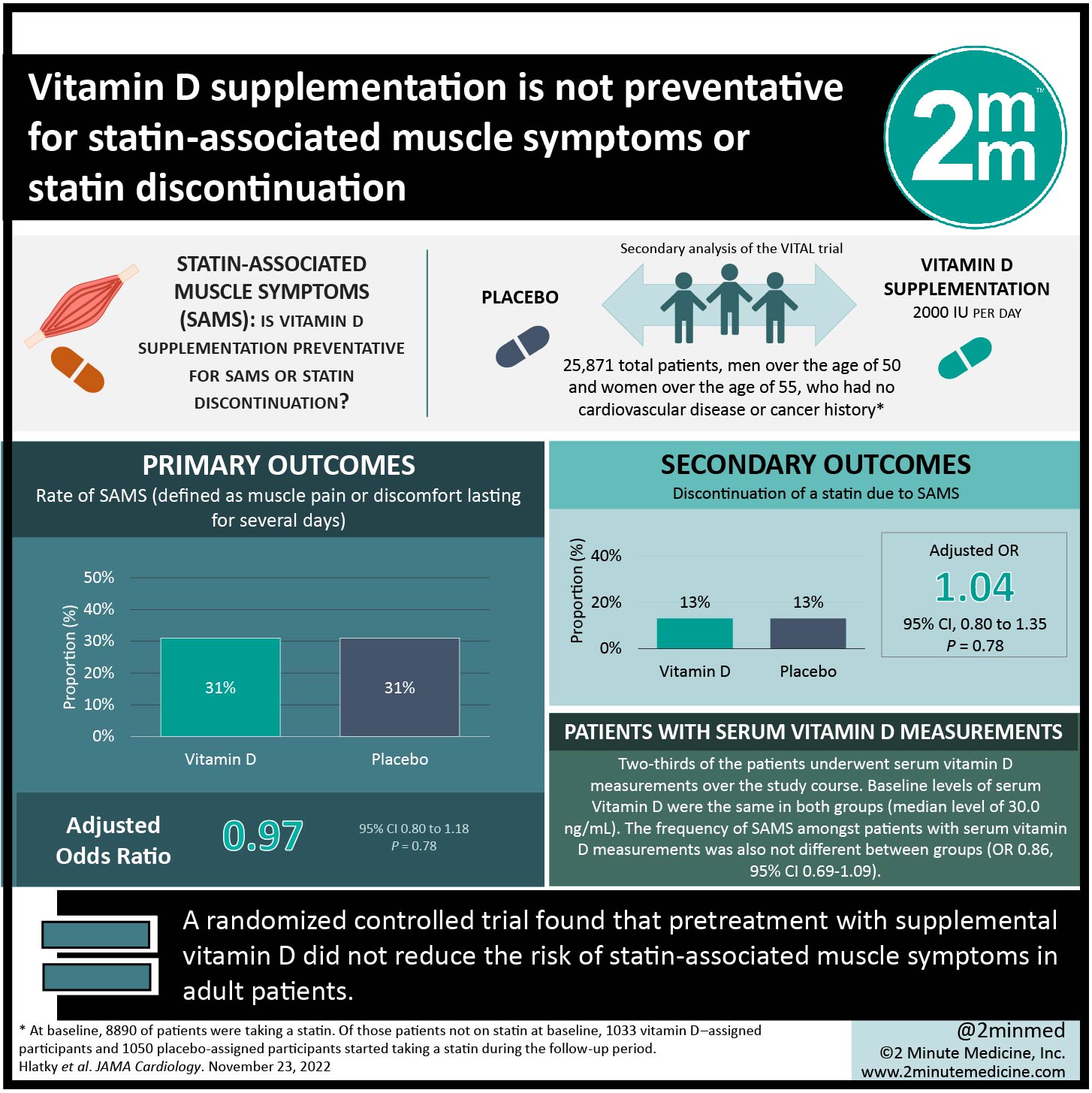
1. A randomized controlled trial found that pretreatment with supplemental vitamin D did not reduce the risk of statin-associated muscle symptoms in adult patients.

2. Vitamin D supplementation also did not reduce the risk of statin discontinuation.

Level of Evidence Rating: 1 (Excellent)

Study Rundown: Statins are amongst the most common medications prescribed in North America for dyslipidemia and heart protection. Adverse effects include statin-associated muscle symptoms (SAMS), which can be bothersome and frequently lead to medication discontinuation. Recently, low-grade evidence has emerged for vitamin D supplementation as a potentially effective means of reducing the incidence of SAMS in patients using statins. This study represents a secondary analysis of alternate outcomes (rate of SAMS and statin discontinuation) from a randomized controlled trial seeking to assess the effect of vitamin D on cancer risk in statin users.

In total, 25,871 participants were randomized. At baseline, 8890 (34%) of patients were taking a statin; of those who were not on statin therapy at baseline, 2,835 reported taking a statin during the follow-up period. 31% of patients in both the vitamin D and placebo groups reported muscle symptoms while taking a statin medication. The rate of statin discontinuation was also the same in both groups at 13%. Baseline serum measurements of vitamin D levels were also not different between the two groups.

RELATED REPORTS

Statin use after but not before breast cancer diagnosis is associated with improved mortality in hormone receptor-positive early breast cancer

Statins do not increase breast cancer risk in postmenopausal women

This secondary analysis of the VITAL trial demonstrated that vitamin D supplementation does not affect the risk of experiencing SAMS in adult patients taking statin medications. Strengths of this study included the randomized trial design, which does well to control for confounding and the large study size. Drawbacks of this study include the inability to assess statin compliance as well as chronology (i.e., the timing of SAMS compared to initiation of statin therapy). Future studies should work to elucidate other agents which may be helpful in preventing SAMS in statin users.

Click here to read this study in JAMA Cardiology

Relevant reading: Statin-associated muscle disease: advances in diagnosis and management

In-Depth [randomized controlled trial]: Data from this study was derived from the VITAL (vitamin D and omega-3) study, a large randomized controlled trial seeking to assess the impact of vitamin D supplementation on cancer risk in statin-users. Eligible patients were men over the age of 50 and women over the age of 55 who had no cardiovascular disease or cancer history. Participants were randomized to receive vitamin D supplements (2000 IU per day), omega-3 supplements or a placebo and completed a survey about the medications they were taking at baseline and over a series of follow-up questionnaires. Patient enrolment took place between November 2011 and March 2014; the mean follow-up time was 4.8 years.

Overall, 31% of patients in both the vitamin D and the placebo group reported SAMS. Therefore, the adjusted odds ratio for SAMS in the vitamin D group versus placebo was 0.97 (95% confidence interval 0.80-1.18). 13% of patients in both groups discontinued the statin medication; the adjusted odds ratio for discontinuation was 1.04 (0.80-1.35).

Amongst patients who underwent serum vitamin D measurements over the study course, baseline levels were the same in both groups, with a mean level of 30.4 ng/mL and a median level of 30.0 ng/mL. The frequency of SAMS amongst patients with serum vitamin D measurements was also not different between groups: 28% of the vitamin D supplementation patients vs 31% of the placebo patients experienced SAMS. The odds ratio for SAMS in vitamin D users versus placebo participants who had serum vitamin D measurements was 0.86 (95% CI, 0.69-1.09).


©2022 2 Minute Medicine, Inc. All rights reserved. No works may be reproduced without expressed written consent from 2 Minute Medicine, Inc. Inquire about licensing here. No article should be construed as medical advice and is not intended as such by the authors or by 2 Minute Medicine, Inc.

Tags: muscle painSAMSstatinstatin associated muscle symptomsstatin discontinuationvitamin dvitamin D supplementation
Previous Post

Two bedaquiline-containing regimens had superior efficacy and safety profiles for treatment of rifampin-resistant tuberculosis

Next Post

Wellness Check: Mental Health

RelatedReports

Variability in interpretation of breast biopsy slides associated with low verification of atypia and ductal carcinoma in situ
Chronic Disease

Statin use after but not before breast cancer diagnosis is associated with improved mortality in hormone receptor-positive early breast cancer

June 8, 2026
Variability in interpretation of breast biopsy slides associated with low verification of atypia and ductal carcinoma in situ
Chronic Disease

Statins do not increase breast cancer risk in postmenopausal women

April 7, 2026
Stochastic resonance stimulation may decrease apnea of prematurity
Weekly Rewinds

2 Minute Medicine Rewind April 6, 2026

April 6, 2026
AAP continues to recommend fluoride for prevention of dental caries
Obstetrics

Lower vitamin D levels in the second and third trimesters are associated with an increased risk of early childhood caries in children

January 13, 2026
Next Post
Shared decision-making tool for antidepressants improves patient and physician satisfaction

Wellness Check: Mental Health

Quick Take: Comparison of Laparoscopic 270 Degree Posterior Partial Fundoplication vs Total Fundoplication for the Treatment of Gastroesophageal Reflex Disease: a Randomized Clinical Trial  

Airway impedance may aid diagnosis of gastroesophageal reflux and aspiration in children

Patients with low back pain or pain at multiple sites at highest risk for chronic opioid use

Buprenorphine in pregnancy is associated with lower neonatal risk than methadone

✦ EvidencePulse™ by 2 Minute Medicine 2026 evidence scan 3 reports You asked top stroke trials 2026 Synthesizing medical evidence... Top 2026 stroke trial results: OCEANIC — ischemic stroke: 6.2% vs 8.4% OPTION* — mRS 0–1: 43.6% vs 34.2% ORIENTAL* — mRS 0–2: 58.6% vs 46.6% *Higher sICH in intervention arms Participants randomizedN OCEANIC 12,327 OPTION 570 ORIENTAL 564 Ask about guidelines or landmark trials... Try EvidencePulse™ Get the signal. Try it now → Physician-trained medical AI by 2 Minute Medicine

2MM+ All Access

Full details →
$4.99 /month

3-day free trial · cancel anytime

  • ✓100+ physician-written reports
  • ✓EvidencePulse™ + HypeCheck™
  • ✓Ad-free reading + newsletters
Start 3-day free trial

Then $4.99/month. Manage renewal in your account.

NPI Lookup · Free

Look up any US clinician

Search by name or NPI number, live from the CMS NPI Registry.

  • OIG exclusion check
  • Licenses and specialties
  • No account needed
Open NPI Lookup →

2 Minute Medicine® is an award winning, physician-run, expert medical media company. Our content is curated, written and edited by practicing health professionals who have clinical and scientific expertise in their field of reporting. Our editorial management team is comprised of highly-trained MD physicians. Join numerous brands, companies, and hospitals who trust our licensed content.

Recent Reports

  • An electronic health record tool for exercise prescription may reduce fall rate among older adults
  • Optogenetic therapy may partially restore vision in retinitis pigmentosa
  • An artificial intelligence system for human papillomavirus-positive dual stain cervical cancer screening reads p16-Ki67 slides
License Content
Terms of Use | Disclaimer
Cookie Policy

Get the app

Read 2 Minute Medicine on iPhone, iPad and Android.

Download on the App StoreGet it on Google Play
QR code for www.2minutemedicine.com/app
On a computer? Scan this with your phone’s camera.
2MM+ All Access Full details →

The medical literature, distilled daily.

Monthly plan selected: $4.99 /month.

$4.99/month

3-day free trial · cancel anytime

Start 3-day free trial

Then $4.99/month. Manage renewal in your account.

Yearly plan selected: $49.90 /year.

$49.90/year

2 months free

Start 3-day free trial

Then $49.90/year.

Membership benefits

  • ✓100+ physician-written reports
  • ✓AI EvidencePulse™ + HypeCheck™
  • ✓Ad-free reading + newsletters
  • ✓NPI watchlist + bulk NPI verification

Already a member? Sign in

  • Get the app
  • About
  • Specialties
    • All Specialties, All Recent Reports
    • Cardiology
    • Chronic Disease
    • Dermatology
    • Emergency
    • Endocrinology
    • Gastroenterology
    • Imaging and Intervention
    • Infectious Disease
    • Nephrology
    • Neurology
    • Obstetrics
    • Oncology
    • Ophthalmology
    • Pediatrics
    • Pharma
    • Preclinical
    • Psychiatry
    • Public Health
    • Pulmonology
    • Rheumatology
    • Surgery
    • Rewinds
    • The Scan
  • EvidencePulse™
  • HypeCheck™
  • AI News
  • Classics™
    • 2MM+ Online Access
    • Paperback and Ebook
  • Tools
    • NPI Registry Lookup
    • RVU Search
  • Partners
    • License Content
    • Advertise with Us
No Result
View All Result

© 2026 2 Minute Medicine, Inc. - Physician-written medical news.