
• About
  • Masthead
  • License Content
  • Advertise
  • Press Releases
  • Newsroom
  • RSS/Email List
  • 2MM Podcast
  • Write for us
  • Contact Us
2 Minute Medicine
No Result
View All Result

No products in the cart.

Sign in
SUBSCRIBE
  • About
  • Specialties
    • All Specialties, All Recent Reports
    • Cardiology
    • Chronic Disease
    • Dermatology
    • Emergency
    • Endocrinology
    • Gastroenterology
    • Imaging and Intervention
    • Infectious Disease
    • Nephrology
    • Neurology
    • Obstetrics
    • Oncology
    • Ophthalmology
    • Pediatrics
    • Pharma
    • Preclinical
    • Psychiatry
    • Public Health
    • Pulmonology
    • Rheumatology
    • Surgery
    • Rewinds
    • The Scan
  • EvidencePulse™
  • HypeCheck™
  • AI News
  • Classics™
    • 2MM+ Online Access
    • Paperback and Ebook
  • Tools
    • NPI Registry Lookup
    • RVU Search
  • Partners
    • License Content
    • Advertise with Us
2 Minute Medicine
  • About
  • Specialties
    • All Specialties, All Recent Reports
    • Cardiology
    • Chronic Disease
    • Dermatology
    • Emergency
    • Endocrinology
    • Gastroenterology
    • Imaging and Intervention
    • Infectious Disease
    • Nephrology
    • Neurology
    • Obstetrics
    • Oncology
    • Ophthalmology
    • Pediatrics
    • Pharma
    • Preclinical
    • Psychiatry
    • Public Health
    • Pulmonology
    • Rheumatology
    • Surgery
    • Rewinds
    • The Scan
  • EvidencePulse™
  • HypeCheck™
  • AI News
  • Classics™
    • 2MM+ Online Access
    • Paperback and Ebook
  • Tools
    • NPI Registry Lookup
    • RVU Search
  • Partners
    • License Content
    • Advertise with Us
Sign in
SUBSCRIBE
2 Minute Medicine
Sign in
Subscribe
2 Minute MedicineFree on Google PlayGet
✦ EvidencePulse™ by 2 Minute Medicine 2026 evidence scan 3 reports You asked top stroke trials 2026 Synthesizing medical evidence... Top 2026 stroke trial results: OCEANIC — ischemic stroke: 6.2% vs 8.4% OPTION* — mRS 0–1: 43.6% vs 34.2% ORIENTAL* — mRS 0–2: 58.6% vs 46.6% *Higher sICH in intervention arms Participants randomizedN OCEANIC 12,327 OPTION 570 ORIENTAL 564 Ask about guidelines or landmark trials... ↑ Try EvidencePulse™ Ask the evidence.
Get the signal.
Try it now → Physician-trained medical AI by 2 Minute Medicine
Home The Classics Cardiology Classics

EAST-AFNET 4 Trial: Early Rhythm Control vs Usual Care in Atrial Fibrillation (East AF) [Classics Series]

byMarc Succi
August 27, 2025
in Cardiology Classics, The Classics
Reading Time: 5 mins read
ABCD2 Score: Predicting Early Stroke Risk After Transient Ischemic Attack (TIA) [Classics Series]
Share on FacebookShare on TwitterShare on LinkedIn

1. The EAST-AFNET 4 trial (East AF) demonstrated that early rhythm control therapy—including antiarrhythmic drugs or catheter ablation—was associated with a significant reduction in the composite outcome of cardiovascular death, stroke, and hospitalization for worsening heart failure or acute coronary syndrome compared to usual care in patients with newly diagnosed atrial fibrillation (AF).

Original Date of Publication: August 2020

Find more landmark study summaries like this in the book 2 Minute Medicine’s The Classics in Medicine: Summaries of the Landmark Trials, 2e (The Classics Series).

Study Rundown:
Management of atrial fibrillation traditionally emphasizes rate control, with rhythm control reserved for symptom relief. However, whether early rhythm control improves long-term outcomes has been debated. The EAST-AFNET 4 trial, a multicenter, randomized, open-label study, evaluated whether initiating rhythm control within one year of AF diagnosis improves clinical outcomes compared to usual care.

Over 2,700 patients with recent-onset AF and cardiovascular conditions were randomized to receive either early rhythm control (antiarrhythmic therapy or ablation) or usual care (initial rate control, rhythm control only if symptoms persisted).

At 5 years, early rhythm control significantly reduced the primary composite endpoint (cardiovascular death, stroke, hospitalization for heart failure, or acute coronary syndrome) compared to usual care. Rates of stroke and hospitalization were lower, with no significant excess of adverse events.

RELATED REPORTS

Optogenetic therapy may partially restore vision in retinitis pigmentosa

An artificial intelligence system for human papillomavirus-positive dual stain cervical cancer screening reads p16-Ki67 slides

This study supports the benefit of an early, proactive rhythm control strategy in atrial fibrillation to prevent major cardiovascular events, challenging prior approaches that prioritized rate control until symptoms demanded otherwise.

Click to read the study in NEJM

In-Depth [randomized controlled trial]:
The EAST-AFNET 4 trial was a multicenter, randomized study conducted across 135 European centers, enrolling 2,789 patients who had been diagnosed with atrial fibrillation within the prior year. All patients had at least one additional cardiovascular risk factor, such as hypertension, diabetes, heart failure, prior stroke or TIA, or structural heart disease. The mean age was approximately 70 years, nearly half were women, and the median CHA₂DS₂-VASc score was 3.4.

Patients were randomized to two treatment strategies. In the early rhythm control group, therapy with antiarrhythmic drugs (class Ic or III agents, including flecainide, amiodarone, dronedarone, and sotalol) or catheter ablation was initiated promptly with the goal of maintaining sinus rhythm. In the usual care group, patients were managed primarily with rate control, and rhythm control was introduced only if symptoms persisted or worsened.

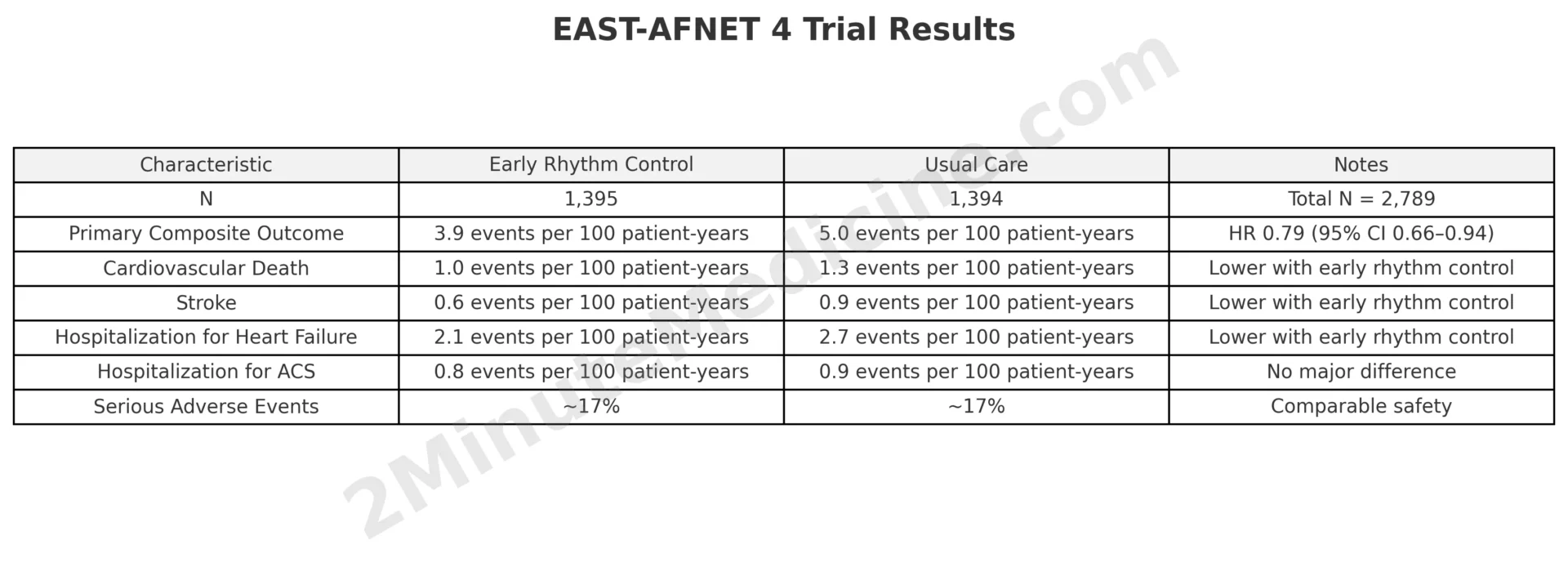
Over a median follow-up of just over five years, early rhythm control significantly reduced the primary composite endpoint of cardiovascular death, stroke, hospitalization for worsening heart failure, or hospitalization for acute coronary syndrome compared to usual care. Importantly, the reduction in adverse outcomes was observed early in follow-up and remained consistent throughout the trial. Rates of cardiovascular death, stroke, and hospitalization for heart failure were all lower in the early rhythm control group, while hospitalization for acute coronary syndrome was similar between groups. Quality of life did not differ significantly at two years, suggesting that the main benefit of early rhythm control lies in reducing hard cardiovascular outcomes rather than symptom improvement alone. Safety outcomes were comparable, with serious adverse events occurring in about 17% of patients in each arm.


Trial Results Table

Characteristic Early Rhythm Control Usual Care Notes
N 1,395 1,394 Total N = 2,789
Primary Composite Outcome 3.9 events per 100 patient-years 5.0 events per 100 patient-years HR 0.79 (95% CI 0.66–0.94)
Cardiovascular Death 1.0 events per 100 patient-years 1.3 events per 100 patient-years Lower with early rhythm control
Stroke 0.6 events per 100 patient-years 0.9 events per 100 patient-years Lower with early rhythm control
Hospitalization for Heart Failure 2.1 events per 100 patient-years 2.7 events per 100 patient-years Lower with early rhythm control
Hospitalization for ACS 0.8 events per 100 patient-years 0.9 events per 100 patient-years No major difference
Serious Adverse Events ~17% ~17% Comparable safety

Key Takeaways:

The EAST-AFNET 4 trial demonstrates that initiating rhythm control within the first year of atrial fibrillation diagnosis reduces cardiovascular complications compared to usual care. The results challenge the traditional paradigm of reserving rhythm control for symptom relief and instead support its role as a disease-modifying strategy. For patients with newly diagnosed atrial fibrillation and cardiovascular comorbidities, early rhythm control using antiarrhythmic drugs or catheter ablation is both effective and safe.

These findings stand in contrast to earlier trials such as the AFFIRM trial, which found no mortality benefit of rhythm control when initiated later in the disease course. Together, these studies suggest that timing is crucial: early initiation of rhythm control may alter the long-term outcomes of atrial fibrillation in ways that delayed intervention does not.

Previous Post

Weekly basal insulin efsitora effective for managing type 2 diabetes

Next Post

#VisualAbstract: Once-weekly Semaglutide Reduces Body Weight in People with Obesity

RelatedReports

A woman using a red light therapy device while seated, surrounded by workout equipment and papers, suggesting engagement in wellness practices.
Chronic Disease

Optogenetic therapy may partially restore vision in retinitis pigmentosa

October 23, 2026
A calendar, a specimen jar, and a brush are depicted alongside a microscopic view of cervical cells, indicating cervical cancer screening.
All Specialties

An artificial intelligence system for human papillomavirus-positive dual stain cervical cancer screening reads p16-Ki67 slides

October 23, 2026
A man walking along a path surrounded by healthy food options, sporting shoes, a heart illustration, and urban scenery, indicating lifestyle changes for cardiovascular health.
Cardiology

Elevated low-density lipoprotein cholesterol is a risk factor for atherosclerotic disease irrespective of familial hypercholesterolemia status

October 22, 2026
An illustration depicting a bowl of vegetables, a smartphone, and a representation of the gut microbiome inside the human intestinal tract.
Chronic Disease

Children with autism spectrum disorder may have reduced fecal microbial diversity

October 21, 2026
Next Post
#VisualAbstract: Once-weekly Semaglutide Reduces Body Weight in People with Obesity

#VisualAbstract: Once-weekly Semaglutide Reduces Body Weight in People with Obesity

Parents desensitized with increasing exposure to movie violence/sex

Australian couple-based genetic screening program feasible and accepted

Quick Take: Combined Surgery and Extensive Intraoperative Peritoneal Lavage vs Surgery Alone for Treatment of Locally Advanced Gastric Cancer: The SEIPLUS Randomized Clinical Tria

Trastuzumab deruxtecan leads to longer overall survival than ramucirumab plus paclitaxel in HER2-positive gastric cancer

✦ EvidencePulse™ by 2 Minute Medicine 2026 evidence scan 3 reports You asked top stroke trials 2026 Synthesizing medical evidence... Top 2026 stroke trial results: OCEANIC — ischemic stroke: 6.2% vs 8.4% OPTION* — mRS 0–1: 43.6% vs 34.2% ORIENTAL* — mRS 0–2: 58.6% vs 46.6% *Higher sICH in intervention arms Participants randomizedN OCEANIC 12,327 OPTION 570 ORIENTAL 564 Ask about guidelines or landmark trials... Try EvidencePulse™ Get the signal. Try it now → Physician-trained medical AI by 2 Minute Medicine

2MM+ All Access

Full details →
$4.99 /month

3-day free trial · cancel anytime

  • ✓100+ physician-written reports
  • ✓EvidencePulse™ + HypeCheck™
  • ✓Ad-free reading + newsletters
Start 3-day free trial

Then $4.99/month. Manage renewal in your account.

NPI Lookup · Free

Look up any US clinician

Search by name or NPI number, live from the CMS NPI Registry.

  • OIG exclusion check
  • Licenses and specialties
  • No account needed
Open NPI Lookup →

2 Minute Medicine® is an award winning, physician-run, expert medical media company. Our content is curated, written and edited by practicing health professionals who have clinical and scientific expertise in their field of reporting. Our editorial management team is comprised of highly-trained MD physicians. Join numerous brands, companies, and hospitals who trust our licensed content.

Recent Reports

  • Optogenetic therapy may partially restore vision in retinitis pigmentosa
  • An artificial intelligence system for human papillomavirus-positive dual stain cervical cancer screening reads p16-Ki67 slides
  • Elevated low-density lipoprotein cholesterol is a risk factor for atherosclerotic disease irrespective of familial hypercholesterolemia status
License Content
Terms of Use | Disclaimer
Cookie Policy

Get the app

Read 2 Minute Medicine on iPhone, iPad and Android.

Download on the App StoreGet it on Google Play
QR code for www.2minutemedicine.com/app
On a computer? Scan this with your phone’s camera.
2MM+ All Access Full details →

The medical literature, distilled daily.

Monthly plan selected: $4.99 /month.

$4.99/month

3-day free trial · cancel anytime

Start 3-day free trial

Then $4.99/month. Manage renewal in your account.

Yearly plan selected: $49.90 /year.

$49.90/year

2 months free

Start 3-day free trial

Then $49.90/year.

Membership benefits

  • ✓100+ physician-written reports
  • ✓AI EvidencePulse™ + HypeCheck™
  • ✓Ad-free reading + newsletters
  • ✓NPI watchlist + bulk NPI verification

Already a member? Sign in

  • Get the app
  • About
  • Specialties
    • All Specialties, All Recent Reports
    • Cardiology
    • Chronic Disease
    • Dermatology
    • Emergency
    • Endocrinology
    • Gastroenterology
    • Imaging and Intervention
    • Infectious Disease
    • Nephrology
    • Neurology
    • Obstetrics
    • Oncology
    • Ophthalmology
    • Pediatrics
    • Pharma
    • Preclinical
    • Psychiatry
    • Public Health
    • Pulmonology
    • Rheumatology
    • Surgery
    • Rewinds
    • The Scan
  • EvidencePulse™
  • HypeCheck™
  • AI News
  • Classics™
    • 2MM+ Online Access
    • Paperback and Ebook
  • Tools
    • NPI Registry Lookup
    • RVU Search
  • Partners
    • License Content
    • Advertise with Us
No Result
View All Result

© 2026 2 Minute Medicine, Inc. - Physician-written medical news.