• About
  • Masthead
  • License Content
  • Advertise
  • Press Releases
  • Newsroom
  • RSS/Email List
  • 2MM Podcast
  • Write for us
  • Contact Us
2 Minute Medicine
No Result
View All Result

No products in the cart.

Sign in
SUBSCRIBE
  • About
  • Specialties
    • All Specialties, All Recent Reports
    • Cardiology
    • Chronic Disease
    • Dermatology
    • Emergency
    • Endocrinology
    • Gastroenterology
    • Imaging and Intervention
    • Infectious Disease
    • Nephrology
    • Neurology
    • Obstetrics
    • Oncology
    • Ophthalmology
    • Pediatrics
    • Pharma
    • Preclinical
    • Psychiatry
    • Public Health
    • Pulmonology
    • Rheumatology
    • Surgery
    • Rewinds
    • The Scan
  • EvidencePulse™
  • HypeCheck™
  • AI News
  • Classics™
    • 2MM+ Online Access
    • Paperback and Ebook
  • Tools
    • NPI Registry Lookup
    • RVU Search
    • Medical School Rankings
    • FDA Drug Approvals
    • Clinical Guidelines
    • Medical Calculators
  • Partners
    • License Content
    • Advertise with Us
2 Minute Medicine
  • About
  • Specialties
    • All Specialties, All Recent Reports
    • Cardiology
    • Chronic Disease
    • Dermatology
    • Emergency
    • Endocrinology
    • Gastroenterology
    • Imaging and Intervention
    • Infectious Disease
    • Nephrology
    • Neurology
    • Obstetrics
    • Oncology
    • Ophthalmology
    • Pediatrics
    • Pharma
    • Preclinical
    • Psychiatry
    • Public Health
    • Pulmonology
    • Rheumatology
    • Surgery
    • Rewinds
    • The Scan
  • EvidencePulse™
  • HypeCheck™
  • AI News
  • Classics™
    • 2MM+ Online Access
    • Paperback and Ebook
  • Tools
    • NPI Registry Lookup
    • RVU Search
    • Medical School Rankings
    • FDA Drug Approvals
    • Clinical Guidelines
    • Medical Calculators
  • Partners
    • License Content
    • Advertise with Us
Sign in
SUBSCRIBE
2 Minute Medicine
Sign in
Subscribe
2 Minute MedicineFree on Google PlayGet
✦ EvidencePulse™ by 2 Minute Medicine 2026 evidence scan 3 reports You asked top stroke trials 2026 Synthesizing medical evidence... Top 2026 stroke trial results: OCEANIC — ischemic stroke: 6.2% vs 8.4% OPTION* — mRS 0–1: 43.6% vs 34.2% ORIENTAL* — mRS 0–2: 58.6% vs 46.6% *Higher sICH in intervention arms Participants randomizedN OCEANIC 12,327 OPTION 570 ORIENTAL 564 Ask about guidelines or landmark trials... ↑ Try EvidencePulse™ Ask the evidence.
Get the signal.
Try it now → Physician-trained medical AI by 2 Minute Medicine
Home The Classics Critical, Emergent and Pulmonary Care Classics

Fleischner Criteria – Fleischner Society 2017 Guidelines: Updated Follow-Up for Incidental Pulmonary Nodules [Classics Series]

by2 Minute Medicine's The Classics in Radiology
August 13, 2025
in Critical, Emergent and Pulmonary Care Classics, Imaging Classics, The Classics
Reading Time: 3 mins read

Quick reference

Fleischner Society 2017 pulmonary nodule guidelines

What to do with a pulmonary nodule found by chance on CT in an adult, under the Fleischner Society's 2017 recommendations: who they apply to, follow-up by nodule type, size and risk, and how to measure.

Fleischner SocietyPublished July 2017

At a glance

  • For nodules found incidentally on CT in adults 35 and older; not for lung cancer screening (use Lung-RADS), people with known cancer, or people who are immunocompromised.
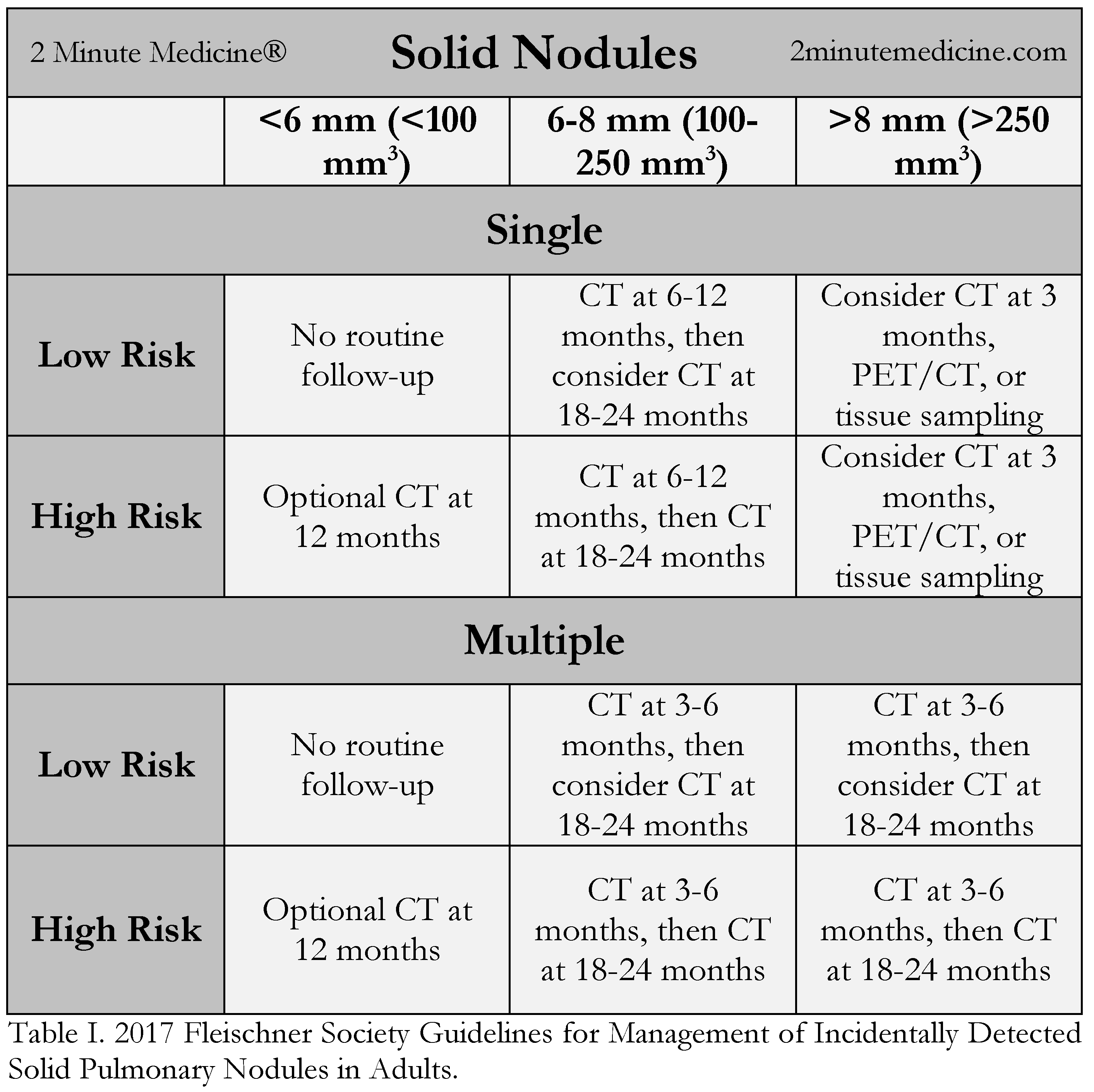
  • A single solid nodule under 6 mm in a low-risk patient needs no routine follow-up; in a high-risk patient, a CT at 12 months is optional.
  • Solid nodules 6 to 8 mm: CT at 6 to 12 months; over 8 mm: consider CT at 3 months, PET/CT or tissue sampling.
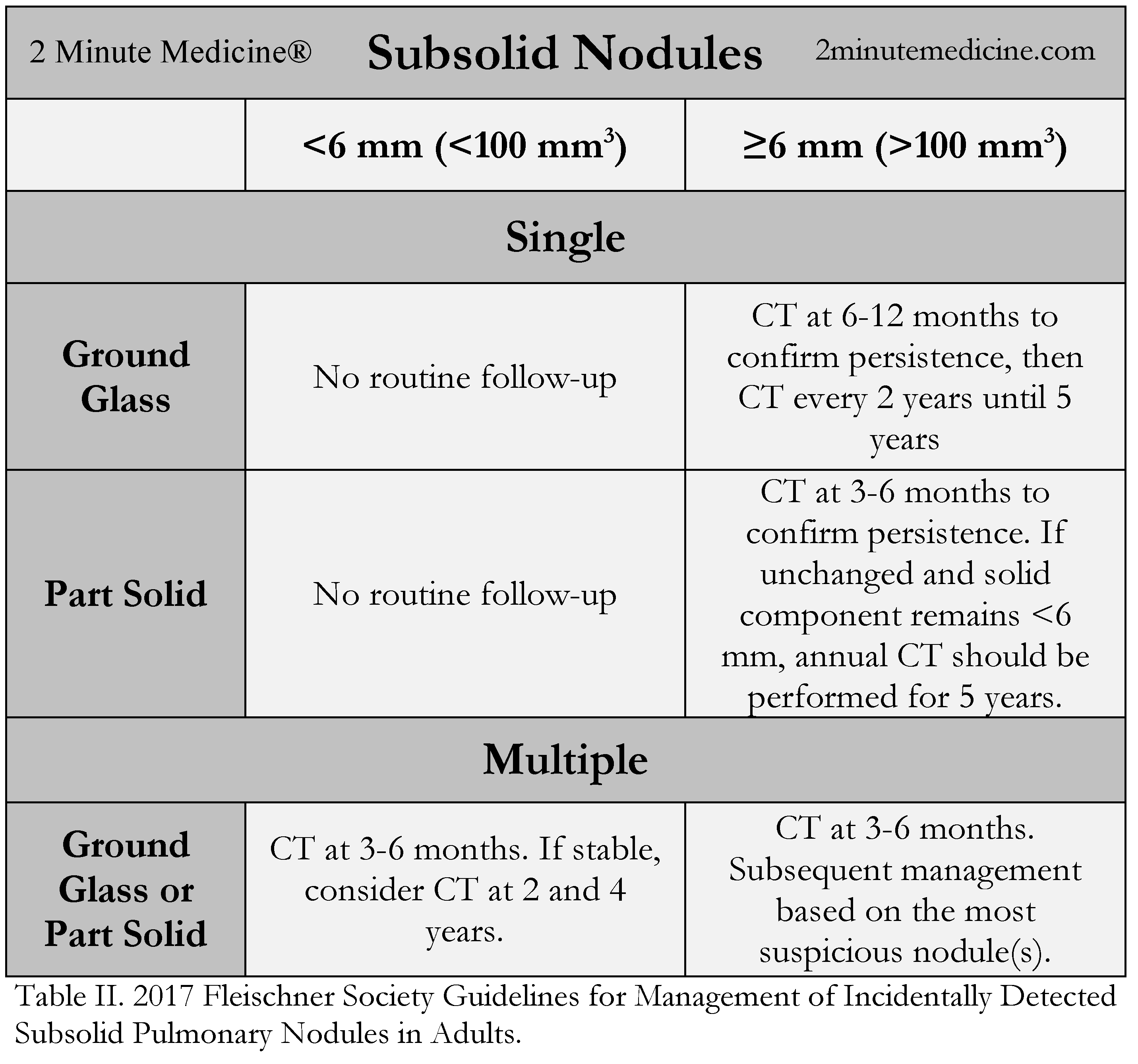
  • Pure ground-glass nodules 6 mm or larger: CT at 6 to 12 months, then every 2 years to 5 years if they persist.
  • Part-solid nodules 6 mm or larger: CT at 3 to 6 months; a persistent solid component of 6 mm or more is highly suspicious.
  • Measure the average of the long and short axes, rounded to the nearest millimeter, on thin sections.

Key recommendations

Who it applies to

  • Use the recommendations for incidental nodules in adults 35 and older. They do not apply to lung cancer screening, to people with a known primary cancer, or to people who are immunocompromised.

  • Judge risk from age, smoking and other exposures, family history, emphysema or fibrosis, upper lobe location, and nodule size and shape such as spiculation.

Single solid nodule

  • Under 6 mm: no routine follow-up in a low-risk patient; an optional CT at 12 months in a high-risk patient, especially with suspicious morphology or an upper lobe location.

  • 6 to 8 mm: CT at 6 to 12 months. If stable, a further CT at 18 to 24 months is considered in low-risk patients and recommended in high-risk patients.

  • Over 8 mm: consider CT at 3 months, PET/CT or tissue sampling.

Multiple solid nodules

  • Under 6 mm: no routine follow-up in low-risk patients, an optional CT at 12 months in high-risk patients. 6 mm or larger: CT at 3 to 6 months, then consider 18 to 24 months, managing by the most suspicious nodule.

Ground-glass nodule

  • Under 6 mm: no routine follow-up. 6 mm or larger: CT at 6 to 12 months to confirm it persists, then every 2 years until 5 years.

Part-solid nodule

  • Under 6 mm: no routine follow-up. 6 mm or larger: CT at 3 to 6 months; if it persists with a solid component under 6 mm, CT every year for 5 years. A solid component of 6 mm or more is highly suspicious.

Multiple subsolid nodules

  • Under 6 mm: CT at 3 to 6 months, then consider CT at 2 and 4 years if stable. 6 mm or larger: CT at 3 to 6 months, then manage by the most suspicious nodule.

Measuring

  • Use thin-section CT (1.5 mm or less). Report size as the average of the long and short axes rounded to the nearest millimeter; volumetry can be used where available.

  • Small, smooth perifissural or juxtapleural nodules with a triangular or oval shape are usually intrapulmonary lymph nodes and need no follow-up, even up to about 10 mm.

How to read the grades Consensus statement

An expert consensus statement: the recommendations are not graded with a formal evidence system.

What changed

Compared with the 2005 (solid) and 2013 (subsolid) Fleischner statements.

Threshold

Before
Solid nodules 4 mm or smaller needed no follow-up in low-risk patients (2005).
Now
The no-follow-up threshold rose to under 6 mm (about 100 cubic millimeters).

Timing

Before
Fixed follow-up times.
Now
Ranges (for example 6 to 12 months) so follow-up fits the patient and the clinic, with fewer scans overall.

Scope

Before
Separate statements for solid (2005) and subsolid (2013) nodules.
Now
One document for solid, subsolid and multiple nodules.

Subsolid nodules

Before
Follow-up intervals for ground-glass and part-solid nodules (2013).
Now
Longer intervals, with follow-up extended to 5 years for persistent subsolid nodules.

Measurement

Before
Single largest diameter.
Now
Average of long and short axes, with volumetric thresholds as an option.

EvidencePulse

Does this apply to my patient?

Pick a question or write your own. EvidencePulse answers from the studies, with citations.

Ask EvidencePulse

Get an alert when this guideline changes

Free in the 2MM Daily Brief: what changed, in our own words, the day it comes out.

Opens Mailchimp to confirm. Unsubscribe anytime.

Questions clinicians ask

Do the Fleischner guidelines apply to lung cancer screening CTs?

No. Nodules found on lung cancer screening CT are managed with the American College of Radiology's Lung-RADS system. Fleischner applies to nodules found incidentally on CT done for other reasons.

Who is excluded from the Fleischner 2017 recommendations?

People under 35, people with a known primary cancer, and people who are immunocompromised. Their nodules need individual management.

How should a nodule be measured?

On thin-section CT, as the average of the long and short axes, rounded to the nearest millimeter. Volumetry can be used where available.

Is there a newer Fleischner statement than 2017?

The 2017 statement remains the current Fleischner guidance for incidental pulmonary nodules.

Sources

  1. MacMahon H, Naidich DP, Goo JM, et al. Guidelines for management of incidental pulmonary nodules detected on CT images: from the Fleischner Society 2017. Radiology. 2017;284(1):228-243. doi.org/10.1148/radiol.2017161659
  2. Bankier AA, MacMahon H, Goo JM, et al. Recommendations for measuring pulmonary nodules at CT: a statement from the Fleischner Society. Radiology. 2017;285(2):584-600. doi.org/10.1148/radiol.2017162894

Summarized in our own words by 2 Minute Medicine's physician editors from the source documents listed here. Strength and evidence grades are the guideline authors' own. This is a quick reference, not a substitute for the full guideline or for clinical judgment.

Our Classics summary of the 2017 statement follows below.

Share on FacebookShare on TwitterShare on LinkedIn

The following study summary is an excerpt from the book 2 Minute Medicine’s The Classics in Radiology: Summaries of Clinically Relevant & Recent Landmark Studies, 1e (The Classics Series).

1. The 2017 update to the Fleischner Society Guidelines greatly reduces unnecessary follow-up imaging for incidental solid and subsolid pulmonary nodules by increasing the size threshold for routine surveillance and using follow-up time ranges rather than rigid intervals. 

2. In low-risk adults, incidentally detected nodules under 6 mm (both solid and ground-glass or part-solid) generally do not require follow-up; higher-risk individuals may warrant a single CT at 12 months. Nodules of 6 mm or larger demand follow-up tailored by type, size, and risk factors.

4. Risk factors for malignancy include nodule size, tobacco and other known carcinogens, family history, upper lobe location, emphysema, and pulmonary fibrosis.

 Original Date of Publication: March 2017 

Study Rundown: The Fleischner Society’s 2017 guidelines, published in Radiology, represent a major update to the organization’s prior recommendations for managing incidentally detected pulmonary nodules. These changes consolidated the 2005 solid nodule guidelines and the 2013 subsolid nodule guidelines into a single, streamlined framework designed to reduce unnecessary imaging and associated patient anxiety, cost, and radiation exposure.

One of the most important changes was raising the minimum size threshold for routine follow-up from 4 mm to 6 mm. This shift was supported by data from large international lung cancer screening trials showing that nodules under 6 mm in low-risk patients carry a <1% malignancy risk, even in populations with higher baseline risk. By avoiding follow-up in these very low-risk cases, clinicians can focus resources on patients more likely to benefit from surveillance.

For low-risk patients with solid or subsolid nodules smaller than 6 mm, no follow-up is generally recommended. In high-risk patients, an optional CT scan at 12 months may be considered. Solid nodules between 6–8 mm typically require one follow-up CT at 6–12 months, with a second scan at 18–24 months for selected cases. Nodules larger than 8 mm warrant more definitive evaluation, which may include an early CT at 3 months, PET-CT, or tissue sampling depending on risk factors and imaging features.

Subsolid nodules—including pure ground-glass and part-solid nodules—have unique growth patterns and a higher likelihood of representing indolent adenocarcinomas. For these, the guidelines recommend follow-up at 6–12 months and then periodic surveillance for up to 5 years. This extended timeframe reflects the slow progression of many subsolid lesions and helps avoid premature invasive testing.

The 2017 update also moved away from rigid follow-up timelines, introducing time ranges that give clinicians the flexibility to personalize surveillance based on the patient’s overall risk profile, nodule morphology, and comorbidities. For accurate characterization, the guidelines emphasize the use of thin-section CT imaging (≤ 1.5 mm slice thickness) with coronal and sagittal reconstructions.

When multiple nodules are present, management is based on the most suspicious nodule rather than applying recommendations to each lesion individually. This prevents over-surveillance while ensuring that the highest-risk findings receive appropriate attention.

Overall, the 2017 Fleischner Society Guidelines mark a shift toward risk-stratified, evidence-based management of incidental pulmonary nodules, minimizing unnecessary follow-up for small, low-risk lesions while ensuring timely investigation of those more likely to represent lung cancer.

Click to read the study in Radiology

MacMahon H, Naidich DP, Goo JM, Lee KS, Leung AN, Mayo JR, Mehta AC, Ohno Y, Powell CA, Prokop M, Rubin GD. Guidelines for Management of Incidental Pulmonary Nodules Detected on CT Images: From the Fleischner Society 2017. Radiology. 2017 Feb 23:161659.

 Additional Review:

Pinsky PF, Gierada DS, Black W, Munden R, Nath H, Aberle D, et al. Performance of Lung-RADS in the National Lung Screening Trial A Retrospective Assessment Performance of Lung-RADS in the NLST. Ann Intern Med. 2015 Apr 7;162(7):485–91.
© 2018 2 Minute Medicine, Inc. All rights reserved. No part of this article may be reproduced, distributed or transmitted in any form or by any means without the prior written permission of 2 Minute Medicine, Inc. To license this content, contact 2 Minute Medicine, Inc. This article is for informational and educational purposes only; it is not medical advice and does not replace the judgment of a qualified healthcare professional.
Image: © 2 Minute Medicine

Tags: pulmonary nodule
Previous Post

Negative colonoscopy screening linked to reduced risk of colorectal cancer and colorectal cancer-related death

Next Post

Operative vaginal delivery associated with higher risk of anal incontinence and pelvic organ prolapse

Next Post
Paternal factors associated with short interpregnancy interval

Operative vaginal delivery associated with higher risk of anal incontinence and pelvic organ prolapse

Using HEART score to risk stratify patients with chest pain is safe but underutilized in the ED

Quick Take: Christmas, National Holidays, Sport Events, and Time Factors as Triggers of Acute Myocardial Infarction: SWEDEHEART Observational Study 1998-2013

Fleischner Criteria – Fleischner Society 2017 Guidelines: Updated Follow-Up for Incidental Pulmonary Nodules [Classics Series]

The ROMICAT 1 trial: Coronary computed tomographic angiography highly sensitive for acute coronary syndrome in patients with acute chest pain [Classics Series]

✦ EvidencePulse™ by 2 Minute Medicine 2026 evidence scan 3 reports You asked top stroke trials 2026 Synthesizing medical evidence... Top 2026 stroke trial results: OCEANIC — ischemic stroke: 6.2% vs 8.4% OPTION* — mRS 0–1: 43.6% vs 34.2% ORIENTAL* — mRS 0–2: 58.6% vs 46.6% *Higher sICH in intervention arms Participants randomizedN OCEANIC 12,327 OPTION 570 ORIENTAL 564 Ask about guidelines or landmark trials... Try EvidencePulse™ Get the signal. Try it now → Physician-trained medical AI by 2 Minute Medicine

2MM+ All Access

Full details →
$4.99 /month

3-day free trial · cancel anytime

  • ✓100+ physician-written reports
  • ✓EvidencePulse™ + HypeCheck™
  • ✓Ad-free reading + newsletters
Start 3-day free trial

Then $4.99/month. Manage renewal in your account.

NPI Lookup · Free

Look up any US clinician

Search by name or NPI number, live from the CMS NPI Registry.

  • OIG exclusion check
  • Licenses and specialties
  • No account needed
Open NPI Lookup →

2 Minute Medicine® is an award winning, physician-run, expert medical media company. Our content is curated, written and edited by practicing health professionals who have clinical and scientific expertise in their field of reporting. Our editorial management team is comprised of highly-trained MD physicians. Join numerous brands, companies, and hospitals who trust our licensed content.

Recent Reports

  • Increased alcohol consumption among post-menopausal women is associated with higher mortality
  • Microplastics generate reactive oxygen species at water interfaces, Nature study finds
  • WHO says Nigeria has no active Ebola cases after patient is evacuated to Switzerland
License Content
Terms of Use | Disclaimer
Cookie Policy

Get the app

Read 2 Minute Medicine on iPhone, iPad and Android.

Download on the App StoreGet it on Google Play
QR code for www.2minutemedicine.com/app
On a computer? Scan this with your phone’s camera.
2MM+ All Access Full details →

The medical literature, distilled daily.

Monthly plan selected: $4.99 /month.

$4.99/month

3-day free trial · cancel anytime

Start 3-day free trial

Then $4.99/month. Manage renewal in your account.

Yearly plan selected: $49.90 /year.

$49.90/year

2 months free

Start 3-day free trial

Then $49.90/year.

Membership benefits

  • ✓100+ physician-written reports
  • ✓AI EvidencePulse™ + HypeCheck™
  • ✓Ad-free reading + newsletters
  • ✓NPI watchlist + bulk NPI verification

Already a member? Sign in

  • Get the app
  • About
  • Specialties
    • All Specialties, All Recent Reports
    • Cardiology
    • Chronic Disease
    • Dermatology
    • Emergency
    • Endocrinology
    • Gastroenterology
    • Imaging and Intervention
    • Infectious Disease
    • Nephrology
    • Neurology
    • Obstetrics
    • Oncology
    • Ophthalmology
    • Pediatrics
    • Pharma
    • Preclinical
    • Psychiatry
    • Public Health
    • Pulmonology
    • Rheumatology
    • Surgery
    • Rewinds
    • The Scan
  • EvidencePulse™
  • HypeCheck™
  • AI News
  • Classics™
    • 2MM+ Online Access
    • Paperback and Ebook
  • Tools
    • NPI Registry Lookup
    • RVU Search
    • Medical School Rankings
    • FDA Drug Approvals
    • Clinical Guidelines
    • Medical Calculators
  • Partners
    • License Content
    • Advertise with Us
No Result
View All Result

© 2026 2 Minute Medicine, Inc. - Physician-written medical news.