


• About
  • Masthead
  • License Content
  • Advertise
  • Submit Press Release
  • RSS/Email List
  • 2MM Podcast
  • Write for us
  • Contact Us
2 Minute Medicine
No Result
View All Result

No products in the cart.

SUBSCRIBE
  • Specialties
    • All Specialties, All Recent Reports
    • Cardiology
    • Chronic Disease
    • Dermatology
    • Emergency
    • Endocrinology
    • Gastroenterology
    • Imaging and Intervention
    • Infectious Disease
    • Nephrology
    • Neurology
    • Obstetrics
    • Oncology
    • Ophthalmology
    • Pediatrics
    • Pharma
    • Preclinical
    • Psychiatry
    • Public Health
    • Pulmonology
    • Rheumatology
    • Surgery
  • Tools
    • EvidencePulse™
    • RVU Search
    • NPI Registry Lookup
  • Pharma
  • AI News
  • The Scan+
  • Classics™+
    • 2MM+ Online Access
    • Paperback and Ebook
  • Rewinds
  • Partners
    • License Content
    • Submit Press Release
    • Advertise with Us
  • Account
    • Subscribe
    • Sign-in
    • My account
2 Minute Medicine
  • Specialties
    • All Specialties, All Recent Reports
    • Cardiology
    • Chronic Disease
    • Dermatology
    • Emergency
    • Endocrinology
    • Gastroenterology
    • Imaging and Intervention
    • Infectious Disease
    • Nephrology
    • Neurology
    • Obstetrics
    • Oncology
    • Ophthalmology
    • Pediatrics
    • Pharma
    • Preclinical
    • Psychiatry
    • Public Health
    • Pulmonology
    • Rheumatology
    • Surgery
  • Tools
    • EvidencePulse™
    • RVU Search
    • NPI Registry Lookup
  • Pharma
  • AI News
  • The Scan+
  • Classics™+
    • 2MM+ Online Access
    • Paperback and Ebook
  • Rewinds
  • Partners
    • License Content
    • Submit Press Release
    • Advertise with Us
  • Account
    • Subscribe
    • Sign-in
    • My account
SUBSCRIBE
2 Minute Medicine
Subscribe
Home All Specialties Neurology

Moderate and late preterm birth increases cerebral palsy risk

byMikhaela MontyandCordelia Ross
December 1, 2014
in Neurology, Pediatrics
Reading Time: 3 mins read
0
Share on FacebookShare on Twitter

1. Resuscitation at birth, antibiotic treatment during the first hospitalization, small for gestational age (SGA), 1-minute Apgar score <7, and intracranial hemorrhage were predictive of cerebral palsy (CP) in moderately preterm and late preterm infants in Finland.

2. The incidence of CP was highest in all preterm groups and decreased nonlinearly after 28 weeks of gestation.

Evidence Rating Level: 1 (Excellent) 

Study Rundown: CP is a neurological disorder resulting from abnormalities in fetal and infant brain development. Preterm birth has been found to be the strongest risk factor for CP, with moderately preterm (MP; 32-33 weeks) and late preterm (LP; 34-36 weeks) infants comprising over 80% of all preterm births. This study explored additional risk factors contributing to the development of CP in MP and LP infants. Results indicated that birth between 1991 and 1995, 1-minute Apgar <7, small size for gestational age, resuscitation at birth, and intracranial hemorrhage all predicted CP in MP and LP infants.. In addition, the incidence of CP decreased in a nonlinear fashion over time, with the greatest drop among very preterm (VP; <32 weeks) infants. This study is limited by possible discrepancies in recording habits among the institutions involved. Nonetheless, a better understanding of risk factors may help improve the prenatal and post-partum care, diagnosis, and treatment of infants at risk for CP.

Click to read the study in Pediatrics

Relevant Reading: Long-term outcomes of moderately preterm, late preterm, and early term infants

RELATED REPORTS

Maternal exposure to environmental stressors is associated with decreased odds of infant survival among preterm infants

2 Minute Medicine Rewind March 2, 2026

Both high and low maternal hemoglobin levels increase neonatal risk

Study Author, Dr. Mikko Hirvonen, MD, talks to 2 Minute Medicine: Department of Pediatrics, Tampere Center for Child and Health Research, Central Finland Health Care District, Jyvaskyla, Finland.

“Moderately and late preterm infants comprise the largest group of all prematurely born infants. According to our study these groups have a greater risk for CP compared to full-term born children. Factors indicating asphyxia and brain damage were most prominently associated with an increased risk of CP.” 

In-Depth [case control study]: Study participants included 1,018,302 infants from the Medical Birth Register, maintained by the National Institutes of Health and Welfare Finland. Participants were divided into VP (<32 weeks), MP (32-32 weeks), LP (34-36 weeks), and term infants (>37 weeks). Three time periods were compared: 1991 to 1995, 1996 to 2001, and 2002 to 2008. Of all births recorded, preterm births made up 5.02% in 1991 to 1995, 5.43% in 1996 to 2001, and 5.18% in 2002 to 2008. Of all premature births, LP and MP infants comprised 88%. The incidence of CP among all births was 0.22% in 1991 and decreased with increasing gestational age and over time, with the biggest decrease in the VP group. Compared to the full term group, the odds of developing CP were 9.37, 5.12, and 2.35 in the VP, MP, and LP groups, respectively (95% CI 7.34-11.96, 4.13-6.34 and 1.99-2.77, respectively). Furthermore, premature rupture of membranes (PROM) was associated with increased risk of CP in the MP group, while antenatal steroid use was linked to decreased CP risk in the same group (OR 3.05 95% CI 1.02-9.12 and 0.27 95% CI 0.09-0.80, respectively).

More from this author: Laundry detergent pods a poisoning risk to young children, Colleges can support students with chronic medical conditions, Active sexting among teens related to sexual activity, AAP policy update recommends first-line contraceptives, addresses specific populations, Clinical efficacy of quadrivalent HPV vaccine persists after 8 years

Image: PD 

©2014 2 Minute Medicine, Inc. All rights reserved. No works may be reproduced without expressed written consent from 2 Minute Medicine, Inc. No article should be construed as medical advice and is not intended as such by the authors, editors, staff or by 2 Minute Medicine, Inc.

Tags: cerebral palsypreterm birth
Previous Post

Weight loss in exclusively breastfed infants differs by delivery type

Next Post

Statin therapy does not prevent osteoporotic fractures [JUPITER trial]

RelatedReports

Prenatal antidepressant exposure may increase risk of poor motor development
Obstetrics

Maternal exposure to environmental stressors is associated with decreased odds of infant survival among preterm infants

March 5, 2026
Few older adolescents meet recommended levels of physical activity
Weekly Rewinds

2 Minute Medicine Rewind March 2, 2026

March 2, 2026
Large proportion of late preterm infants and older admitted to the NICU
Hematology

Both high and low maternal hemoglobin levels increase neonatal risk

February 2, 2026
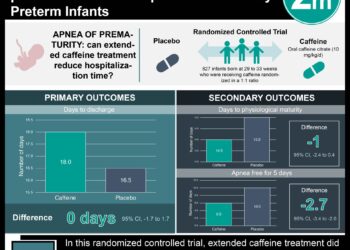
#VisualAbstract: Extended Caffeine Does Not Reduce Hospitalization Time for Apnea in Moderately Preterm Infants
StudyGraphics

#VisualAbstract: Extended Caffeine Does Not Reduce Hospitalization Time for Apnea in Moderately Preterm Infants

May 21, 2025
Next Post
Statin therapy does not prevent osteoporotic fractures [JUPITER trial]

Statin therapy does not prevent osteoporotic fractures [JUPITER trial]

Midlife diabetes associated with cognitive decline

Midlife diabetes associated with cognitive decline

2 Minute Medicine Rewind November 23 – November 30, 2014

2 Minute Medicine Rewind November 23 – November 30, 2014

2 Minute Medicine® is an award winning, physician-run, expert medical media company. Our content is curated, written and edited by practicing health professionals who have clinical and scientific expertise in their field of reporting. Our editorial management team is comprised of highly-trained MD physicians. Join numerous brands, companies, and hospitals who trust our licensed content.

Recent Reports

  • α-synuclein pathology is associated with faster tau accumulation in women
  • Higher ultra-processed food intake in young children is associated with adverse early behavioural outcomes
  • Lower preoperative serum calcium is associated with increased risk of postoperative complications in patients undergoing orthopedic surgery
License Content
Terms of Use | Disclaimer
Cookie Policy
Privacy Statement (EU)
Disclaimer

© 2025 2 Minute Medicine, Inc. - Physician-written medical news.

  • Specialties
    • All Specialties, All Recent Reports
    • Cardiology
    • Chronic Disease
    • Dermatology
    • Emergency
    • Endocrinology
    • Gastroenterology
    • Imaging and Intervention
    • Infectious Disease
    • Nephrology
    • Neurology
    • Obstetrics
    • Oncology
    • Ophthalmology
    • Pediatrics
    • Pharma
    • Preclinical
    • Psychiatry
    • Public Health
    • Pulmonology
    • Rheumatology
    • Surgery
  • Tools
    • EvidencePulse™
    • RVU Search
    • NPI Registry Lookup
  • Pharma
  • AI News
  • The Scan
  • Classics™
    • 2MM+ Online Access
    • Paperback and Ebook
  • Rewinds
  • Partners
    • License Content
    • Submit Press Release
    • Advertise with Us
  • Account
    • Subscribe
    • Sign-in
    • My account
No Result
View All Result

© 2025 2 Minute Medicine, Inc. - Physician-written medical news.