

Patient Basics: Foot Sprain
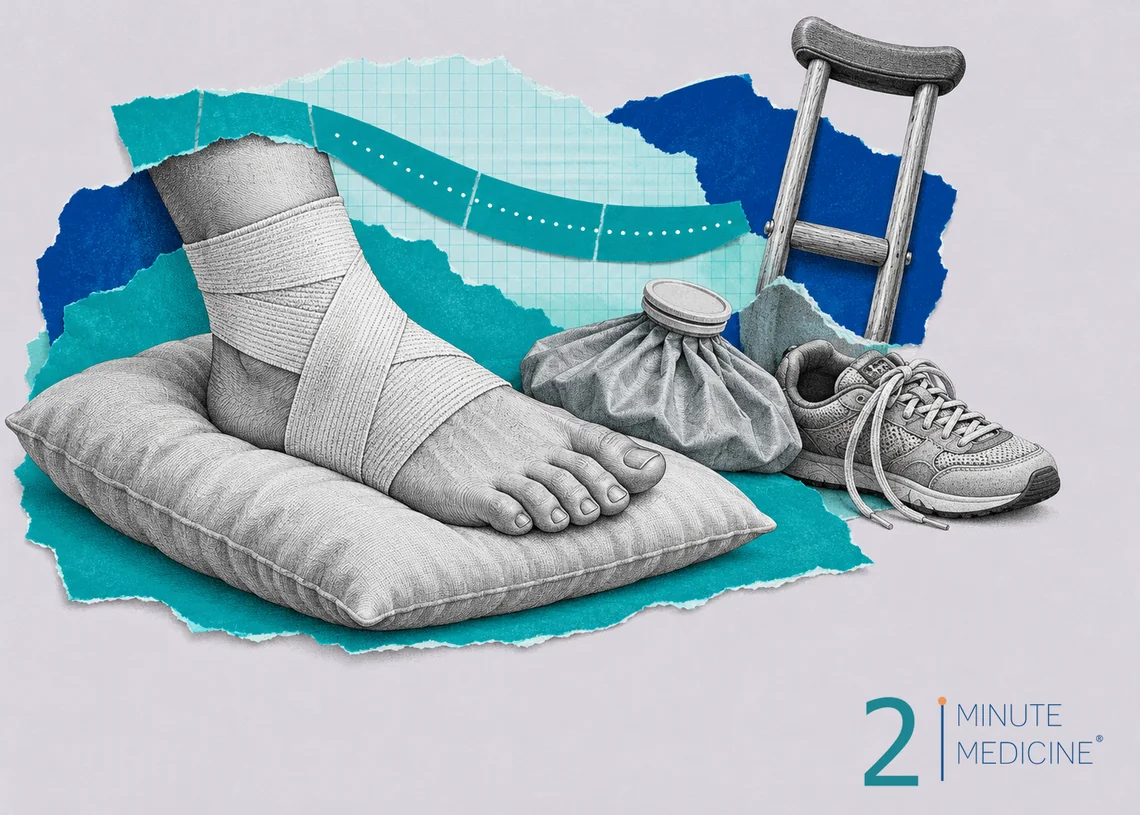
When you sprain your foot, you stretch or tear one or more of its ligaments, the tough bands that hold bones together at a joint. A midfoot sprain, in the middle of the foot where the arch meets the long toe bones, is easy to miss. Most foot sprains heal with rest, ice and support, but a bad midfoot sprain (a Lisfranc injury) can need a cast or surgery. Get your foot checked if you can’t walk on it.
Key points
- Foot sprains usually happen when the foot twists, bends too far or takes a heavy blow.
- Pain, swelling and bruising are common. Bruising on the bottom of the arch is a warning sign of a midfoot injury.
- X-rays rule out a broken bone. Some injuries need X-rays taken while you stand.
- Mild sprains often feel better in 2 to 4 weeks. Serious midfoot sprains can take months.
- See a doctor if you can’t take four steps, or the pain isn’t easing after a few days.
Types of foot sprain
Midfoot sprain (Lisfranc injury)
The midfoot is the middle of the foot, where the small bones of the arch meet the five long bones that lead to the toes (the metatarsals). A midfoot sprain stretches or tears the ligaments that hold these joints together, so it is sometimes called a metatarsal sprain. It can happen when you twist on a foot pointed downward, for example missing a step, when someone lands on your heel, or when something heavy falls on the foot. It is common in football and other field sports, and in car crashes.
Turf toe and forefoot sprains
Turf toe is a sprain of the big toe joint from bending the toe too far upward while pushing off. It’s common in sports played on artificial turf, and in dancers. The smaller toe joints can be sprained by stubbing or jamming them.
Pain on the outer side of the foot after rolling it is often an ankle sprain or a break near the back end of the fifth metatarsal, the long bone that leads to the little toe. X-rays can tell these apart, and your doctor will check the ankle too.
How bad is it?
Doctors grade sprains, including midfoot sprains, by how much damage there is:
- Grade 1: the ligament is stretched, with mild pain and swelling.
- Grade 2: the ligament is partly torn. Walking hurts and there is more swelling and bruising.
- Grade 3: the ligament is torn through, and the joint may be loose or out of line. Standing on the foot is very hard.
Symptoms
- Pain that gets worse when you stand, walk or push off
- Swelling on the top of the foot or around a toe
- Bruising, sometimes on the sole of the foot
- Stiffness, or trouble moving the big toe
- A feeling that the foot is weak or unstable
How it’s diagnosed
Your doctor will ask how you got hurt and press on different parts of the foot and ankle to find the sore spot. They will check the pulses and feeling in your foot.
- X-rays are taken if you can’t put weight on the foot, or if certain bones are tender. For a possible Lisfranc injury, X-rays are often taken while you stand, which can show a small gap between bones that is hidden when lying down.
- CT or MRI scans can show small breaks or ligament tears that X-rays miss.
Treatment
First few days
- Protect and rest. Limit walking. Use crutches if putting weight on the foot hurts.
- Ice. Apply a cold pack wrapped in a thin towel for 15 to 20 minutes every few hours.
- Compression. An elastic bandage can control swelling. Loosen it if your toes tingle, go numb or turn pale.
- Raise the foot above the level of your heart when sitting or lying down.
- Pain relief. Acetaminophen, ibuprofen or naproxen can help. Ask your doctor if you have stomach, kidney or heart problems.
Support while it heals
Depending on the injury, you may wear a stiff-soled shoe, a walking boot, or a cast. Turf toe is often treated with taping or a stiff shoe insert that keeps the big toe from bending. A Lisfranc sprain usually means several weeks in a boot or cast without putting weight on the foot.
Surgery
Surgery is needed when the bones of the midfoot have shifted out of place, or a ligament is completely torn. The surgeon holds the bones in line with screws or plates, or sometimes fuses joints together. Severe turf toe injuries sometimes need repair as well.
Getting moving again
As pain eases, gentle exercises restore movement, strength and balance. A physical therapist can guide you. Go back to running or sports only when you can walk, hop and push off without pain. Going back too early raises the risk of a second injury and long-term pain.
Recovery time
- Mild toe and forefoot sprains: about 2 to 4 weeks
- Grade 1 (mild) midfoot sprains: often about 4 to 6 weeks
- Grade 2 midfoot sprains and turf toe: often 6 to 8 weeks or longer, with several weeks in a boot
- Grade 3 midfoot injuries: usually surgery, and several months to a year before full activity
Some people have stiffness or arthritis in the injured joint years later, especially after midfoot injuries.
Lowering your risk
- Wear shoes that fit and support your foot for the sport or task.
- Warm up before exercise and build up training slowly.
- Keep stairs well lit and floors clear of clutter.
- Wear steel-toed boots if heavy objects could fall on your feet at work.
- Do balance and foot-strengthening exercises after a sprain.
When to see a doctor
- You can’t take four steps on the foot
- Bruising on the bottom of the foot
- The foot looks misshapen
- Pain and swelling aren’t improving after 3 to 5 days of home care
- You have diabetes or nerve damage in your feet
Get emergency care if the foot is cold, pale, blue or numb, if a bone is showing, or if pain is severe and getting worse in a tight, swollen foot.
Common questions about midfoot sprains and other foot sprains
How do I know if my foot is sprained or broken?
You often can’t tell without an X-ray. A break is more likely if you can’t take four steps, if pressing on certain bones causes sharp pain, or if the foot looks misshapen. Both cause pain, swelling and bruising, so get it checked if you aren’t sure.
Is ice or heat better for a sprained foot?
Use ice for the first 2 or 3 days to ease pain and swelling. After that, warmth can loosen stiff joints before stretching or exercise. Avoid heat while the foot is still very swollen, since it can make the swelling worse.
Can you walk on a midfoot sprain?
Sometimes, with a mild sprain that doesn’t hurt much. Many midfoot sprains need several weeks in a boot or cast with little or no weight on the foot, because walking too soon can let the bones drift apart. Use crutches and see a doctor if walking causes sharp pain or a limp.
Questions to ask your doctor
- Which ligament is hurt, and how badly?
- Do I need X-rays while standing, or another scan?
- How much weight can I put on my foot, and for how long?
- Do I need a boot, a cast or surgery?
- When can I go back to work or sports?
Learn more
- Sprains and strains (MedlinePlus, U.S. National Library of Medicine)
This guide is general information and doesn’t replace advice from your own doctor. Last updated October 2026.






 Get the app