
• About
  • Masthead
  • License Content
  • Advertise
  • Press Releases
  • Newsroom
  • RSS/Email List
  • 2MM Podcast
  • Write for us
  • Contact Us
2 Minute Medicine
No Result
View All Result

No products in the cart.

Sign in
SUBSCRIBE
  • About
  • Specialties
    • All Specialties, All Recent Reports
    • Cardiology
    • Chronic Disease
    • Dermatology
    • Emergency
    • Endocrinology
    • Gastroenterology
    • Imaging and Intervention
    • Infectious Disease
    • Nephrology
    • Neurology
    • Obstetrics
    • Oncology
    • Ophthalmology
    • Pediatrics
    • Pharma
    • Preclinical
    • Psychiatry
    • Public Health
    • Pulmonology
    • Rheumatology
    • Surgery
    • Rewinds
    • The Scan
  • EvidencePulse™
  • HypeCheck™
  • AI News
  • Classics™
    • 2MM+ Online Access
    • Paperback and Ebook
  • Tools
    • NPI Registry Lookup
    • RVU Search
    • Physician Pay by Specialty
    • ICD-10 Code Lookup
    • FDA Drug Approvals
    • Drug Safety for Breastfeeding/Pregnancy
    • Clinical Guidelines
    • Medical Calculators
    • ECG Reference
      • QTc Calculator
      • Sgarbossa Criteria
      • ECG Axis Calculator
      • AV Block Helper
  • Rankings
    • Medical School Rankings
    • Residency Rankings
  • Partners
    • License Content
    • Advertise with Us
2 Minute Medicine
  • About
  • Specialties
    • All Specialties, All Recent Reports
    • Cardiology
    • Chronic Disease
    • Dermatology
    • Emergency
    • Endocrinology
    • Gastroenterology
    • Imaging and Intervention
    • Infectious Disease
    • Nephrology
    • Neurology
    • Obstetrics
    • Oncology
    • Ophthalmology
    • Pediatrics
    • Pharma
    • Preclinical
    • Psychiatry
    • Public Health
    • Pulmonology
    • Rheumatology
    • Surgery
    • Rewinds
    • The Scan
  • EvidencePulse™
  • HypeCheck™
  • AI News
  • Classics™
    • 2MM+ Online Access
    • Paperback and Ebook
  • Tools
    • NPI Registry Lookup
    • RVU Search
    • Physician Pay by Specialty
    • ICD-10 Code Lookup
    • FDA Drug Approvals
    • Drug Safety for Breastfeeding/Pregnancy
    • Clinical Guidelines
    • Medical Calculators
    • ECG Reference
      • QTc Calculator
      • Sgarbossa Criteria
      • ECG Axis Calculator
      • AV Block Helper
  • Rankings
    • Medical School Rankings
    • Residency Rankings
  • Partners
    • License Content
    • Advertise with Us
Sign in
SUBSCRIBE
2 Minute Medicine
Sign in
Subscribe
2 Minute MedicineFree on Google PlayGet
✦EvidencePulse™by 2 Minute Medicine3 reportsYou askedtop stroke trials 2026Synthesizing medical evidence...Top 2026 stroke trial results:OCEANIC — ischemic stroke: 6.2% vs 8.4%OPTION* — mRS 0–1: 43.6% vs 34.2%ORIENTAL* — mRS 0–2: 58.6% vs 46.6%*Higher sICH in intervention armsParticipants randomizedNOCEANIC12,327OPTION570ORIENTAL564Ask about guidelines or landmark trials...↑Try EvidencePulse™Ask the evidence. Get the signal.Try it now →
Home Health A to Z

Patient Basics: Gallbladder and Bile Duct Cancer
by2 Minute Medicine
October 30, 2026
in Health A to Z, Uncategorized
Reading Time: 6 mins read
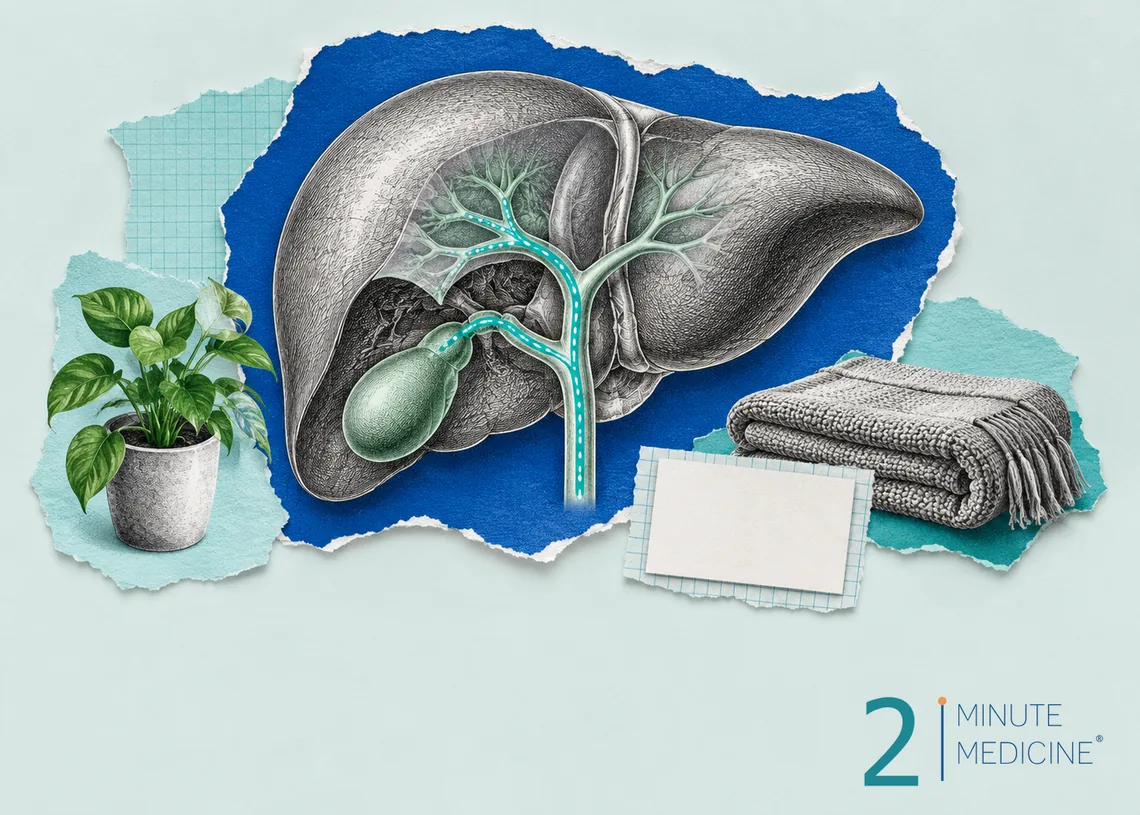
Bile duct cancer collage of an engraved liver, gallbladder and bile ducts, a teal ribbon, a potted plant and a knit blanket
Share on FacebookShare on TwitterShare on LinkedIn

Gallbladder cancer and bile duct cancer (cholangiocarcinoma) start in the organs that store and carry bile, a fluid the liver makes to help digest fat. Both are uncommon in the US. They often cause no symptoms early on, and the first sign is often yellowing of the skin and eyes (jaundice). Surgery gives the best chance of a cure when the cancer is found early, and newer drug treatments help many people when it can’t be removed.

Key points

  • Jaundice, itching, dark urine, pale stools, belly pain and weight loss are the main symptoms.
  • Gallstones, long-term swelling of the bile ducts and some liver diseases raise the risk.
  • Some gallbladder cancers are found by chance after the gallbladder is removed for gallstones.
  • Tumors should be tested for gene changes, because several targeted medicines now exist.
  • A small tube (stent) placed in a blocked bile duct can quickly ease jaundice and itching.

Where these cancers start

The liver makes bile all day. Tiny ducts inside the liver carry it to larger ducts that join just outside the liver. The gallbladder, a small pear-shaped pouch under the liver, stores bile between meals and squeezes it out after you eat. The common bile duct then carries bile to the small intestine.

  • Gallbladder cancer starts in the inner lining of the gallbladder.
  • Bile duct cancer can start in the ducts inside the liver (intrahepatic), where the ducts leave the liver (perihilar, the most common spot, also called a Klatskin tumor), or in the lower duct near the small intestine (distal).

Who is at higher risk

  • Gallstones, especially large ones present for many years
  • Primary sclerosing cholangitis, a long-term disease that scars the bile ducts and is often linked to ulcerative colitis
  • Bile duct cysts present from birth
  • Cirrhosis, and long-term hepatitis B or C
  • Gallbladder polyps larger than about 1 centimeter, or a gallbladder wall hardened by calcium
  • Obesity, diabetes, smoking and heavy drinking
  • Liver fluke infections from raw or undercooked freshwater fish, common in parts of Southeast Asia. These are treated with a medicine called praziquantel.
  • Older age. Gallbladder cancer is more common in women and in people of Native American or Latin American heritage.

Most people with these risk factors never get cancer.

Symptoms of gallbladder and bile duct cancer

  • Yellow skin and yellow whites of the eyes
  • Itching all over
  • Dark, tea-colored urine and pale, greasy or clay-colored stools
  • Pain in the upper right belly
  • Loss of appetite, nausea and weight loss you can’t explain
  • Fever, which can mean a blocked duct has become infected

These symptoms are much more often caused by gallstones or liver problems than by cancer, but they always need a check.

How it’s diagnosed

  • Blood tests check the liver and bilirubin, the substance that turns skin yellow. Markers called CA 19-9 and CEA may be high, but they can’t diagnose cancer on their own.
  • Imaging. An ultrasound is often first. A CT scan and an MRI of the bile ducts (MRCP) show the tumor and whether it has spread.
  • ERCP. A thin, flexible scope goes through the mouth into the small intestine, and dye is put into the bile ducts. The doctor can take cell samples and place a stent at the same time.
  • Endoscopic ultrasound or a needle biopsy may be used to get tissue.
  • Tumor gene testing looks for changes, such as in the FGFR2, IDH1 or HER2 genes, that specific medicines can target.

The stage of the cancer depends on its size, whether it has reached nearby blood vessels, lymph nodes or the liver, and whether it has spread farther. A key question is whether surgery can remove all of it.

Treatment

Care works best at a center with a team that treats many people with these cancers, including surgeons, cancer doctors and specialists in bile duct procedures.

RELATED REPORTS

Segment 4b/5 resection offers no survival advantage over wedge resection in gallbladder cancer

Surgery

  • For gallbladder cancer, surgery removes the gallbladder along with part of the nearby liver and lymph nodes. If cancer was found after a routine gallbladder removal, a second operation is often needed.
  • For bile duct cancer, the surgeon removes the affected ducts and often part of the liver. Cancer near the small intestine may need a Whipple procedure, which also removes part of the pancreas and small intestine.
  • A liver transplant is an option for a small group of people with early perihilar cancer at a few specialized centers.
  • Chemotherapy pills (capecitabine) after surgery lower the chance that the cancer comes back.

When surgery isn’t possible

  • Chemotherapy with immunotherapy. The usual first treatment combines gemcitabine and cisplatin with an immune-boosting drug, durvalumab or pembrolizumab.
  • Targeted medicines are used when the tumor has a matching gene change.
  • Radiation, and for tumors in the liver, treatments that deliver radiation beads or chemotherapy directly into the tumor’s blood supply.
  • Clinical trials of new treatments are open to many people with these cancers.

Easing symptoms

A stent placed during ERCP, or a drain placed through the skin into the liver, lets bile flow again. This clears jaundice and itching and lowers the risk of infection. Pain medicine, nutrition support and a palliative care team can help at any stage, alongside cancer treatment.

Living with it

How well treatment works depends on the type and stage of the cancer. Cancer that is found early and fully removed can be cured. When it can’t be removed, treatment can slow it, ease symptoms and help people live longer. A social worker, counselor or support group can help you and your family cope.

Lowering your risk

  • Keep a healthy weight, don’t smoke and limit alcohol.
  • Get the hepatitis B vaccine, and get tested and treated for hepatitis C.
  • If you have primary sclerosing cholangitis, follow your plan for regular checks.
  • Ask your doctor whether large gallbladder polyps should be removed.
  • Cook freshwater fish thoroughly.

When to see a doctor

  • Yellow skin or eyes
  • Dark urine, pale stools or itching all over
  • Pain in the upper right belly that doesn’t go away
  • Weight loss you can’t explain

Get emergency care for fever and chills along with yellow skin or belly pain. This can mean a serious bile duct infection.

Common questions about gallbladder and bile duct cancer

What else can block a bile duct?

Gallstones that slip into the common bile duct are the most common cause of a blocked bile duct. Others include scarring or narrowing of a duct, swelling of the pancreas, cysts, liver flukes and tumors of the pancreas. Any blockage can cause jaundice, so the cause always needs to be found.

What does a dilated bile duct mean?

A dilated, or enlarged, bile duct on a scan often means something downstream is slowing the flow of bile, such as a stone, a narrowing or a growth. A slightly wide duct can be harmless in older adults or after gallbladder removal. If an MRCP scan finds no cause and liver tests are normal, it may only need watching.

Is yellow skin always a sign of cancer?

No. Jaundice in adults most often comes from hepatitis, gallstones blocking a duct, alcohol-related liver disease, or Gilbert syndrome, a harmless condition that runs in families. In newborns it is common and usually mild. Still, yellow skin or eyes in an adult always needs a prompt check to find the cause.

Questions to ask your doctor

  • Where exactly is the cancer, and what stage is it?
  • Can surgery remove it, and how many of these operations does this center do?
  • Has my tumor been tested for gene changes?
  • What can be done about jaundice and itching?
  • Is there a clinical trial that fits me?

Learn more

  • Gallbladder cancer (National Cancer Institute)
  • Bile duct cancer (cholangiocarcinoma) (National Cancer Institute)

This guide is general information and doesn’t replace advice from your own doctor. Last updated October 2026.
Tags: Gallbladder and Bile Duct Cancer
Previous Post

Patient Basics: Foot Sprain

Next Post

Patient Basics: Farsightedness (Hyperopia)

RelatedReports

Bile duct cancer collage of an engraved liver, gallbladder and bile ducts, a teal ribbon, a potted plant and a knit blanket
Chronic Disease

Segment 4b/5 resection offers no survival advantage over wedge resection in gallbladder cancer

April 22, 2026
Next Post
Farsightedness collage: an eyeball drawing with light focusing behind the retina, plus-lens glasses and a blank open book

Patient Basics: Farsightedness (Hyperopia)

Female infertility collage: an engraved drawing of the uterus, tubes and ovaries, an hourglass, two mugs and a seedling

Patient Basics: Female Infertility

Esophagitis collage: an engraved esophagus and stomach, a single tablet, a tall glass of water and a wedge pillow

Patient Basics: Esophagitis

✦ EvidencePulse™ by 2 Minute Medicine 3 reports You asked top stroke trials 2026 Synthesizing medical evidence... Top 2026 stroke trial results: OCEANIC — ischemic stroke: 6.2% vs 8.4% OPTION* — mRS 0–1: 43.6% vs 34.2% ORIENTAL* — mRS 0–2: 58.6% vs 46.6% *Higher sICH in intervention arms Participants randomizedN OCEANIC 12,327 OPTION 570 ORIENTAL 564 Ask about guidelines or landmark trials... Try EvidencePulse™ Get the signal. Try it now → Physician-trained medical AI by 2 Minute Medicine

2MM+ All Access

Full details →
$4.99 /month

3-day free trial · cancel anytime

  • ✓100+ physician-written reports
  • ✓EvidencePulse™ + HypeCheck™
  • ✓Ad-free reading + newsletters
Start 3-day free trial

Then $4.99/month. Manage renewal in your account.

2 Minute Medicine® is an award winning, physician-run, expert medical media company. Our content is curated, written and edited by practicing health professionals who have clinical and scientific expertise in their field of reporting. Our editorial management team is comprised of highly-trained MD physicians. Join numerous brands, companies, and hospitals who trust our licensed content.

Recent Reports

  • Pelacarsen lowers lipoprotein(a) but does not reduce major cardiovascular events in patients with established cardiovascular disease
  • Durvalumab plus enfortumab vedotin was approved for perioperative treatment of muscle-invasive bladder cancer
  • CDC reports 5,412 confirmed measles cases in the United States in 2026
License Content
Terms of Use | Disclaimer
Cookie Policy

Get the app

Read 2 Minute Medicine on iPhone, iPad and Android.

Download on the App StoreGet it on Google Play
QR code for www.2minutemedicine.com/app
On a computer? Scan this with your phone’s camera.
2MM+ All Access Full details →

The medical literature, distilled daily.

Monthly plan selected: $4.99 /month.

$4.99/month

3-day free trial · cancel anytime

Start 3-day free trial

Then $4.99/month. Manage renewal in your account.

Yearly plan selected: $49.90 /year.

$49.90/year

2 months free

Start 3-day free trial

Then $49.90/year.

Membership benefits

  • ✓100+ new physician-written study summaries monthly, 12,000+ searchable
  • ✓AI EvidencePulse™ + HypeCheck™
  • ✓Ad-free reading + newsletters
  • ✓FDA drug approvals + clinical calculators

Already a member? Sign in

  • Get the app
  • About
  • Specialties
    • All Specialties, All Recent Reports
    • Cardiology
    • Chronic Disease
    • Dermatology
    • Emergency
    • Endocrinology
    • Gastroenterology
    • Imaging and Intervention
    • Infectious Disease
    • Nephrology
    • Neurology
    • Obstetrics
    • Oncology
    • Ophthalmology
    • Pediatrics
    • Pharma
    • Preclinical
    • Psychiatry
    • Public Health
    • Pulmonology
    • Rheumatology
    • Surgery
    • Rewinds
    • The Scan
  • EvidencePulse™
  • HypeCheck™
  • AI News
  • Classics™
    • 2MM+ Online Access
    • Paperback and Ebook
  • Tools
    • NPI Registry Lookup
    • RVU Search
    • Physician Pay by Specialty
    • ICD-10 Code Lookup
    • FDA Drug Approvals
    • Drug Safety for Breastfeeding/Pregnancy
    • Clinical Guidelines
    • Medical Calculators
    • ECG Reference
      • QTc Calculator
      • Sgarbossa Criteria
      • ECG Axis Calculator
      • AV Block Helper
  • Rankings
    • Medical School Rankings
    • Residency Rankings
  • Partners
    • License Content
    • Advertise with Us
No Result
View All Result

© 2026 2 Minute Medicine, Inc. - Physician-written medical news.


