

Patient Basics: Hernia
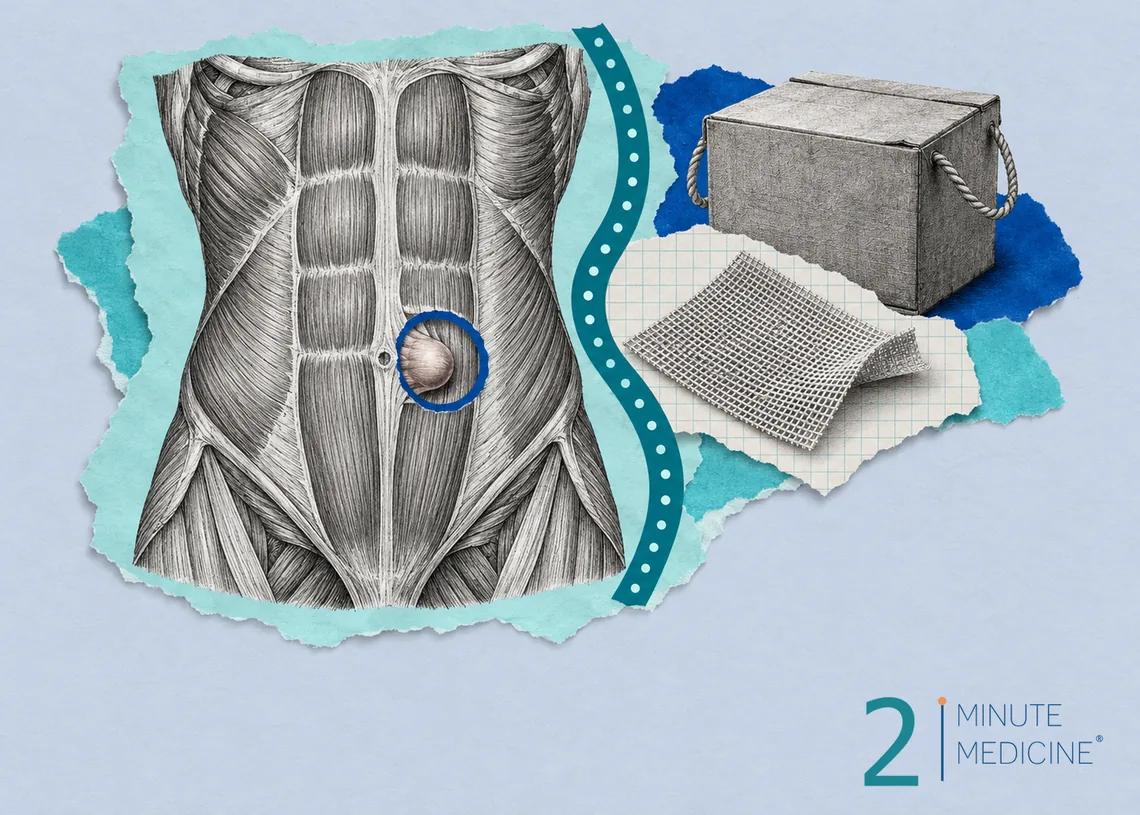
A hernia happens when part of an organ or fatty tissue pushes through a weak spot in the muscle wall that should hold it in. Most hernias form in the belly wall or groin and show up as a soft bulge. In adults they don’t go away on their own. A bulge that becomes stuck, hard and very painful is an emergency.
Key points
- Common types are in the groin (inguinal), at the belly button (umbilical), at an old surgical scar (incisional) and at the top of the thigh (femoral).
- A typical hernia bulge grows when you stand, cough or strain and shrinks when you lie down.
- Small hernias with mild symptoms can sometimes be watched. Many people end up having surgery.
- Repair is often done through small cuts, and most people go home the same day.
- Get emergency care if a bulge turns painful, firm or dark and won’t go back in, especially with vomiting.
Types of hernia
- Inguinal hernia. This forms in the groin and is the most common type. It’s far more common in men. At least 1 in 4 men get one at some point in life, compared with only a few women in 100. In men, the bulge can reach into the scrotum.
- Femoral hernia. This forms just below the groin crease, at the top of the thigh. It’s more common in women and more likely to get stuck, so it’s usually repaired.
- Umbilical hernia. This forms at the belly button. It’s common in babies and usually closes on its own by age 4 or 5. In adults it’s linked to extra weight, pregnancy and fluid buildup in the belly.
- Incisional hernia. This pushes through the scar from an earlier belly operation.
- Epigastric hernia. A small bulge forms in the midline between the breastbone and the belly button.
- Hiatal hernia. Part of the stomach slides up through the diaphragm into the chest, next to the esophagus (food pipe). There’s no bulge you can see or feel, but it can cause heartburn.
What causes a hernia
Some people are born with a weak spot. Others develop one as tissue weakens with age or strain. Things that raise the risk include:
- Heavy lifting
- A long-lasting cough, such as from smoking or COPD
- Straining on the toilet because of constipation, or to pass urine because of an enlarged prostate
- Extra body weight
- Pregnancy
- Past belly surgery
- A family history of hernias
- Smoking, which weakens tissue
Hernia symptoms
- A bulge that stands out more when you stand, cough or lift, and may disappear when you lie down
- An ache, heaviness, burning or dragging feeling at the bulge, often worse by evening
- In babies, a bulge at the belly button or groin that shows when they cry
Some hernias cause no symptoms at all and are found during a checkup.
When a hernia becomes an emergency
A loop of intestine or fat can get trapped in the opening (incarcerated). If its blood supply is cut off (strangulated), the trapped tissue can die within hours. Go to an emergency department or call 911 if you have:
- Sudden or severe pain at the bulge
- A bulge that becomes hard and tender and can’t be pushed back in
- Skin over the bulge that turns red, purple or dark
- Nausea, vomiting or fever
- No gas or bowel movements
How it’s diagnosed
A doctor can usually find a hernia by looking and feeling while you stand and cough. If the bulge is hard to feel or the cause of pain is unclear, an ultrasound, CT scan or MRI can help.
Treatment
Watchful waiting
For men with a small groin hernia that causes little or no discomfort, waiting is a safe choice. Many eventually choose surgery as symptoms grow. Femoral hernias are usually fixed soon because they’re more likely to get stuck. A supportive belt (truss) may ease discomfort but doesn’t fix the hernia, so ask a doctor before using one.
Surgery
The surgeon pushes the tissue back into place and closes the weak spot, usually reinforcing it with a piece of mesh, a flexible screen that the body’s own tissue grows into.
- Open repair uses one cut over the hernia.
- Laparoscopic or robotic repair uses a few small cuts and a camera. It may mean less pain and a quicker return to activity, and it works well for hernias on both sides or hernias that have come back.
Small umbilical hernias may be closed with stitches alone. In babies, umbilical hernias are usually watched, while groin hernias are repaired soon because they can get stuck.
Recovery
- Walk around the same day.
- Most people return to desk work within a week or two and to full activity within a few weeks.
- Avoid heavy lifting for as long as your surgeon advises.
- Take pain medicine as directed, and use a stool softener so you don’t strain.
Possible problems include infection, bleeding, trouble urinating right after surgery, groin pain that lingers, and the hernia coming back. Problems with the mesh are uncommon.
Lowering your risk
- Keep a healthy weight.
- Don’t smoke.
- Get treatment for a lasting cough, constipation or trouble urinating.
- Lift with your legs, and get help with heavy objects.
- After belly surgery, follow your surgeon’s lifting limits.
Common questions about hernia
What is a hernia in the stomach?
People use the phrase for two different things. A bulge in the belly wall, such as at the belly button, along the midline or at an old scar, is often called a stomach hernia. In a hiatal hernia, the stomach itself slides up into the chest and causes heartburn rather than a bulge.
How big can a hernia get?
Hernias range from smaller than a grape to larger than a grapefruit. Most grow slowly over months or years, and a large groin hernia can reach into the scrotum. Size doesn’t tell you how dangerous it is, because a hernia with a small, tight opening can trap tissue more easily than a wide one.
Can you have a hernia and not know it?
Yes. Small hernias often cause no pain and may show only as a slight bulge when you stand or cough, and hiatal hernias make no bulge at all. Many are found at a checkup or on a scan done for something else. Even a mild hernia tends to grow, so have it checked.
What is a fat hernia?
It’s a hernia that holds only fatty tissue, not intestine. Many small belly button and epigastric hernias contain just a plug of fat from inside the belly. They can still ache and get stuck, so doctors treat them like other hernias.
Can women get hernias?
Yes. Women often get belly button, incisional and femoral hernias, and pregnancy raises the risk. Groin hernias are less common in women and are often small, causing pain without an obvious bulge, so an ultrasound or MRI may be needed to find one.
Questions to ask your doctor
- What type of hernia do I have?
- Is it safe to wait, or should I have surgery?
- Would you use open or laparoscopic surgery, and will you use mesh?
- How long until I can lift, exercise and work?
- How likely is the hernia to come back?
Learn more
- Hernia (MedlinePlus, U.S. National Library of Medicine)
- Inguinal hernia (National Institute of Diabetes and Digestive and Kidney Diseases)
This guide is general information and doesn’t replace advice from your own doctor. Last updated October 2026.
RelatedReports







 Get the app