

Patient Basics: Pancreatic Cancer
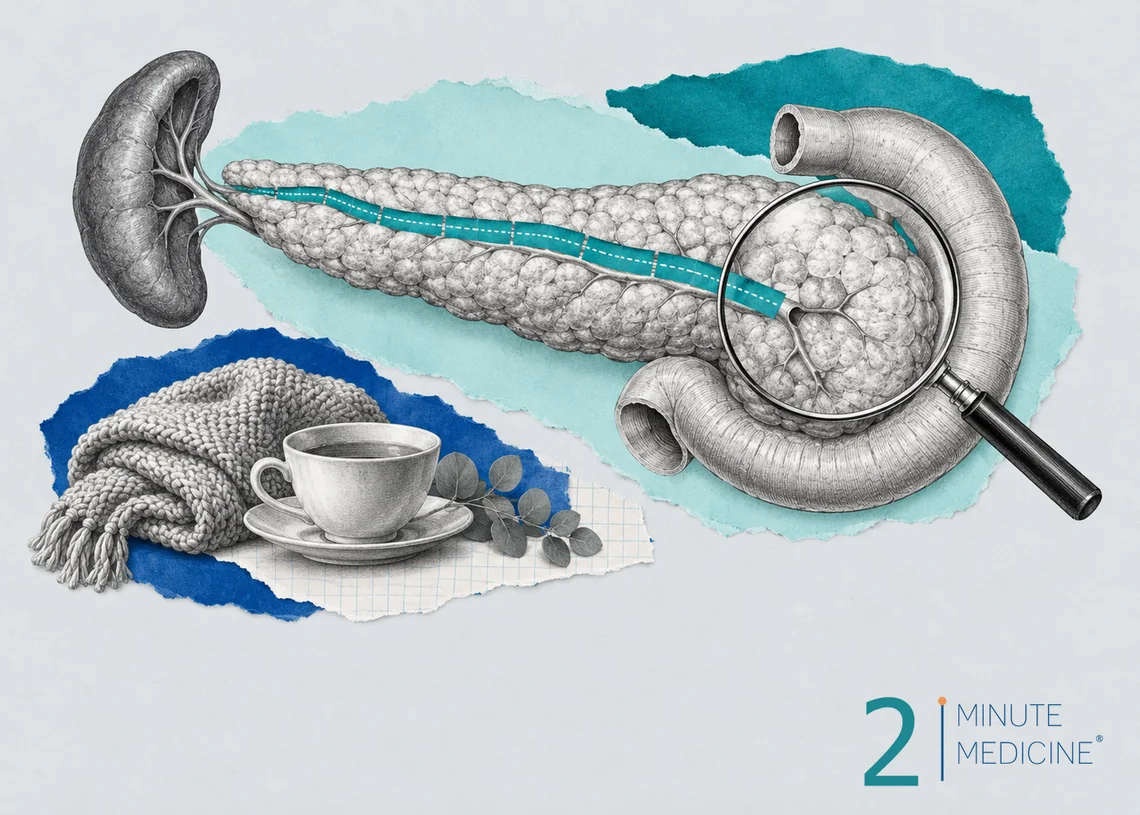
Pancreatic cancer starts in the pancreas, a gland that sits deep in the upper belly behind the stomach. It often causes few symptoms until it has grown or spread, which makes it one of the hardest cancers to treat. Yellow skin or eyes, belly pain that spreads to the back, and weight loss you can’t explain are warning signs that need a prompt visit to a doctor.
Key points
- Most pancreatic cancers are adenocarcinomas, which start in the cells lining the gland’s ducts.
- Smoking, obesity, long-standing diabetes, chronic pancreatitis and inherited gene changes raise the risk.
- Early signs are vague. Jaundice (yellowing) is often the first clear one.
- Surgery offers the best chance of a cure, but only about 1 in 5 people can have it when the cancer is found.
- Everyone with pancreatic cancer should be offered genetic testing.
Where the pancreas is
The pancreas is about 6 inches long and shaped a bit like a tadpole lying on its side. Its wide head sits in the middle of the upper belly, tucked into the curve of the small intestine. Its body and thin tail stretch across to the left, behind the stomach, ending near the spleen.
The pancreas has two jobs. It makes digestive juices that flow into the intestine to break down food, and it makes hormones such as insulin that control blood sugar.
What organs are on the left side of your body?
In the upper left belly, under the ribs, are the stomach, the spleen, the tail of the pancreas, the left kidney and a bend of the large intestine (colon). Lower on the left are the descending and S-shaped (sigmoid) parts of the colon and, in women, the left ovary. Above the diaphragm, the left lung and most of the heart sit on the left side of the chest.
Pancreatic cancer symptoms
- Jaundice: yellow skin and eyes, dark urine, pale or clay-colored stools and itchy skin. A tumor in the head of the pancreas can block the bile duct and cause this.
- Belly or back pain: a dull ache in the upper belly that spreads to the middle of the back. It may be worse lying down or after eating.
- Weight loss and poor appetite, or feeling full after a few bites
- Greasy, floating, foul-smelling stools, because the pancreas isn’t making enough digestive juice
- New diabetes after age 50, especially with weight loss
- Nausea, tiredness or a blood clot in a leg or lung
Cancers in the body or tail of the pancreas, on the left side, tend to cause symptoms later than those in the head.
Left side abdominal pain: is it your pancreas?
Usually not. Left-side belly pain is far more often caused by gas, constipation, gastritis, a kidney stone, a muscle strain, or diverticulitis (inflamed pouches in the colon, usually in the lower left). See a doctor for left-side pain that is severe, lasts more than a few days, or comes with fever, vomiting, yellow skin or weight loss.
What causes pancreatic cancer
Cancer starts when changes in a cell’s genes make it grow out of control. Doctors can’t say why one person gets pancreatic cancer and another doesn’t, but these raise the risk:
- Smoking, the biggest risk you can change
- Older age. Most people are over 65 when it’s found.
- Obesity and type 2 diabetes
- Chronic pancreatitis, often from heavy drinking or inherited conditions
- Family history, with two or more close relatives who had pancreatic cancer
- Inherited gene changes, such as BRCA1, BRCA2, PALB2 and those that cause Lynch syndrome
- Some pancreatic cysts, which doctors may watch with regular scans
How it’s diagnosed
- CT scan with contrast dye, set up to look closely at the pancreas. It shows the tumor, nearby blood vessels and any spread.
- MRI, which can give a clearer view of the bile ducts and liver
- Endoscopic ultrasound. A thin, flexible tube with an ultrasound probe goes down the throat into the stomach. The doctor can take a sample (biopsy) with a fine needle.
- Blood tests, including liver tests and a tumor marker called CA 19-9. The marker helps track treatment but is not used to screen healthy people.
- ERCP, a scope test that can place a small tube (stent) to open a blocked bile duct and clear jaundice
Doctors group the cancer by whether it can be removed. It may be resectable (removable), borderline, locally advanced (wrapped around major blood vessels), or metastatic (spread to the liver, lungs or belly lining).
How pancreatic cancer is treated
Surgery
For cancers in the head of the pancreas, the usual operation is a Whipple procedure (pancreaticoduodenectomy). The surgeon removes the head of the pancreas, part of the small intestine, the gallbladder and part of the bile duct, then reconnects the rest. Cancers in the tail are removed with a distal pancreatectomy, often along with the spleen. Results are best at hospitals that do many of these operations.
Chemotherapy and radiation
Most people have chemotherapy before or after surgery, or both. Common combinations are FOLFIRINOX (or the related NALIRIFOX) and gemcitabine with nab-paclitaxel. Chemotherapy is also the main treatment when the cancer can’t be removed. Radiation may be added to control the tumor or ease pain.
Targeted treatment and trials
Tumor and gene testing guide some choices. People with inherited BRCA changes may take olaparib, and a small number with certain tumor changes can have immunotherapy. Many new drugs, including ones aimed at the KRAS gene, are being tested in clinical trials. Ask whether a trial fits you.
Comfort and nutrition
Palliative care (care focused on symptoms and quality of life) helps at every stage, starting at diagnosis. It can include nerve blocks and medicines for pain, stents for blockages, and enzyme capsules taken with meals to help digest food. A dietitian can help you keep weight on.
Lowering your risk
- Don’t smoke, and get help to quit if you do.
- Keep a healthy weight and stay active.
- Limit alcohol.
- If pancreatic cancer runs in your family or you carry a risk gene, ask about genetic counseling. Some high-risk people have yearly MRI or endoscopic ultrasound at a specialist center.
When to see a doctor
- Yellow skin or eyes, dark urine or pale stools
- Belly pain that spreads to your back and keeps coming back
- Weight loss you can’t explain
- New diabetes after 50, especially with weight loss
- Ongoing greasy, floating stools
Common questions about pancreatic cancer
Is pancreatic cancer the fastest-killing cancer?
It is one of the deadliest. In the US, it is the third leading cause of cancer death, and only about 1 in 8 people are alive 5 years after diagnosis. When it is found before it spreads and can be removed, the outlook is much better, with about 4 in 10 people alive at 5 years.
Can pancreatic cancer be detected early?
Not easily. There is no quick home check or routine screening test for people at average risk, and CA 19-9 is not accurate enough for screening. People at high risk because of genes or family history can have regular MRI or endoscopic ultrasound, which can find small cancers.
What does pancreatic cancer pain feel like?
It is often a dull, gnawing ache in the upper middle belly that bores through to the back. It may get worse after eating or when lying flat, and ease when leaning forward. Pain like this has many other causes, but see a doctor if it lasts or comes with weight loss.
Is a pancreatic neuroendocrine tumor the same thing?
No. Neuroendocrine tumors start in the hormone-making cells of the pancreas, not the duct cells. They are much less common, usually grow more slowly and are treated differently. Many people live for years with them. Ask your doctor which type you have, since it changes the plan.
Questions to ask your doctor
- What type and stage of pancreatic cancer do I have?
- Can my tumor be removed with surgery?
- Should I have genetic testing, and should my family be tested?
- What are the goals and side effects of my treatment?
- Is there a clinical trial I could join?
Learn more
- Pancreatic cancer (National Cancer Institute)
- Pancreatic cancer (MedlinePlus, U.S. National Library of Medicine)
This guide is general information and doesn’t replace advice from your own doctor. Last updated October 2026.
RelatedReports







 Get the app