
• About
  • Masthead
  • License Content
  • Advertise
  • Press Releases
  • Newsroom
  • RSS/Email List
  • 2MM Podcast
  • Write for us
  • Contact Us
2 Minute Medicine
No Result
View All Result

No products in the cart.

Sign in
SUBSCRIBE
  • About
  • Specialties
    • All Specialties, All Recent Reports
    • Cardiology
    • Chronic Disease
    • Dermatology
    • Emergency
    • Endocrinology
    • Gastroenterology
    • Imaging and Intervention
    • Infectious Disease
    • Nephrology
    • Neurology
    • Obstetrics
    • Oncology
    • Ophthalmology
    • Pediatrics
    • Pharma
    • Preclinical
    • Psychiatry
    • Public Health
    • Pulmonology
    • Rheumatology
    • Surgery
    • Rewinds
    • The Scan
  • EvidencePulse™
  • HypeCheck™
  • AI News
  • Classics™
    • 2MM+ Online Access
    • Paperback and Ebook
  • Tools
    • NPI Registry Lookup
    • RVU Search
    • Physician Pay by Specialty
    • ICD-10 Code Lookup
    • FDA Drug Approvals
    • Drug Safety for Breastfeeding/Pregnancy
    • Clinical Guidelines
    • Medical Calculators
    • ECG Reference
      • QTc Calculator
      • Sgarbossa Criteria
      • ECG Axis Calculator
      • AV Block Helper
  • Rankings
    • Medical School Rankings
    • Residency Rankings
  • Partners
    • License Content
    • Advertise with Us
2 Minute Medicine
  • About
  • Specialties
    • All Specialties, All Recent Reports
    • Cardiology
    • Chronic Disease
    • Dermatology
    • Emergency
    • Endocrinology
    • Gastroenterology
    • Imaging and Intervention
    • Infectious Disease
    • Nephrology
    • Neurology
    • Obstetrics
    • Oncology
    • Ophthalmology
    • Pediatrics
    • Pharma
    • Preclinical
    • Psychiatry
    • Public Health
    • Pulmonology
    • Rheumatology
    • Surgery
    • Rewinds
    • The Scan
  • EvidencePulse™
  • HypeCheck™
  • AI News
  • Classics™
    • 2MM+ Online Access
    • Paperback and Ebook
  • Tools
    • NPI Registry Lookup
    • RVU Search
    • Physician Pay by Specialty
    • ICD-10 Code Lookup
    • FDA Drug Approvals
    • Drug Safety for Breastfeeding/Pregnancy
    • Clinical Guidelines
    • Medical Calculators
    • ECG Reference
      • QTc Calculator
      • Sgarbossa Criteria
      • ECG Axis Calculator
      • AV Block Helper
  • Rankings
    • Medical School Rankings
    • Residency Rankings
  • Partners
    • License Content
    • Advertise with Us
Sign in
SUBSCRIBE
2 Minute Medicine
Sign in
Subscribe
2 Minute MedicineFree on Google PlayGet
✦EvidencePulse™by 2 Minute Medicine3 reportsYou askedtop stroke trials 2026Synthesizing medical evidence...Top 2026 stroke trial results:OCEANIC — ischemic stroke: 6.2% vs 8.4%OPTION* — mRS 0–1: 43.6% vs 34.2%ORIENTAL* — mRS 0–2: 58.6% vs 46.6%*Higher sICH in intervention armsParticipants randomizedNOCEANIC12,327OPTION570ORIENTAL564Ask about guidelines or landmark trials...↑Try EvidencePulse™Ask the evidence. Get the signal.Try it now →
Home Health A to Z

Patient Basics: Sprain (Overview)
by2 Minute Medicine
October 30, 2026
in Health A to Z
Reading Time: 5 mins read
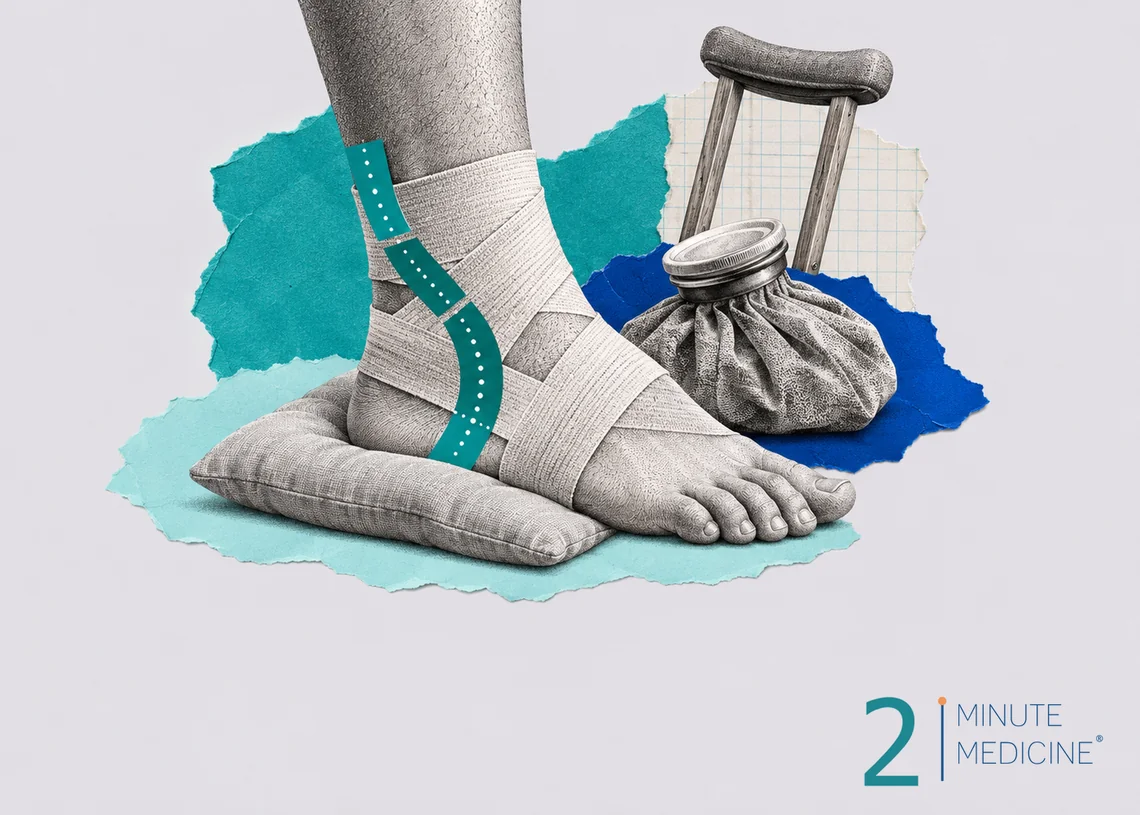
Sprain collage: an engraved ankle wrapped in an elastic bandage beside a cloth ice pack and the top of a wooden crutch
Share on FacebookShare on TwitterShare on LinkedIn

A sprain is a stretch or tear of a ligament, one of the tough bands that hold bones together at a joint. It usually happens when a joint is twisted or bent past its normal range, as when you roll your ankle on a curb. Most sprains heal well with rest, ice, support and then exercises to rebuild strength and balance.

Key points

  • Ankles are sprained most often, followed by wrists, knees and thumbs.
  • A sprain affects a ligament. A strain affects a muscle or tendon.
  • Pain, swelling, bruising and trouble using the joint are the main signs.
  • Most mild sprains heal in 1 to 3 weeks. Bad ones can take months.
  • Gentle movement and balance exercises, started early, help prevent the joint from giving way again.

What causes a sprain

Ligaments let joints move but stop them from moving too far. A sudden twist, fall or blow can push a joint beyond that limit and overstretch or tear the ligament. Common examples are:

  • Ankle: rolling the foot inward on uneven ground, a step or another player’s foot. This injures the ligaments on the outer side of the ankle.
  • Wrist: landing on an outstretched hand during a fall
  • Knee: twisting with the foot planted, or a hit to the side of the knee in sports
  • Thumb: bending the thumb backward, often from a fall while holding a ski pole (skier’s thumb)
  • Finger: a ball jamming the tip of the finger

The risk is higher when you’re tired, haven’t warmed up, wear poor footwear, play sports with jumping and quick turns, or have sprained the same joint before.

Sprain symptoms

  • Pain, especially when you move or put weight on the joint
  • Swelling that builds over hours
  • Bruising that may spread down toward the toes or fingers over a few days
  • A pop or tearing feeling at the time of injury
  • A joint that feels loose or wobbly

How bad is it? Sprain grades

  • Grade 1 (mild): the ligament is stretched, with tiny tears. There is some pain and swelling, but the joint is stable.
  • Grade 2 (moderate): part of the ligament is torn. Swelling and bruising are more obvious, and the joint may feel a bit loose.
  • Grade 3 (severe): the ligament is torn all the way through. The joint is unstable, and it may be hard or impossible to use.

How it’s diagnosed

A doctor will ask how the injury happened, look at the joint, press on the bones and ligaments, and gently test how far it moves. They will check the pulses and feeling below the injury.

Not every sprain needs an X-ray. For ankles and feet, doctors follow simple rules based on whether you could take 4 steps and whether certain spots on the bone are tender. An X-ray checks for a broken bone. An MRI or ultrasound may be used later for a badly injured knee, a joint that stays unstable, or pain that isn’t improving.

How a sprain is treated

The first 2 to 3 days

  • Protect the joint with a brace, splint or wrap. Use crutches if walking hurts a lot.
  • Rest from activities that cause pain, but keep moving other parts of your body.
  • Ice for 15 to 20 minutes every 2 to 3 hours while awake. Put a thin cloth between the ice and your skin.
  • Compress with an elastic bandage, snug but not tight. Loosen it if your toes or fingers tingle, turn pale or go numb.
  • Raise the joint above the level of your heart when you can.

Acetaminophen, ibuprofen or naproxen can ease pain. Gels you rub on the skin, such as diclofenac, also help. Check with a doctor first if you have kidney disease, stomach ulcers or heart disease, or take blood thinners.

RELATED REPORTS

No Content Available

Getting moving again

As soon as pain allows, usually within a few days, start gentle movement. For an ankle, trace the letters of the alphabet with your toes and start walking with support. Then add exercises for strength and balance, such as standing on one leg. A physical therapist can guide you, especially after a moderate or severe sprain.

Ligaments that heal without this kind of training can leave the joint weak, and many people go on to sprain it again. Wearing a brace or tape for sports for several months after an ankle sprain lowers that risk.

Surgery

Few sprains need surgery. It may be considered for a complete tear in certain joints, such as some thumb and knee injuries, or for an ankle that keeps giving way despite months of therapy.

Preventing sprains

  • Warm up before exercise and sports.
  • Do regular balance and strength exercises, especially after a past sprain.
  • Wear shoes that fit well and suit the activity.
  • Take care on uneven ground, stairs and wet floors, and keep walkways clear and well lit.
  • Stop when you’re tired or in pain.

When to see a doctor

  • You can’t put weight on the leg or use the joint
  • The bone itself is very tender to touch
  • Numbness, tingling or weakness below the injury
  • The joint looks out of shape or feels very loose
  • Pain and swelling aren’t getting better after 5 to 7 days
  • A child has a joint injury, because children are more likely to injure a growth plate than a ligament

Get emergency care if the joint is clearly bent out of place, the hand or foot turns cold, pale or blue, or there is an open wound over the injury.

Common questions about sprains

How can I tell if it’s a sprain or a broken bone?

It’s often hard to tell at home. A broken bone is more likely if you can’t take more than a few steps, the bone itself is very tender, or the joint looks misshapen. Bruising and swelling happen with both. If you aren’t sure, see a doctor, who may order an X-ray.

Should I walk on a sprained ankle?

Yes, once you can do so without sharp pain, using a brace and crutches at first if needed. Gentle walking and movement help the ligament heal stronger than strict rest does. Don’t push through severe pain, and see a doctor if you can’t bear weight at all.

Should I use ice or heat on a sprain?

Use ice for the first 2 to 3 days to ease pain and swelling, 15 to 20 minutes at a time, with a cloth against your skin. After that, some people find warmth helps stiff muscles before exercise. Avoid heat while the joint is still swollen and warm.

How long does a sprain take to heal?

A mild sprain usually feels better in 1 to 3 weeks. A moderate sprain takes about 3 to 6 weeks, and a severe one can take 3 months or more. The ligament keeps getting stronger for months after the pain goes, so keep up your exercises.

Questions to ask your doctor

  • How bad is my sprain?
  • Do I need an X-ray or other scan?
  • Should I use a brace or crutches, and for how long?
  • Which exercises should I do, and when can I start?
  • When can I go back to sports or work?

Learn more

  • Sprains and strains (MedlinePlus, U.S. National Library of Medicine)
  • Sprains and strains (NHS)

This guide is general information and doesn’t replace advice from your own doctor. Last updated October 2026.

Tags: Sprain (Overview)
Previous Post

Patient Basics: Squamous Cell Carcinoma of the Lung

Next Post

Patient Basics: Squamous Cell Carcinoma of the Skin

RelatedReports

No Content Available
Next Post
Shoulder dislocation collage: shoulder bones with the arm bone out of its socket, a folded sling, ice pack and volleyball

Patient Basics: Shoulder Dislocation

Collage of a young woman with a shoulder sprain, arm in a sling, a drawing of the shoulder bones and a rolled exercise band

Patient Basics: Shoulder Sprain (Shoulder Separation)

Spider veins collage: a raised lower leg with fine branching veins, a rolled compression stocking and a vein valve

Patient Basics: Spider Veins

✦ EvidencePulse™ by 2 Minute Medicine 3 reports You asked top stroke trials 2026 Synthesizing medical evidence... Top 2026 stroke trial results: OCEANIC — ischemic stroke: 6.2% vs 8.4% OPTION* — mRS 0–1: 43.6% vs 34.2% ORIENTAL* — mRS 0–2: 58.6% vs 46.6% *Higher sICH in intervention arms Participants randomizedN OCEANIC 12,327 OPTION 570 ORIENTAL 564 Ask about guidelines or landmark trials... Try EvidencePulse™ Get the signal. Try it now → Physician-trained medical AI by 2 Minute Medicine

2MM+ All Access

Full details →
$4.99 /month

3-day free trial · cancel anytime

  • ✓100+ physician-written reports
  • ✓EvidencePulse™ + HypeCheck™
  • ✓Ad-free reading + newsletters
Start 3-day free trial

Then $4.99/month. Manage renewal in your account.

2 Minute Medicine® is an award winning, physician-run, expert medical media company. Our content is curated, written and edited by practicing health professionals who have clinical and scientific expertise in their field of reporting. Our editorial management team is comprised of highly-trained MD physicians. Join numerous brands, companies, and hospitals who trust our licensed content.

Recent Reports

  • AI Model Shows Promise in Predicting PTSD Risk Following Trauma
  • 2 Minute Medicine Rewind November 16, 2026
  • ERX1000 plus semaglutide increased weight loss and metabolic measures in diet-induced obese mice
License Content
Terms of Use | Disclaimer
Cookie Policy

Get the app

Read 2 Minute Medicine on iPhone, iPad and Android.

Download on the App StoreGet it on Google Play
QR code for www.2minutemedicine.com/app
On a computer? Scan this with your phone’s camera.
2MM+ All Access Full details →

The medical literature, distilled daily.

Monthly plan selected: $4.99 /month.

$4.99/month

3-day free trial · cancel anytime

Start 3-day free trial

Then $4.99/month. Manage renewal in your account.

Yearly plan selected: $49.90 /year.

$49.90/year

2 months free

Start 3-day free trial

Then $49.90/year.

Membership benefits

  • ✓100+ new physician-written study summaries monthly, 12,000+ searchable
  • ✓AI EvidencePulse™ + HypeCheck™
  • ✓Ad-free reading + newsletters
  • ✓FDA drug approvals + clinical calculators

Already a member? Sign in

  • Get the app
  • About
  • Specialties
    • All Specialties, All Recent Reports
    • Cardiology
    • Chronic Disease
    • Dermatology
    • Emergency
    • Endocrinology
    • Gastroenterology
    • Imaging and Intervention
    • Infectious Disease
    • Nephrology
    • Neurology
    • Obstetrics
    • Oncology
    • Ophthalmology
    • Pediatrics
    • Pharma
    • Preclinical
    • Psychiatry
    • Public Health
    • Pulmonology
    • Rheumatology
    • Surgery
    • Rewinds
    • The Scan
  • EvidencePulse™
  • HypeCheck™
  • AI News
  • Classics™
    • 2MM+ Online Access
    • Paperback and Ebook
  • Tools
    • NPI Registry Lookup
    • RVU Search
    • Physician Pay by Specialty
    • ICD-10 Code Lookup
    • FDA Drug Approvals
    • Drug Safety for Breastfeeding/Pregnancy
    • Clinical Guidelines
    • Medical Calculators
    • ECG Reference
      • QTc Calculator
      • Sgarbossa Criteria
      • ECG Axis Calculator
      • AV Block Helper
  • Rankings
    • Medical School Rankings
    • Residency Rankings
  • Partners
    • License Content
    • Advertise with Us
No Result
View All Result

© 2026 2 Minute Medicine, Inc. - Physician-written medical news.


