

The Harvey-Bradshaw Index is a practical alternative to the Crohn’s Disease Activity Index in measuring disease severity [Classics Series]
![ABCD2 Score: Predicting Early Stroke Risk After Transient Ischemic Attack (TIA) [Classics Series]](https://www.2minutemedicine.com/wp-content/uploads/2013/05/web-cover-classics-with-logo-medicine-BW-small-jpg.jpg)
1. The Crohn’s Disease Activity Index (CDAI) is accurate in quantifying disease severity in patients with Crohn’s disease, but is cumbersome in practice.
2. The Harvey-Bradshaw Index (HBI) is a practical alternative that is simpler and has been statistically validated.
Original Date of Publication: March 1980
This study summary is an excerpt from the book 2 Minute Medicine’s The Classics in Medicine: Summaries of the Landmark Trials, 2e (The Classics Series).
Study Rundown: Crohn’s disease is a disorder of unidentified etiology characterized by inflammation of the gastrointestinal tract. The course tends to follow a chronic pattern of remissions and exacerbations with significant variability of organ distribution, yielding a broad spectrum of clinical presentations. The CDAI was developed as a research tool in an attempt to quantify the degree of illness. It gives a score based on a diary of symptoms kept by the patient for 7 days, taking into account other measurements such as the patient's weight and hematocrit. While the CDAI has been shown to be accurate in assessing disease severity and avoiding a single ‘good or bad day’ bias, it is criticized as too burdensome for routine practice.
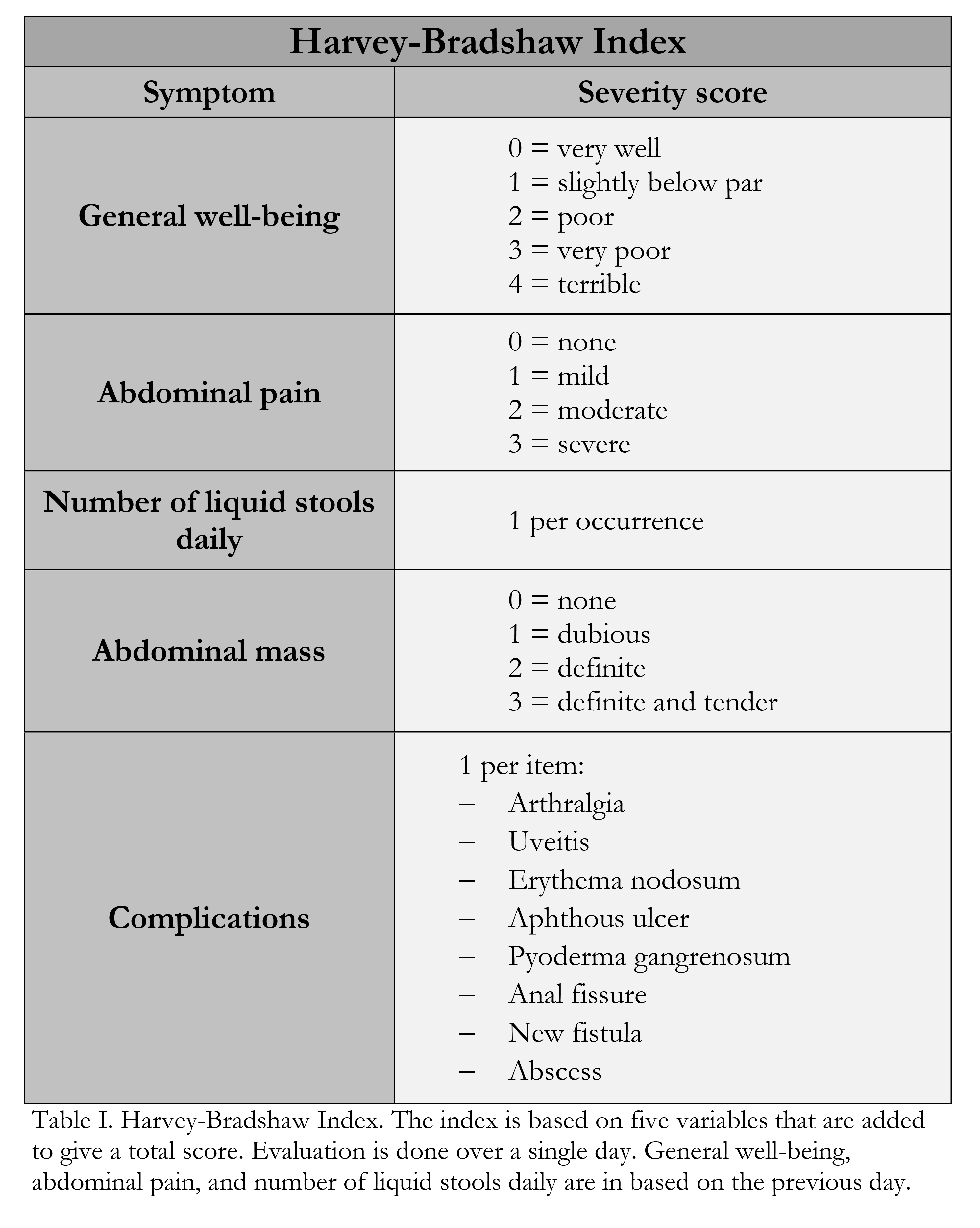
The HBI was devised as a simpler version of the CDAI. It consists of only clinical parameters, does not require biochemical tests, and is far simpler to use than the CDAI. Best, a contributor to the CDAI, drew statistically significant correlations between the HBI and CDAI using prediction limits. Vermeire et al. further validated these correlations using statistical analysis of 2 large multicenter prospective cohort studies (PEGylated antibody fragment evaluation in Crohn’s disease: safety and efficacy – PRECiSE 1 and 2). Both indicated that the HBI is a good – though imperfect – substitute for the CDAI in evaluating disease severity. These results support the use of the HBI for routine practice, reserving the CDAI for clinical trials requiring high accuracy.
Please click to read study in The Lancet
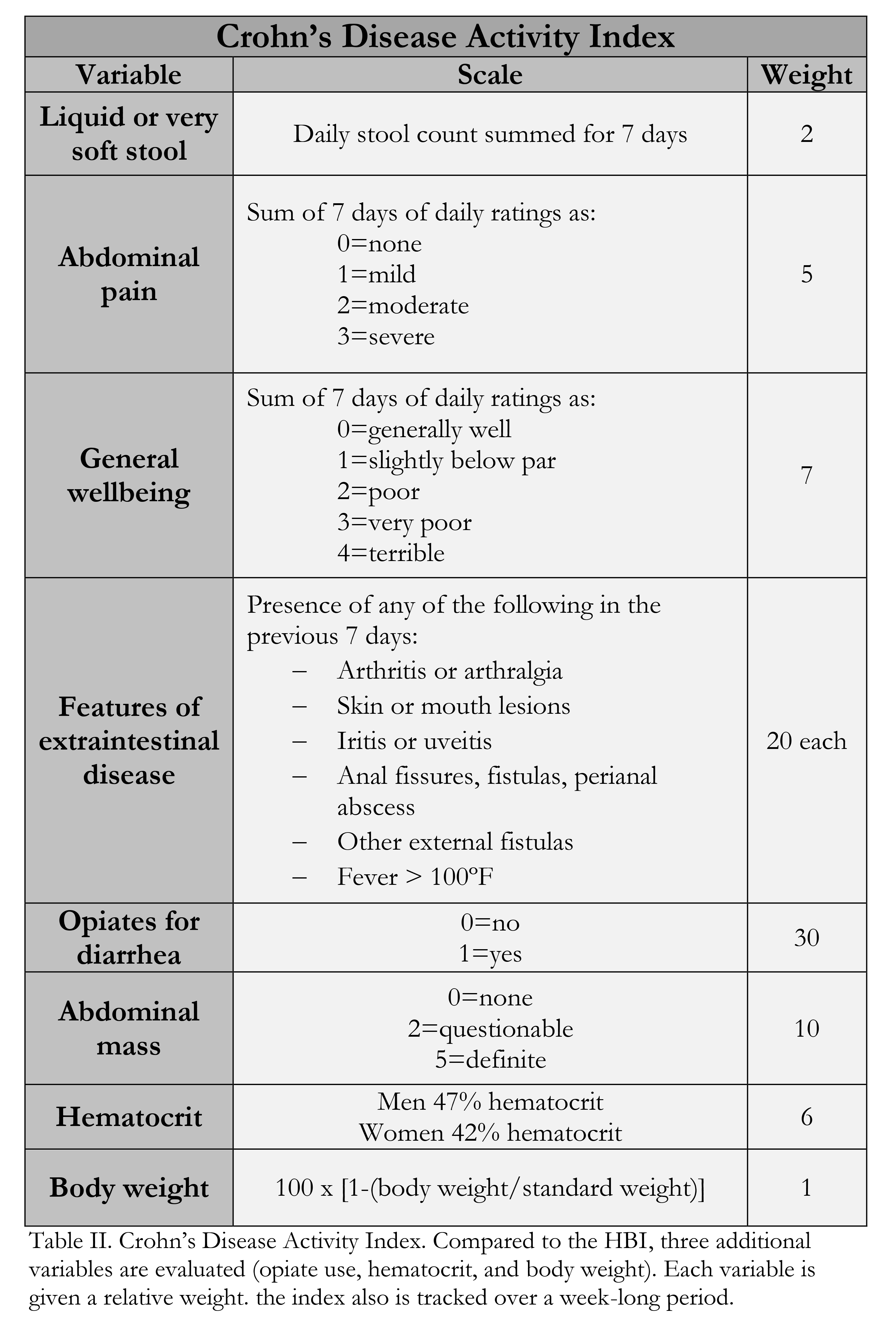
In-Depth [prospective cohort]: The CDAI is based on 8 parameters, each adjusted using a weighting factor (indicated in parentheses), as follows: number of liquid or soft stools each day for seven days (x2), abdominal pain each day for seven days (x5), general well-being each day for seven days (x7), presence of complications (x20), taking Lomotil or opiates to control diarrhea (x30), presence of an abdominal mass (x10), hematocrit of under 0.47 in men and 0.42 in women (x6), and percentage deviation from standard weight (x1). Points are added for clinical findings of arthritis, uveitis, fistulae or abscesses, fevers, and other complications. Remission of disease is defined as a score below 150 and severe disease is defined as a value greater than 450. The HBI uses only 5 items: general well-being, abdominal pain, number of liquid stools per day, abdominal mass, and complications. The first three of these are scored from the previous day to reduce bias.
112 patients attending a gastroenterology clinic were assessed with both the CDAI and the HBI on the same visit. The results were then plotted and regression analysis was run to assess the correlation between the two methods of data collection. The results indicated a positive correlation of 0.93 (p < 0.001). The results of PRECiSE 1 and 2 indicated a pooled correlation of 0.800 (0.780 – 0.819 confidence interval). This is in close agreement with Best’s finding of a 27-point change in the CDAI for every point change in the HBI.
Harvey RF, Bradshaw JM. A Simple Index of Crohn’s-Disease Activity. The Lancet. 1980 Mar 8;315(8167):514.
Additional Review:
Vermeire S, Schreiber S, Sandborn WJ, Dubois C, Rutgeerts P. Correlation between the Crohn's disease activity and Harvey–Bradshaw indices in assessing Crohn's disease severity. Clinical Gastroenterology and Hepatology. 2010 Apr 30;8(4):357-63.
Best WR. Predicting the Crohn's disease activity index from the Harvey-Bradshaw index. Inflammatory bowel diseases. 2006 Apr 1;12(4):304-10.
© 2 Minute Medicine, Inc. All rights reserved. No works may be reproduced without expressed written consent from 2 Minute Medicine, Inc. Inquire about licensing here. No article should be construed as medical advice and is not intended as such by the authors or by 2 Minute Medicine, Inc.


![CRISPR-mediated gene activation rescues obesity caused by haploinsufficiency [PreClinical]](https://www.2minutemedicine.com/wp-content/uploads/2019/03/CRISPR-350x250.jpg)
![PFO closure equivalent to medical management in prevention of recurrent stroke [PC and RESPECT trials]](https://www.2minutemedicine.com/wp-content/uploads/2013/03/Echokardiogram_von_Atriumseptumdefekt_Ostium_secundum1-75x75.jpg)


