

• About
  • Masthead
  • License Content
  • Advertise
  • Submit Press Release
  • RSS/Email List
  • 2MM Podcast
  • Write for us
  • Contact Us
2 Minute Medicine
No Result
View All Result

No products in the cart.

SUBSCRIBE
  • Specialties
    • All Specialties, All Recent Reports
    • Cardiology
    • Chronic Disease
    • Dermatology
    • Emergency
    • Endocrinology
    • Gastroenterology
    • Imaging and Intervention
    • Infectious Disease
    • Nephrology
    • Neurology
    • Obstetrics
    • Oncology
    • Ophthalmology
    • Pediatrics
    • Pharma
    • Preclinical
    • Psychiatry
    • Public Health
    • Pulmonology
    • Rheumatology
    • Surgery
  • Tools
    • EvidencePulse™
    • RVU Search
    • NPI Registry Lookup
  • Pharma
  • AI News
  • The Scan+
  • Classics™+
    • 2MM+ Online Access
    • Paperback and Ebook
  • Rewinds
  • Partners
    • License Content
    • Submit Press Release
    • Advertise with Us
  • Account
    • Subscribe
    • Sign-in
    • My account
2 Minute Medicine
  • Specialties
    • All Specialties, All Recent Reports
    • Cardiology
    • Chronic Disease
    • Dermatology
    • Emergency
    • Endocrinology
    • Gastroenterology
    • Imaging and Intervention
    • Infectious Disease
    • Nephrology
    • Neurology
    • Obstetrics
    • Oncology
    • Ophthalmology
    • Pediatrics
    • Pharma
    • Preclinical
    • Psychiatry
    • Public Health
    • Pulmonology
    • Rheumatology
    • Surgery
  • Tools
    • EvidencePulse™
    • RVU Search
    • NPI Registry Lookup
  • Pharma
  • AI News
  • The Scan+
  • Classics™+
    • 2MM+ Online Access
    • Paperback and Ebook
  • Rewinds
  • Partners
    • License Content
    • Submit Press Release
    • Advertise with Us
  • Account
    • Subscribe
    • Sign-in
    • My account
SUBSCRIBE
2 Minute Medicine
Subscribe
Home StudyGraphics

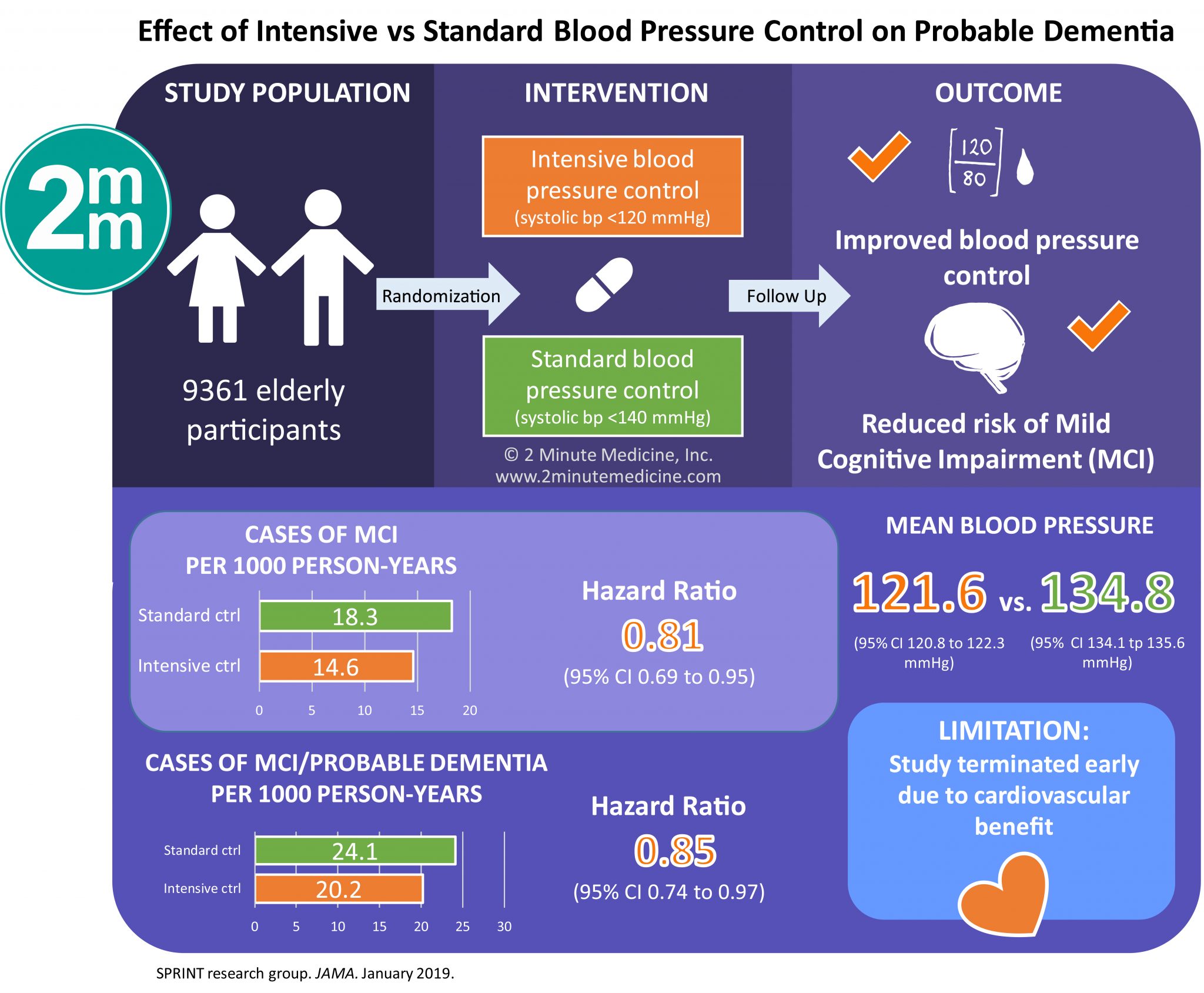
#VisualAbstract: Effect of Intensive vs Standard Blood Pressure Control on Probable Dementia
byStudy Graphics | C.WuandConstance Wu
September 6, 2020
in StudyGraphics
Reading Time: 2 mins read
0
Share on FacebookShare on Twitter

1. In this randomized controlled trial, intensive blood pressure lowering in elderly patients reduced the risk of developing Mild Cognitive Impairment (MCI) compared to standard blood pressure lowering.

2. While there was no difference in the risk of dementia between groups, the trial was terminated early due to observed cardiovascular benefits seen in the intensive blood pressure lowering group.

Evidence Rating Level: 1 (Excellent)

Study Rundown: Vascular damage caused by high blood pressure has been shown to increase the risk and severity of dementia. However, while excessively high blood pressures are known to influence pathology, it is unclear if intensive blood pressure lowering has a beneficial or detrimental effect on dementia risk. The Systolic Blood Pressure Intervention Trial (SPRINT) was designed to evaluate the effect of lowering systolic blood pressure to less than 120mmHg on cardiovascular, renal, and cognitive outcomes. In this randomized controlled trial, elderly patients were randomized to receive either intensive blood pressure lowering (systolic blood pressure goal <120 mmHg) or standard blood pressure lowering (<140 mmHg) therapies. Though intensive blood pressure lowering did not result in a reduction in dementia diagnoses, it did reduce the risk of Mild Cognitive Impairment (MCI).

It has been hypothesized that intensive blood pressure lowering may increase the risk of dementia, this study suggests that it is unlikely to change dementia risk but may reduce the pre-dementia state of MCI. Though the study was well-designed and had a relatively large sample size, there was a drop-off in follow-up rates after about four years, and it is unclear if reduced conversion to dementia would be apparent at later time points. Finally, the trial was terminated early due to the cardiovascular benefit of better blood pressure control, which perhaps limited the observed cognitive differences.

Click to read the study in JAMA

RELATED REPORTS

A multimodal approach combining cognitive assessment with biomarkers may accurately predict dementia risk

2 Minute Medicine Rewind May 18, 2026

Early control of systolic blood pressure following intracerebral hemorrhage may improve functional recovery

©2019 2 Minute Medicine, Inc. All rights reserved. No works may be reproduced without expressed written consent from 2 Minute Medicine, Inc. Inquire about licensing here. No article should be construed as medical advice and is not intended as such by the authors or by 2 Minute Medicine, Inc.


Tags: dementiahypertension
Previous Post

Nurse-led psychological intervention does not reduce PTSD symptoms in ICU patients

Next Post

The CLEAR trial: decolonization routine associated with lower infection risk among MRSA carrier patients

RelatedReports

Quick Take: Risk of rhabdomyolysis with donepezil compared with rivastigmine or galantamine
Chronic Disease

A multimodal approach combining cognitive assessment with biomarkers may accurately predict dementia risk

May 19, 2026
Transthoracic echocardiography can rule out endocarditis in low-risk bacteremic patients
Weekly Rewinds

2 Minute Medicine Rewind May 18, 2026

May 18, 2026
No difference in mortality for intensive versus standard reduction in blood pressure in intracerebral hemorrhage: The ATACH-2 trial
Emergency

Early control of systolic blood pressure following intracerebral hemorrhage may improve functional recovery

March 24, 2026
Quick Take: The clinical effectiveness of sertraline in primary care and the role of depression severity and duration (PANDA): a pragmatic, double-blind, placebo-controlled randomized trial
Cardiology

New guidelines limit hypertension treatment in adults over 65

March 16, 2026
Next Post
High risk of complications, but low mortality among children with MRSA bacteremia

The CLEAR trial: decolonization routine associated with lower infection risk among MRSA carrier patients

Peripheral perfusion-targeted resuscitation does not lower mortality in septic shock patients

#VisualAbstract: Intravenous Iron in Patients Undergoing Maintenance Hemodialysis

#VisualAbstract: Intravenous Iron in Patients Undergoing Maintenance Hemodialysis

2 Minute Medicine® is an award winning, physician-run, expert medical media company. Our content is curated, written and edited by practicing health professionals who have clinical and scientific expertise in their field of reporting. Our editorial management team is comprised of highly-trained MD physicians. Join numerous brands, companies, and hospitals who trust our licensed content.

Recent Reports

  • Food coloring additives are associated with higher incidence of type 2 diabetes
  • Children conceived through infertility treatments may have similar growth compared to naturally conceived children
  • Ring-augmented one-anastomosis gastric bypass may not improve weight loss compared to conventional one-anastomosis gastric bypass
License Content
Terms of Use | Disclaimer
Cookie Policy
Privacy Statement (EU)
Disclaimer
  • Specialties
    • All Specialties, All Recent Reports
    • Cardiology
    • Chronic Disease
    • Dermatology
    • Emergency
    • Endocrinology
    • Gastroenterology
    • Imaging and Intervention
    • Infectious Disease
    • Nephrology
    • Neurology
    • Obstetrics
    • Oncology
    • Ophthalmology
    • Pediatrics
    • Pharma
    • Preclinical
    • Psychiatry
    • Public Health
    • Pulmonology
    • Rheumatology
    • Surgery
  • Tools
    • EvidencePulse™
    • RVU Search
    • NPI Registry Lookup
  • Pharma
  • AI News
  • The Scan
  • Classics™
    • 2MM+ Online Access
    • Paperback and Ebook
  • Rewinds
  • Partners
    • License Content
    • Submit Press Release
    • Advertise with Us
  • Account
    • Subscribe
    • Sign-in
    • My account
No Result
View All Result

© 2026 2 Minute Medicine, Inc. - Physician-written medical news.