• About
  • Masthead
  • License Content
  • Advertise
  • Submit Press Release
  • RSS/Email List
  • 2MM Podcast
  • Write for us
  • Contact Us
2 Minute Medicine
No Result
View All Result

No products in the cart.

SUBSCRIBE
  • Specialties
    • All Specialties, All Recent Reports
    • Cardiology
    • Chronic Disease
    • Dermatology
    • Emergency
    • Endocrinology
    • Gastroenterology
    • Imaging and Intervention
    • Infectious Disease
    • Nephrology
    • Neurology
    • Obstetrics
    • Oncology
    • Ophthalmology
    • Pediatrics
    • Pharma
    • Preclinical
    • Psychiatry
    • Public Health
    • Pulmonology
    • Rheumatology
    • Surgery
  • Tools
    • EvidencePulse™
    • RVU Search
    • NPI Registry Lookup
  • Pharma
  • AI News
  • The Scan+
  • Classics™+
    • 2MM+ Online Access
    • Paperback and Ebook
  • Rewinds
  • Partners
    • License Content
    • Submit Press Release
    • Advertise with Us
  • Account
    • Subscribe
    • Sign-in
    • My account
2 Minute Medicine
  • Specialties
    • All Specialties, All Recent Reports
    • Cardiology
    • Chronic Disease
    • Dermatology
    • Emergency
    • Endocrinology
    • Gastroenterology
    • Imaging and Intervention
    • Infectious Disease
    • Nephrology
    • Neurology
    • Obstetrics
    • Oncology
    • Ophthalmology
    • Pediatrics
    • Pharma
    • Preclinical
    • Psychiatry
    • Public Health
    • Pulmonology
    • Rheumatology
    • Surgery
  • Tools
    • EvidencePulse™
    • RVU Search
    • NPI Registry Lookup
  • Pharma
  • AI News
  • The Scan+
  • Classics™+
    • 2MM+ Online Access
    • Paperback and Ebook
  • Rewinds
  • Partners
    • License Content
    • Submit Press Release
    • Advertise with Us
  • Account
    • Subscribe
    • Sign-in
    • My account
SUBSCRIBE
2 Minute Medicine
Subscribe
Home StudyGraphics

#VisualAbstract: Effectiveness of stand-alone telephone-delivered intervention for reducing problem alcohol use
byMinjee Kim
October 6, 2022
in StudyGraphics
Reading Time: 3 mins read
0
Share on FacebookShare on Twitter

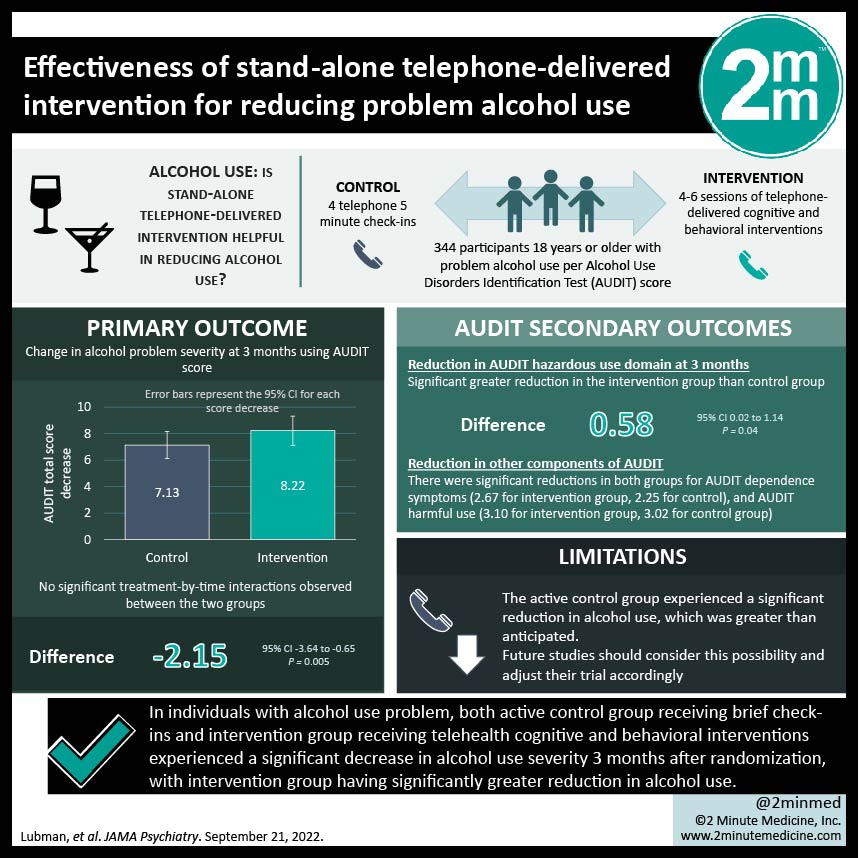
1. In this randomized controlled trial, in participants with problem alcohol use, individuals in the active control group, receiving brief check-ins, and the intervention group, receiving telehealth cognitive and behavioural interventions, both experienced a significant decrease in alcohol use severity 3 months after randomization. 

2. The intervention group showed a significantly greater reduction in alcohol use than the active control group.

Evidence Rating Level: 1 (Excellent)

Alcohol use is a leading cause of preventable morbidity and mortality, but there is a sharp contrast between its prevalence and the use of alcohol treatments. This treatment gap is attributable to the multiple individual and structural barriers that exist, and especially since the pandemic, access to treatment has been further disrupted. Telehealth has the potential to overcome many of the barriers to accessing treatment and has been previously studied in smoking cessation with great success. There is a lack of high-quality evidence surrounding telehealth in the treatment of alcohol use disorders, and the purpose of this single-site, double-blind, parallel-group randomized controlled trial was to examine the effectiveness of a telephone-delivered treatment, Ready2Change, in reducing alcohol use in patients with alcohol use problems. Participants 18 years or older with problem alcohol use (as per the Alcohol Use Disorders Identification Test (AUDIT) score), were recruited from Australia using social media between May 2018 and October 2019. Participants were randomized in a 1:1 ratio to the intervention group or control group. The intervention group received 4-6 sessions of telephone-delivered intervention, while the active control group received 4 telephone check-ins from a researcher. The primary outcome was a change in alcohol problem severity at 3 months after baseline, using the AUDIT score. 344 participants were included in the study, with 173 patients (50.3%) assigned to the intervention group, and 171 participants (49.7%) assigned to the active control group. With respect to the primary outcome, there was a significant difference in the AUDIT score for the treatment group when compared to the active control group at 3 months (difference, -2.15; 95% CI, -3.64 to -0.65; P=.005). There were no significant treatment-by-time interactions observed between the two groups. In both groups, there was a significant decrease in total AUDIT score from baseline to 3 months (P<.001). A major limitation of this study was that the active control group experienced a significant reduction in alcohol use, which was greater than anticipated; future studies should consider this possibility and adjust their trial accordingly. Overall, the findings from this trial did not suggest the superior effectiveness of the intervention when compared to the active control, as both groups experienced a significant decrease in AUDIT score between baseline and three months. However, the intervention group showed a greater reduction in AUDIT score at 3 months relative to the active control group. The results of this trial support benefits of a telephone-delivered intervention, which may reduce the treatment gap for problem alcohol use in the general population.

Click to read the study in JAMA Psychiatry

RELATED REPORTS

Telehealth yields modest improvements in diabetes outcomes 

Combined use of cannabis and alcohol may increase driving impairment and subjective intoxication

Limited pharmacotherapy initiation during veteran hospitalizations for alcohol use disorder

©2022 2 Minute Medicine, Inc. All rights reserved. No works may be reproduced without expressed written consent from 2 Minute Medicine, Inc. Inquire about licensing here. No article should be construed as medical advice and is not intended as such by the authors or by 2 Minute Medicine, Inc.


Tags: Alcoholalcohol usealcohol use disorderalcohol use disorders identification test (AUDIT)AUDIT scorebehavioral interventioncognitive behavioral therapy (CBT)Ready2Changetelehealthtelephone check-in
Previous Post

Stereotactic body radiation does not improve outcomes in patients with advanced Merkel cell carcinoma receiving nivolumab and ipilimumab

Next Post

Wellness Check: Nutrition

RelatedReports

Chronic Disease

Telehealth yields modest improvements in diabetes outcomes 

June 22, 2026
Systematic review examines benefits and adverse effects of cannabinoid therapy
Emergency

Combined use of cannabis and alcohol may increase driving impairment and subjective intoxication

May 8, 2026
Increased risk of stillbirth recurrence after a previous stillbirth
Chronic Disease

Limited pharmacotherapy initiation during veteran hospitalizations for alcohol use disorder

May 4, 2026
Patient-reported feedback may not improve health-related quality of life
AI Roundup

Amazon Health Services expands generative artificial intelligence assistant to all United States customers

April 8, 2026
Next Post
Provision of medically-tailored meals linked with lower admissions and medical spending

Wellness Check: Nutrition

#VisualAbstract: Cefepime and Enmetazobactam in treatment of urinary tract infection or acute pyelonephritis was more effective than Piperacillin and Tazobactam

#VisualAbstract: Cefepime and Enmetazobactam in treatment of urinary tract infection or acute pyelonephritis was more effective than Piperacillin and Tazobactam

Children’s hospital visits for suicide ideation and attempts are increasing

Ketamine use demonstrates promise for treatment-resistant depression

2 Minute Medicine® is an award winning, physician-run, expert medical media company. Our content is curated, written and edited by practicing health professionals who have clinical and scientific expertise in their field of reporting. Our editorial management team is comprised of highly-trained MD physicians. Join numerous brands, companies, and hospitals who trust our licensed content.

Recent Reports

  • Cruise ship hantavirus outbreak turns into a global contact tracing test
  • Celebrity body scans are colliding with radiology evidence
  • Antibiotic prescribing remains high for uncomplicated diverticulitis 
License Content
Terms of Use | Disclaimer
Cookie Policy
Privacy Statement (EU)
Disclaimer
  • Specialties
    • All Specialties, All Recent Reports
    • Cardiology
    • Chronic Disease
    • Dermatology
    • Emergency
    • Endocrinology
    • Gastroenterology
    • Imaging and Intervention
    • Infectious Disease
    • Nephrology
    • Neurology
    • Obstetrics
    • Oncology
    • Ophthalmology
    • Pediatrics
    • Pharma
    • Preclinical
    • Psychiatry
    • Public Health
    • Pulmonology
    • Rheumatology
    • Surgery
  • Tools
    • EvidencePulse™
    • RVU Search
    • NPI Registry Lookup
  • Pharma
  • AI News
  • The Scan
  • Classics™
    • 2MM+ Online Access
    • Paperback and Ebook
  • Rewinds
  • Partners
    • License Content
    • Submit Press Release
    • Advertise with Us
  • Account
    • Subscribe
    • Sign-in
    • My account
No Result
View All Result

© 2026 2 Minute Medicine, Inc. - Physician-written medical news.