• About
  • Masthead
  • License Content
  • Advertise
  • Submit Press Release
  • RSS/Email List
  • 2MM Podcast
  • Write for us
  • Contact Us
2 Minute Medicine
No Result
View All Result

No products in the cart.

SUBSCRIBE
  • Specialties
    • All Specialties, All Recent Reports
    • Cardiology
    • Chronic Disease
    • Dermatology
    • Emergency
    • Endocrinology
    • Gastroenterology
    • Imaging and Intervention
    • Infectious Disease
    • Nephrology
    • Neurology
    • Obstetrics
    • Oncology
    • Ophthalmology
    • Pediatrics
    • Pharma
    • Preclinical
    • Psychiatry
    • Public Health
    • Pulmonology
    • Rheumatology
    • Surgery
  • Tools
    • EvidencePulse™
    • RVU Search
    • NPI Registry Lookup
  • Pharma
  • AI News
  • The Scan+
  • Classics™+
    • 2MM+ Online Access
    • Paperback and Ebook
  • Rewinds
  • Partners
    • License Content
    • Submit Press Release
    • Advertise with Us
  • Account
    • Subscribe
    • Sign-in
    • My account
2 Minute Medicine
  • Specialties
    • All Specialties, All Recent Reports
    • Cardiology
    • Chronic Disease
    • Dermatology
    • Emergency
    • Endocrinology
    • Gastroenterology
    • Imaging and Intervention
    • Infectious Disease
    • Nephrology
    • Neurology
    • Obstetrics
    • Oncology
    • Ophthalmology
    • Pediatrics
    • Pharma
    • Preclinical
    • Psychiatry
    • Public Health
    • Pulmonology
    • Rheumatology
    • Surgery
  • Tools
    • EvidencePulse™
    • RVU Search
    • NPI Registry Lookup
  • Pharma
  • AI News
  • The Scan+
  • Classics™+
    • 2MM+ Online Access
    • Paperback and Ebook
  • Rewinds
  • Partners
    • License Content
    • Submit Press Release
    • Advertise with Us
  • Account
    • Subscribe
    • Sign-in
    • My account
SUBSCRIBE
2 Minute Medicine
Subscribe
Home StudyGraphics

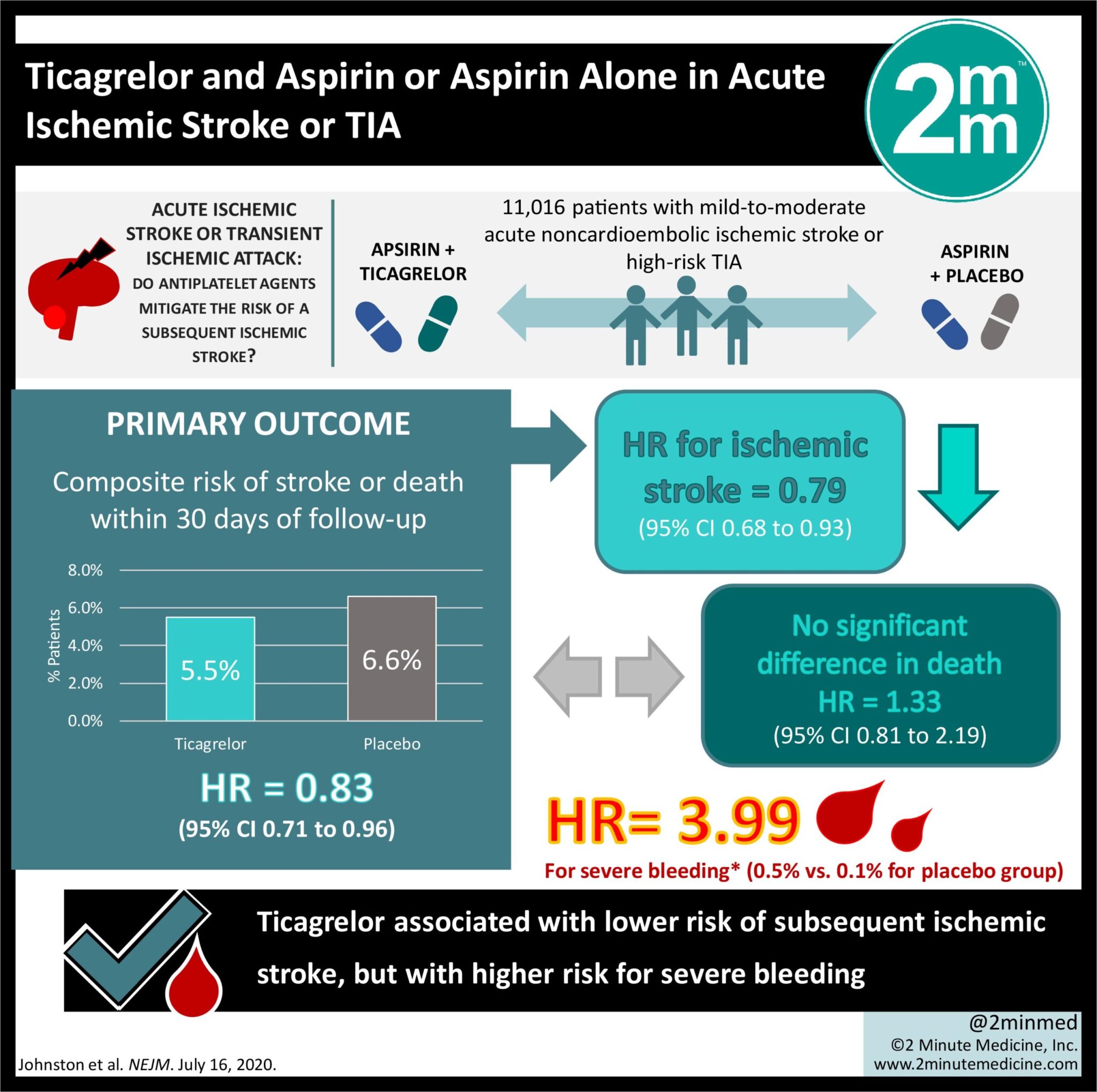
#VisualAbstract: Ticagrelor and aspirin vs. aspirin alone for ischemic stroke or TIA
byConstance Wu
August 10, 2020
in StudyGraphics
Reading Time: 3 mins read
0
Share on FacebookShare on Twitter

1. Ticagrelor and aspirin taken after a mild-to-moderate acute non-cardioembolic stroke or high-risk transient ischemic attack led to a lower rate of subsequent stroke within 30 days.

2. The incidence of overall disability at 30 days did not differ between groups.

Evidence Rating Level: 1 (Excellent)

Study Rundown: Following an acute ischemic stroke or transient ischemic attack (TIA), the risk of a subsequent ischemic stroke is estimated to be 5-10% within the first few months. A number of trials have sought to examine the role of antiplatelet agents to mitigate such a risk. Ticagrelor is a P2Y-12 inhibitor increasingly employed as part of dual antiplatelet therapy (DAPT) following myocardial infarction and coronary reperfusion. Evidence from prior subgroup analyses has suggested its potential benefit when used in combination with aspirin after an ischemic stroke. This multi-center, placebo-controlled, randomized controlled trial found use of aspirin and ticagrelor following a mild-moderate acute non-cardioembolic stroke or TIA to reduce the composite risk of stroke or death within thirty days when compared with use of aspirin alone. Such a finding provides further evidence in support of a short-term role of DAPT therapy following acute stroke, demonstrating a magnitude of benefit similarly exhibited in previous studies examining DAPT therapy within this setting. However, caution must be exercised in interpreting the study’s principal finding. The report of a reduced rate of stroke or death, while both included in the pre-defined primary outcome, fails to qualify the nearly equivalent all-cause mortality rate observed at thirty days in both groups. Differences in the presented primary outcome are explained largely by the reduced rate of ischemic stroke at 30 days. It should be noted there was no incident reduction in disability at 30 days between groups and a higher rate of severe bleeding – including rates of intracranial hemorrhage or fatal bleeding – was observed in those taking both aspirin and ticagrelor. The study may benefit from further characterization of functional outcomes to better delineate the risk, benefit profile.

Click here to read the study, published today in NEJM

Relevant Reading: Antiplatelet Therapy in Ischemic Stroke and Transient Ischemic Attack: An Overview of Major Trials and Meta-Analysis

RELATED REPORTS

A multidisciplinary home-based intervention may reduce risk of falls after stroke

Prednisone may have bone and cardiovascular benefits compared to hydrocortisone therapy in adrenal insufficiency

Lilly’s retatrutide achieves significant weight loss and A1C reduction in Phase 3 trial

In-Depth [randomized controlled trial]: A total of 11,016 patients were enrolled and underwent randomization across 414 sites in twenty-eight countries from January 2018 until October 2019. Patients were eligible if they were found to have a mild-to-moderate acute noncardioembolic ischemic stroke or a high-risk TIA and were not planned for an endovascular intervention, including thrombectomy or thrombolysis. Randomization occurred within twenty-four hours of symptom onset or last known normal. Subjects were loaded and maintained on either aspirin and ticagrelor or aspirin and placebo for at least thirty days, after which antiplatelet therapy was left to the discretion of study site investigators. Follow-up data was collected at approximately five, thirty, and sixty days following randomization.  The primary-outcome event rate, defined as a composite risk of stroke or death within 30 days of follow-up, was lower in those taking aspirin and ticagrelor (5.5%) when compared to those taking aspirin alone (6.6%), (HR 0.83, 95% CI 0.71-0.96). The rate of ischemic stroke was lower in those taking aspirin and ticagrelor group (5.0% vs 6.3%, HR 0.79, 95% CI 0.68-0.93). No significant difference was seen in the rate of death (HR 1.33, 95% CI 0.81-2.19) or overall disability at 30 days (OR 0.98, 95% CI 0.89-1.07). A higher rate of severe bleeding was seen in 0.5% of those in the ticagrelor group, compared to 0.1% in those taking placebo (HR 3.99, 95% CI 1.74-9.14). Permanent discontinuation due to bleeding or dyspnea occurred in 3.8% of those in the aspirin and ticagrelor group, compared to 0.8% in those taking aspirin alone.

©2020 2 Minute Medicine, Inc. All rights reserved. No works may be reproduced without expressed written consent from 2 Minute Medicine, Inc. Inquire about licensing here. No article should be construed as medical advice and is not intended as such by the authors or by 2 Minute Medicine, Inc.

Previous Post

mRNA-1273 SARS-CoV-2 vaccine likely effective in nonhuman primates

Next Post

Ofatumumab may reduce annual relapse rates compared to teriflunomide in multiple sclerosis

RelatedReports

Intensive rehabilitation not superior to traditional therapy for arm function after stroke
Chronic Disease

A multidisciplinary home-based intervention may reduce risk of falls after stroke

April 3, 2026
Implementation of pneumococcal vaccine programs linked to decreased antibiotic prescription
Chronic Disease

Prednisone may have bone and cardiovascular benefits compared to hydrocortisone therapy in adrenal insufficiency

April 3, 2026
Sleep duration inversely related to childhood type 2 diabetes risk makers
Cardiology

Lilly’s retatrutide achieves significant weight loss and A1C reduction in Phase 3 trial

April 3, 2026
Imaging biomarkers may improve prediction of aortic valve stenosis
Cardiology

Early surgical valve replacement offers survival benefit in asymptomatic, very severe aortic stenosis

April 3, 2026
Next Post

Ofatumumab may reduce annual relapse rates compared to teriflunomide in multiple sclerosis

Survival greater in cervical cancer patients undergoing abdominal hysterectomy compared to minimally invasive techniques: the LACC trial

2 Minute Medicine Rewind August 10, 2020

Patients with low back pain or pain at multiple sites at highest risk for chronic opioid use

Usage of first-line antidepressant medications in early pregnancy associated with selected birth defects

2 Minute Medicine® is an award winning, physician-run, expert medical media company. Our content is curated, written and edited by practicing health professionals who have clinical and scientific expertise in their field of reporting. Our editorial management team is comprised of highly-trained MD physicians. Join numerous brands, companies, and hospitals who trust our licensed content.

Recent Reports

  • A multidisciplinary home-based intervention may reduce risk of falls after stroke
  • Prednisone may have bone and cardiovascular benefits compared to hydrocortisone therapy in adrenal insufficiency
  • Lilly’s retatrutide achieves significant weight loss and A1C reduction in Phase 3 trial
License Content
Terms of Use | Disclaimer
Cookie Policy
Privacy Statement (EU)
Disclaimer

The Classics in Medicine Paperback Released!

Over the past 30 years, the transition from print to digital media has contributed to an exponential increase in medical literature. In response, 2 Minute Medicine presents 160+ authoritative, physician-written summaries of the most cited landmark trials in medicine.

amazon-logo_blackGet-it-on-iBooks-badge

Click anywhere to close this announcement

  • Specialties
    • All Specialties, All Recent Reports
    • Cardiology
    • Chronic Disease
    • Dermatology
    • Emergency
    • Endocrinology
    • Gastroenterology
    • Imaging and Intervention
    • Infectious Disease
    • Nephrology
    • Neurology
    • Obstetrics
    • Oncology
    • Ophthalmology
    • Pediatrics
    • Pharma
    • Preclinical
    • Psychiatry
    • Public Health
    • Pulmonology
    • Rheumatology
    • Surgery
  • Tools
    • EvidencePulse™
    • RVU Search
    • NPI Registry Lookup
  • Pharma
  • AI News
  • The Scan
  • Classics™
    • 2MM+ Online Access
    • Paperback and Ebook
  • Rewinds
  • Partners
    • License Content
    • Submit Press Release
    • Advertise with Us
  • Account
    • Subscribe
    • Sign-in
    • My account
No Result
View All Result

© 2026 2 Minute Medicine, Inc. - Physician-written medical news.