• About
  • Masthead
  • License Content
  • Advertise
  • Submit Press Release
  • RSS/Email List
  • 2MM Podcast
  • Write for us
  • Contact Us
2 Minute Medicine
No Result
View All Result

No products in the cart.

SUBSCRIBE
  • Specialties
    • All Specialties, All Recent Reports
    • Cardiology
    • Chronic Disease
    • Dermatology
    • Emergency
    • Endocrinology
    • Gastroenterology
    • Imaging and Intervention
    • Infectious Disease
    • Nephrology
    • Neurology
    • Obstetrics
    • Oncology
    • Ophthalmology
    • Pediatrics
    • Pharma
    • Preclinical
    • Psychiatry
    • Public Health
    • Pulmonology
    • Rheumatology
    • Surgery
  • Tools
    • EvidencePulse™
    • HypeCheck™
    • NPI Registry Lookup
    • RVU Search
  • Pharma
  • AI News
  • The Scan+
  • Classics™+
    • 2MM+ Online Access
    • Paperback and Ebook
  • Rewinds
  • Partners
    • License Content
    • Submit Press Release
    • Advertise with Us
  • Account
    • Subscribe
    • Cart
    • Sign-in
    • My account
2 Minute Medicine
  • Specialties
    • All Specialties, All Recent Reports
    • Cardiology
    • Chronic Disease
    • Dermatology
    • Emergency
    • Endocrinology
    • Gastroenterology
    • Imaging and Intervention
    • Infectious Disease
    • Nephrology
    • Neurology
    • Obstetrics
    • Oncology
    • Ophthalmology
    • Pediatrics
    • Pharma
    • Preclinical
    • Psychiatry
    • Public Health
    • Pulmonology
    • Rheumatology
    • Surgery
  • Tools
    • EvidencePulse™
    • HypeCheck™
    • NPI Registry Lookup
    • RVU Search
  • Pharma
  • AI News
  • The Scan+
  • Classics™+
    • 2MM+ Online Access
    • Paperback and Ebook
  • Rewinds
  • Partners
    • License Content
    • Submit Press Release
    • Advertise with Us
  • Account
    • Subscribe
    • Cart
    • Sign-in
    • My account
SUBSCRIBE
2 Minute Medicine
Subscribe
Home StudyGraphics

#VisualAbstract: Drug-eluting stents for saphenous vein grafts associated with better outcomes than bare-metal stents
byConstance Wu
October 28, 2020
in StudyGraphics
Reading Time: 3 mins read
0
Share on FacebookShare on Twitter

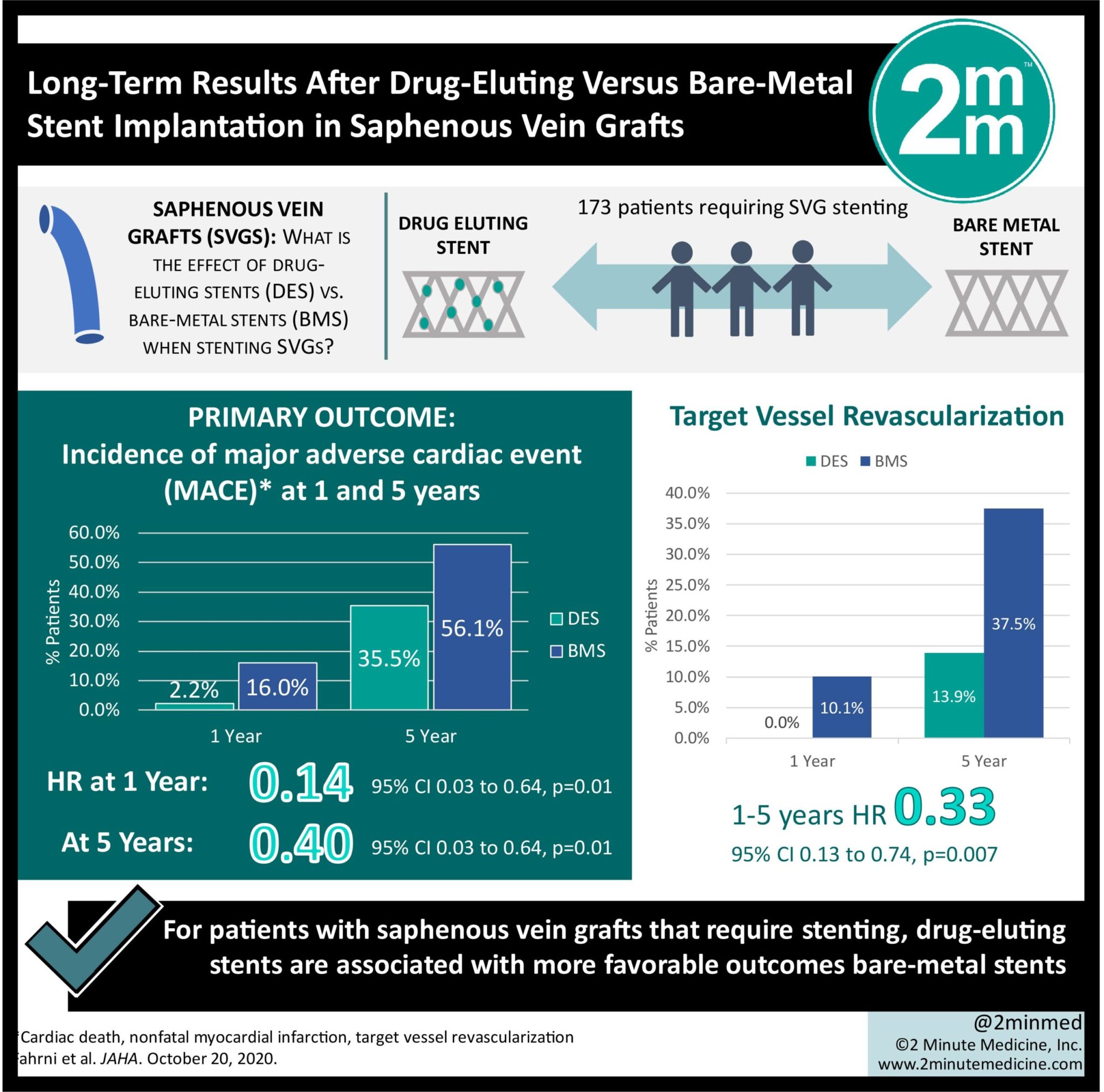
1. Among patients who have received a saphenous vein graft during coronary bypass surgery and later experience treatment failure, deployment of a drug-eluting stent during percutaneous coronary intervention leads to more favorable outcomes than does use of a bare-metal stent.

Evidence Rating Level: 1 (Excellent)

Study Rundown: Though it has been shown in previous studies that drug-eluting stents (DES) are associated with more favorable outcomes than bare-metal stents (BMS) when stenting native vessels, data regarding the stenting of saphenous vein grafts (SVGs) is less clear. SVGs are commonly implanted during coronary bypass surgery; due to the relatively high rate of post-operative occlusion, 6% of all percutaneous coronary interventions are performed on SVGs. There is a paucity of data for this particular intervention, some of which is conflicting. A recent trial found no difference in outcome at 12 months between DES and BMS when stenting SVG lesions. To clarify these findings, this study assessed the efficacy and safety of DES among patients undergoing percutaneous coronary intervention in SVG lesions over a longer, five-year period.

In this randomized controlled trial, patients were recruited from six clinical centers in Switzerland, Germany, and Denmark, and randomized 1:1 during coronary intervention to received either a paclitaxel-eluting stent (DES cohort) or a bare-metal stent (BMS cohort). The primary outcome was the incidence of major adverse cardiac events (MACE), defined as the composite of cardiac death, nonfatal myocardial infarction, and target vessel revascularization (TVR) of the stented SVG. At one year, the BMS cohort has a significantly higher incidence of MACE as well as TVR. Furthermore, at the five-year follow-up, incidence of MACE remained significantly in favor of DES. The randomized design of this study lends credence to its findings, though it should be noted that study enrollment was prematurely terminated and thus the study was unpowered, which may have impacted the results. In all, this study suggests that among patients presenting for percutaneous coronary intervention of SVG lesions, the use of DES leads to more favorable outcomes when compared with BMS, and therefore may be the preferred intervention in this population.

Click here to read the study in JAHA

Relevant reading: Drug-eluting stents versus bare-metal stents in saphenous vein grafts: a double-blind, randomised trial

RELATED REPORTS

A medical care at home program following hospitalization with acute decompensated heart failure may offer a safe and effective alternative to continued hospitalization

Catheter ablation within 1 year of atrial fibrillation diagnosis is associated with reduced risk of recurrence

2 Minute Medicine Rewind July 20, 2026

In-depth [randomized controlled trial]: 173 patients with SVG were included in this study, with 89 (mean [SD] age = 70.5 [7.9] years, 89.9% male) randomized to receive DES and 84 (mean [SD] age = 71.4 [8.7] years, 89.3% male) randomized to receive BMS. At one year, the incidence of MACE was significantly higher in the BMS cohort (HR 0.14, 95% CI 0.03 to 0.64, p = 0.01), as was the need for TVR (10.1% vs. 0% in the DES cohort, HR 0.05, 95% CI 0.00 to 0.44, p = 0.003). After adjusting for potential confounders like age, sex, and diabetes mellitus, the advantage of DES in terms of MACE remained significant (HR 0.16, 95% CI 0.03 to 0.71, p = 0.01). At five years, the incidence of MACE continued to favor DES compared with BMS (35.5% vs. 56.1%, HR 0.40, 95% CI 0.23 to 0.68, p < 0.001). When considering the need for TVR, an advantage for patients treated with DES compared with BMS was again demonstrated (13.9% vs. 37.5%, HR 0.23, 95% CI 0.10 to 0.51, p < 0.001). Finally, the need for TVR among patients treated with DES was consistently lower throughout the five-year follow-up period when compared with patients treated with BMS (1-5 years HR 0.33, 95% CI 0.13 to 0.74, p = 0.007). Of note, patients treated with BMS presented more frequently for multiple TVR procedures compared with patients treated with DES (n = 8 [9.5%] vs. n = 1 [1.1%], p = 0.013).

©2020 2 Minute Medicine, Inc. All rights reserved. No works may be reproduced without expressed written consent from 2 Minute Medicine, Inc. Inquire about licensing here. No article should be construed as medical advice and is not intended as such by the authors or by 2 Minute Medicine, Inc.

Tags: bare metalbare metal stentsCABGcardiologycoronary artery bypass surgery (CABG)drug eluting stentssaphenous vein graftsstentstents
Previous Post

#VisualAbstract: Outcomes of COVID-19-related ARDS patients on extracorporeal membrane oxygenation

Next Post

#VisualAbstract: COVID-19 pandemic associated with decreased rates of institutional childbirth and increased neonatal mortality in Nepal

RelatedReports

Remote patient monitoring did not reduce heart failure readmissions: The BEAT-HF trial
Cardiology

A medical care at home program following hospitalization with acute decompensated heart failure may offer a safe and effective alternative to continued hospitalization

July 24, 2026
Rivaroxaban likely reduces risk of recurrent stroke in specific subgroup of patients with embolic stroke of undetermined source
Cardiology

Catheter ablation within 1 year of atrial fibrillation diagnosis is associated with reduced risk of recurrence

July 24, 2026
Remote patient monitoring did not reduce heart failure readmissions: The BEAT-HF trial
Weekly Rewinds

2 Minute Medicine Rewind July 20, 2026

July 20, 2026
Computed tomography improves diagnostic certainty in the emergency department
Cardiology

Two scores for risk stratification of adults presenting with syncope may be effective at identifying those with low risk

May 29, 2026
Next Post
#VisualAbstract: Drug-eluting stents for saphenous vein grafts associated with better outcomes than bare-metal stents

#VisualAbstract: COVID-19 pandemic associated with decreased rates of institutional childbirth and increased neonatal mortality in Nepal

Dasatinib and blinatumomab treatment for acute lymphoblastic leukemia

Dasatinib and blinatumomab treatment for acute lymphoblastic leukemia

2 Minute Medicine Rewind August 19, 2019

HPV vaccination associated with substantial lower invasive cervical cancer risk

2 Minute Medicine® is an award winning, physician-run, expert medical media company. Our content is curated, written and edited by practicing health professionals who have clinical and scientific expertise in their field of reporting. Our editorial management team is comprised of highly-trained MD physicians. Join numerous brands, companies, and hospitals who trust our licensed content.

Recent Reports

  • Dementia diagnosis underreporting is common and associated with reduced care engagement
  • A landmark court ruling was associated with increased travel across state borders for abortion care
  • Older married couples demonstrate domain-specific cognitive concordance 
License Content
Terms of Use | Disclaimer
Cookie Policy
Privacy Statement (EU)
Disclaimer
Cleantalk Pixel
  • Specialties
    • All Specialties, All Recent Reports
    • Cardiology
    • Chronic Disease
    • Dermatology
    • Emergency
    • Endocrinology
    • Gastroenterology
    • Imaging and Intervention
    • Infectious Disease
    • Nephrology
    • Neurology
    • Obstetrics
    • Oncology
    • Ophthalmology
    • Pediatrics
    • Pharma
    • Preclinical
    • Psychiatry
    • Public Health
    • Pulmonology
    • Rheumatology
    • Surgery
  • Tools
    • EvidencePulse™
    • HypeCheck™
    • NPI Registry Lookup
    • RVU Search
  • Pharma
  • AI News
  • The Scan
  • Classics™
    • 2MM+ Online Access
    • Paperback and Ebook
  • Rewinds
  • Partners
    • License Content
    • Submit Press Release
    • Advertise with Us
  • Account
    • Subscribe
    • Cart
    • Sign-in
    • My account
No Result
View All Result

© 2026 2 Minute Medicine, Inc. - Physician-written medical news.