• About
  • Masthead
  • License Content
  • Advertise
  • Submit Press Release
  • RSS/Email List
  • 2MM Podcast
  • Write for us
  • Contact Us
2 Minute Medicine
No Result
View All Result

No products in the cart.

SUBSCRIBE
  • About
  • Specialties
    • All Specialties, All Recent Reports
    • Cardiology
    • Chronic Disease
    • Dermatology
    • Emergency
    • Endocrinology
    • Gastroenterology
    • Imaging and Intervention
    • Infectious Disease
    • Nephrology
    • Neurology
    • Obstetrics
    • Oncology
    • Ophthalmology
    • Pediatrics
    • Pharma
    • Preclinical
    • Psychiatry
    • Public Health
    • Pulmonology
    • Rheumatology
    • Surgery
  • Tools+
    • EvidencePulse™
    • HypeCheck™
    • NPI Registry Lookup
    • RVU Search
  • Pharma
  • AI Roundup
  • The Scan+
  • Classics™+
    • 2MM+ Online Access
    • Paperback and Ebook
  • Rewinds
  • Partners
    • License Content
    • Submit Press Release
    • Advertise with Us
  • Account
    • Subscribe
    • My account
    • Cart
    • Sign-in
2 Minute Medicine
  • About
  • Specialties
    • All Specialties, All Recent Reports
    • Cardiology
    • Chronic Disease
    • Dermatology
    • Emergency
    • Endocrinology
    • Gastroenterology
    • Imaging and Intervention
    • Infectious Disease
    • Nephrology
    • Neurology
    • Obstetrics
    • Oncology
    • Ophthalmology
    • Pediatrics
    • Pharma
    • Preclinical
    • Psychiatry
    • Public Health
    • Pulmonology
    • Rheumatology
    • Surgery
  • Tools+
    • EvidencePulse™
    • HypeCheck™
    • NPI Registry Lookup
    • RVU Search
  • Pharma
  • AI Roundup
  • The Scan+
  • Classics™+
    • 2MM+ Online Access
    • Paperback and Ebook
  • Rewinds
  • Partners
    • License Content
    • Submit Press Release
    • Advertise with Us
  • Account
    • Subscribe
    • My account
    • Cart
    • Sign-in
SUBSCRIBE
2 Minute Medicine
Subscribe
EvidencePulse™ by 2 Minute Medicine 2026 evidence scan 3 reports You asked top stroke trials 2026 Synthesizing medical evidence... Top 2026 stroke trial results: OCEANIC — ischemic stroke: 6.2% vs 8.4% OPTION* — mRS 0–1: 43.6% vs 34.2% ORIENTAL* — mRS 0–2: 58.6% vs 46.6% *Higher sICH in intervention arms Participants randomizedN OCEANIC 12,327 OPTION 570 ORIENTAL 564 Ask about guidelines or landmark trials... ↑ Try EvidencePulse™ Ask the evidence.
Get the signal.
Try it now → Physician-trained medical AI by 2 Minute Medicine
Home StudyGraphics

#VisualAbstract: Continuous electrocardiogram monitoring following discharge detects atrial fibrillation in postoperative cardiac patients
byMinjee Kim
September 9, 2021
in StudyGraphics
Reading Time: 4 mins read
#VisualAbstract: Continuous electrocardiogram monitoring following discharge detects atrial fibrillation in postoperative cardiac patients
Share on FacebookShare on Twitter

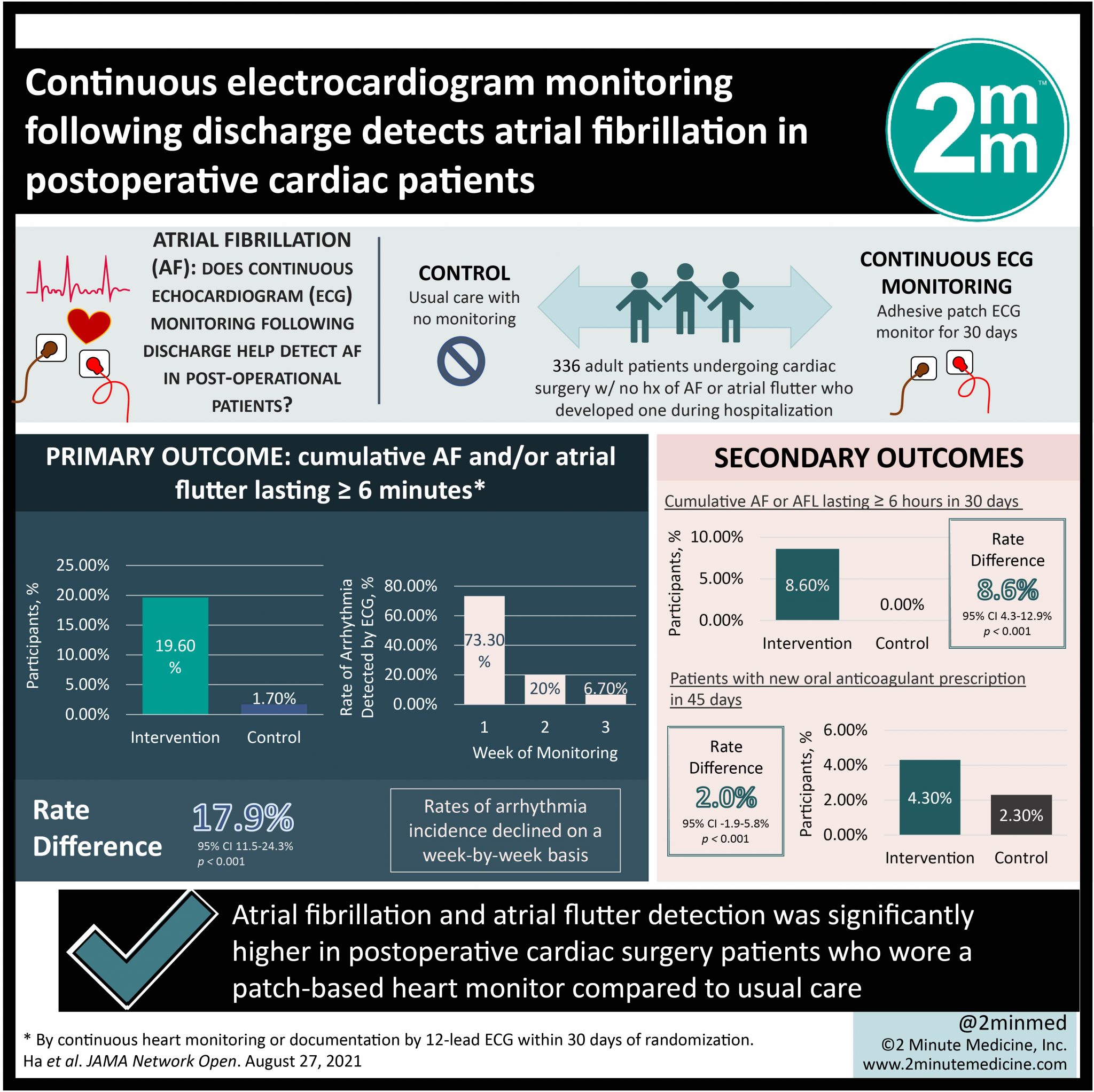
1. Rates of detected atrial fibrillation (A fib) were significantly higher in postoperative cardiac surgery patients who wore a patch-based heart monitor for 30 days following randomization compared to those who underwent usual care.

2. A significant amount of time spent in A fib (6 hours cumulative, 24 hours cumulative) was detected amongst several patients undergoing continuous monitoring during the study period, but none of the patients undergoing usual care.

Evidence Rating Level: 1 (Excellent)

Study Rundown: Cardiac surgical patients are known to be at risk for developing episodes of postoperative atrial fibrillation (A fib), the majority of which are thought to occur in the days following surgery. The incidence of cardiac arrhythmias following discharge from cardiac surgery is poorly understood. This risk of developing undetected A fib is particularly salient for patients at high risk of stroke; the present randomized controlled trial sought to evaluate the utility of continuous electrocardiogram (ECG) monitoring for 30 days in this population. 336 adult patients undergoing cardiac surgery with no history of A fib or atrial flutter (A flutter) who developed one of these two arrhythmias during hospitalization and who were considered at high risk of stroke (see In-Depth) were included. The intervention group (163 patients, 48.5%) wore an adhesive patch ECG monitor for 30 days while the control group (173 patients, 51.5%) did not. Usual care included any ECG or Holter monitor testing which was clinically indicated. The primary outcome was cumulative A fib/A flutter duration of at least 6 minutes; this occurred in 19.6% of continuous monitoring patients versus 1.7% of controls. Cumulative A fib/A flutter lasting more than 6 hours was detected in 8.6% of the continuous monitoring patients, and none of the controls. The difference in rates of oral anticoagulant prescription within 45 days of randomization was not significant between the two groups. This investigation of continuous cardiac monitoring for 30 days following cardiac surgery amongst high stroke-risk patients demonstrated that nearly one in five patients experienced episodes of A fib/A flutter which would have otherwise gone undetected. These arrhythmias are known to be thrombogenic and often merit the initiation of oral anticoagulant therapy to prevent stroke or other thrombotic events. Strengths of this study include its novelty: the majority of studies of postoperative arrhythmias focus on the short timeline prior to discharge while Ha et al identified risks that extend for weeks and months postoperatively. The trial design was well-planned to control for bias, and the findings reported here are worth consideration in the management of high stroke-risk patients and the prescription of oral anticoagulants. In addition, thorough analyses (subgroup, as randomized) were performed to demonstrate the strength of findings. Some limitations include the relatively low sample size, owing in part to the COVID-19 pandemic which halted patient recruitment at 85% of the intended number. The eligibility criteria was fairly stringent, which reduces the external validity of this trial. Additionally, the limitations of continued ECG monitoring must be accounted for: this technology may be costly, can produce false positives and is associated with some adverse events which may reduce patient compliance.

Click to read the study in JAMA Network Open

Relevant Reading: Short- and long-term mortality associated with new-onset atrial fibrillation after coronary artery bypass grafting: A systematic review and meta-analysis

RELATED REPORTS

Apixaban (Eliquis) is associated with reduced rates of ischemic stroke and bleeding in patients with atrial fibrillation and advanced chronic kidney disease compared with warfarin (Coumadin)

2 Minute Medicine Rewind September 7, 2026

2 Minute Medicine Rewind August 31, 2026

In-Depth [randomized controlled trial]: This trial took place at 8 cardiac surgical centres in Canada. High risk of stroke was evaluated using the CHA2DS2-VASc criteria with a score of 4 or higher, or with a score of at least 2 with an additional risk factor for stroke. Patients were excluded if they were already taking oral anticoagulants. Block randomization was performed by a computer-generated algorithm which stratified patients by study site and type of surgery. The projected sample size assuming a 2% attrition rate and an 80% power was 396, although enrollment fell short of this number. Intention-to-treat analysis was employed, although the study had good retention rates with 91.4% of patients attending all follow-up visits. There were no significant differences in baseline characteristics between the intervention and control groups. The absolute difference in rates of primary outcome between the two groups was 17.9% (19.6% versus 1.7%), with a 95% confidence interval (95CI) of 11.5-24.3% (p<0.001). The number needed to screen for this intervention was found to be 6 patients. The rates of arrhythmia incidence declined on a week-by-week basis, with 73.3% of A fib/A flutter episodes detected within the first week of the trial, 20.0% during the second week and 6.7% during the third. The absolute difference in rates of cumulative A fib/A flutter greater than 6 hours was 8.6% (8.6% versus 0%), 95CI 4.3-12.9% (p<0.001). 7 patients in the monitoring group and 4 in the control group were prescribed an oral anticoagulant within 45 days of randomization (absolute difference 2.0%, 95CI -1.9-5.8%). A subgroup analysis was planned a priori to investigate whether type of surgery was an effect modifier, and did not yield significant differences between the groups.

Image: PD

©2021 2 Minute Medicine, Inc. All rights reserved. No works may be reproduced without expressed written consent from 2 Minute Medicine, Inc. Inquire about licensing here. No article should be construed as medical advice and is not intended as such by the authors or by 2 Minute Medicine, Inc.
Tags: #cardiac monitoring#ECG#oral anticoagulation#post-cardiac surgeryafibanticoagulationatrial fibrillationatrial flutterCardiac surgeryEKGPostoperative complicationsstroke risk
Previous Post

Association between intimate partner violence during pregnancy and risk of preterm birth 

Next Post

Wellness Check: Mental Health

RelatedReports

Nephrology

Apixaban (Eliquis) is associated with reduced rates of ischemic stroke and bleeding in patients with atrial fibrillation and advanced chronic kidney disease compared with warfarin (Coumadin)

September 9, 2026
Long-term outcomes for off-pump and on-pump CABG are similar
Weekly Rewinds

2 Minute Medicine Rewind September 7, 2026

September 7, 2026
Rivaroxaban likely reduces risk of recurrent stroke in specific subgroup of patients with embolic stroke of undetermined source
Weekly Rewinds

2 Minute Medicine Rewind August 31, 2026

August 31, 2026
Rivaroxaban likely reduces risk of recurrent stroke in specific subgroup of patients with embolic stroke of undetermined source
Cardiology

Catheter ablation within 1 year of atrial fibrillation diagnosis is associated with reduced risk of recurrence

July 24, 2026
Next Post
Quick Take: Effect of Developmentally Adapted Cognitive Processing Therapy for Youth With Symptoms of Posttraumatic Stress Disorder After Childhood Sexual and Physical Abuse

Wellness Check: Mental Health

#VisualAbstract: Efficacy and safety of adalimumab in conjunction with surgery in moderate to severe hidradenitis suppurativa

#VisualAbstract: Association of age and pediatric household transmission of SARS-CoV-2 infection

Quick Take: Analgesic efficacy and safety of morphine in the Procedural Pain in Premature Infants (Poppi) study: randomised placebo-controlled trial

Study highlights poor outcomes in very preterm infants with early-onset sepsis

EvidencePulse™ by 2 Minute Medicine 2026 evidence scan 3 reports You asked top stroke trials 2026 Synthesizing medical evidence... Top 2026 stroke trial results: OCEANIC — ischemic stroke: 6.2% vs 8.4% OPTION* — mRS 0–1: 43.6% vs 34.2% ORIENTAL* — mRS 0–2: 58.6% vs 46.6% *Higher sICH in intervention arms Participants randomizedN OCEANIC 12,327 OPTION 570 ORIENTAL 564 Ask about guidelines or landmark trials... ↑ Try EvidencePulse™ Ask the evidence.
Get the signal.
Try it now → Physician-trained medical AI by 2 Minute Medicine

2MM+ All Access

Full details →
$4.99 /month

5-day free trial · cancel anytime

  • ✓100+ physician-written reports
  • ✓EvidencePulse™ + HypeCheck™
  • ✓Ad-free reading + newsletters
Start 5-day free trial

Then $4.99/month. Manage renewal in your account.

2 Minute Medicine® is an award winning, physician-run, expert medical media company. Our content is curated, written and edited by practicing health professionals who have clinical and scientific expertise in their field of reporting. Our editorial management team is comprised of highly-trained MD physicians. Join numerous brands, companies, and hospitals who trust our licensed content.

Recent Reports

  • The rate of urethrocutaneous fistula following caudal and penile blocks for hypospadias repair may be similar
  • Adjuvant chemotherapy not linked to improved outcomes in localized appendiceal adenocarcinoma
  • Deep learning model improved cancer recurrence prediction for pediatric glioma using serial imaging
License Content
Terms of Use | Disclaimer
Cookie Policy
Cleantalk Pixel
2MM+ All Access Full details →

The medical literature, distilled daily.

Monthly plan selected: $4.99 /month.

$4.99/month

5-day free trial · cancel anytime

Start 5-day free trial

Then $4.99/month. Manage renewal in your account.

Yearly plan selected: $49.90 /year.

$49.90/year

2 months free · only $4.16/month

Start 5-day free trial

Then $49.90/year. Manage renewal in your account.

Membership benefits

  • ✓100+ physician-written reports
  • ✓AI EvidencePulse™ + HypeCheck™
  • ✓Ad-free reading + newsletters

Already a member? Sign in

  • About
  • Specialties
    • All Specialties, All Recent Reports
    • Cardiology
    • Chronic Disease
    • Dermatology
    • Emergency
    • Endocrinology
    • Gastroenterology
    • Imaging and Intervention
    • Infectious Disease
    • Nephrology
    • Neurology
    • Obstetrics
    • Oncology
    • Ophthalmology
    • Pediatrics
    • Pharma
    • Preclinical
    • Psychiatry
    • Public Health
    • Pulmonology
    • Rheumatology
    • Surgery
  • Tools
    • EvidencePulse™
    • HypeCheck™
    • NPI Registry Lookup
    • RVU Search
  • Pharma
  • AI Roundup
  • The Scan
  • Classics™
    • 2MM+ Online Access
    • Paperback and Ebook
  • Rewinds
  • Partners
    • License Content
    • Submit Press Release
    • Advertise with Us
  • Account
    • Subscribe
    • My account
    • Cart
    • Sign-in
No Result
View All Result

© 2026 2 Minute Medicine, Inc. - Physician-written medical news.