• About
  • Masthead
  • License Content
  • Advertise
  • Submit Press Release
  • RSS/Email List
  • 2MM Podcast
  • Write for us
  • Contact Us
2 Minute Medicine
No Result
View All Result

No products in the cart.

SUBSCRIBE
  • Specialties
    • All Specialties, All Recent Reports
    • Cardiology
    • Chronic Disease
    • Dermatology
    • Emergency
    • Endocrinology
    • Gastroenterology
    • Imaging and Intervention
    • Infectious Disease
    • Nephrology
    • Neurology
    • Obstetrics
    • Oncology
    • Ophthalmology
    • Pediatrics
    • Pharma
    • Preclinical
    • Psychiatry
    • Public Health
    • Pulmonology
    • Rheumatology
    • Surgery
  • Tools
    • EvidencePulse™
    • RVU Search
    • NPI Registry Lookup
  • Pharma
  • AI News
  • The Scan+
  • Classics™+
    • 2MM+ Online Access
    • Paperback and Ebook
  • Rewinds
  • Partners
    • License Content
    • Submit Press Release
    • Advertise with Us
  • Account
    • Subscribe
    • Sign-in
    • My account
2 Minute Medicine
  • Specialties
    • All Specialties, All Recent Reports
    • Cardiology
    • Chronic Disease
    • Dermatology
    • Emergency
    • Endocrinology
    • Gastroenterology
    • Imaging and Intervention
    • Infectious Disease
    • Nephrology
    • Neurology
    • Obstetrics
    • Oncology
    • Ophthalmology
    • Pediatrics
    • Pharma
    • Preclinical
    • Psychiatry
    • Public Health
    • Pulmonology
    • Rheumatology
    • Surgery
  • Tools
    • EvidencePulse™
    • RVU Search
    • NPI Registry Lookup
  • Pharma
  • AI News
  • The Scan+
  • Classics™+
    • 2MM+ Online Access
    • Paperback and Ebook
  • Rewinds
  • Partners
    • License Content
    • Submit Press Release
    • Advertise with Us
  • Account
    • Subscribe
    • Sign-in
    • My account
SUBSCRIBE
2 Minute Medicine
Subscribe
Home All Specialties Chronic Disease

Lung cancer screening with low-dose CT most effective for those at high risk

bys25qthea
July 19, 2013
in Chronic Disease, Imaging and Intervention, Oncology, Pulmonology
Reading Time: 3 mins read
0
Share on FacebookShare on Twitter

Image: PD 

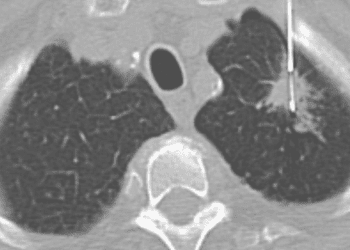
1. Individuals at high risk of lung cancer stand to benefit from screening with low-dose CT, whereas those at low risk of lung cancer do not. 

Evidence Rating Level: 1 (Excellent)     

Study Rundown: The National Lung Screening Trial (NLST) identified individuals at high risk of lung cancer by the following criteria: 55 to 74 years old, smoking history of 30 pack-years or more and 15 years or less since quitting. In this group, screening with low-dose computed tomography (CT) was found to prevent a significant number of lung cancer deaths compared to conventional radiography.

Most agree that screening should be reserved for those at high risk since they stand to benefit most. For any screening test, sensitivity and specificity are key parameters. Does the test detect tumors reliably without generating excessive false positives? Additionally, the prevalence of disease in the screened population must be considered. A positive test in a population with high disease prevalence is more meaningful than a positive test in a low-prevalence population because the former is less likely to be a false alarm.

In this study, the authors revisit the NLST data and stratify patients into quintiles of risk in order to demonstrate empirically that low-dose CT screening is best applied to patients at high risk for lung cancer.

RELATED REPORTS

Guideline-based lymph node sampling is not associated with increased postoperative complications in lung cancer

2 Minute Medicine Rewind June 8, 2026

Why Pfizer Is Looking East for Its Next Generation of Cancer Drugs

Click to read the study, published today in NEJM

Relevant Reading: The National Lung Screening Trial: Overview and Study Design

In-Depth [statistical study]: First, the authors developed a risk-prediction model to stratify the NLST participants into risk quintiles, with the highest-risk quintile having a 2.00% 5-year risk of lung cancer mortality and the lowest-risk quintile having an 0.15 to 0.55% risk. This model was validated against data from the PLCO trial (another cancer screening trial).

After stratifying the participants into these risk quintiles, the authors found, as expected, that there were more lung cancer deaths prevented and fewer false positives in the highest-risk quintile. For comparison, in the lowest-risk group, 5276 individuals had to be screened to prevent a single lung cancer death, whereas in the highest-risk group, only 161 had to be screened.

In light of these findings, the key question for the application of this screening test is how best to identify “high-risk” individuals. The NLST study criteria provide a starting point, but efforts have been made to develop better risk-prediction models in order to optimize the application of the screening test. The goal, as ever, is to maximize deaths prevented while minimizing false positives. A consensus on the best means of risk prediction is yet to emerge.

By Tomi Jun and Mitalee Patil

More from this author: Early risk factor for progression of cystic fibrosis identified, Gut microbes implicated in stroke and heart attacks: new dietary link, New leukemia mutation offers therapeutic targets, Childhood ADHD associated with increased risk of suicide, A marker of aggressive liver cancer and potential therapeutic target identified   

© 2013 2minutemedicine.com. All rights reserved. No works may be reproduced without expressed written consent from 2minutemedicine.com. Disclaimer: We present factual information directly from peer reviewed medical journals. No post should be construed as medical advice and is not intended as such by the authors, editors, staff or by 2minutemedicine.com. PLEASE SEE A HEALTHCARE PROVIDER IN YOUR AREA IF YOU SEEK MEDICAL ADVICE OF ANY SORT.  

Tags: cancercancer screeningCT scanhealthlung canceroncology
Previous Post

Radium-223 prolongs survival in metastatic prostate cancer patients

Next Post

Pancreatic islet autotransplantation a potential treatment for malignant disease

RelatedReports

Lessons from real-world implementation of lung cancer screening
Chronic Disease

Guideline-based lymph node sampling is not associated with increased postoperative complications in lung cancer

June 9, 2026
Weekly Rewinds

2 Minute Medicine Rewind June 8, 2026

June 8, 2026
Quick Take: Effect of Pregabalin on Radiotherapy-Related Neuropathic Pain in Patients With Head and Neck Cancer: A Randomized Controlled Trial
Oncology

Why Pfizer Is Looking East for Its Next Generation of Cancer Drugs

June 4, 2026
2 Minute Medicine: Pharma Roundup: Price Hikes, Breakthrough Approvals, Legal Showdowns, Biotech Expansion, and Europe’s Pricing Debate [May 12nd, 2025]
Pharma

2MM: Pharma Roundup – Pfizer’s $10.5B Innovent oncology partnership, Guselkumab (Tremfya) gains a broader psoriatic arthritis label, Venetoclax (Venclyxto) expands first-line CLL options, and Seladelpar (Livdelzi) advances in primary biliary cholangitis

June 3, 2026
Next Post
Pancreatic islet autotransplantation a potential treatment for malignant disease

Pancreatic islet autotransplantation a potential treatment for malignant disease

Dementia prevalence declining in the UK

Dementia prevalence declining in the UK

Recent surgery, operative times increase complications of knee arthroscopy

Recent surgery, operative times increase complications of knee arthroscopy

2 Minute Medicine® is an award winning, physician-run, expert medical media company. Our content is curated, written and edited by practicing health professionals who have clinical and scientific expertise in their field of reporting. Our editorial management team is comprised of highly-trained MD physicians. Join numerous brands, companies, and hospitals who trust our licensed content.

Recent Reports

  • High intake of sugar-sweetened beverages is associated with increased risk of hepatocellular carcinoma
  • Pediatric hospitals adopt generative AI for documentation and care coordination
  • Hospitals face a new test of artificial intelligence governance
License Content
Terms of Use | Disclaimer
Cookie Policy
Privacy Statement (EU)
Disclaimer
  • Specialties
    • All Specialties, All Recent Reports
    • Cardiology
    • Chronic Disease
    • Dermatology
    • Emergency
    • Endocrinology
    • Gastroenterology
    • Imaging and Intervention
    • Infectious Disease
    • Nephrology
    • Neurology
    • Obstetrics
    • Oncology
    • Ophthalmology
    • Pediatrics
    • Pharma
    • Preclinical
    • Psychiatry
    • Public Health
    • Pulmonology
    • Rheumatology
    • Surgery
  • Tools
    • EvidencePulse™
    • RVU Search
    • NPI Registry Lookup
  • Pharma
  • AI News
  • The Scan
  • Classics™
    • 2MM+ Online Access
    • Paperback and Ebook
  • Rewinds
  • Partners
    • License Content
    • Submit Press Release
    • Advertise with Us
  • Account
    • Subscribe
    • Sign-in
    • My account
No Result
View All Result

© 2026 2 Minute Medicine, Inc. - Physician-written medical news.