• About
  • Masthead
  • License Content
  • Advertise
  • Press Releases
  • Newsroom
  • RSS/Email List
  • 2MM Podcast
  • Write for us
  • Contact Us
2 Minute Medicine
No Result
View All Result

No products in the cart.

Sign in
SUBSCRIBE
  • About
  • Specialties
    • All Specialties, All Recent Reports
    • Cardiology
    • Chronic Disease
    • Dermatology
    • Emergency
    • Endocrinology
    • Gastroenterology
    • Imaging and Intervention
    • Infectious Disease
    • Nephrology
    • Neurology
    • Obstetrics
    • Oncology
    • Ophthalmology
    • Pediatrics
    • Pharma
    • Preclinical
    • Psychiatry
    • Public Health
    • Pulmonology
    • Rheumatology
    • Surgery
    • Rewinds
    • The Scan
  • EvidencePulse™
  • HypeCheck™
  • AI News
  • Classics™
    • 2MM+ Online Access
    • Paperback and Ebook
  • Tools
    • NPI Registry Lookup
    • RVU Search
    • Physician Pay by Specialty
    • ICD-10 Code Lookup
    • FDA Drug Approvals
    • Drug Safety for Breastfeeding/Pregnancy
    • Clinical Guidelines
    • Medical Calculators
    • ECG Reference
      • QTc Calculator
      • Sgarbossa Criteria
      • ECG Axis Calculator
      • AV Block Helper
  • Rankings
    • Medical School Rankings
    • Residency Rankings
  • Partners
    • License Content
    • Advertise with Us
2 Minute Medicine
  • About
  • Specialties
    • All Specialties, All Recent Reports
    • Cardiology
    • Chronic Disease
    • Dermatology
    • Emergency
    • Endocrinology
    • Gastroenterology
    • Imaging and Intervention
    • Infectious Disease
    • Nephrology
    • Neurology
    • Obstetrics
    • Oncology
    • Ophthalmology
    • Pediatrics
    • Pharma
    • Preclinical
    • Psychiatry
    • Public Health
    • Pulmonology
    • Rheumatology
    • Surgery
    • Rewinds
    • The Scan
  • EvidencePulse™
  • HypeCheck™
  • AI News
  • Classics™
    • 2MM+ Online Access
    • Paperback and Ebook
  • Tools
    • NPI Registry Lookup
    • RVU Search
    • Physician Pay by Specialty
    • ICD-10 Code Lookup
    • FDA Drug Approvals
    • Drug Safety for Breastfeeding/Pregnancy
    • Clinical Guidelines
    • Medical Calculators
    • ECG Reference
      • QTc Calculator
      • Sgarbossa Criteria
      • ECG Axis Calculator
      • AV Block Helper
  • Rankings
    • Medical School Rankings
    • Residency Rankings
  • Partners
    • License Content
    • Advertise with Us
Sign in
SUBSCRIBE
2 Minute Medicine
Sign in
Subscribe
2 Minute MedicineFree on Google PlayGet
✦EvidencePulse™by 2 Minute Medicine3 reportsYou askedtop stroke trials 2026Synthesizing medical evidence...Top 2026 stroke trial results:OCEANIC — ischemic stroke: 6.2% vs 8.4%OPTION* — mRS 0–1: 43.6% vs 34.2%ORIENTAL* — mRS 0–2: 58.6% vs 46.6%*Higher sICH in intervention armsParticipants randomizedNOCEANIC12,327OPTION570ORIENTAL564Ask about guidelines or landmark trials...↑Try EvidencePulse™Ask the evidence. Get the signal.Try it now →
Home All Specialties

High intake of sugar-sweetened beverages is associated with increased risk of hepatocellular carcinoma
bySiwen LiuandSimon Pan
June 19, 2026
in All Specialties, Chronic Disease, Endocrinology, Gastroenterology, Oncology
Reading Time: 3 mins read
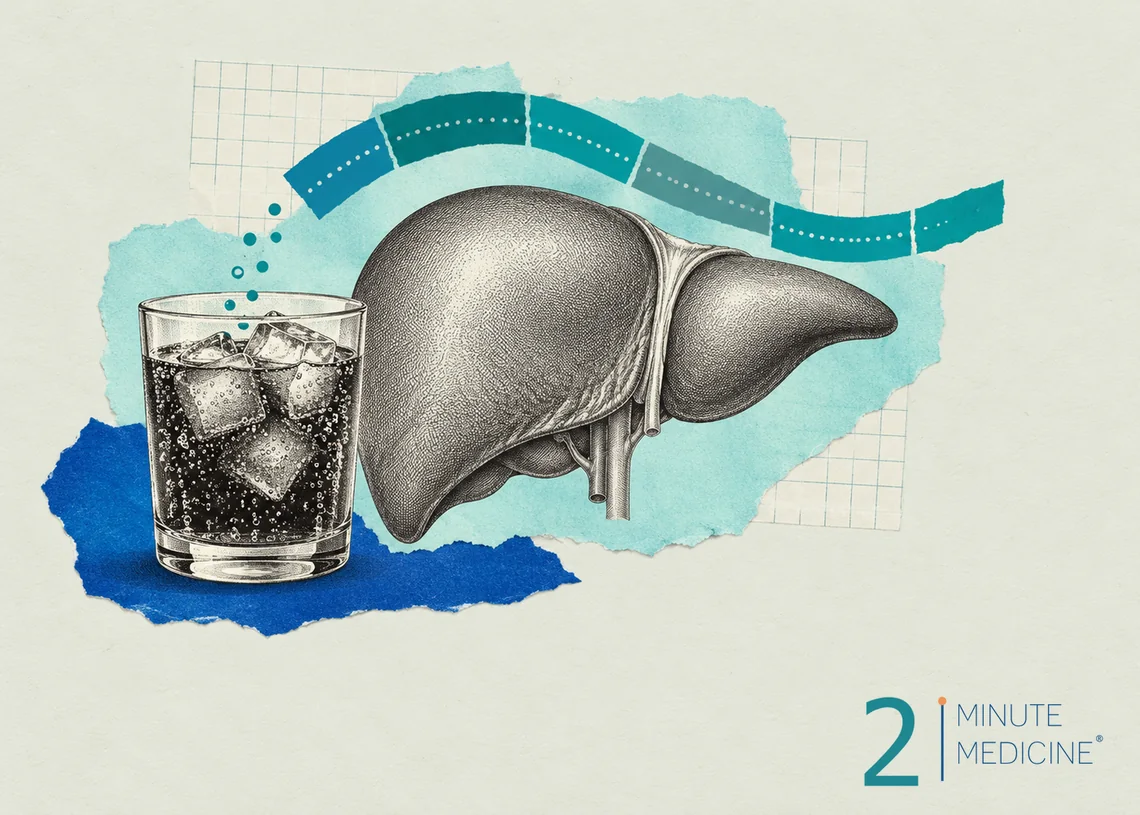
Sugary drinks and liver cancer collage: an engraved liver beside a glass of dark fizzy drink with ice and rising bubbles
Share on FacebookShare on TwitterShare on LinkedIn

1. Increased intake of sugar-sweetened beverages was associated with increased risk of hepatocellular carcinoma and intrahepatic cholangiocarcinoma, while intake of artificially sweetened beverages was not associated with liver cancer risk overall or by subtype. 

Evidence Rating Level: 2 (Good)

Study Rundown: Liver cancer is among the leading causes of cancer mortality worldwide. Consumption of artificially sweetened beverages (ASBs) and sugar-sweetened beverages (SSBs) has been associated with metabolic disorders such as obesity and type 2 diabetes, which are established risk factors for liver cancer. However, research on the association between beverage consumption and liver cancer subtypes remains limited and inconsistent. This study thus investigated the associations between ASB and SSB consumption and risk of incident liver cancer overall and by subtype. This was a pooled analysis of 11 prospective cohort studies from the US and Europe that included adults without a history of cancer at baseline. The exposures were self-reported intake of ASB and SSB assessed at baseline. The main outcomes were incident liver cancer overall and by subtype (hepatocellular carcinoma [HCC] and intrahepatic cholangiocarcinoma [ICC]). In total, 1,518,411 participants were analyzed. ASB intake per 1-beverage/day increase was not associated with total liver cancer risk, HCC, or ICC. SSB intake per 1-beverage/day increase was not associated with total liver cancer risk but was associated with a 10% increased risk of HCC and 15% increased risk of ICC. Overall, this study found that increased SSB intake was associated with increased risk of HCC and ICC, while ASB intake was not associated with liver cancer risk overall or by subtype. 

Click to read the study in JAMA Network Open Medicine 

Relevant reading: Consumption of soft drinks and juices and risk of liver and biliary tract cancers in a European cohort

In-Depth [Prospective cohort study]:

RELATED REPORTS

Male sex is associated with higher mortality among patients with hepatocellular carcinoma

Weight loss is associated with improved vascular function in patients with metabolic dysfunction-associated steatotic liver disease

This pooled analysis of 11 prospective cohort studies (10 US and 1 European) included adults without a history of cancer at baseline. Across cohorts, participants were enrolled between 1980 and 2009 and followed up through end-of-study dates ranging from 2000 to 2019. The exposures were self-reported intake of ASB and SSB assessed at baseline using food frequency questionnaires. Participants were followed up via state cancer registries or follow-up surveys for incident liver cancer. The main outcomes were incident liver cancer overall and by subtype (HCC and ICC) identified through cancer registries or medical record review. In total, 1,518,411 participants (mean [SD] age, 57.8 [10.1] years; 883,832 female [58.2%]) were analyzed, and 2,811 incident liver cancer cases were reported (1,699 HCC and 444 ICC cases) during a median (IQR) of 17.8 (12.8–23.5) years of follow-up. After adjusting for confounders, ASB intake per 1-beverage/day increase was not associated with total liver cancer risk, HCC (10 cohorts), or ICC (6 cohorts). SSB intake per 1-beverage/day increase was not associated with total liver cancer risk but was associated with a 10% increased risk of HCC (HR, 1.10; 95% CI, 1.03-1.18; 10 cohorts) and 15% increased risk of ICC (HR, 1.15; 95% CI, 1.00-1.32; 6 cohorts). Overall, this study found that increased SSB consumption was associated with increased risk of HCC and ICC, while ASB intake was not associated with liver cancer risk overall or by subtype. These findings do not strongly support previously suggested associations between ASB and liver cancer, specifically aspartame and HCC. However, these findings suggest that reducing the consumption of SSB may be beneficial in lowering the risk of liver cancer. Some strengths of this study include a large study sample consisting of cohorts in the US and Europe, with long follow-up, and the analysis of cohorts using harmonized data. Some limitations of this study include self-reported intakes of ASB and SSB from dietary assessments, which are prone to measurement error; measuring ASB and SSB intake at only 1 point, which may not capture changes in consumption over time; the presence of residual confounding, such as underlying liver disease; and the presence of heterogeneity between cohorts despite harmonizing data. Future studies in other populations should confirm study findings and address these limitations.

Image: PD

©2026 2 Minute Medicine, Inc. All rights reserved. No works may be reproduced without expressed written consent from 2 Minute Medicine, Inc. Inquire about licensing here. No article should be construed as medical advice and is not intended as such by the authors or by 2 Minute Medicine, Inc. 

Tags: Gastroenterologyhepatocellular carcinomasugar sweetened beveragessweetener
Previous Post

Pediatric hospitals adopt generative AI for documentation and care coordination

Next Post

The Scan by 2 Minute Medicine®: celebrity whole-body MRI craze floods clinics, cruise ship hantavirus outbreak prompts global tracing, “Ozempic personality” raises new questions, and TikTok’s “cortisol face” trend drives endocrine workups

RelatedReports
A liver illustration with spilled sugar cubes and two drink cups, highlighting the link between sugary drinks and liver health.
Chronic Disease

Male sex is associated with higher mortality among patients with hepatocellular carcinoma

October 7, 2026
Fatty liver disease may independently predict high-risk coronary disease
Cardiology

Weight loss is associated with improved vascular function in patients with metabolic dysfunction-associated steatotic liver disease

August 21, 2026
Quick Take: Diagnostic Yield of One-Time Colonoscopy vs One-Time Flexible Sigmoidoscopy vs Multiple Rounds of Mailed Fecal Immunohistochemical Tests in Colorectal Cancer Screening
Chronic Disease

Male sex and hispanic ethnicity are associated with increased risk of early-onset colorectal cancer

June 29, 2026
Colonoscopy collage: a coiled endoscope on blue paper, a tall glass of clear liquid and a folded hospital gown on a stool
Gastroenterology

A lower volume of polyethylene glycol with ascorbate (MoviPrep) may improve bowel cleansing prior to colonoscopy

May 26, 2026
Next Post
The Scan by 2 Minute Medicine®:  Ultra-Trail du Mont-Blanc, Taylor Swift, NBA rookie Chet Holmgren and Magic Mushrooms!

The Scan by 2 Minute Medicine®: celebrity whole-body MRI craze floods clinics, cruise ship hantavirus outbreak prompts global tracing, “Ozempic personality” raises new questions, and TikTok’s “cortisol face” trend drives endocrine workups

Cervical cancer screening practices less cost-effective than suggested guidelines

Delayed CIN2 treatment does not increase cancer risk 

Diabetes collage: a lidded sugar bowl inside a blue paper circle, with a whole apple and a bunch of leafy greens

Telehealth yields modest improvements in diabetes outcomes 

✦ EvidencePulse™ by 2 Minute Medicine 3 reports You asked top stroke trials 2026 Synthesizing medical evidence... Top 2026 stroke trial results: OCEANIC — ischemic stroke: 6.2% vs 8.4% OPTION* — mRS 0–1: 43.6% vs 34.2% ORIENTAL* — mRS 0–2: 58.6% vs 46.6% *Higher sICH in intervention arms Participants randomizedN OCEANIC 12,327 OPTION 570 ORIENTAL 564 Ask about guidelines or landmark trials... Try EvidencePulse™ Get the signal. Try it now → Physician-trained medical AI by 2 Minute Medicine

2MM+ All Access

Full details →
$4.99 /month

3-day free trial · cancel anytime

  • ✓100+ physician-written reports
  • ✓EvidencePulse™ + HypeCheck™
  • ✓Ad-free reading + newsletters
Start 3-day free trial

Then $4.99/month. Manage renewal in your account.

2 Minute Medicine® is an award winning, physician-run, expert medical media company. Our content is curated, written and edited by practicing health professionals who have clinical and scientific expertise in their field of reporting. Our editorial management team is comprised of highly-trained MD physicians. Join numerous brands, companies, and hospitals who trust our licensed content.

Recent Reports

  • Medicaid status, race and ethnicity are independently associated with increased odds of severe maternal morbidity
  • Artificial intelligence-generated pre-visit summaries improved communication outcomes in neurosurgical consultations
  • Midline catheters may reduce catheter-related bloodstream infections compared with peripherally inserted central catheters in intensive care unit patients
License Content
Terms of Use | Disclaimer
Cookie Policy

Get the app

Read 2 Minute Medicine on iPhone, iPad and Android.

Download on the App StoreGet it on Google Play
QR code for www.2minutemedicine.com/app
On a computer? Scan this with your phone’s camera.
2MM+ All Access Full details →

The medical literature, distilled daily.

Monthly plan selected: $4.99 /month.

$4.99/month

3-day free trial · cancel anytime

Start 3-day free trial

Then $4.99/month. Manage renewal in your account.

Yearly plan selected: $49.90 /year.

$49.90/year

2 months free

Start 3-day free trial

Then $49.90/year.

Membership benefits

  • ✓100+ physician-written reports
  • ✓AI EvidencePulse™ + HypeCheck™
  • ✓Ad-free reading + newsletters
  • ✓FDA drug approvals + clinical calculators

Already a member? Sign in

  • Get the app
  • About
  • Specialties
    • All Specialties, All Recent Reports
    • Cardiology
    • Chronic Disease
    • Dermatology
    • Emergency
    • Endocrinology
    • Gastroenterology
    • Imaging and Intervention
    • Infectious Disease
    • Nephrology
    • Neurology
    • Obstetrics
    • Oncology
    • Ophthalmology
    • Pediatrics
    • Pharma
    • Preclinical
    • Psychiatry
    • Public Health
    • Pulmonology
    • Rheumatology
    • Surgery
    • Rewinds
    • The Scan
  • EvidencePulse™
  • HypeCheck™
  • AI News
  • Classics™
    • 2MM+ Online Access
    • Paperback and Ebook
  • Tools
    • NPI Registry Lookup
    • RVU Search
    • Physician Pay by Specialty
    • ICD-10 Code Lookup
    • FDA Drug Approvals
    • Drug Safety for Breastfeeding/Pregnancy
    • Clinical Guidelines
    • Medical Calculators
    • ECG Reference
      • QTc Calculator
      • Sgarbossa Criteria
      • ECG Axis Calculator
      • AV Block Helper
  • Rankings
    • Medical School Rankings
    • Residency Rankings
  • Partners
    • License Content
    • Advertise with Us
No Result
View All Result

© 2026 2 Minute Medicine, Inc. - Physician-written medical news.