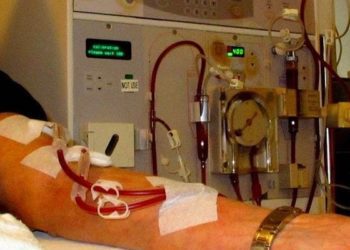
Low bicarbonate replacement fluid may lead to a more stable acid-base profile compared with high bicarbonate replacement fluid during continuous veno-venous hemofiltration

1. Low bicarbonate replacement fluid (LBF) leads to more stable pH and HCO3− compared to high bicarbonate replacement fluid (LBF) during continuous veno-venous hemofiltration (CVVH) with regional citrate anticoagulation (RCA).
Evidence Rating Level: 1 (Excellent)
CVVH (continuous veno-venous hemofiltration) with RCA (regional citrate anticoagulation) causes alkalinization due to the metabolic conversion of citrate to carbonate. Thus, the bicarbonate concentration of the CVVH replacement fluid is a key determinant of systemic pH. However, very few protocols have been published on acid-base changes in CVVH. This prospective, randomized, controlled, cross-over trial randomized 88 patients to receive either LBF (low bicarbonate replacement fluid) (22 mmol/l HCO3−, median [IQR] age, 64.5 [54.5-70.5]; 73% male) or HBF (30 mmol/l HCO3−, median [IQR] age, 64.5 [60.5-73.0]; 64% male) for 48 hours, after which the replacement fluid was switched and treatment was continued for another 48 hours after a 3 hour washout period. The primary endpoint was incidence of pH or HCO3− excursion, defined as pH > 7.45 or HCO3− > 26 mmol/l within 16–48 h of each treatment phase. Patients in the HBF group had a significantly higher incidence of pH (OR 1.78, 95% CI 1.12–2.82; p = 0.015) and HCO3− (OR 3.60, 95% CI 2.16–5.99; p < 0.001) excursions. There was no significant difference in the time to pH (p = 0.102) or HCO3− normalization (p = 0.468). In summary, this study found LBF during CVVH with CRA leads to a more stable acid-base profile in terms of pH and HCO3− compared to HBF. Future research is needed to determine if this translates to improved long-term outcomes.
Click here to read this study in Intensive Care Med
Image: PD
©2025 2 Minute Medicine, Inc. All rights reserved. No works may be reproduced without expressed written consent from 2 Minute Medicine, Inc. Inquire about licensing here. No article should be construed as medical advice and is not intended as such by the authors or by 2 Minute Medicine, Inc.