• About
  • Masthead
  • License Content
  • Advertise
  • Press Releases
  • Newsroom
  • RSS/Email List
  • 2MM Podcast
  • Write for us
  • Contact Us
2 Minute Medicine
No Result
View All Result

No products in the cart.

Sign in
SUBSCRIBE
  • About
  • Specialties
    • All Specialties, All Recent Reports
    • Cardiology
    • Chronic Disease
    • Dermatology
    • Emergency
    • Endocrinology
    • Gastroenterology
    • Imaging and Intervention
    • Infectious Disease
    • Nephrology
    • Neurology
    • Obstetrics
    • Oncology
    • Ophthalmology
    • Pediatrics
    • Pharma
    • Preclinical
    • Psychiatry
    • Public Health
    • Pulmonology
    • Rheumatology
    • Surgery
    • Rewinds
    • The Scan
  • EvidencePulse™
  • HypeCheck™
  • AI News
  • Classics™
    • 2MM+ Online Access
    • Paperback and Ebook
  • Tools
    • NPI Registry Lookup
    • RVU Search
    • Physician Pay by Specialty
    • ICD-10 Code Lookup
    • FDA Drug Approvals
    • Drug Safety for Breastfeeding/Pregnancy
    • Clinical Guidelines
    • Medical Calculators
    • ECG Reference
      • QTc Calculator
      • Sgarbossa Criteria
      • ECG Axis Calculator
      • AV Block Helper
  • Rankings
    • Medical School Rankings
    • Residency Rankings
  • Partners
    • License Content
    • Advertise with Us
2 Minute Medicine
  • About
  • Specialties
    • All Specialties, All Recent Reports
    • Cardiology
    • Chronic Disease
    • Dermatology
    • Emergency
    • Endocrinology
    • Gastroenterology
    • Imaging and Intervention
    • Infectious Disease
    • Nephrology
    • Neurology
    • Obstetrics
    • Oncology
    • Ophthalmology
    • Pediatrics
    • Pharma
    • Preclinical
    • Psychiatry
    • Public Health
    • Pulmonology
    • Rheumatology
    • Surgery
    • Rewinds
    • The Scan
  • EvidencePulse™
  • HypeCheck™
  • AI News
  • Classics™
    • 2MM+ Online Access
    • Paperback and Ebook
  • Tools
    • NPI Registry Lookup
    • RVU Search
    • Physician Pay by Specialty
    • ICD-10 Code Lookup
    • FDA Drug Approvals
    • Drug Safety for Breastfeeding/Pregnancy
    • Clinical Guidelines
    • Medical Calculators
    • ECG Reference
      • QTc Calculator
      • Sgarbossa Criteria
      • ECG Axis Calculator
      • AV Block Helper
  • Rankings
    • Medical School Rankings
    • Residency Rankings
  • Partners
    • License Content
    • Advertise with Us
Sign in
SUBSCRIBE
2 Minute Medicine
Sign in
Subscribe
2 Minute MedicineFree on Google PlayGet
✦EvidencePulse™by 2 Minute Medicine3 reportsYou askedtop stroke trials 2026Synthesizing medical evidence...Top 2026 stroke trial results:OCEANIC — ischemic stroke: 6.2% vs 8.4%OPTION* — mRS 0–1: 43.6% vs 34.2%ORIENTAL* — mRS 0–2: 58.6% vs 46.6%*Higher sICH in intervention armsParticipants randomizedNOCEANIC12,327OPTION570ORIENTAL564Ask about guidelines or landmark trials...↑Try EvidencePulse™Ask the evidence. Get the signal.Try it now →
Home All Specialties Dermatology

Narrow margin excision of T1a melanoma not associated with recurrence or melanoma-specific mortality
byAliyah KingandYuchen Dai
June 1, 2023
in Dermatology, Oncology
Reading Time: 3 mins read
Melanoma immunohistochemical analysis useful to determine BRAFV600E mutation status
Share on FacebookShare on TwitterShare on LinkedIn

1. Wide local excision of T1a melanoma near critical structures with narrow (5-mm) margins was not associated with worse outcomes.

2. Fewer reconstructive surgeries were found in wide local excision of T1a melanoma near critical structures with narrow (5-mm) compared to wide (10-mm) margins.

Evidence Rating Level: 2 (Good)

Study Rundown: Surgical excision is recommended for T1 melanoma with 10-mm margins; however, this recommendation may cause additional problems in areas close to critical structures (e.g., the scalp, face, external genitalia, acral, periumbilical, and perineal areas). Thus, this retrospective cohort study compared the outcomes of wide (10-mm) and narrow (5-mm) margin excisions for T1a melanoma near critical areas. Recurrence and melanoma-specific mortality (MSM) rates were extracted from 1,179 patients over the age of 18 diagnosed between 2001 and 2020 from the National Cancer Insitute of Milan, Italy. In addition to local recurrence and MSM, the need for reconstructive surgery defined by excision margin width was explored. Local excision with narrow margins was not associated with an increased risk of local recurrence. Higher risks of recurrence were associated with Breslow thickness greater than 0.4 mm, a mitotic rate greater than 1/mm2, acral lentiginous melanoma subtypes, and lentigo maligna melanoma subtypes. Furthermore, more patients in the wide-excision group required reconstructive surgery. Some strengths of this study included the large cohort of patients and long follow-ups. However, the study is limited by its retrospective nature and how the wide and narrow groups were defined by the patient’s decision to accept or refuse melanoma guideline recommendations. In addition, although all slides were examined according to a common protocol, the histopathological review was not centralized. Overall, the results did not find a significant association between narrow margins and worse outcomes; however, narrow margins were significantly associated with fewer reconstructive surgeries.

Click to read the study in JAMA Dermatology

Relevant Reading: Reducing margins of wide local excision in head and neck melanoma for function and cosmesis: 5-year local recurrence-free survival

RELATED REPORTS

#VisualAbstract: Neoadjuvant Nivolumab and Ipilimumab Improve Outcomes in Resectable Stage III Melanoma

Comparison of surgical modalities in the treatment of Merkel Cell Carcinoma

FDA approvedFor melanoma: Tudriqev (vusolimogene oderparepvec-wtpg), Aug 6, 2026→

In-Depth [retrospective cohort]: The inclusion criteria for this retrospective cohort study included patients aged 18 years or older diagnosed with localized T1a primary cutaneous melanoma of the head, face, acral, external genitalia, periumbilical, and/or perineal areas. Furthermore, the patients were required to have been treated between 2001 and 2020 at the National Cancer Insitute in Milan, Italy. 1,341 patients met the inclusion criteria; however, 162 patients were excluded due to missing data (85; 6.3%), patient history of additional invasive cancer other than basal cell carcinoma (38; 2.8%), patient diagnosis of primary mucosal melanoma (8; 0.6%), and incomplete excision margins after wide local excision (31; 2.3%). Age, sex, tumour site, melanoma subtype, vertical growth phase, Breslow thickness, mitotic rate per square millimetre, Clark level, tumour-infiltrating lymphocytes, lymphovascular invasion, and tumour regression was retrieved from a database for the total of 1,179 patients (median [IQR] age, 50.0 [39.5-63.0] years; female, 610 [51.7%]; male, 569 [49.3%]). Out of the 626 patients (53.1%) who received wide excisions, the linear repair was performed for 434 patients (69.3%)  and flap or graft reconstruction was performed for 192 patients (30.7%). Out of the 554 patients (46.9%) who received narrow excisions, linear repair was performed for 491 patients (88.8%)  and flap or graft reconstruction was performed for 62 patients (11.2%). The wide group had a weighted 10-year MSM of 1.8% (95% CI, 0.8%-4.2%), whereas the narrow group was 4.2% (95% CI, 2.2%-7.9%). The wide group had a weighted 10-year local recurrence rate of 5.7% (95% CI, 3.9%-8.3%), whereas the narrow group was 6.7% (95% CI, 4.7%-9.5%). MSM was found to be worse with Breslow thickness greater than 0.4 mm (subdistribution hazard ratio [sHR] for 0.6 vs 0.4 mm, 2.42; 95% CI, 1.59-3.68; P < .001) and with a mitotic rate greater than 1/mm2 (sHR for a single increment, 3.35; 95% CI, 2.59-4.32; P < .001). Through a multivariable analysis, the incidence of local recurrence was associated with acral lentiginous melanoma, lentigo maligna melanoma, and increasing Breslow thickness. 62 patients (11.2%) in the narrow group and 192 (30.7%) in the wide group required reconstructive surgery (P < .001), suggesting that narrow margins may reduce scarring, poor healing, infection, and mental issues occurring with excisions close to critical areas. Overall, this retrospective cohort study found that treating primary T1a melanomas with narrow 5-mm margins was not significantly associated with worse outcomes; however, it was significantly associated with fewer reconstructive surgeries.

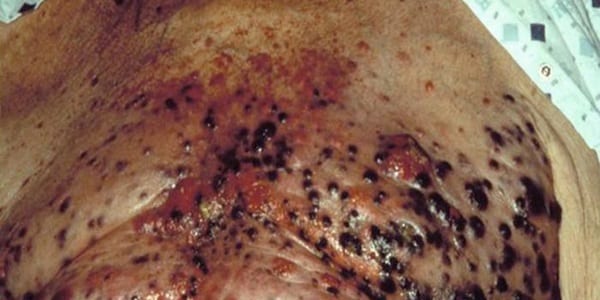
Image: PD

©2023 2 Minute Medicine, Inc. All rights reserved. No works may be reproduced without expressed written consent from 2 Minute Medicine, Inc. Inquire about licensing here. No article should be construed as medical advice and is not intended as such by the authors or by 2 Minute Medicine, Inc.

Tags: Acral lentiginous melanomamalignant melanomanarrow margin excisionT1a melanomawide local excision
Previous Post

Prostate cancer overscreening persists despite guideline changes

Next Post

Development of a probability model for bleeding after pediatric tonsillectomy

RelatedReports

#VisualAbstract: Neoadjuvant Nivolumab and Ipilimumab Improve Outcomes in Resectable Stage III Melanoma
Chronic Disease

#VisualAbstract: Neoadjuvant Nivolumab and Ipilimumab Improve Outcomes in Resectable Stage III Melanoma

June 18, 2024
Basal cell carcinoma collage: a drawing of skin layers with the basal layer in teal, a sun hat, sunscreen and a magnifier
Dermatology

Comparison of surgical modalities in the treatment of Merkel Cell Carcinoma

September 9, 2023
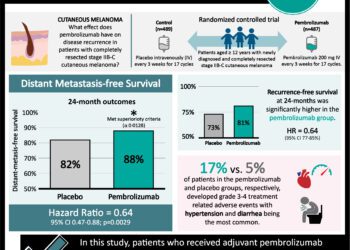
#VisualAbstract: Adjuvant pembrolizumab improves distant  metastasis-free survival in stage IIB-C melanoma
StudyGraphics

#VisualAbstract: Adjuvant pembrolizumab improves distant metastasis-free survival in stage IIB-C melanoma

February 13, 2023
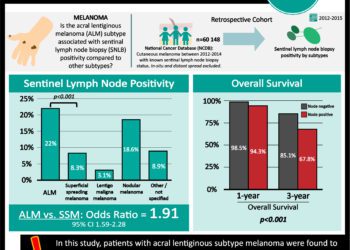
#VisualAbstract: Acral lentiginous melanoma may be associated with higher rates of sentinel lymph node positivity compared to other melanoma subtypes
StudyGraphics

#VisualAbstract: Acral lentiginous melanoma may be associated with higher rates of sentinel lymph node positivity compared to other melanoma subtypes

January 11, 2022
Next Post

Development of a probability model for bleeding after pediatric tonsillectomy

Collage of an older man beside an engraved heart with a small pacemaker and its thin wires, and a steady teal ribbon

Early detection and treatment of cardiac implantable electronic device-related infections associated with reduced mortality

Cardiac magnetic resonance tissue biomarkers unlikely to identify cancer therapy-related cardiac dysfunction in patients with breast cancer

✦ EvidencePulse™ by 2 Minute Medicine 3 reports You asked top stroke trials 2026 Synthesizing medical evidence... Top 2026 stroke trial results: OCEANIC — ischemic stroke: 6.2% vs 8.4% OPTION* — mRS 0–1: 43.6% vs 34.2% ORIENTAL* — mRS 0–2: 58.6% vs 46.6% *Higher sICH in intervention arms Participants randomizedN OCEANIC 12,327 OPTION 570 ORIENTAL 564 Ask about guidelines or landmark trials... Try EvidencePulse™ Get the signal. Try it now → Physician-trained medical AI by 2 Minute Medicine

2MM+ All Access

Full details →
$4.99 /month

3-day free trial · cancel anytime

  • ✓100+ physician-written reports
  • ✓EvidencePulse™ + HypeCheck™
  • ✓Ad-free reading + newsletters
Start 3-day free trial

Then $4.99/month. Manage renewal in your account.

2 Minute Medicine® is an award winning, physician-run, expert medical media company. Our content is curated, written and edited by practicing health professionals who have clinical and scientific expertise in their field of reporting. Our editorial management team is comprised of highly-trained MD physicians. Join numerous brands, companies, and hospitals who trust our licensed content.

Recent Reports

  • Medicaid status, race and ethnicity are independently associated with increased odds of severe maternal morbidity
  • Artificial intelligence-generated pre-visit summaries improved communication outcomes in neurosurgical consultations
  • Midline catheters may reduce catheter-related bloodstream infections compared with peripherally inserted central catheters in intensive care unit patients
License Content
Terms of Use | Disclaimer
Cookie Policy

Get the app

Read 2 Minute Medicine on iPhone, iPad and Android.

Download on the App StoreGet it on Google Play
QR code for www.2minutemedicine.com/app
On a computer? Scan this with your phone’s camera.
2MM+ All Access Full details →

The medical literature, distilled daily.

Monthly plan selected: $4.99 /month.

$4.99/month

3-day free trial · cancel anytime

Start 3-day free trial

Then $4.99/month. Manage renewal in your account.

Yearly plan selected: $49.90 /year.

$49.90/year

2 months free

Start 3-day free trial

Then $49.90/year.

Membership benefits

  • ✓100+ physician-written reports
  • ✓AI EvidencePulse™ + HypeCheck™
  • ✓Ad-free reading + newsletters
  • ✓FDA drug approvals + clinical calculators

Already a member? Sign in

  • Get the app
  • About
  • Specialties
    • All Specialties, All Recent Reports
    • Cardiology
    • Chronic Disease
    • Dermatology
    • Emergency
    • Endocrinology
    • Gastroenterology
    • Imaging and Intervention
    • Infectious Disease
    • Nephrology
    • Neurology
    • Obstetrics
    • Oncology
    • Ophthalmology
    • Pediatrics
    • Pharma
    • Preclinical
    • Psychiatry
    • Public Health
    • Pulmonology
    • Rheumatology
    • Surgery
    • Rewinds
    • The Scan
  • EvidencePulse™
  • HypeCheck™
  • AI News
  • Classics™
    • 2MM+ Online Access
    • Paperback and Ebook
  • Tools
    • NPI Registry Lookup
    • RVU Search
    • Physician Pay by Specialty
    • ICD-10 Code Lookup
    • FDA Drug Approvals
    • Drug Safety for Breastfeeding/Pregnancy
    • Clinical Guidelines
    • Medical Calculators
    • ECG Reference
      • QTc Calculator
      • Sgarbossa Criteria
      • ECG Axis Calculator
      • AV Block Helper
  • Rankings
    • Medical School Rankings
    • Residency Rankings
  • Partners
    • License Content
    • Advertise with Us
No Result
View All Result

© 2026 2 Minute Medicine, Inc. - Physician-written medical news.