

Patient Basics: Bell’s Palsy
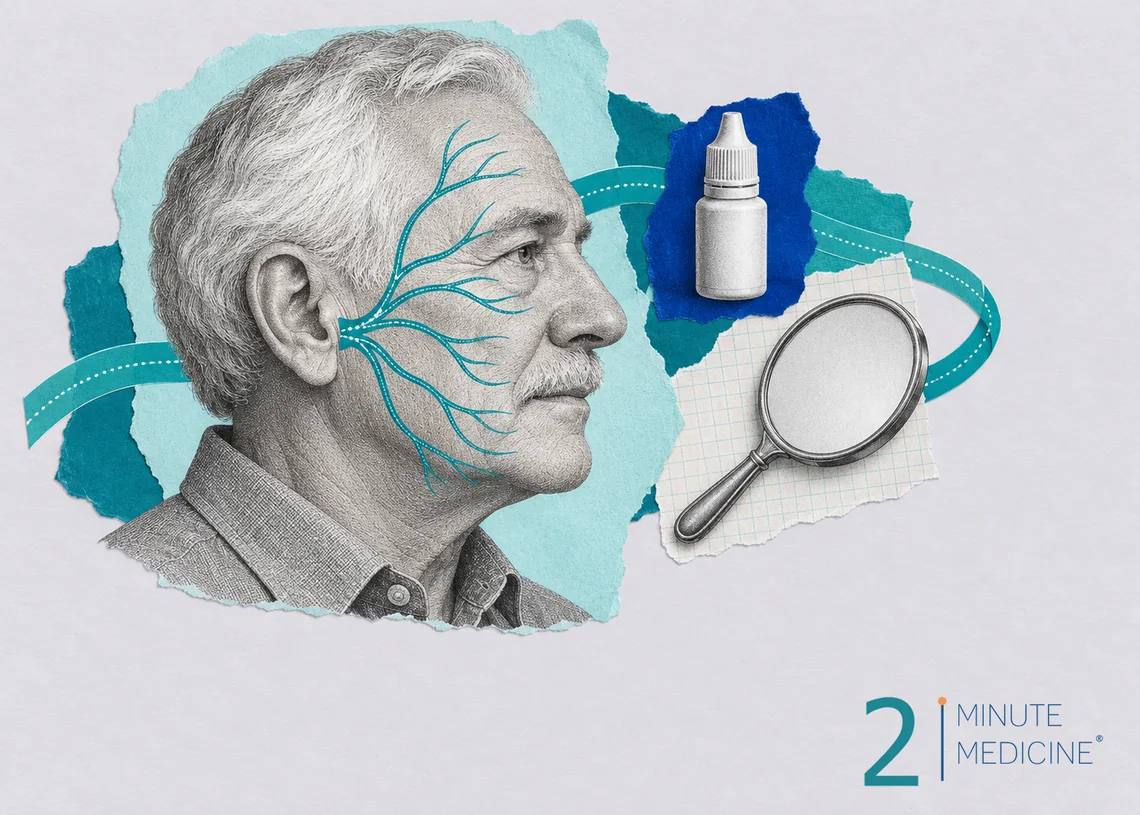
Bell’s palsy is sudden weakness or drooping of the muscles on half of the face, from a problem with the nerve that controls them. It comes on over a day or two and can make it hard to close one eye or smile evenly. Most people recover fully within a few months, and steroid pills started within three days improve the odds. Because a stroke can look similar, any new facial drooping needs a doctor’s check right away.
Key points
- Call 911 if facial drooping comes with weakness in an arm or leg, trouble speaking, confusion or a severe headache.
- Bell’s palsy is likely caused by swelling of the facial nerve, often after a viral infection.
- Steroid pills such as prednisone work best when started within 72 hours.
- Protecting the eye from drying out is an important part of care.
- Most people start to improve within 2 to 3 weeks.
What causes Bell’s palsy
The facial nerve runs from the brain through a narrow bony tunnel in the skull, then fans out across the side of the face. Its branches control blinking, smiling, raising the eyebrows and closing the lips. If the nerve swells inside that tunnel, it gets squeezed and stops sending signals well.
The swelling is thought to be set off by a virus in many cases, most often herpes simplex, the cold sore virus. Bell’s palsy is more common:
- During late pregnancy and in the first week after giving birth
- In people with diabetes, high blood pressure or obesity
- After a cold or flu
- Between the ages of about 15 and 60
Cold drafts or sleeping near an open window don’t cause it.
Doctors call it Bell’s palsy only when no other cause is found. Facial weakness can also come from a stroke, Lyme disease, Ramsay Hunt syndrome (shingles near the ear, with a painful rash or blisters on or inside the ear), ear infections and, rarely, tumors.
Symptoms of Bell’s palsy
- Weakness or paralysis on one side of the face, coming on over hours to two or three days
- A drooping corner of the mouth and drooling
- Trouble closing one eye or blinking, with a dry or watery eye
- Not being able to raise the eyebrow or wrinkle the forehead on that side
- Pain behind or around the ear, sometimes a day or two before the weakness
- Food tasting different on one side of the tongue
- Sounds seeming louder in one ear
- Food getting trapped in the cheek
Bell’s palsy affects only the face. Weakness in the arms or legs, slurred or confused speech, or trouble walking points to another problem, such as a stroke.
How it’s diagnosed
A doctor examines your face, ears, eyes and the rest of your nervous system. One clue is the forehead. In Bell’s palsy, the whole side of the face is weak, including the forehead. In a stroke, the forehead often still moves. You may have a blood test for Lyme disease if it’s common where you live, and a blood sugar test. A CT or MRI scan is done if anything is unusual, such as both sides being weak, weakness that builds slowly over weeks, other nerve problems, or no improvement after a few months.
Bell’s palsy treatment
Steroids
A short course of a steroid such as prednisone, usually for about a week to 10 days, reduces nerve swelling and raises the chance of full recovery. It helps most when started within 72 hours of the first symptoms. Steroids can raise blood sugar, so people with diabetes need closer checks.
Antiviral medicine
Doctors sometimes add valacyclovir or acyclovir for severe weakness. The extra benefit is small at best, and antivirals alone don’t help.
Eye care
If your eye doesn’t close fully, it can dry out and get scratched. To protect it:
- Use lubricating eye drops (artificial tears) often during the day.
- Use a thicker eye ointment at night, and tape the eyelid closed or wear an eye patch or moisture shield.
- Wear wraparound glasses or sunglasses outdoors to block wind and dust.
- See a doctor promptly if the eye becomes red or painful or your vision changes.
Care at home
- Take small bites, chew on the stronger side, and drink through a straw if that’s easier.
- Rinse your mouth after meals to clear food from the weak cheek.
- Do gentle facial exercises and massage in front of a mirror, as a physical therapist shows you.
- Use a warm cloth and an over-the-counter pain reliever for ear pain.
If recovery is slow
A facial therapy specialist can help retrain muscles. Botulinum toxin shots can ease tight muscles or unwanted movements. For lasting weakness, surgery can help the eyelid close or restore movement.
Recovery
Most people notice improvement within 2 to 3 weeks and are close to normal within about 3 months, though some take up to 6 months. Even without treatment, about 7 in 10 people recover completely, and more do with early steroids. Some are left with mild weakness, a tear when eating, or linked movements, such as the eye closing a little when they smile. Bell’s palsy comes back in a small share of people, sometimes on the other side.
When to see a doctor
Call 911 if facial drooping comes with weakness or numbness in an arm or leg, trouble speaking or understanding, confusion, loss of vision, sudden severe headache, or trouble walking. These are signs of a stroke.
See a doctor the same day for any new weakness of the face, even if it’s mild. Go back if:
- Your eye becomes red, painful or blurry
- A rash or blisters appear around your ear or mouth
- Weakness spreads to both sides or keeps getting worse after a few days
- You see no improvement after about three weeks
Common questions about Bell’s palsy
Is Bell’s palsy dangerous?
Bell’s palsy itself isn’t life-threatening, and most people recover fully. The main risk is damage to an eye that can’t close, so eye protection matters. The bigger danger is mistaking a stroke for Bell’s palsy, which is why sudden facial drooping always needs a prompt medical check.
Is Bell’s palsy painful?
Many people have an ache behind or around the ear, sometimes starting before the face weakens. It usually eases within a week or two. Severe ear pain with a rash or blisters may be Ramsay Hunt syndrome, which needs antiviral treatment, so tell your doctor.
Can children get Bell’s palsy?
Yes, though it’s less common than in adults. Children usually recover well, often faster than adults. Doctors look carefully for other causes in children, such as an ear infection or Lyme disease, and treatment may include steroids and eye protection. Take any child with new facial drooping to a doctor promptly.
What should you not eat with Bell’s palsy?
No foods are known to cause Bell’s palsy or slow recovery, so there’s no special diet to follow. Eating can be messy, though. Soft foods, small bites and chewing on the stronger side help. Very hot drinks can burn a numb lip, so let them cool.
Can Bell’s palsy be prevented?
There’s no known way to prevent Bell’s palsy. Keeping diabetes and blood pressure under control may lower your risk, since both are linked to it. If you’ve had it before, knowing the early signs means you can get steroids started quickly if it comes back.
Questions to ask your doctor
- Are you sure this is Bell’s palsy and not a stroke or another cause?
- Should I take steroids, and do I need an antiviral too?
- How should I protect my eye, day and night?
- Would facial physical therapy help me?
- When should I expect improvement, and what if it doesn’t come?
Learn more
- Bell’s palsy (National Institute of Neurological Disorders and Stroke)
- Bell’s palsy (MedlinePlus, U.S. National Library of Medicine)
This guide is general information and doesn’t replace advice from your own doctor. Last updated October 2026.






 Get the app