• About
  • Masthead
  • License Content
  • Advertise
  • Press Releases
  • Newsroom
  • RSS/Email List
  • 2MM Podcast
  • Write for us
  • Contact Us
2 Minute Medicine
No Result
View All Result

No products in the cart.

Sign in
SUBSCRIBE
  • About
  • Specialties
    • All Specialties, All Recent Reports
    • Cardiology
    • Chronic Disease
    • Dermatology
    • Emergency
    • Endocrinology
    • Gastroenterology
    • Imaging and Intervention
    • Infectious Disease
    • Nephrology
    • Neurology
    • Obstetrics
    • Oncology
    • Ophthalmology
    • Pediatrics
    • Pharma
    • Preclinical
    • Psychiatry
    • Public Health
    • Pulmonology
    • Rheumatology
    • Surgery
    • Rewinds
    • The Scan
  • EvidencePulse™
  • HypeCheck™
  • AI News
  • Classics™
    • 2MM+ Online Access
    • Paperback and Ebook
  • Tools
    • NPI Registry Lookup
    • RVU Search
    • Physician Pay by Specialty
    • ICD-10 Code Lookup
    • FDA Drug Approvals
    • Drug Safety for Breastfeeding/Pregnancy
    • Clinical Guidelines
    • Medical Calculators
    • ECG Reference
      • QTc Calculator
      • Sgarbossa Criteria
      • ECG Axis Calculator
      • AV Block Helper
  • Rankings
    • Medical School Rankings
    • Residency Rankings
  • Partners
    • License Content
    • Advertise with Us
2 Minute Medicine
  • About
  • Specialties
    • All Specialties, All Recent Reports
    • Cardiology
    • Chronic Disease
    • Dermatology
    • Emergency
    • Endocrinology
    • Gastroenterology
    • Imaging and Intervention
    • Infectious Disease
    • Nephrology
    • Neurology
    • Obstetrics
    • Oncology
    • Ophthalmology
    • Pediatrics
    • Pharma
    • Preclinical
    • Psychiatry
    • Public Health
    • Pulmonology
    • Rheumatology
    • Surgery
    • Rewinds
    • The Scan
  • EvidencePulse™
  • HypeCheck™
  • AI News
  • Classics™
    • 2MM+ Online Access
    • Paperback and Ebook
  • Tools
    • NPI Registry Lookup
    • RVU Search
    • Physician Pay by Specialty
    • ICD-10 Code Lookup
    • FDA Drug Approvals
    • Drug Safety for Breastfeeding/Pregnancy
    • Clinical Guidelines
    • Medical Calculators
    • ECG Reference
      • QTc Calculator
      • Sgarbossa Criteria
      • ECG Axis Calculator
      • AV Block Helper
  • Rankings
    • Medical School Rankings
    • Residency Rankings
  • Partners
    • License Content
    • Advertise with Us
Sign in
SUBSCRIBE
2 Minute Medicine
Sign in
Subscribe
2 Minute MedicineFree on Google PlayGet
✦EvidencePulse™by 2 Minute Medicine3 reportsYou askedtop stroke trials 2026Synthesizing medical evidence...Top 2026 stroke trial results:OCEANIC — ischemic stroke: 6.2% vs 8.4%OPTION* — mRS 0–1: 43.6% vs 34.2%ORIENTAL* — mRS 0–2: 58.6% vs 46.6%*Higher sICH in intervention armsParticipants randomizedNOCEANIC12,327OPTION570ORIENTAL564Ask about guidelines or landmark trials...↑Try EvidencePulse™Ask the evidence. Get the signal.Try it now →
Home Health A to Z

Patient Basics: Hydrocephalus (Water on the Brain)
by2 Minute Medicine
October 30, 2026
in Health A to Z
Reading Time: 6 mins read
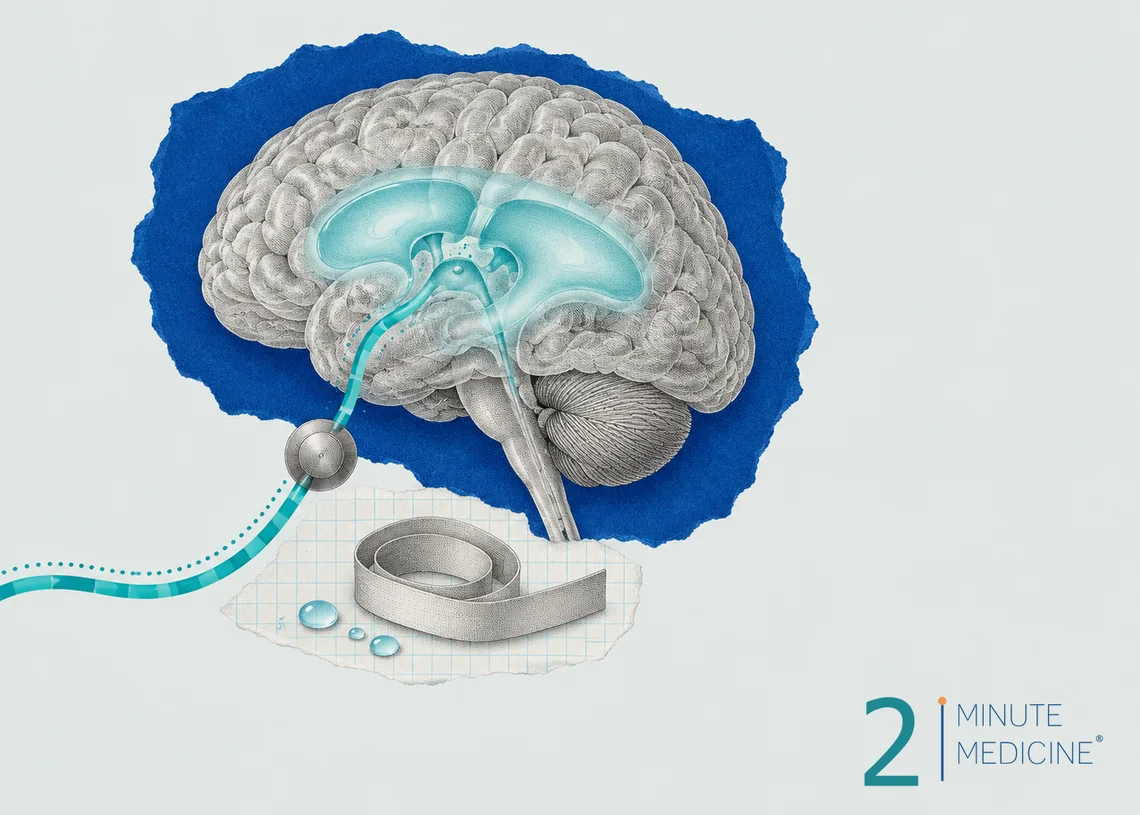
Hydrocephalus collage: a brain with enlarged teal ventricles, a thin shunt tube with a valve, and a blank measuring tape
Share on FacebookShare on TwitterShare on LinkedIn

Hydrocephalus is a buildup of cerebrospinal fluid, the clear fluid that cushions the brain, inside the brain’s hollow spaces (ventricles). The extra fluid stretches the ventricles and presses on the brain. It is often called “water on the brain,” and treatment to drain the fluid can prevent or limit brain damage.

Key points

  • Babies can be born with it, but it can also start at any age, including late in life.
  • In babies, the main sign is a head that grows too fast, often with a bulging soft spot.
  • In older children and adults, headache, vomiting, blurry vision and sleepiness are common signs.
  • In older adults, trouble walking, leaking urine and slower thinking can point to normal pressure hydrocephalus.
  • Most people are treated with a shunt, a thin tube that drains fluid. Shunts can block or get infected, so learn the warning signs.

How brain fluid normally flows

The brain has four connected ventricles. Tissue inside them makes cerebrospinal fluid all day long, about a pint a day in adults. The fluid flows through narrow channels, bathes the outside of the brain and spinal cord, and is then absorbed into the blood. Hydrocephalus happens when this flow is blocked or the fluid isn’t absorbed well, so it builds up.

Types of hydrocephalus

  • Obstructive (non-communicating). Something blocks the flow between the ventricles. A common cause is a narrowed channel between the third and fourth ventricles (aqueductal stenosis). A tumor or cyst can also block it.
  • Communicating. Fluid leaves the ventricles normally but isn’t absorbed well around the brain. This often follows bleeding in or around the brain, meningitis, a head injury or brain surgery.
  • Normal pressure hydrocephalus (NPH). A type of communicating hydrocephalus seen mostly in people over 60. Fluid pressure readings may be close to normal, but the enlarged ventricles still affect walking, bladder control and thinking. Often there is no clear cause.

Doctors also say congenital when it is present at birth and acquired when it develops later.

What causes hydrocephalus

In babies:

  • Aqueductal stenosis
  • Spina bifida, a problem with how the spine forms before birth
  • Bleeding in the brain in babies born very early
  • Infections during pregnancy, such as cytomegalovirus (CMV) or toxoplasmosis
  • Some genetic conditions and differences in how the brain formed

In older children and adults: brain tumors and cysts, bleeding from a burst aneurysm, meningitis, head injury and stroke.

Hydrocephalus isn’t contagious.

RELATED REPORTS

The Scan by 2 Minute Medicine®: Billy Joel’s Brain Condition, Gigi Robinson’s Surgical Advocacy, Climate and Cancer Risk, and West Nile Virus Reaches the United Kingdom

Shunt settings may have little effect on intracranial pressure in hydrocephalus

Hydrocephalus symptoms

In babies

  • A head that is large or grows faster than expected
  • A soft spot (fontanelle) on top of the head that bulges or feels tense
  • Eyes that seem fixed looking downward
  • Vomiting, poor feeding, sleepiness or fussiness
  • Seizures
  • Slow development

In older children and adults

These are signs of raised pressure inside the skull (increased intracranial pressure, or ICP):

  • Headache, often worse in the morning or when lying down
  • Nausea and vomiting
  • Blurry or double vision
  • Sleepiness and confusion
  • Trouble with balance or walking
  • Changes in personality or school work

Normal pressure hydrocephalus

Walking usually changes first. Steps become short and shuffling, and the feet can seem stuck to the floor. Later, people may have a sudden urge to urinate or leak urine, and thinking becomes slow and forgetful. NPH is often mistaken for Parkinson’s disease or dementia.

How hydrocephalus is diagnosed

  • Head size. A baby’s head is measured at every checkup and plotted on a growth chart.
  • Ultrasound. In babies, the scan is done through the soft spot. Hydrocephalus can also be seen on ultrasound before birth.
  • CT or MRI. These scans show enlarged ventricles and often the cause.
  • Eye exam. Swelling at the back of the eye can be a sign of high pressure.
  • Tap test for NPH. A doctor removes some spinal fluid through a needle in the lower back. If walking gets better over the next day or so, a shunt is likely to help.

Hydrocephalus treatment

Shunt

A neurosurgeon places a thin, flexible tube into a ventricle. The tube runs under the skin, usually down to the belly, where the body absorbs the fluid. A valve controls how fast fluid drains. Some valves can be adjusted from outside the head with a magnet. Most people keep their shunt for life.

Endoscopic third ventriculostomy (ETV)

Using a tiny camera, the surgeon makes a small opening in the floor of one ventricle so fluid can flow around a blockage. No tube is left behind. ETV works best for obstructive hydrocephalus.

Treating the cause

Removing a tumor or cyst can sometimes restore normal flow. After a brain bleed or infection, a temporary drain may be used first.

Shunt problems and side effects

Many people need at least one shunt repair over the years. Problems include:

  • Blockage, the most common problem. Symptoms of hydrocephalus come back.
  • Infection, most often in the first few months after surgery. Signs include fever, redness along the tubing and belly pain.
  • Draining too much, which causes headaches when sitting or standing that ease when lying down.
  • A break or disconnection, more likely as children grow.

Keep a record of your shunt type. If your valve can be adjusted, its setting may need checking after an MRI.

Living with hydrocephalus

How well someone does rests largely on the cause and on how early treatment starts. With treatment, many children with hydrocephalus go to school, work and live full lives. Some have learning, attention, vision or movement problems, and early therapy helps. Many older adults with NPH walk better after a shunt, especially when it is placed early. Without treatment, hydrocephalus that keeps worsening can be fatal.

Get emergency care

  • Severe headache with vomiting
  • Being very sleepy or hard to wake
  • A seizure
  • A bulging soft spot in a baby, with vomiting or poor feeding
  • Fever, redness along the tubing or belly pain in someone with a shunt

Common questions about hydrocephalus

Can babies with hydrocephalus survive?

Yes. Most babies treated for hydrocephalus survive, and many grow up with normal or near-normal abilities. How well a child does depends on the cause, other health problems such as spina bifida, and how quickly the fluid is drained. Regular follow-up helps catch shunt problems early.

Why does my baby have a big head?

Many babies have large heads that run in the family and are healthy. Doctors watch how fast the head grows on a chart. A head that grows faster than expected, especially with a bulging soft spot, vomiting, sleepiness or delayed milestones, needs an ultrasound or other scan.

Can hydrocephalus go away?

It rarely goes away by itself, but it can be controlled. An ETV can sometimes solve the problem for good. A shunt keeps fluid draining but usually stays for life. Some temporary cases, such as after a brain bleed, settle once the cause clears.

Can adults get water on the brain?

Yes. Adults can develop hydrocephalus after a head injury, a brain bleed, meningitis or a tumor. Adults over 60 can develop normal pressure hydrocephalus, which causes trouble walking, bladder leaks and memory problems. A shunt can help, especially when the problem is found early.

Questions to ask your doctor

  • What type of hydrocephalus is this, and what caused it?
  • Is a shunt or an ETV better in this case?
  • What are the signs that a shunt isn’t working?
  • How often will we need scans and checkups?
  • What therapy or school support might help?

Learn more

  • Hydrocephalus (National Institute of Neurological Disorders and Stroke)
  • Hydrocephalus (MedlinePlus, U.S. National Library of Medicine)

This guide is general information and doesn’t replace advice from your own doctor. Last updated October 2026.

Tags: hydrocephalus
Previous Post

Patient Basics: Ingrown Toenail

Next Post

Patient Basics: Iron Deficiency

RelatedReports

The Scan by 2 Minute Medicine®:  Ultra-Trail du Mont-Blanc, Taylor Swift, NBA rookie Chet Holmgren and Magic Mushrooms!
The Scan by 2 Minute Medicine®

The Scan by 2 Minute Medicine®: Billy Joel’s Brain Condition, Gigi Robinson’s Surgical Advocacy, Climate and Cancer Risk, and West Nile Virus Reaches the United Kingdom

May 27, 2025
Pre-operative transcranial magnetic stimulation useful for language mapping
Emergency

Shunt settings may have little effect on intracranial pressure in hydrocephalus

June 29, 2014
Next Post
HIV/AIDS collage of engraved immune cells, a looped awareness ribbon, a weekly pill organizer and a mouth swab test kit

Patient Basics: HIV/AIDS

Herniated disk collage: an engraved lower spine with one bulging disk, a teal ribbon along the nerve and a hot water bottle

Patient Basics: Herniated Disk

Collage of an engraved stomach bulging above the diaphragm in a hiatal hernia, a foam wedge pillow and half a lemon

Patient Basics: Hiatal Hernia

✦ EvidencePulse™ by 2 Minute Medicine 3 reports You asked top stroke trials 2026 Synthesizing medical evidence... Top 2026 stroke trial results: OCEANIC — ischemic stroke: 6.2% vs 8.4% OPTION* — mRS 0–1: 43.6% vs 34.2% ORIENTAL* — mRS 0–2: 58.6% vs 46.6% *Higher sICH in intervention arms Participants randomizedN OCEANIC 12,327 OPTION 570 ORIENTAL 564 Ask about guidelines or landmark trials... Try EvidencePulse™ Get the signal. Try it now → Physician-trained medical AI by 2 Minute Medicine

2MM+ All Access

Full details →
$4.99 /month

3-day free trial · cancel anytime

  • ✓100+ physician-written reports
  • ✓EvidencePulse™ + HypeCheck™
  • ✓Ad-free reading + newsletters
Start 3-day free trial

Then $4.99/month. Manage renewal in your account.

NPI Lookup · Free

Look up any US clinician

Search by name or NPI number, live from the CMS NPI Registry.

  • OIG exclusion check
  • Licenses and specialties
  • No account needed
Open NPI Lookup →

2 Minute Medicine® is an award winning, physician-run, expert medical media company. Our content is curated, written and edited by practicing health professionals who have clinical and scientific expertise in their field of reporting. Our editorial management team is comprised of highly-trained MD physicians. Join numerous brands, companies, and hospitals who trust our licensed content.

Recent Reports

  • Non-inpatient care settings may offer alternatives to inpatient beds for select patients
  • Pirtobrutinib improves progression-free survival versus bendamustine plus rituximab in previously untreated CLL/SLL
  • Angiography-derived vessel fractional flow reserve (vFFR) was noninferior to pressure wire–based fractional flow reserve (FFR) for guiding revascularization in intermediate coronary stenoses
License Content
Terms of Use | Disclaimer
Cookie Policy

Get the app

Read 2 Minute Medicine on iPhone, iPad and Android.

Download on the App StoreGet it on Google Play
QR code for www.2minutemedicine.com/app
On a computer? Scan this with your phone’s camera.
2MM+ All Access Full details →

The medical literature, distilled daily.

Monthly plan selected: $4.99 /month.

$4.99/month

3-day free trial · cancel anytime

Start 3-day free trial

Then $4.99/month. Manage renewal in your account.

Yearly plan selected: $49.90 /year.

$49.90/year

2 months free

Start 3-day free trial

Then $49.90/year.

Membership benefits

  • ✓100+ physician-written reports
  • ✓AI EvidencePulse™ + HypeCheck™
  • ✓Ad-free reading + newsletters
  • ✓FDA drug approvals + clinical calculators

Already a member? Sign in

  • Get the app
  • About
  • Specialties
    • All Specialties, All Recent Reports
    • Cardiology
    • Chronic Disease
    • Dermatology
    • Emergency
    • Endocrinology
    • Gastroenterology
    • Imaging and Intervention
    • Infectious Disease
    • Nephrology
    • Neurology
    • Obstetrics
    • Oncology
    • Ophthalmology
    • Pediatrics
    • Pharma
    • Preclinical
    • Psychiatry
    • Public Health
    • Pulmonology
    • Rheumatology
    • Surgery
    • Rewinds
    • The Scan
  • EvidencePulse™
  • HypeCheck™
  • AI News
  • Classics™
    • 2MM+ Online Access
    • Paperback and Ebook
  • Tools
    • NPI Registry Lookup
    • RVU Search
    • Physician Pay by Specialty
    • ICD-10 Code Lookup
    • FDA Drug Approvals
    • Drug Safety for Breastfeeding/Pregnancy
    • Clinical Guidelines
    • Medical Calculators
    • ECG Reference
      • QTc Calculator
      • Sgarbossa Criteria
      • ECG Axis Calculator
      • AV Block Helper
  • Rankings
    • Medical School Rankings
    • Residency Rankings
  • Partners
    • License Content
    • Advertise with Us
No Result
View All Result

© 2026 2 Minute Medicine, Inc. - Physician-written medical news.