
• About
  • Masthead
  • License Content
  • Advertise
  • Press Releases
  • Newsroom
  • RSS/Email List
  • 2MM Podcast
  • Write for us
  • Contact Us
2 Minute Medicine
No Result
View All Result

No products in the cart.

Sign in
SUBSCRIBE
  • About
  • Specialties
    • All Specialties, All Recent Reports
    • Cardiology
    • Chronic Disease
    • Dermatology
    • Emergency
    • Endocrinology
    • Gastroenterology
    • Imaging and Intervention
    • Infectious Disease
    • Nephrology
    • Neurology
    • Obstetrics
    • Oncology
    • Ophthalmology
    • Pediatrics
    • Pharma
    • Preclinical
    • Psychiatry
    • Public Health
    • Pulmonology
    • Rheumatology
    • Surgery
    • Rewinds
    • The Scan
  • EvidencePulse™
  • HypeCheck™
  • AI News
  • Classics™
    • 2MM+ Online Access
    • Paperback and Ebook
  • Tools
    • NPI Registry Lookup
    • RVU Search
    • Physician Pay by Specialty
    • ICD-10 Code Lookup
    • FDA Drug Approvals
    • Drug Safety for Breastfeeding/Pregnancy
    • Clinical Guidelines
    • Medical Calculators
    • ECG Reference
      • QTc Calculator
      • Sgarbossa Criteria
      • ECG Axis Calculator
      • AV Block Helper
  • Rankings
    • Medical School Rankings
    • Residency Rankings
  • Partners
    • License Content
    • Advertise with Us
2 Minute Medicine
  • About
  • Specialties
    • All Specialties, All Recent Reports
    • Cardiology
    • Chronic Disease
    • Dermatology
    • Emergency
    • Endocrinology
    • Gastroenterology
    • Imaging and Intervention
    • Infectious Disease
    • Nephrology
    • Neurology
    • Obstetrics
    • Oncology
    • Ophthalmology
    • Pediatrics
    • Pharma
    • Preclinical
    • Psychiatry
    • Public Health
    • Pulmonology
    • Rheumatology
    • Surgery
    • Rewinds
    • The Scan
  • EvidencePulse™
  • HypeCheck™
  • AI News
  • Classics™
    • 2MM+ Online Access
    • Paperback and Ebook
  • Tools
    • NPI Registry Lookup
    • RVU Search
    • Physician Pay by Specialty
    • ICD-10 Code Lookup
    • FDA Drug Approvals
    • Drug Safety for Breastfeeding/Pregnancy
    • Clinical Guidelines
    • Medical Calculators
    • ECG Reference
      • QTc Calculator
      • Sgarbossa Criteria
      • ECG Axis Calculator
      • AV Block Helper
  • Rankings
    • Medical School Rankings
    • Residency Rankings
  • Partners
    • License Content
    • Advertise with Us
Sign in
SUBSCRIBE
2 Minute Medicine
Sign in
Subscribe
2 Minute MedicineFree on Google PlayGet
✦EvidencePulse™by 2 Minute Medicine3 reportsYou askedtop stroke trials 2026Synthesizing medical evidence...Top 2026 stroke trial results:OCEANIC — ischemic stroke: 6.2% vs 8.4%OPTION* — mRS 0–1: 43.6% vs 34.2%ORIENTAL* — mRS 0–2: 58.6% vs 46.6%*Higher sICH in intervention armsParticipants randomizedNOCEANIC12,327OPTION570ORIENTAL564Ask about guidelines or landmark trials...↑Try EvidencePulse™Ask the evidence. Get the signal.Try it now →
Home Health A to Z

Patient Basics: Presbyopia
by2 Minute Medicine
October 30, 2026
in Health A to Z
Reading Time: 5 mins read
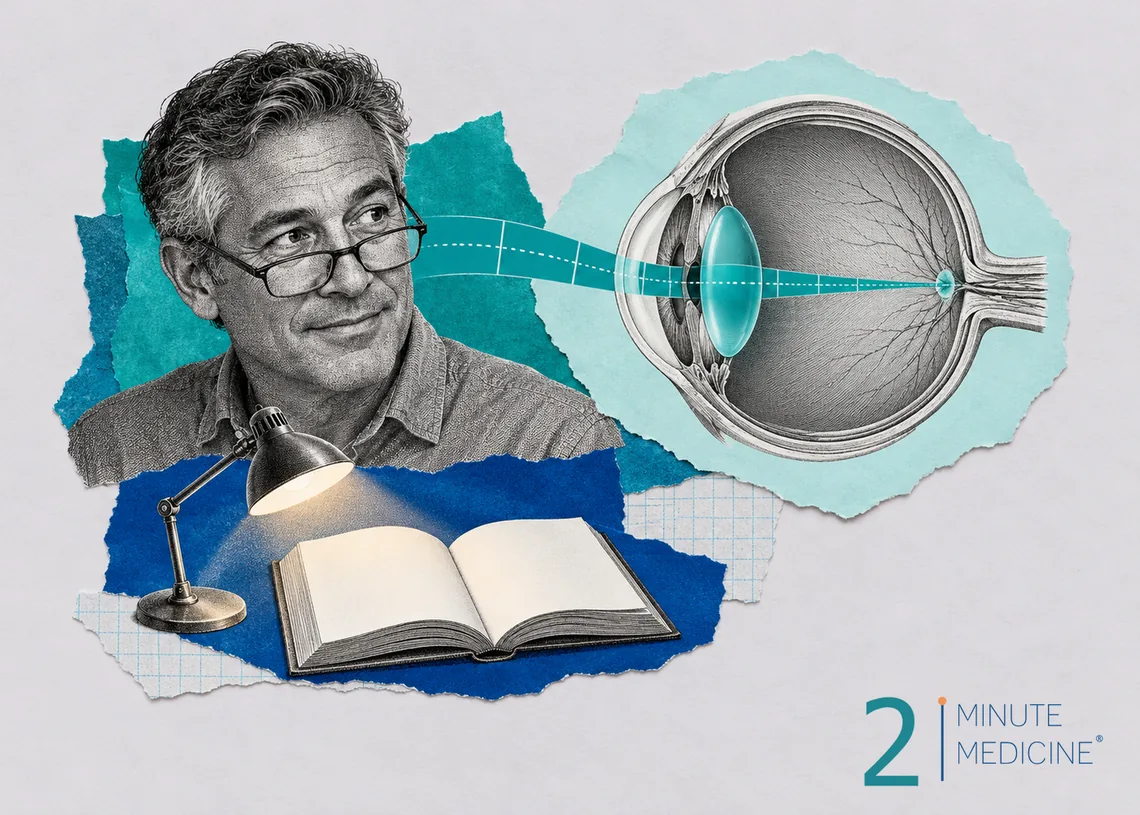
Presbyopia collage: a man in reading glasses, an eye cross-section with its lens in teal, a blank open book and a desk lamp
Share on FacebookShare on TwitterShare on LinkedIn

Presbyopia is the gradual loss of your eyes’ ability to focus on things up close, such as a phone, a menu or small print. It’s a normal part of aging, not a disease, and nearly everyone notices it sometime in their 40s. It gets worse until about age 65 and then levels off. Reading glasses, other types of glasses or contact lenses, eye drops and surgery can all help.

Key points

  • Presbyopia happens because the lens inside the eye stiffens with age and can’t change shape to focus up close.
  • A common first sign is holding things farther away to read them.
  • It affects people whether or not they already wear glasses for distance.
  • Simple reading glasses work for many people. Bifocals, progressive lenses and multifocal contacts are options if you also need distance correction.
  • Have a full eye exam around age 40, since other eye diseases become more common at this age too.

What causes presbyopia

To see clearly up close, a ring of muscle inside the eye tightens, and the lens behind the pupil becomes rounder to bend light more. This is called accommodation. In childhood the lens is soft and changes shape easily. Throughout life, the lens keeps adding layers and slowly gets thicker and stiffer. By your 40s it can’t round up enough, so near objects stay blurry.

Eye exercises, diet and vitamins can’t stop this process. Some things can bring it on a little earlier, such as being farsighted, diabetes, and some medicines that affect focusing, such as certain antidepressants, antihistamines and diuretics.

Presbyopia symptoms

  • Holding books, menus or your phone at arm’s length to read them
  • Blurry print at your normal reading distance
  • Needing brighter light to read
  • Eye strain, tired eyes or headaches after reading or close work
  • Trouble threading a needle or reading small labels

Symptoms are often worse in dim light, in the evening, or when you’re tired.

How presbyopia is diagnosed

An optometrist or ophthalmologist checks your near vision as part of a routine eye exam. You’ll read letters on a chart up close and far away while trying different lenses, and the doctor will measure how much help you need. Most exams include eye drops to widen your pupils, so the doctor can look for other problems that become more common with age, such as glaucoma, cataracts and macular degeneration. Blurry vision can also come from diabetes, so mention any health conditions.

Presbyopia treatment options

Glasses

  • Reading glasses. Store-bought readers work well if you see clearly far away and both eyes need about the same help. They come in different strengths. Pick the weakest pair that lets you read comfortably at your usual distance. Your eye doctor can tell you which strength to try.
  • Prescription readers. These are better if your eyes differ from each other or you have astigmatism.
  • Bifocals. The top of the lens is for distance and a small section at the bottom is for reading.
  • Progressive lenses. These change strength smoothly from top to bottom with no visible line, covering distance, computer and reading ranges. They take a week or two to get used to.
  • Computer or office glasses. These are set for screen and desk distances.

Contact lenses

  • Multifocal contacts have zones for near and far vision in each lens.
  • Monovision uses one contact set for distance in your dominant eye and one for reading in the other. Your brain learns to use the right eye for the task. Depth perception may be a little weaker, which matters for some jobs and sports.

Eye drops

Prescription drops such as pilocarpine make the pupil smaller. Like a camera’s small aperture, this sharpens near vision for several hours. They work best in early presbyopia. Side effects can include headache, red eyes and dimmer vision in low light, so be careful driving at night. Rarely, they’ve been linked to a tear in the retina. They’re not right for people with certain eye conditions.

RELATED REPORTS

No Content Available

Surgery

  • Laser vision correction (LASIK or PRK) can set up monovision, with one eye for distance and one for near.
  • Lens replacement. The eye’s natural lens is removed and replaced with an artificial lens, the same operation used for cataracts. Multifocal or extended-range lenses can reduce the need for glasses at most distances. They can cause glare or halos around lights at night, and some people still use readers for fine print.

Surgery is a permanent choice with small risks, so talk through the trade-offs with an eye surgeon.

Everyday tips

  • Use bright, direct light for reading and close work.
  • Make the text larger on your phone, tablet and computer.
  • Rest your eyes during long reading or screen sessions. Every 20 minutes, look at something about 20 feet away for 20 seconds.
  • Keep a pair of readers wherever you often need them.

When to see an eye doctor

  • You’re having trouble reading or doing close work
  • Your readers no longer seem strong enough
  • You get frequent headaches or eye strain
  • You have diabetes or high blood pressure, which call for regular eye checks

Get care right away for sudden blurry or lost vision, eye pain, double vision, flashes of light, a shower of new floaters, or a shadow over part of your vision. These aren’t signs of presbyopia and can be emergencies.

Common questions about presbyopia

At what age does presbyopia start?

Most people notice it between ages 40 and 45, though it can show up a bit earlier in people who are farsighted. Near vision keeps slipping, and readers need to get stronger every few years, until about 65. After that, the change usually stops.

Is presbyopia the same as farsightedness?

No. Farsightedness (hyperopia) comes from the shape of the eye and is often present from childhood. It can blur both near and distant vision. Presbyopia comes from an aging lens and affects everyone eventually. People who are farsighted tend to notice presbyopia sooner.

Can presbyopia be reversed?

No treatment restores the lens’s natural flexibility, and eye exercises don’t help. Glasses, contacts, eye drops and surgery work around the problem. People who are nearsighted may find they can read without glasses by taking off their distance pair, which is a normal effect.

Are drugstore reading glasses okay to use?

For many people, yes. They don’t harm your eyes, even if the strength isn’t perfect. They may not suit you if your two eyes need different strengths or you have astigmatism, which can cause eye strain. Still get regular eye exams, since readers won’t fix other eye problems.

Questions to ask your doctor

  • What strength of reading glasses should I use?
  • Would progressive lenses or multifocal contacts suit my daily life?
  • Am I a good candidate for presbyopia eye drops?
  • Should I consider lens replacement surgery?
  • How often should I have my eyes checked?

Learn more

  • Presbyopia (National Eye Institute)
  • Presbyopia (MedlinePlus, U.S. National Library of Medicine)

This guide is general information and doesn’t replace advice from your own doctor. Last updated October 2026.

Tags: Presbyopia
Previous Post

Patient Basics: Preeclampsia and Eclampsia

Next Post

Patient Basics: Pneumonia

RelatedReports

No Content Available
Next Post
Pneumonia collage of an older man in a cardigan beside a cluster of lung air sacs, a thermometer and a bowl of soup

Patient Basics: Pneumonia

PCL injury collage: a knee joint drawing with the crossed ligaments, a hinged knee brace, a soccer ball and a crutch

Patient Basics: Posterior Cruciate Ligament (PCL) Injuries

Peripheral artery disease collage: leg arteries drawing, walking shoes, a dotted walking path and a blood pressure cuff

Patient Basics: Peripheral Arterial Disease (PAD)

✦ EvidencePulse™ by 2 Minute Medicine 3 reports You asked top stroke trials 2026 Synthesizing medical evidence... Top 2026 stroke trial results: OCEANIC — ischemic stroke: 6.2% vs 8.4% OPTION* — mRS 0–1: 43.6% vs 34.2% ORIENTAL* — mRS 0–2: 58.6% vs 46.6% *Higher sICH in intervention arms Participants randomizedN OCEANIC 12,327 OPTION 570 ORIENTAL 564 Ask about guidelines or landmark trials... Try EvidencePulse™ Get the signal. Try it now → Physician-trained medical AI by 2 Minute Medicine

2MM+ All Access

Full details →
$4.99 /month

3-day free trial · cancel anytime

  • ✓100+ physician-written reports
  • ✓EvidencePulse™ + HypeCheck™
  • ✓Ad-free reading + newsletters
Start 3-day free trial

Then $4.99/month. Manage renewal in your account.

2 Minute Medicine® is an award winning, physician-run, expert medical media company. Our content is curated, written and edited by practicing health professionals who have clinical and scientific expertise in their field of reporting. Our editorial management team is comprised of highly-trained MD physicians. Join numerous brands, companies, and hospitals who trust our licensed content.

Recent Reports

  • Medicaid status, race and ethnicity are independently associated with increased odds of severe maternal morbidity
  • Artificial intelligence-generated pre-visit summaries improved communication outcomes in neurosurgical consultations
  • Midline catheters may reduce catheter-related bloodstream infections compared with peripherally inserted central catheters in intensive care unit patients
License Content
Terms of Use | Disclaimer
Cookie Policy

Get the app

Read 2 Minute Medicine on iPhone, iPad and Android.

Download on the App StoreGet it on Google Play
QR code for www.2minutemedicine.com/app
On a computer? Scan this with your phone’s camera.
2MM+ All Access Full details →

The medical literature, distilled daily.

Monthly plan selected: $4.99 /month.

$4.99/month

3-day free trial · cancel anytime

Start 3-day free trial

Then $4.99/month. Manage renewal in your account.

Yearly plan selected: $49.90 /year.

$49.90/year

2 months free

Start 3-day free trial

Then $49.90/year.

Membership benefits

  • ✓100+ physician-written reports
  • ✓AI EvidencePulse™ + HypeCheck™
  • ✓Ad-free reading + newsletters
  • ✓FDA drug approvals + clinical calculators

Already a member? Sign in

  • Get the app
  • About
  • Specialties
    • All Specialties, All Recent Reports
    • Cardiology
    • Chronic Disease
    • Dermatology
    • Emergency
    • Endocrinology
    • Gastroenterology
    • Imaging and Intervention
    • Infectious Disease
    • Nephrology
    • Neurology
    • Obstetrics
    • Oncology
    • Ophthalmology
    • Pediatrics
    • Pharma
    • Preclinical
    • Psychiatry
    • Public Health
    • Pulmonology
    • Rheumatology
    • Surgery
    • Rewinds
    • The Scan
  • EvidencePulse™
  • HypeCheck™
  • AI News
  • Classics™
    • 2MM+ Online Access
    • Paperback and Ebook
  • Tools
    • NPI Registry Lookup
    • RVU Search
    • Physician Pay by Specialty
    • ICD-10 Code Lookup
    • FDA Drug Approvals
    • Drug Safety for Breastfeeding/Pregnancy
    • Clinical Guidelines
    • Medical Calculators
    • ECG Reference
      • QTc Calculator
      • Sgarbossa Criteria
      • ECG Axis Calculator
      • AV Block Helper
  • Rankings
    • Medical School Rankings
    • Residency Rankings
  • Partners
    • License Content
    • Advertise with Us
No Result
View All Result

© 2026 2 Minute Medicine, Inc. - Physician-written medical news.


