• About
  • Masthead
  • License Content
  • Advertise
  • Submit Press Release
  • RSS/Email List
  • 2MM Podcast
  • Write for us
  • Contact Us
2 Minute Medicine
No Result
View All Result

No products in the cart.

SUBSCRIBE
  • Specialties
    • All Specialties, All Recent Reports
    • Cardiology
    • Chronic Disease
    • Dermatology
    • Emergency
    • Endocrinology
    • Gastroenterology
    • Imaging and Intervention
    • Infectious Disease
    • Nephrology
    • Neurology
    • Obstetrics
    • Oncology
    • Ophthalmology
    • Pediatrics
    • Pharma
    • Preclinical
    • Psychiatry
    • Public Health
    • Pulmonology
    • Rheumatology
    • Surgery
  • Tools
    • EvidencePulse™
    • RVU Search
    • NPI Registry Lookup
  • Pharma
  • AI News
  • The Scan+
  • Classics™+
    • 2MM+ Online Access
    • Paperback and Ebook
  • Rewinds
  • Partners
    • License Content
    • Submit Press Release
    • Advertise with Us
  • Account
    • Subscribe
    • Sign-in
    • My account
2 Minute Medicine
  • Specialties
    • All Specialties, All Recent Reports
    • Cardiology
    • Chronic Disease
    • Dermatology
    • Emergency
    • Endocrinology
    • Gastroenterology
    • Imaging and Intervention
    • Infectious Disease
    • Nephrology
    • Neurology
    • Obstetrics
    • Oncology
    • Ophthalmology
    • Pediatrics
    • Pharma
    • Preclinical
    • Psychiatry
    • Public Health
    • Pulmonology
    • Rheumatology
    • Surgery
  • Tools
    • EvidencePulse™
    • RVU Search
    • NPI Registry Lookup
  • Pharma
  • AI News
  • The Scan+
  • Classics™+
    • 2MM+ Online Access
    • Paperback and Ebook
  • Rewinds
  • Partners
    • License Content
    • Submit Press Release
    • Advertise with Us
  • Account
    • Subscribe
    • Sign-in
    • My account
SUBSCRIBE
2 Minute Medicine
Subscribe
Home All Specialties Gastroenterology

Racial differences in colorectal cancer survival linked to health at initial diagnosis

byNicholas WoolfandSai Folmsbee
December 16, 2014
in Gastroenterology, Oncology, Public Health
Reading Time: 3 mins read
0
Share on FacebookShare on Twitter

1. The initial presentation characteristics accounted for a large portion of the overall disparity in five-year survival of colorectal cancer between black and white patients.

2. This survival gap only dropped marginally after accounting for treatment differences between these patient populations.

Evidence Rating Level: 2 (Good)

Study Rundown: Colorectal cancer (CRC) accounts for 50,000 deaths in the United States annually, the second-highest among all cancers. The racial disparity in CRC survival over the last few decades has been clear, with black patients historically facing worse outcomes than white patients. To further examine the source of this disparity, this study sequentially compared one population of black patients to three paired white patient populations. Five-year survival comparisons revealed a nearly 10% difference between white and black populations, after adjusting for demographic characteristics. When the comparison was further adjusted based on health at initial diagnosis, the five-year survival difference favoring white over black patients fell by nearly one-half. After accounting for both presentation and treatment characteristics, there was still a survival disparity, suggesting that treatment regimens only account for a small portion of the differences. This study was limited in that it did not include a “hospital quality” variable in its treatment match algorithm, and it did not examine possible CRC survival disparities among other races. Still, the findings implicate health status at CRC diagnosis as a potentially major cause of racial disparities in survival.

Click to read the study today in the Annals of Internal Medicine

Relevant Reading: Racial disparities in colorectal cancer survival: To what extent are racial disparities explained by differences in treatment, tumor characteristics, or hospital characteristics?

RELATED REPORTS

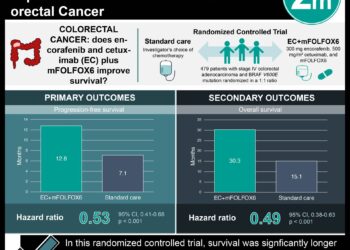
#VisualAbstract: Encorafenib, Cetuximab, and mFOLFOX6 Improves Survival in BRAF-Mutated Colorectal Cancer

Sotorasib plus panitumumab may be a promising treatment option for colorectal cancer

#VisualAbstract: Invitation to Fecal Immunochemical Test is Noninferior to Colonoscopy Screening in Colorectal Cancer Mortality

In-Depth [retrospective cohort]: This study used patient records obtained from the Survey, Epidemiology, and End Results (SEER)-Medicare database from 1991 through 2005. The authors employed tapered multivariate matching to sequentially compare black patients with three white patient populations matched based on demographic, initial presentation (i.e., tumor stage and comorbid conditions), and treatment characteristics (i.e., chemotherapy, surgery, radiation), respectively. There was a 9.9% five-year survival difference (95%CI 8.3-11.4%, p<0.001) between white and black patients matched for demographic characteristics. A 4.9% survival difference (95%CI 3.6-6.1%, p<0.001) existed between the two patient populations after accounting for health characteristics present at initial diagnosis. However, after further adjusting the comparison based on treatment regimens, the survival difference only decreased to 4.3% (95%CI2.9-5.5%, p<0.001).

More from this author: NSAIDs linked with serious bleeding events in afib patients, Genetic, environmental risk assessment does not increase colon cancer screening, Financial conflicts of interest bias recommendations for influenza meds, USPSTF recommends counseling for patients at high-risk for STIs, USPSTF recommends aspirin for women at risk for preeclampsia

Image: CC/Emmanuelm

©2014 2 Minute Medicine, Inc. All rights reserved. No works may be reproduced without expressed written consent from 2 Minute Medicine, Inc. No article should be construed as medical advice and is not intended as such by the authors, editors, staff or by 2 Minute Medicine, Inc.

Tags: colorectal cancer
Previous Post

Targeted MRI may improve sensitivity for multiple sclerosis diagnosis

Next Post

Entecavir more effective than lamivudine in preventing HBV reactivation

RelatedReports

#VisualAbstract: Encorafenib, Cetuximab, and mFOLFOX6 Improves Survival in BRAF-Mutated Colorectal Cancer
StudyGraphics

#VisualAbstract: Encorafenib, Cetuximab, and mFOLFOX6 Improves Survival in BRAF-Mutated Colorectal Cancer

June 13, 2025
Benefits of high-intensity surveillance following colorectal adenoma removal likely outweigh costs
Gastroenterology

Sotorasib plus panitumumab may be a promising treatment option for colorectal cancer

April 16, 2025
#VisualAbstract: Invitation to Fecal Immunochemical Test is Noninferior to Colonoscopy Screening in Colorectal Cancer Mortality
StudyGraphics

#VisualAbstract: Invitation to Fecal Immunochemical Test is Noninferior to Colonoscopy Screening in Colorectal Cancer Mortality

April 7, 2025
Development of a risk index for colorectal cancer screening
Chronic Disease

Nivolumab plus ipilimumab improves progression-free survival in metastatic colorectal cancer

April 3, 2025
Next Post
Entecavir more effective than lamivudine in preventing HBV reactivation

Entecavir more effective than lamivudine in preventing HBV reactivation

Engineered stem cells mitigate liver damage caused by radiation [PreClinical]

Engineered stem cells mitigate liver damage caused by radiation [PreClinical]

AAP guidelines for pneumococcal vaccination in high-risk groups released

Inflated media health news coverage linked to press release exaggeration

2 Minute Medicine® is an award winning, physician-run, expert medical media company. Our content is curated, written and edited by practicing health professionals who have clinical and scientific expertise in their field of reporting. Our editorial management team is comprised of highly-trained MD physicians. Join numerous brands, companies, and hospitals who trust our licensed content.

Recent Reports

  • An ultrasound test may more reliably detect ovarian cancer in premenopausal women than the Risk of Malignancy Index
  • Chimeric antigen receptor T-cell therapy may induce sustained remission in multirefractory autoimmune hemolytic anemia
  • Neonatal Hyperbilirubinemia and navigating the 2022 AAP guideline updates
License Content
Terms of Use | Disclaimer
Cookie Policy
Privacy Statement (EU)
Disclaimer

© 2025 2 Minute Medicine, Inc. - Physician-written medical news.

  • Specialties
    • All Specialties, All Recent Reports
    • Cardiology
    • Chronic Disease
    • Dermatology
    • Emergency
    • Endocrinology
    • Gastroenterology
    • Imaging and Intervention
    • Infectious Disease
    • Nephrology
    • Neurology
    • Obstetrics
    • Oncology
    • Ophthalmology
    • Pediatrics
    • Pharma
    • Preclinical
    • Psychiatry
    • Public Health
    • Pulmonology
    • Rheumatology
    • Surgery
  • Tools
    • EvidencePulse™
    • RVU Search
    • NPI Registry Lookup
  • Pharma
  • AI News
  • The Scan
  • Classics™
    • 2MM+ Online Access
    • Paperback and Ebook
  • Rewinds
  • Partners
    • License Content
    • Submit Press Release
    • Advertise with Us
  • Account
    • Subscribe
    • Sign-in
    • My account
No Result
View All Result

© 2025 2 Minute Medicine, Inc. - Physician-written medical news.