• About
  • Masthead
  • License Content
  • Advertise
  • Submit Press Release
  • RSS/Email List
  • 2MM Podcast
  • Write for us
  • Contact Us
2 Minute Medicine
No Result
View All Result

No products in the cart.

SUBSCRIBE
  • About
  • Specialties
    • All Specialties, All Recent Reports
    • Cardiology
    • Chronic Disease
    • Dermatology
    • Emergency
    • Endocrinology
    • Gastroenterology
    • Imaging and Intervention
    • Infectious Disease
    • Nephrology
    • Neurology
    • Obstetrics
    • Oncology
    • Ophthalmology
    • Pediatrics
    • Pharma
    • Preclinical
    • Psychiatry
    • Public Health
    • Pulmonology
    • Rheumatology
    • Surgery
  • Tools+
    • EvidencePulse™
    • HypeCheck™
    • NPI Registry Lookup
    • RVU Search
  • Pharma
  • AI News
  • The Scan+
  • Classics™+
    • 2MM+ Online Access
    • Paperback and Ebook
  • Rewinds
  • Partners
    • License Content
    • Submit Press Release
    • Advertise with Us
  • Account
    • Subscribe
    • My account
    • Cart
    • Sign-in
2 Minute Medicine
  • About
  • Specialties
    • All Specialties, All Recent Reports
    • Cardiology
    • Chronic Disease
    • Dermatology
    • Emergency
    • Endocrinology
    • Gastroenterology
    • Imaging and Intervention
    • Infectious Disease
    • Nephrology
    • Neurology
    • Obstetrics
    • Oncology
    • Ophthalmology
    • Pediatrics
    • Pharma
    • Preclinical
    • Psychiatry
    • Public Health
    • Pulmonology
    • Rheumatology
    • Surgery
  • Tools+
    • EvidencePulse™
    • HypeCheck™
    • NPI Registry Lookup
    • RVU Search
  • Pharma
  • AI News
  • The Scan+
  • Classics™+
    • 2MM+ Online Access
    • Paperback and Ebook
  • Rewinds
  • Partners
    • License Content
    • Submit Press Release
    • Advertise with Us
  • Account
    • Subscribe
    • My account
    • Cart
    • Sign-in
SUBSCRIBE
2 Minute Medicine
Subscribe
Home All Specialties Chronic Disease

Study suggests testing certain protein combinations can enhance sensitivity of fecal immunochemical test used in colorectal cancer screenings
byEvelyn NguyenandDeepti Shroff
November 22, 2017
in Chronic Disease, Gastroenterology, Oncology, Public Health, Surgery
Reading Time: 3 mins read
0
Share on FacebookShare on Twitter

1. Testing for certain combinations of 4 proteins was found to have a sensitivity for detecting colorectal cancer (CRC) and advanced adenomas higher than that of testing for hemoglobin alone.

2. Identification of such proteins using antibody-based assays and small sample volumes suggests the potential for these protein biomarkers to be incorporated into common CRC screening programs.

Evidence Rating Level: 4 (Below Average)      

Study Rundown: CRC screening aims to decrease mortality through early detection at a treatable stage.  The gold standard for CRC screening is colonoscopy, but cost and patient compliance make non-invasive methods common use as triage to colonoscopy.  One such method is the fecal immunochemical test (FIT), which tests for hemoglobin in the stool.  However, there are concerns about the suboptimal sensitivity of FIT for detecting CRC, especially in cases of advanced adenoma.  Although studies have shown that FIT used in combination with multitarget stool DNA testing has higher sensitivity than using only FIT, this method is cost-prohibitive.  The aim of this case-control study was to find protein biomarkers present in stool samples that would either complement or perform better than hemoglobin for detection of CRC and advanced adenoma.  Researchers found that combinations of 4 proteins allowed them to reach a sensitivity of 80% for detecting CRC and 45% for detecting advanced adenoma. At a specificity of 95%, these sensitivities are better than those testing solely for hemoglobin.  The study serves as proof of concept that detection of these proteins in small FIT samples suggests the potential for these protein biomarkers to be incorporated into common CRC screening programs.

A strength of the study is that a protein-based test allows for the use of a small sample device that is easily sent through the mail and for testing to be done on small sample volumes.  Such a test is also less expensive than the multitarget stool DNA test.  A limitation of the study is that some of the best protein combinations found in FIT samples could not be validated due to the unavailability of certain antibodies.

Click to read the study in Annals of Internal Medicine

RELATED REPORTS

Male sex and hispanic ethnicity are associated with increased risk of early-onset colorectal cancer

Lung cancer screening models show variable performance across populations

2 Minute Medicine Rewind June 29, 2026

Relevant Reading: Multitarget stool DNA testing for colorectal-cancer screening

In-Depth [case-control study]: In this study, researchers recruited patients from a colonoscopy-controlled referral population from multiple centers. A total of 315 stool samples were taken in two series.  In the first series, there were 12 patients with CRC and control samples from 10 people without colorectal neoplasia.  In the second series, there were 81, 40, and 43 patients with CRC, advanced adenomas, and nonadvanced adenomas, respectively, in addition to 129 controls.  There was also a third series of FIT samples from 14, 16, and 18 patients with CRC, advanced adenomas, and nonadvanced adenomas, respectively, in addition to 24 controls.  Using mass spectrometry, logistic regression analysis, classification and regression tree (CART) analysis, researchers identified protein combinations that differed in CRC or advanced adenoma samples in comparison to control samples.  A combination of 4 proteins was found to have higher discriminatory power than ones using 2 or 3 proteins.  Based on areas under the curve (AUCs), the panel that performed best was comprised of C3, lactotransferrin, hemoglobin (HBA1), and HP.  Of the biomarker panels that performed in the top 10, 17 proteins were included.  Amongst these 17 proteins, 11 differentiated CRC from controls (azurocidin 1 [AZU1], C3, C5, CDA, FN1, HBA1, HBB, HP, LTF, MPO, and RBP4), 8 differentiated advanced neoplasia from controls (C3, glutathione-disulfide reductase [GSR], HBB, HP, S100A8, S100A9, SERPINF2, and transferrin [TF]), and 5 differentiated advanced adenoma from controls (AZU1, HPX, LTF, MPO, and SERPINF2).  All 10 panels had a much higher AUC (0.93 to 0.94) than HBA1 alone (0.88).  At 95% specificity, all panels had a statistically significantly higher sensitivity (65% to 80%) compared to HBA1 alone (43%).

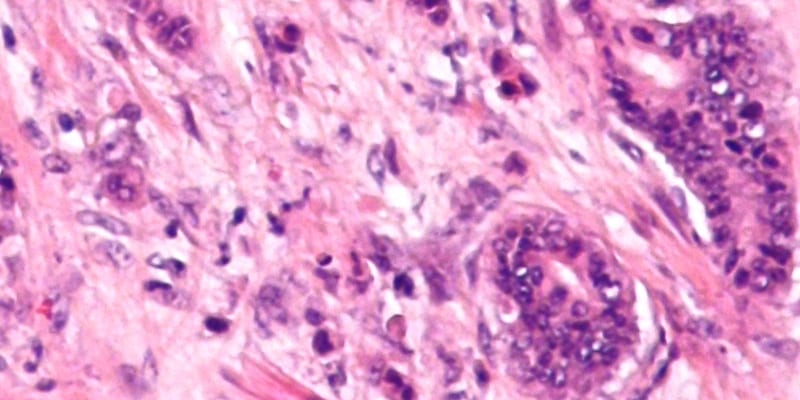
Image: CC/Wiki

©2017 2 Minute Medicine, Inc. All rights reserved. No works may be reproduced without expressed written consent from 2 Minute Medicine, Inc. Inquire about licensing here. No article should be construed as medical advice and is not intended as such by the authors or by 2 Minute Medicine, Inc.

Tags: cancer screeningcolorectal cancer
Previous Post

Gardasil vaccine demonstrates immunogenic response at 10-year follow-up

Next Post

2 Minute Medicine Rewind November 20, 2017

RelatedReports

Quick Take: Diagnostic Yield of One-Time Colonoscopy vs One-Time Flexible Sigmoidoscopy vs Multiple Rounds of Mailed Fecal Immunohistochemical Tests in Colorectal Cancer Screening
Chronic Disease

Male sex and hispanic ethnicity are associated with increased risk of early-onset colorectal cancer

June 29, 2026
Thoracic radiotherapy improves survival in small-cell lung cancer patients
Oncology

Lung cancer screening models show variable performance across populations

June 29, 2026
Weekly Rewinds

2 Minute Medicine Rewind June 29, 2026

June 29, 2026
MRI helps predict risk of local recurrence in upper rectal cancers
Imaging and Intervention

Celebrity body scans are colliding with radiology evidence

June 23, 2026
Next Post
Ultrasound screening for AAAs has no effect on all-cause mortality

2 Minute Medicine Rewind November 20, 2017

Study reveals suburban clinicians’ perspectives on screening for food insecurity

CFTR modulation therapy improves predicted FEV1 in patients with heterozygote residual function cystic fibrosis

Screening program aids in safe ivermectin distribution in Loa loa endemic areas

Screening program aids in safe ivermectin distribution in Loa loa endemic areas

EvidencePulse™ by 2 Minute Medicine 2026 evidence scan 3 reports You asked top stroke trials 2026 Synthesizing medical evidence... Top 2026 stroke trial results: OCEANIC — ischemic stroke: 6.2% vs 8.4% OPTION* — mRS 0–1: 43.6% vs 34.2% ORIENTAL* — mRS 0–2: 58.6% vs 46.6% *Higher sICH in intervention arms Participants randomizedN OCEANIC 12,327 OPTION 570 ORIENTAL 564 Ask about guidelines or landmark trials... ↑ Try EvidencePulse™ Ask the evidence.
Get the signal.
Try it now → Physician-trained medical AI by 2 Minute Medicine

2MM+ All Access

Full details →
$4.99 /month

5-day free trial · cancel anytime

  • ✓100+ physician-written reports
  • ✓EvidencePulse™ + HypeCheck™
  • ✓Ad-free reading + newsletters
Start 5-day free trial

Then $4.99/month. Manage renewal in your account.

2 Minute Medicine® is an award winning, physician-run, expert medical media company. Our content is curated, written and edited by practicing health professionals who have clinical and scientific expertise in their field of reporting. Our editorial management team is comprised of highly-trained MD physicians. Join numerous brands, companies, and hospitals who trust our licensed content.

Recent Reports

  • Looksmaxxing raises body dysmorphia concerns among adolescent males
  • A healthy lifestyle may reduce risk of infection in patients with type 2 diabetes
  • Fexofenadine and famotidine lack clinical trial evidence for menopausal symptoms
License Content
Terms of Use | Disclaimer
Cookie Policy
Cleantalk Pixel
  • About
  • Specialties
    • All Specialties, All Recent Reports
    • Cardiology
    • Chronic Disease
    • Dermatology
    • Emergency
    • Endocrinology
    • Gastroenterology
    • Imaging and Intervention
    • Infectious Disease
    • Nephrology
    • Neurology
    • Obstetrics
    • Oncology
    • Ophthalmology
    • Pediatrics
    • Pharma
    • Preclinical
    • Psychiatry
    • Public Health
    • Pulmonology
    • Rheumatology
    • Surgery
  • Tools
    • EvidencePulse™
    • HypeCheck™
    • NPI Registry Lookup
    • RVU Search
  • Pharma
  • AI News
  • The Scan
  • Classics™
    • 2MM+ Online Access
    • Paperback and Ebook
  • Rewinds
  • Partners
    • License Content
    • Submit Press Release
    • Advertise with Us
  • Account
    • Subscribe
    • My account
    • Cart
    • Sign-in
No Result
View All Result

© 2026 2 Minute Medicine, Inc. - Physician-written medical news.