• About
  • Masthead
  • License Content
  • Advertise
  • Submit Press Release
  • RSS/Email List
  • 2MM Podcast
  • Write for us
  • Contact Us
2 Minute Medicine
No Result
View All Result

No products in the cart.

SUBSCRIBE
  • About
  • Specialties
    • All Specialties, All Recent Reports
    • Cardiology
    • Chronic Disease
    • Dermatology
    • Emergency
    • Endocrinology
    • Gastroenterology
    • Imaging and Intervention
    • Infectious Disease
    • Nephrology
    • Neurology
    • Obstetrics
    • Oncology
    • Ophthalmology
    • Pediatrics
    • Pharma
    • Preclinical
    • Psychiatry
    • Public Health
    • Pulmonology
    • Rheumatology
    • Surgery
  • Tools+
    • EvidencePulse™
    • HypeCheck™
    • NPI Registry Lookup
    • RVU Search
  • Pharma
  • AI Roundup
  • The Scan+
  • Classics™+
    • 2MM+ Online Access
    • Paperback and Ebook
  • Rewinds
  • Partners
    • License Content
    • Submit Press Release
    • Advertise with Us
  • Account
    • Subscribe
    • My account
    • Cart
    • Sign in
2 Minute Medicine
  • About
  • Specialties
    • All Specialties, All Recent Reports
    • Cardiology
    • Chronic Disease
    • Dermatology
    • Emergency
    • Endocrinology
    • Gastroenterology
    • Imaging and Intervention
    • Infectious Disease
    • Nephrology
    • Neurology
    • Obstetrics
    • Oncology
    • Ophthalmology
    • Pediatrics
    • Pharma
    • Preclinical
    • Psychiatry
    • Public Health
    • Pulmonology
    • Rheumatology
    • Surgery
  • Tools+
    • EvidencePulse™
    • HypeCheck™
    • NPI Registry Lookup
    • RVU Search
  • Pharma
  • AI Roundup
  • The Scan+
  • Classics™+
    • 2MM+ Online Access
    • Paperback and Ebook
  • Rewinds
  • Partners
    • License Content
    • Submit Press Release
    • Advertise with Us
  • Account
    • Subscribe
    • My account
    • Cart
    • Sign in
SUBSCRIBE
2 Minute Medicine
Subscribe
EvidencePulse™ by 2 Minute Medicine 2026 evidence scan 3 reports You asked top stroke trials 2026 Synthesizing medical evidence... Top 2026 stroke trial results: OCEANIC — ischemic stroke: 6.2% vs 8.4% OPTION* — mRS 0–1: 43.6% vs 34.2% ORIENTAL* — mRS 0–2: 58.6% vs 46.6% *Higher sICH in intervention arms Participants randomizedN OCEANIC 12,327 OPTION 570 ORIENTAL 564 Ask about guidelines or landmark trials... ↑ Try EvidencePulse™ Ask the evidence.
Get the signal.
Try it now → Physician-trained medical AI by 2 Minute Medicine
Home StudyGraphics

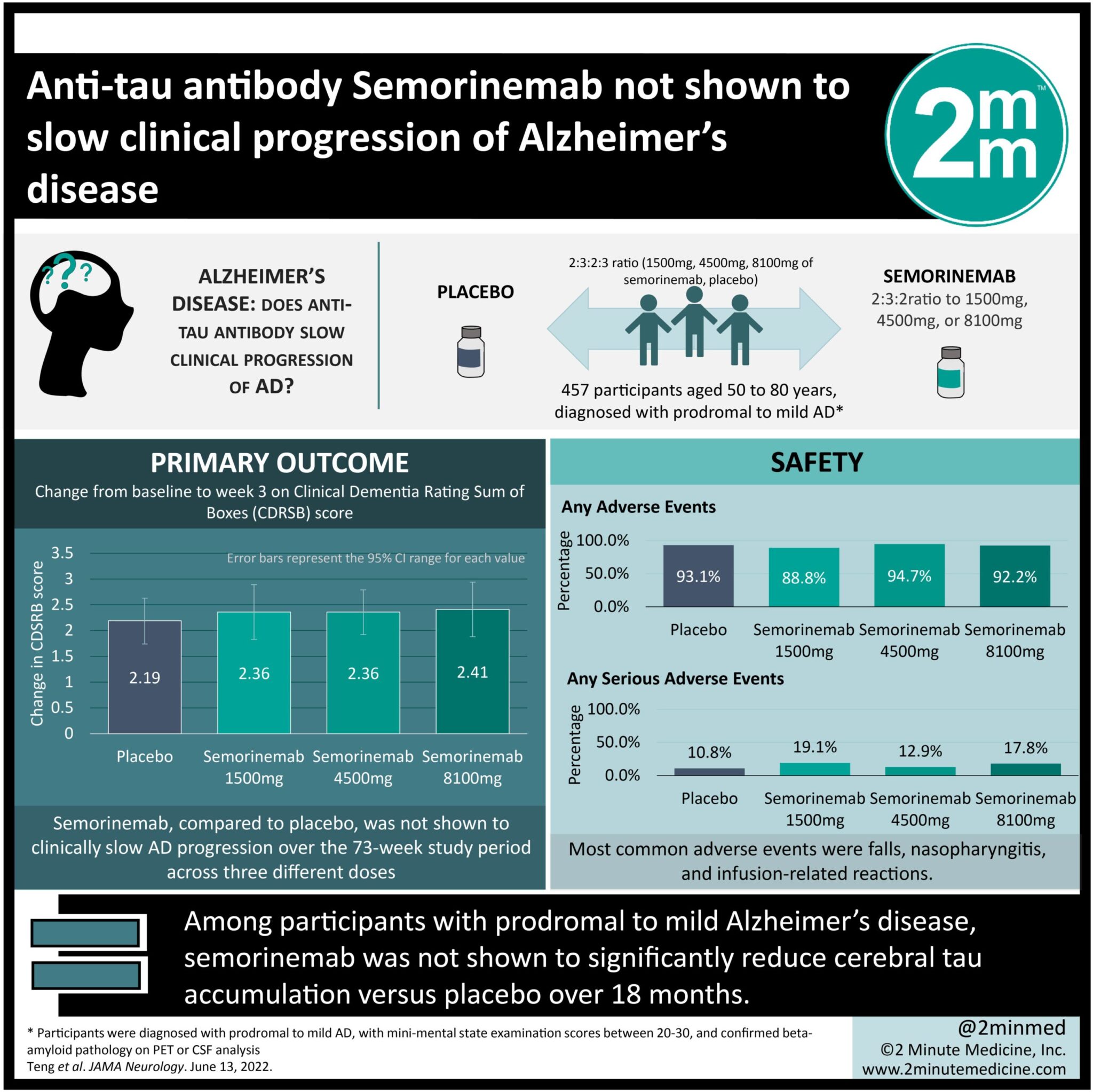
#VisualAbstract: Anti-tau antibody Semorinemab not shown to slow clinical progression of Alzheimer’s disease
byMinjee Kim
June 29, 2022
in StudyGraphics
Reading Time: 3 mins read
#VisualAbstract: Varenicline improves successful smoking cessation amongst African American daily smokers: KIS-IV Trial
Share on FacebookShare on Twitter

1. In this randomized controlled trial, among 457 participants with prodromal to mild Alzheimer’s disease, semorinemab was not shown to significantly reduce cerebral tau accumulation versus placebo over 18 months.

2. Semorinemab demonstrated a reasonable safety profile comparable to placebo, the most common adverse events being falls, nasopharyngitis and infusion-related reactions.

Evidence Rating Level: 1 (Excellent)

Study Rundown: Alzheimer’s disease (AD) is characterized by neurofibrillary tangles composed of aggregated tau protein. Cerebral tau accumulation has been correlated with disease severity, and is often a target for treatments such as monoclonal antibodies. This phase 2, randomized controlled trial evaluated the safety and efficacy of the monoclonal anti-tau antibody semorinemab in 457 patients with prodromal to mild AD. Over a 73-week blinded study period between 2017 to 2020, participants were randomized to receive intravenous infusions of placebo or semorinemab (1500mg, 4500mg, or 8100mg). Participants were individuals aged between 50 to 80 years, diagnosed with prodromal to mild AD. The main outcomes were change from baseline to week 73 on the Clinical Dementia Rating-Sum of Boxes score (CDRSB), and assessments of the safety and efficacy of semorinemab compared to placebo. In the modified intent to treat cohort, efficacy analyses showed no difference in rates of cerebral tau accumulation or rates of clinical decline of AD between the placebo arm and the semorinemab dose arm at any dosing point. Additionally, similar proportions of participants in the placebo and semorinemab arm experienced adverse events, most of which were mild. These included falls, nasopharyngitis and infusion-related reactions. A notable strength of this study was that it is the first to publish phase 2 clinical data of an anti-tau-monoclonal antibody as a treatment for prodromal to mild AD. Due to the COVID-19 pandemic however, a limitation was that some participants missed doses and/or missed clinical assessments.

Click to read the study in JAMA Neurology

RELATED REPORTS

Earlier menopause is associated with faster cognitive decline and greater late-life brain changes

Dementia diagnosis underreporting is common and associated with reduced care engagement

Older married couples demonstrate domain-specific cognitive concordance 

Relevant Reading: Alzheimer’s disease: an update on pathobiology and treatment strategies

In-Depth [randomized controlled trial]: This phase 2, randomized, double-blind, placebo-controlled clinical trial evaluated the safety and efficacy of the monoclonal anti-tau antibody, semorinemab in patients with prodromal to mild AD. The trial was conducted between 2017 and 2020 at 97 sites in North America, Europe and Australia. Individuals aged 50 to 80 years, diagnosed with prodromal to mild AD were included. Participants were randomized in a 2:3:2:3 ratio to either 1500mg, 4500mg, or 8100mg of semorinemab, or placebo. Similar increases in CDRSB were observed in the modified intent-to-treat cohort (n-422; mean [SD] age 69.6 [7.0] years; 235 women [55.7%]) between the placebo group (n=126;   = 2.19 [95% CI, 1.74-2.63]) and the semorinemab group (1500mg: n=86,  = 2.36 [95% CI, 1.83-2.89]; 4500mg: n=126;  = 2.36 [95% CI, 1.92-2.79]; 8100mg: n=84;  = 2.41 [95% CI, 1.88-2.94]). A total of 441 participants were placed in the safety-evaluable cohort, and similar proportions experienced adverse events (AEs) in the semorinemab (1500mg: 89 [88.8%]; 4500mg: 132 [94.7%]; 8100mg: 90 [92.2%]) and placebo (130 [93.1%]) group. The most common higher-grade AEs were falls (placebo: 2 [1.5%]; 1500mg: 2 [2.2%]; 4500mg: 2 [1.5%], 8100mg: 1 [1.1%]) and pneumonia (placebo: 1[0.8%]; 1500mg: 1[1.1%]; 4500mg: 1 [1.5%]; 8100mg: 2 [2.2%]). Four deaths were recorded during the blinded portion of the trial (placebo: 2; 4500mg: 1; 8100mg: 1), however investigators did not attribute them to the study drug.

©2022 2 Minute Medicine, Inc. All rights reserved. No works may be reproduced without expressed written consent from 2 Minute Medicine, Inc. Inquire about licensing here. No article should be construed as medical advice and is not intended as such by the authors or by 2 Minute Medicine, Inc.

Tags: Alzheimer'sAlzheimer’s diseaseanti-tau antibodydementianeurofibrillary tanglessemorinemabtau protein
Previous Post

United States medical cannabis registration increased significantly between 2016 and 2020

Next Post

Arterial chemoembolization improves survival in non-resectable hepatocellular carcinoma [Classics Series]

RelatedReports

Longevity

Earlier menopause is associated with faster cognitive decline and greater late-life brain changes

October 5, 2026
Quick Take: Risk of rhabdomyolysis with donepezil compared with rivastigmine or galantamine
Chronic Disease

Dementia diagnosis underreporting is common and associated with reduced care engagement

August 29, 2026
Neurology

Older married couples demonstrate domain-specific cognitive concordance 

August 28, 2026
Chronic Disease

One in four National Football League (NFL) players who died between 2016-2021 had evidence of chronic traumatic encephalopathy

August 27, 2026
Next Post
ABCD2 Score: Predicting Early Stroke Risk After Transient Ischemic Attack (TIA) [Classics Series]

Arterial chemoembolization improves survival in non-resectable hepatocellular carcinoma [Classics Series]

Novel combination therapy may be effective for noncirrhotic HCV infection [UNITY-1 trial]

Fazirsiran reduces Z-AAT protein production in alpha1-antitrypsin deficiency

Mutation linked with decrease in cutaneous diffuse large B-cell lymphoma

Lisocabtagene maraleucel improves survival for relapsed or refractory large B-cell lymphoma

EvidencePulse™ by 2 Minute Medicine 2026 evidence scan 3 reports You asked top stroke trials 2026 Synthesizing medical evidence... Top 2026 stroke trial results: OCEANIC — ischemic stroke: 6.2% vs 8.4% OPTION* — mRS 0–1: 43.6% vs 34.2% ORIENTAL* — mRS 0–2: 58.6% vs 46.6% *Higher sICH in intervention arms Participants randomizedN OCEANIC 12,327 OPTION 570 ORIENTAL 564 Ask about guidelines or landmark trials... ↑ Try EvidencePulse™ Get the signal. Try it now → Physician-trained medical AI by 2 Minute Medicine

2MM+ All Access

Full details →
$4.99 /month

3-day free trial · cancel anytime

  • ✓100+ physician-written reports
  • ✓EvidencePulse™ + HypeCheck™
  • ✓Ad-free reading + newsletters
Start 3-day free trial

Then $4.99/month. Manage renewal in your account.

2 Minute Medicine® is an award winning, physician-run, expert medical media company. Our content is curated, written and edited by practicing health professionals who have clinical and scientific expertise in their field of reporting. Our editorial management team is comprised of highly-trained MD physicians. Join numerous brands, companies, and hospitals who trust our licensed content.

Recent Reports

  • Gepotidacin (Blujepa) is safe and effective in women with uncomplicated urinary tract infections
  • Most routine blood tests do not require prolonged fasting
  • Pairing cardiac magnetic resonance with electrocardiograms (ECGs) improved artificial intelligence (AI) assessments of cardiovascular diseases
License Content
Terms of Use | Disclaimer
Cookie Policy
Cleantalk Pixel
2MM+ All Access Full details →

The medical literature, distilled daily.

Monthly plan selected: $4.99 /month.

$4.99/month

3-day free trial · cancel anytime

Start 3-day free trial

Then $4.99/month. Manage renewal in your account.

Yearly plan selected: $49.90 /year.

$49.90/year

2 months free

Start 3-day free trial

Then $49.90/year.

Membership benefits

  • ✓100+ physician-written reports
  • ✓AI EvidencePulse™ + HypeCheck™
  • ✓Ad-free reading + newsletters

Already a member? Sign in

  • About
  • Specialties
    • All Specialties, All Recent Reports
    • Cardiology
    • Chronic Disease
    • Dermatology
    • Emergency
    • Endocrinology
    • Gastroenterology
    • Imaging and Intervention
    • Infectious Disease
    • Nephrology
    • Neurology
    • Obstetrics
    • Oncology
    • Ophthalmology
    • Pediatrics
    • Pharma
    • Preclinical
    • Psychiatry
    • Public Health
    • Pulmonology
    • Rheumatology
    • Surgery
  • Tools
    • EvidencePulse™
    • HypeCheck™
    • NPI Registry Lookup
    • RVU Search
  • Pharma
  • AI Roundup
  • The Scan
  • Classics™
    • 2MM+ Online Access
    • Paperback and Ebook
  • Rewinds
  • Partners
    • License Content
    • Submit Press Release
    • Advertise with Us
  • Account
    • Subscribe
    • My account
    • Cart
    • Sign in
No Result
View All Result

© 2026 2 Minute Medicine, Inc. - Physician-written medical news.