• About
  • Masthead
  • License Content
  • Advertise
  • Press Releases
  • Newsroom
  • RSS/Email List
  • 2MM Podcast
  • Write for us
  • Contact Us
2 Minute Medicine
No Result
View All Result

No products in the cart.

Sign in
SUBSCRIBE
  • About
  • Specialties
    • All Specialties, All Recent Reports
    • Cardiology
    • Chronic Disease
    • Dermatology
    • Emergency
    • Endocrinology
    • Gastroenterology
    • Imaging and Intervention
    • Infectious Disease
    • Nephrology
    • Neurology
    • Obstetrics
    • Oncology
    • Ophthalmology
    • Pediatrics
    • Pharma
    • Preclinical
    • Psychiatry
    • Public Health
    • Pulmonology
    • Rheumatology
    • Surgery
    • Rewinds
    • The Scan
  • EvidencePulse™
  • HypeCheck™
  • AI News
  • Classics™
    • 2MM+ Online Access
    • Paperback and Ebook
  • Tools
    • NPI Registry Lookup
    • RVU Search
  • Partners
    • License Content
    • Advertise with Us
2 Minute Medicine
  • About
  • Specialties
    • All Specialties, All Recent Reports
    • Cardiology
    • Chronic Disease
    • Dermatology
    • Emergency
    • Endocrinology
    • Gastroenterology
    • Imaging and Intervention
    • Infectious Disease
    • Nephrology
    • Neurology
    • Obstetrics
    • Oncology
    • Ophthalmology
    • Pediatrics
    • Pharma
    • Preclinical
    • Psychiatry
    • Public Health
    • Pulmonology
    • Rheumatology
    • Surgery
    • Rewinds
    • The Scan
  • EvidencePulse™
  • HypeCheck™
  • AI News
  • Classics™
    • 2MM+ Online Access
    • Paperback and Ebook
  • Tools
    • NPI Registry Lookup
    • RVU Search
  • Partners
    • License Content
    • Advertise with Us
Sign in
SUBSCRIBE
2 Minute Medicine
Sign in
Subscribe
2 Minute MedicineFree on Google PlayGet
✦ EvidencePulse™ by 2 Minute Medicine 2026 evidence scan 3 reports You asked top stroke trials 2026 Synthesizing medical evidence... Top 2026 stroke trial results: OCEANIC — ischemic stroke: 6.2% vs 8.4% OPTION* — mRS 0–1: 43.6% vs 34.2% ORIENTAL* — mRS 0–2: 58.6% vs 46.6% *Higher sICH in intervention arms Participants randomizedN OCEANIC 12,327 OPTION 570 ORIENTAL 564 Ask about guidelines or landmark trials... ↑ Try EvidencePulse™ Ask the evidence.
Get the signal.
Try it now → Physician-trained medical AI by 2 Minute Medicine
Home StudyGraphics

#VisualAbstract: Aspirin thromboprophylaxis noninferior to low-molecular-weight heparin in patients with fractures
byMinjee Kim
February 2, 2023
in StudyGraphics
Reading Time: 3 mins read
#VisualAbstract: Aspirin thromboprophylaxis noninferior to low-molecular-weight heparin in patients with fractures
Share on FacebookShare on TwitterShare on LinkedIn

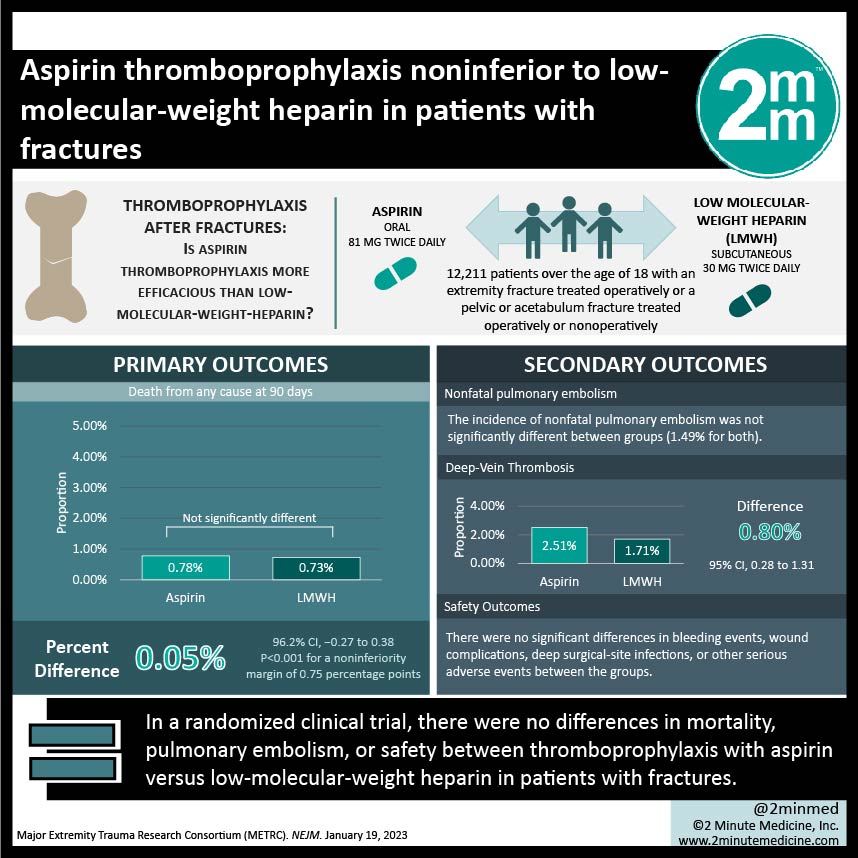
1. In this randomized clinical trial, there were no differences in mortality, pulmonary embolism, or safety between thromboprophylaxis with aspirin versus low-molecular-weight heparin in patients with fractures.

2. Incidence of deep vein thrombosis was higher with aspirin use compared to low-molecular-weight heparin use.

Evidence Rating Level: 1 (Excellent)

Study Rundown: Thromboprophylaxis therapy is currently recommended to reduce death and complications associated with venous thromboembolism after fractures. Aspirin is often preferred over low-molecular-weight heparin by patients for thromboprophylaxis due to its lower cost and oral administration. However, there is paucity in evidence comparing aspirin and low-molecular-weight heparin treatment. In this randomized clinical trial, the efficacy and safety of aspirin and low-molecular-weight heparin for thromboprophylaxis treatment were compared in patients with an extremity, pelvic, or acetabulum fracture. Low-molecular-weight heparin was administered subcutaneously at a 30 mg dose twice daily and aspirin was given orally at an 81 mg dose twice daily. The duration of thromboprophylaxis ended or continued at discharge depending on existing clinical protocols of each hospital. Patients were followed for 90 days. Incidence of death was not significantly different between groups, even after stratifying by age or cause of death. Incidence of nonfatal pulmonary embolism was not significantly different between groups. There were significantly more deep vein thrombosis occurrences in the aspirin group compared to the low-molecular-weight heparin group. Safety outcomes, including bleeding events, wound complications, deep surgical-site infections, or other serious adverse events, were not significantly different between groups. As limitations, the study had an open-label design and there were differences in the duration of thromboprophylaxis therapy after discharge depending on hospital protocol.

Click to read the study in NEJM

RELATED REPORTS

2 Minute Medicine Rewind Aug 24th, 2026 

Antithrombotic agents may be effective in preventing migraine in patients with patent foramen ovale

In-Depth [randomized controlled trial]: This randomized controlled clinical trial compared the efficacy and safety of thromboprophylaxis treatment with aspirin and low-molecular-weight heparin in patients with fractures. Patients over the age of 18 with an extremity fracture treated operatively or a pelvic or acetabulum fracture treated operatively or nonoperatively (n = 12,211) were randomized to receive aspirin (n = 6,101) or low-molecular-weight heparin (n = 6,110). Patients were followed for 90 days. Protocol adherence was 94.7% and 96.9% for the aspirin and low-molecular-weight heparin groups, respectively. The 90-day probability of death was 0.78% and 0.73% in the aspirin and low-molecular-weight heparin groups, respectively,  and not significantly different between groups. The incidence of nonfatal pulmonary embolism was not significantly different between groups. The 90-day probability of deep vein thrombosis was significantly higher in the aspirin group compared to the low-molecular-weight heparin group (2.51% and 1.71%; 0.80 percentage points difference; 95% Confidence Interval, 0.28 to 1.31). For safety outcomes, there were no significant differences in bleeding events, wound complications, deep surgical-site infections, or other serious adverse events between groups. In summary, thromboprophylaxis with aspirin was noninferior to low-molecular-weight heparin for the prevention of thromboembolic events in patients with orthopedic trauma.

©2023 2 Minute Medicine, Inc. All rights reserved. No works may be reproduced without expressed written consent from 2 Minute Medicine, Inc. Inquire about licensing here. No article should be construed as medical advice and is not intended as such by the authors or by 2 Minute Medicine, Inc.

Tags: aspirinenoxaparinfracturefractureslow molecular weight heparin (LMWH)SQHthromboprophylaxis
Previous Post

Evaluation of medical school parental leave policies in the United States

Next Post

Wellness Check: Exercise

RelatedReports

Survival greater in cervical cancer patients undergoing abdominal hysterectomy compared to minimally invasive techniques: the LACC trial
Weekly Rewinds

2 Minute Medicine Rewind Aug 24th, 2026 

August 26, 2026
Prochlorperazine for migraine may lower likelihood of ED return
Chronic Disease

Antithrombotic agents may be effective in preventing migraine in patients with patent foramen ovale

August 7, 2026
Differences in sudden unexpected infant death rates reported between states
Cardiology

Adjunctive prednisolone does not reduce coronary artery lesions in Kawasaki disease

April 15, 2026
Nearly Half of All Pediatric Buprenorphine Exposures Result in Hospitalization
Cardiology

Clopidogrel monotherapy is superior to aspirin for secondary prevention in coronary artery disease

October 30, 2025
Next Post
Few older adolescents meet recommended levels of physical activity

Wellness Check: Exercise

Antiarrhythmic drugs have no survival benefit in shock-refractory out-of-hospital cardiac arrest

Extracorporeal CPR and conventional CPR similarly improve cardiac arrest survival

CPAP may not decrease cardiovascular events in sleep apnea

Sodium-glucose cotransporter 2 inhibitors may reduce incidence of obstructive airway disease

✦ EvidencePulse™ by 2 Minute Medicine 2026 evidence scan 3 reports You asked top stroke trials 2026 Synthesizing medical evidence... Top 2026 stroke trial results: OCEANIC — ischemic stroke: 6.2% vs 8.4% OPTION* — mRS 0–1: 43.6% vs 34.2% ORIENTAL* — mRS 0–2: 58.6% vs 46.6% *Higher sICH in intervention arms Participants randomizedN OCEANIC 12,327 OPTION 570 ORIENTAL 564 Ask about guidelines or landmark trials... Try EvidencePulse™ Get the signal. Try it now → Physician-trained medical AI by 2 Minute Medicine

2MM+ All Access

Full details →
$4.99 /month

3-day free trial · cancel anytime

  • ✓100+ physician-written reports
  • ✓EvidencePulse™ + HypeCheck™
  • ✓Ad-free reading + newsletters
Start 3-day free trial

Then $4.99/month. Manage renewal in your account.

NPI Lookup · Free

Look up any US clinician

Search by name or NPI number, live from the CMS NPI Registry.

  • OIG exclusion check
  • Licenses and specialties
  • No account needed
Open NPI Lookup →

2 Minute Medicine® is an award winning, physician-run, expert medical media company. Our content is curated, written and edited by practicing health professionals who have clinical and scientific expertise in their field of reporting. Our editorial management team is comprised of highly-trained MD physicians. Join numerous brands, companies, and hospitals who trust our licensed content.

Recent Reports

  • An electronic health record tool for exercise prescription may reduce fall rate among older adults
  • Optogenetic therapy may partially restore vision in retinitis pigmentosa
  • An artificial intelligence system for human papillomavirus-positive dual stain cervical cancer screening reads p16-Ki67 slides
License Content
Terms of Use | Disclaimer
Cookie Policy

Get the app

Read 2 Minute Medicine on iPhone, iPad and Android.

Download on the App StoreGet it on Google Play
QR code for www.2minutemedicine.com/app
On a computer? Scan this with your phone’s camera.
2MM+ All Access Full details →

The medical literature, distilled daily.

Monthly plan selected: $4.99 /month.

$4.99/month

3-day free trial · cancel anytime

Start 3-day free trial

Then $4.99/month. Manage renewal in your account.

Yearly plan selected: $49.90 /year.

$49.90/year

2 months free

Start 3-day free trial

Then $49.90/year.

Membership benefits

  • ✓100+ physician-written reports
  • ✓AI EvidencePulse™ + HypeCheck™
  • ✓Ad-free reading + newsletters
  • ✓NPI watchlist + bulk NPI verification

Already a member? Sign in

  • Get the app
  • About
  • Specialties
    • All Specialties, All Recent Reports
    • Cardiology
    • Chronic Disease
    • Dermatology
    • Emergency
    • Endocrinology
    • Gastroenterology
    • Imaging and Intervention
    • Infectious Disease
    • Nephrology
    • Neurology
    • Obstetrics
    • Oncology
    • Ophthalmology
    • Pediatrics
    • Pharma
    • Preclinical
    • Psychiatry
    • Public Health
    • Pulmonology
    • Rheumatology
    • Surgery
    • Rewinds
    • The Scan
  • EvidencePulse™
  • HypeCheck™
  • AI News
  • Classics™
    • 2MM+ Online Access
    • Paperback and Ebook
  • Tools
    • NPI Registry Lookup
    • RVU Search
  • Partners
    • License Content
    • Advertise with Us
No Result
View All Result

© 2026 2 Minute Medicine, Inc. - Physician-written medical news.