• About
  • Masthead
  • License Content
  • Advertise
  • Submit Press Release
  • RSS/Email List
  • 2MM Podcast
  • Write for us
  • Contact Us
2 Minute Medicine
No Result
View All Result

No products in the cart.

SUBSCRIBE
  • Specialties
    • All Specialties, All Recent Reports
    • Cardiology
    • Chronic Disease
    • Dermatology
    • Emergency
    • Endocrinology
    • Gastroenterology
    • Imaging and Intervention
    • Infectious Disease
    • Nephrology
    • Neurology
    • Obstetrics
    • Oncology
    • Ophthalmology
    • Pediatrics
    • Pharma
    • Preclinical
    • Psychiatry
    • Public Health
    • Pulmonology
    • Rheumatology
    • Surgery
  • Tools
    • EvidencePulse™
    • RVU Search
    • NPI Registry Lookup
  • Pharma
  • AI News
  • The Scan+
  • Classics™+
    • 2MM+ Online Access
    • Paperback and Ebook
  • Rewinds
  • Partners
    • License Content
    • Submit Press Release
    • Advertise with Us
  • Account
    • Subscribe
    • Sign-in
    • My account
2 Minute Medicine
  • Specialties
    • All Specialties, All Recent Reports
    • Cardiology
    • Chronic Disease
    • Dermatology
    • Emergency
    • Endocrinology
    • Gastroenterology
    • Imaging and Intervention
    • Infectious Disease
    • Nephrology
    • Neurology
    • Obstetrics
    • Oncology
    • Ophthalmology
    • Pediatrics
    • Pharma
    • Preclinical
    • Psychiatry
    • Public Health
    • Pulmonology
    • Rheumatology
    • Surgery
  • Tools
    • EvidencePulse™
    • RVU Search
    • NPI Registry Lookup
  • Pharma
  • AI News
  • The Scan+
  • Classics™+
    • 2MM+ Online Access
    • Paperback and Ebook
  • Rewinds
  • Partners
    • License Content
    • Submit Press Release
    • Advertise with Us
  • Account
    • Subscribe
    • Sign-in
    • My account
SUBSCRIBE
2 Minute Medicine
Subscribe
Home StudyGraphics

#VisualAbstract: Association of Skipping Breakfast With Cardiovascular and All-Cause Mortality
byStudy Graphics | C.WuandConstance Wu
August 22, 2020
in StudyGraphics
Reading Time: 2 mins read
0
Share on FacebookShare on Twitter

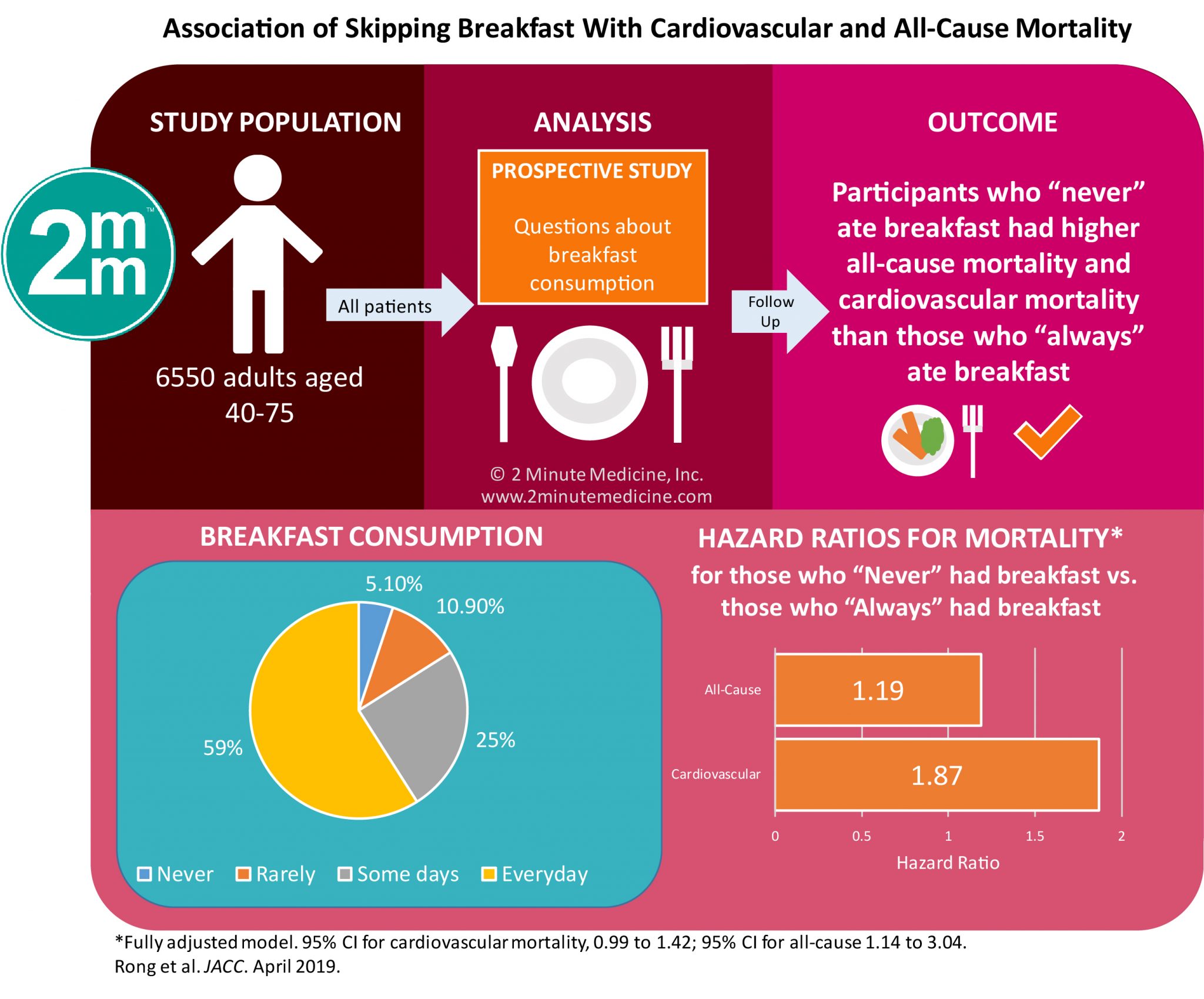
1. In this prospective cohort study based on data from the National Health and Nutrition Examination Survey III (1988 – 1994), people who self-reported never eating breakfast had almost double the cardiovascular mortality compared to those who always reported eating breakfast.

2. There was a non-significant trend towards increased all-cause mortality amongst those who self-reported never eating breakfast.

Evidence Rating Level: 1 (Excellent)

Study Rundown: Cardiovascular disease is a leading cause of mortality and morbidity in North America. There is a small amount of evidence that skipping breakfast is linked with several chronic diseases, but the impact on mortality is not clear. In this nationally representative prospective cohort study from the United States, self-reported ‘never’ eating breakfast was associated with an increased risk of cardiovascular mortality and a signal towards increased all-cause mortality compared with ‘always’ eating breakfast. Although ‘never’ eating breakfast was associated with obesity, dyslipidemia, former smoking, heavy drinking, lower income, physical inactivity, and being unmarried, the above elevated mortality risk remained after correcting for these factors.

Strengths of the study included using a validated survey, obtaining large amount of demographic information, using a nationally-representative group of people, and the long term follow up data. The main limitations of this study included the self-reported nature of breakfast intake (which introduces recall bias), lack of breakfast intake data during the decades of follow up, and the low numbers in the ‘never-breakfast’ group.

Click to read the study in JACC

RELATED REPORTS

2MM: AI Roundup: NHS England expands Microsoft Copilot nationwide, ARPA-H advances autonomous cardiovascular AI, FDA advisors back Moderna’s mRNA influenza vaccine, and UpDoc earns first clearance for a patient-facing large language model

WHO launches 2026 global initiative to bridge the schizophrenia mortality gap

Placental abruption during pregnancy is not associated with increased risk of cardiovascular mortality in children

Click to read an accompanying editorial in JACC

©2019 2 Minute Medicine, Inc. All rights reserved. No works may be reproduced without expressed written consent from 2 Minute Medicine, Inc. Inquire about licensing here. No article should be construed as medical advice and is not intended as such by the authors or by 2 Minute Medicine, Inc.


Tags: breakfastcardiovascular diseasecardiovascular mortalitynutrition
Previous Post

Rate of opioid prescribing in adolescents largely unchanged

Next Post

Quick Take: Liver Fibrosis and Metabolic Alterations in Adults with Alpha1 Antitrypsin Deficiency Caused by the Pi*ZZ Mutation

RelatedReports

2MM: AI Roundup- AI Cancer Test, Smarter Hospitals, Faster Drug Discovery, and Mental Health Tech [May 2nd, 2025]
AI Roundup

2MM: AI Roundup: NHS England expands Microsoft Copilot nationwide, ARPA-H advances autonomous cardiovascular AI, FDA advisors back Moderna’s mRNA influenza vaccine, and UpDoc earns first clearance for a patient-facing large language model

July 22, 2026
Jessica Lau
Psychiatry

WHO launches 2026 global initiative to bridge the schizophrenia mortality gap

April 30, 2026
Cardiology

Placental abruption during pregnancy is not associated with increased risk of cardiovascular mortality in children

April 1, 2026
Reduced gestational weight gain with lifestyle intervention
Cardiology

Replacing sedentary time with physical activity may lower risk of all-cause mortality

March 2, 2026
Next Post
Quick Take: Liver Fibrosis and Metabolic Alterations in Adults with Alpha1 Antitrypsin Deficiency Caused by the Pi*ZZ Mutation

Quick Take: Liver Fibrosis and Metabolic Alterations in Adults with Alpha1 Antitrypsin Deficiency Caused by the Pi*ZZ Mutation

Quick Take: Effect of Pregabalin on Radiotherapy-Related Neuropathic Pain in Patients With Head and Neck Cancer: A Randomized Controlled Trial

Cancer medications approved by FDA accelerated approval program struggle to show benefit

Quick Take: Combined Surgery and Extensive Intraoperative Peritoneal Lavage vs Surgery Alone for Treatment of Locally Advanced Gastric Cancer: The SEIPLUS Randomized Clinical Tria

Laparoscopic distal gastrectomy non-inferior to open distal gastrectomy for locally advanced gastric cancer

2 Minute Medicine® is an award winning, physician-run, expert medical media company. Our content is curated, written and edited by practicing health professionals who have clinical and scientific expertise in their field of reporting. Our editorial management team is comprised of highly-trained MD physicians. Join numerous brands, companies, and hospitals who trust our licensed content.

Recent Reports

  • Perioperative toripalimab improves event-free survival in non-small cell lung cancer
  • Antithrombotic agents may be effective in preventing migraine in patients with patent foramen ovale
  • Active surveillance is cost-effective compared with standard surgery among esophageal cancer patients with complete clinical response after neoadjuvant chemoradiotherapy
License Content
Terms of Use | Disclaimer
Cookie Policy
Privacy Statement (EU)
Disclaimer
  • Specialties
    • All Specialties, All Recent Reports
    • Cardiology
    • Chronic Disease
    • Dermatology
    • Emergency
    • Endocrinology
    • Gastroenterology
    • Imaging and Intervention
    • Infectious Disease
    • Nephrology
    • Neurology
    • Obstetrics
    • Oncology
    • Ophthalmology
    • Pediatrics
    • Pharma
    • Preclinical
    • Psychiatry
    • Public Health
    • Pulmonology
    • Rheumatology
    • Surgery
  • Tools
    • EvidencePulse™
    • RVU Search
    • NPI Registry Lookup
  • Pharma
  • AI News
  • The Scan
  • Classics™
    • 2MM+ Online Access
    • Paperback and Ebook
  • Rewinds
  • Partners
    • License Content
    • Submit Press Release
    • Advertise with Us
  • Account
    • Subscribe
    • Sign-in
    • My account
No Result
View All Result

© 2026 2 Minute Medicine, Inc. - Physician-written medical news.