• About
  • Masthead
  • License Content
  • Advertise
  • Submit Press Release
  • RSS/Email List
  • 2MM Podcast
  • Write for us
  • Contact Us
2 Minute Medicine
No Result
View All Result

No products in the cart.

SUBSCRIBE
  • About
  • Specialties
    • All Specialties, All Recent Reports
    • Cardiology
    • Chronic Disease
    • Dermatology
    • Emergency
    • Endocrinology
    • Gastroenterology
    • Imaging and Intervention
    • Infectious Disease
    • Nephrology
    • Neurology
    • Obstetrics
    • Oncology
    • Ophthalmology
    • Pediatrics
    • Pharma
    • Preclinical
    • Psychiatry
    • Public Health
    • Pulmonology
    • Rheumatology
    • Surgery
  • Tools+
    • EvidencePulse™
    • HypeCheck™
    • NPI Registry Lookup
    • RVU Search
  • Pharma
  • AI Roundup
  • The Scan+
  • Classics™+
    • 2MM+ Online Access
    • Paperback and Ebook
  • Rewinds
  • Partners
    • License Content
    • Submit Press Release
    • Advertise with Us
  • Account
    • Subscribe
    • My account
    • Cart
    • Sign-in
2 Minute Medicine
  • About
  • Specialties
    • All Specialties, All Recent Reports
    • Cardiology
    • Chronic Disease
    • Dermatology
    • Emergency
    • Endocrinology
    • Gastroenterology
    • Imaging and Intervention
    • Infectious Disease
    • Nephrology
    • Neurology
    • Obstetrics
    • Oncology
    • Ophthalmology
    • Pediatrics
    • Pharma
    • Preclinical
    • Psychiatry
    • Public Health
    • Pulmonology
    • Rheumatology
    • Surgery
  • Tools+
    • EvidencePulse™
    • HypeCheck™
    • NPI Registry Lookup
    • RVU Search
  • Pharma
  • AI Roundup
  • The Scan+
  • Classics™+
    • 2MM+ Online Access
    • Paperback and Ebook
  • Rewinds
  • Partners
    • License Content
    • Submit Press Release
    • Advertise with Us
  • Account
    • Subscribe
    • My account
    • Cart
    • Sign-in
SUBSCRIBE
2 Minute Medicine
Subscribe
EvidencePulse™ by 2 Minute Medicine 2026 evidence scan 3 reports You asked top stroke trials 2026 Synthesizing medical evidence... Top 2026 stroke trial results: OCEANIC — ischemic stroke: 6.2% vs 8.4% OPTION* — mRS 0–1: 43.6% vs 34.2% ORIENTAL* — mRS 0–2: 58.6% vs 46.6% *Higher sICH in intervention arms Participants randomizedN OCEANIC 12,327 OPTION 570 ORIENTAL 564 Ask about guidelines or landmark trials... ↑ Try EvidencePulse™ Ask the evidence.
Get the signal.
Try it now → Physician-trained medical AI by 2 Minute Medicine
Home StudyGraphics

#VisualAbstract: Colchicine may lower the risk of cardiovascular events in patients with coronary disease
byConstance Wu
September 10, 2020
in StudyGraphics
Reading Time: 3 mins read
#VisualAbstract: Serum IL-6 and TNF-α levels identified as independent predictors of COVID-19 severity and mortality
Share on FacebookShare on Twitter

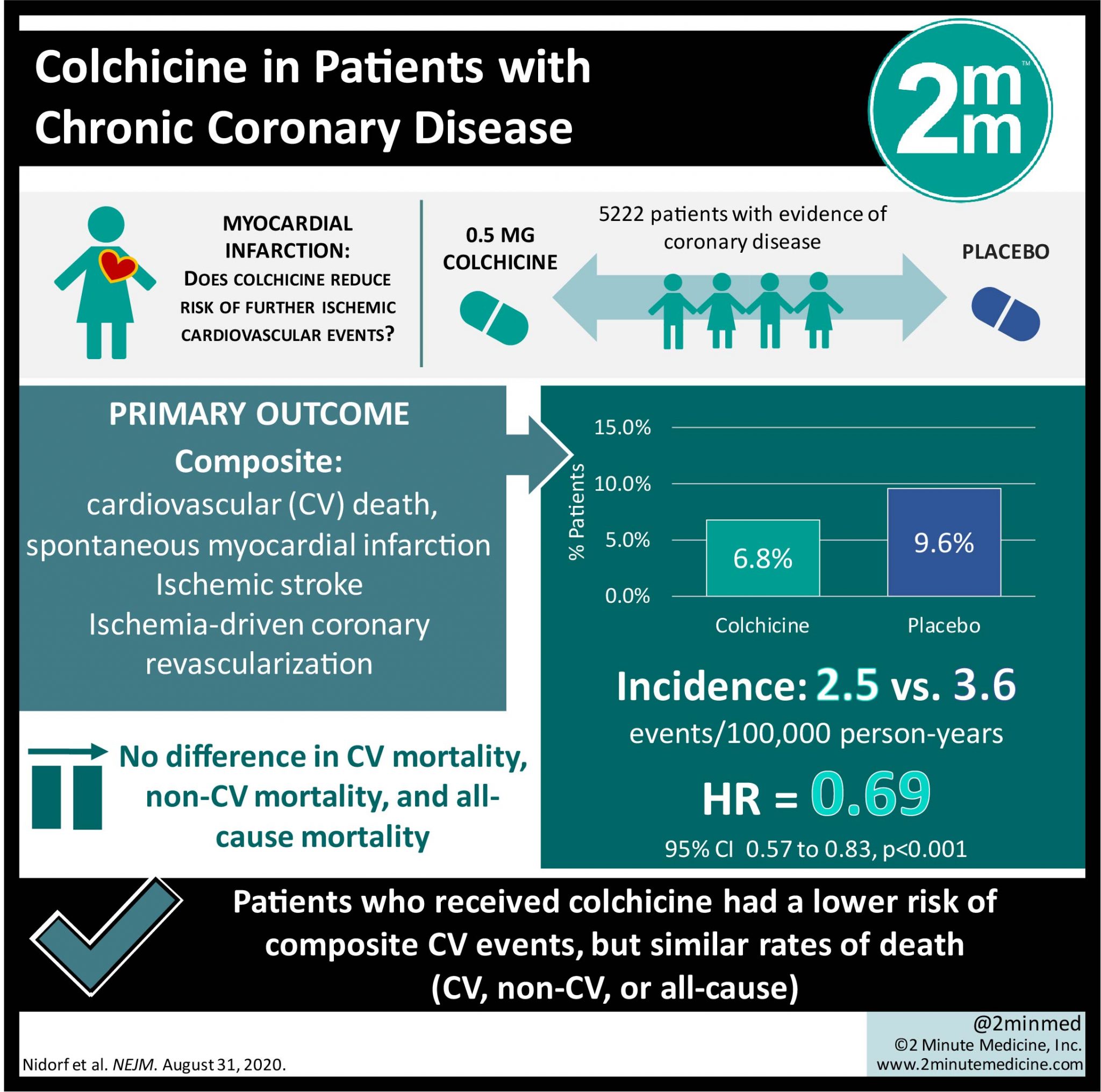
1. Patients who received low-dose colchicine daily had a ~30% lower risk of cardiovascular events compared to those who received placebo.

2. Although the incidence of cardiovascular death was similar between groups, the colchicine group had a numerically greater number of non-cardiovascular deaths as well as all-cause deaths compared to the placebo group.

Evidence Rating Level: 1 (Excellent)

Study Rundown: Colchicine is an anti-inflammatory drug that exerts its effects through inhibition of microtubule assembly, thereby reducing inflammasome activation and modulating leukocyte responsiveness. The Colchicine Cardiovascular Outcomes Trial (COLCOT) found that daily use of colchicine soon after myocardial infarction reduced the risk of further ischemic cardiovascular events and the previous Low-Dose Colchicine (LoDoCo) pilot trial found that patients with stable coronary disease who received colchicine were significantly less likely to experience acute cardiovascular events compared to those who did not. This randomized, placebo-controlled trial, termed LoDoCo2, confirmed the association between colchicine use and decreased risk of cardiovascular events using a patient population that was roughly 10 times larger than the first. This benefit became detectable early in the study and persisted with no attenuation over 5 years of treatment. Adverse events such as cancer, infection, pneumonia, and gastrointestinal upset occurred at similar rates between groups. While not quite statistically significant, the incidence rate of non-cardiovascular death was higher in the colchicine group compared to placebo. This study circumvented many weaknesses of the original LoDoCo trial, including a small sample size and the lack of placebo control, but some limitations still remained, such as the lack of data on blood pressure, lipid levels, and biomarkers of inflammation. Overall, the results of the LoDoCo2 trial lend further support to the effectiveness of colchicine in reducing the occurrence of cardiovascular events in patients with chronic coronary disease.

Click here to read the study, published today in NEJM

Relevant Reading: Low-Dose Colchicine for Secondary Prevention of Cardiovascular Disease

RELATED REPORTS

Chronic exposure to particulate matter is associated with increased cardiovascular risk

2 Minute Medicine Rewind September 7, 2026

Weight loss is associated with improved vascular function in patients with metabolic dysfunction-associated steatotic liver disease

In-Depth [randomized controlled trial]: In this multicenter study beginning in August 2014, 5222 patients between 35 and 82 years of age with evidence of coronary disease entered a 1-month open-label run-in phase before being randomly assigned in a 1:1 ratio to either continue receiving 0.5 mg colchicine daily or begin receiving placebo. Patients with moderate-to-severe renal impairment, severe heart failure, or severe valvular heart disease were excluded. The primary endpoint, a composite of cardiovascular death, spontaneous myocardial infarction, ischemic stroke, and ischemia-driven coronary revascularization, occurred in 187 patients (6.8%) in the colchicine group and 264 patients (9.6%) in the placebo group (incidence, 2.5 vs. 3.6 events, respectively, per 100 person-years; hazard ratio [HR], 0.69; 95% confidence interval [CI], 0.57 to 0.83; P<0.001). This effect was consistent across subgroups defined according to age, sex, smoking status, diabetes, renal function, hypertension, and statin dose. Between-group differences were also detected in the first five pre-ranked secondary endpoints, all of which were different combinations of the individual components noted above (P<0.01 for all). However, both groups had similar cardiovascular mortality (20 vs. 25 fatalities; HR, 0.80; 95% CI, 0.44 to 1.44), non-cardiovascular mortality (53 vs. 35 fatalities; HR, 1.51; 95% CI, 0.99 to 2.31), and all-cause mortality (incidence, 0.9 vs. 0.8 events, respectively, per 100 person-years; HR, 1.21; 95% CI, 0.86 to 1.71).

©2020 2 Minute Medicine, Inc. All rights reserved. No works may be reproduced without expressed written consent from 2 Minute Medicine, Inc. Inquire about licensing here. No article should be construed as medical advice and is not intended as such by the authors or by 2 Minute Medicine, Inc.

Tags: cardiovascularcardiovascular eventscardiovascular mortalitycardiovascular riskcolchicineCoronary artery disease
Previous Post

Angiotensin II infusion for refractory shock associated with improved hemodynamic stability and decreased vasopressor requirement

Next Post

#VisualAbstract: Proadrenomedullin predicts severe community-acquired pneumonia among children

RelatedReports

Cardiology

Chronic exposure to particulate matter is associated with increased cardiovascular risk

September 10, 2026
Long-term outcomes for off-pump and on-pump CABG are similar
Weekly Rewinds

2 Minute Medicine Rewind September 7, 2026

September 7, 2026
Fatty liver disease may independently predict high-risk coronary disease
Cardiology

Weight loss is associated with improved vascular function in patients with metabolic dysfunction-associated steatotic liver disease

August 21, 2026
Implementation of pneumococcal vaccine programs linked to decreased antibiotic prescription
Chronic Disease

Prednisone may have bone and cardiovascular benefits compared to hydrocortisone therapy in adrenal insufficiency

April 3, 2026
Next Post
#VisualAbstract: Serum IL-6 and TNF-α levels identified as independent predictors of COVID-19 severity and mortality

#VisualAbstract: Proadrenomedullin predicts severe community-acquired pneumonia among children

Steroids and opioids often inappropriately prescribed in the emergency department for pediatric pneumonia and sinusitis

No significant differences in outcomes between pre- and post-treatment administration of P2Y12 inhibitors for NSTE-ACS

#VisualAbstract: Serum IL-6 and TNF-α levels identified as independent predictors of COVID-19 severity and mortality

#VisualAbstract: Serum IL-6 and TNF-α levels identified as independent predictors of COVID-19 severity and mortality

EvidencePulse™ by 2 Minute Medicine 2026 evidence scan 3 reports You asked top stroke trials 2026 Synthesizing medical evidence... Top 2026 stroke trial results: OCEANIC — ischemic stroke: 6.2% vs 8.4% OPTION* — mRS 0–1: 43.6% vs 34.2% ORIENTAL* — mRS 0–2: 58.6% vs 46.6% *Higher sICH in intervention arms Participants randomizedN OCEANIC 12,327 OPTION 570 ORIENTAL 564 Ask about guidelines or landmark trials... ↑ Try EvidencePulse™ Ask the evidence.
Get the signal.
Try it now → Physician-trained medical AI by 2 Minute Medicine

2MM+ All Access

Full details →
$4.99 /month

5-day free trial · cancel anytime

  • ✓100+ physician-written reports
  • ✓EvidencePulse™ + HypeCheck™
  • ✓Ad-free reading + newsletters
Start 5-day free trial

Then $4.99/month. Manage renewal in your account.

2 Minute Medicine® is an award winning, physician-run, expert medical media company. Our content is curated, written and edited by practicing health professionals who have clinical and scientific expertise in their field of reporting. Our editorial management team is comprised of highly-trained MD physicians. Join numerous brands, companies, and hospitals who trust our licensed content.

Recent Reports

  • The use of neoadjuvant chemotherapy in patients with advanced epithelial ovarian cancer may reduce mortality
  • Alcohol use declines but remains above pre-pandemic levels
  • High maternal egg-peanut intake not associated with reduced infant allergy
License Content
Terms of Use | Disclaimer
Cookie Policy
Cleantalk Pixel
2MM+ All Access Full details →

The medical literature, distilled daily.

Monthly plan selected: $4.99 /month.

$4.99/month

5-day free trial · cancel anytime

Start 5-day free trial

Then $4.99/month. Manage renewal in your account.

Yearly plan selected: $49.90 /year.

$49.90/year

2 months free · only $4.16/month

Start 5-day free trial

Then $49.90/year. Manage renewal in your account.

Membership benefits

  • ✓100+ physician-written reports
  • ✓AI EvidencePulse™ + HypeCheck™
  • ✓Ad-free reading + newsletters

Already a member? Sign in

  • About
  • Specialties
    • All Specialties, All Recent Reports
    • Cardiology
    • Chronic Disease
    • Dermatology
    • Emergency
    • Endocrinology
    • Gastroenterology
    • Imaging and Intervention
    • Infectious Disease
    • Nephrology
    • Neurology
    • Obstetrics
    • Oncology
    • Ophthalmology
    • Pediatrics
    • Pharma
    • Preclinical
    • Psychiatry
    • Public Health
    • Pulmonology
    • Rheumatology
    • Surgery
  • Tools
    • EvidencePulse™
    • HypeCheck™
    • NPI Registry Lookup
    • RVU Search
  • Pharma
  • AI Roundup
  • The Scan
  • Classics™
    • 2MM+ Online Access
    • Paperback and Ebook
  • Rewinds
  • Partners
    • License Content
    • Submit Press Release
    • Advertise with Us
  • Account
    • Subscribe
    • My account
    • Cart
    • Sign-in
No Result
View All Result

© 2026 2 Minute Medicine, Inc. - Physician-written medical news.