
• About
  • Masthead
  • License Content
  • Advertise
  • RSS/Email List
  • 2MM Podcast
  • Write for us
  • Contact Us
2 Minute Medicine
No Result
View All Result

No products in the cart.

Sign in
SUBSCRIBE
  • About
  • Specialties
    • All Specialties, All Recent Reports
    • Cardiology
    • Chronic Disease
    • Dermatology
    • Emergency
    • Endocrinology
    • Gastroenterology
    • Imaging and Intervention
    • Infectious Disease
    • Nephrology
    • Neurology
    • Obstetrics
    • Oncology
    • Ophthalmology
    • Pediatrics
    • Pharma
    • Preclinical
    • Psychiatry
    • Public Health
    • Pulmonology
    • Rheumatology
    • Surgery
  • Tools+
    • EvidencePulse™
    • HypeCheck™
    • NPI Registry Lookup
    • RVU Search
  • Pharma
  • AI Roundup
  • The Scan+
  • Classics™+
    • 2MM+ Online Access
    • Paperback and Ebook
  • Rewinds
  • Partners
    • License Content
    • Advertise with Us
2 Minute Medicine
  • About
  • Specialties
    • All Specialties, All Recent Reports
    • Cardiology
    • Chronic Disease
    • Dermatology
    • Emergency
    • Endocrinology
    • Gastroenterology
    • Imaging and Intervention
    • Infectious Disease
    • Nephrology
    • Neurology
    • Obstetrics
    • Oncology
    • Ophthalmology
    • Pediatrics
    • Pharma
    • Preclinical
    • Psychiatry
    • Public Health
    • Pulmonology
    • Rheumatology
    • Surgery
  • Tools+
    • EvidencePulse™
    • HypeCheck™
    • NPI Registry Lookup
    • RVU Search
  • Pharma
  • AI Roundup
  • The Scan+
  • Classics™+
    • 2MM+ Online Access
    • Paperback and Ebook
  • Rewinds
  • Partners
    • License Content
    • Advertise with Us
Sign in
SUBSCRIBE
2 Minute Medicine
Sign in
Subscribe
EvidencePulse™ by 2 Minute Medicine 2026 evidence scan 3 reports You asked top stroke trials 2026 Synthesizing medical evidence... Top 2026 stroke trial results: OCEANIC — ischemic stroke: 6.2% vs 8.4% OPTION* — mRS 0–1: 43.6% vs 34.2% ORIENTAL* — mRS 0–2: 58.6% vs 46.6% *Higher sICH in intervention arms Participants randomizedN OCEANIC 12,327 OPTION 570 ORIENTAL 564 Ask about guidelines or landmark trials... ↑ Try EvidencePulse™ Ask the evidence.
Get the signal.
Try it now → Physician-trained medical AI by 2 Minute Medicine
Home StudyGraphics

#VisualAbstract: Stopping Renin-Angiotensin System Inhibitors in Patients with Advanced CKD Increases Risk of Major Cardiovascular Events and Mortality
byConstance Wu
January 13, 2021
in StudyGraphics
Reading Time: 2 mins read
#VisualAbstract: Occult Blood in Feces Is Associated With an Increased Risk of Ischemic Stroke and Myocardial Infarction
Share on FacebookShare on TwitterShare on LinkedIn

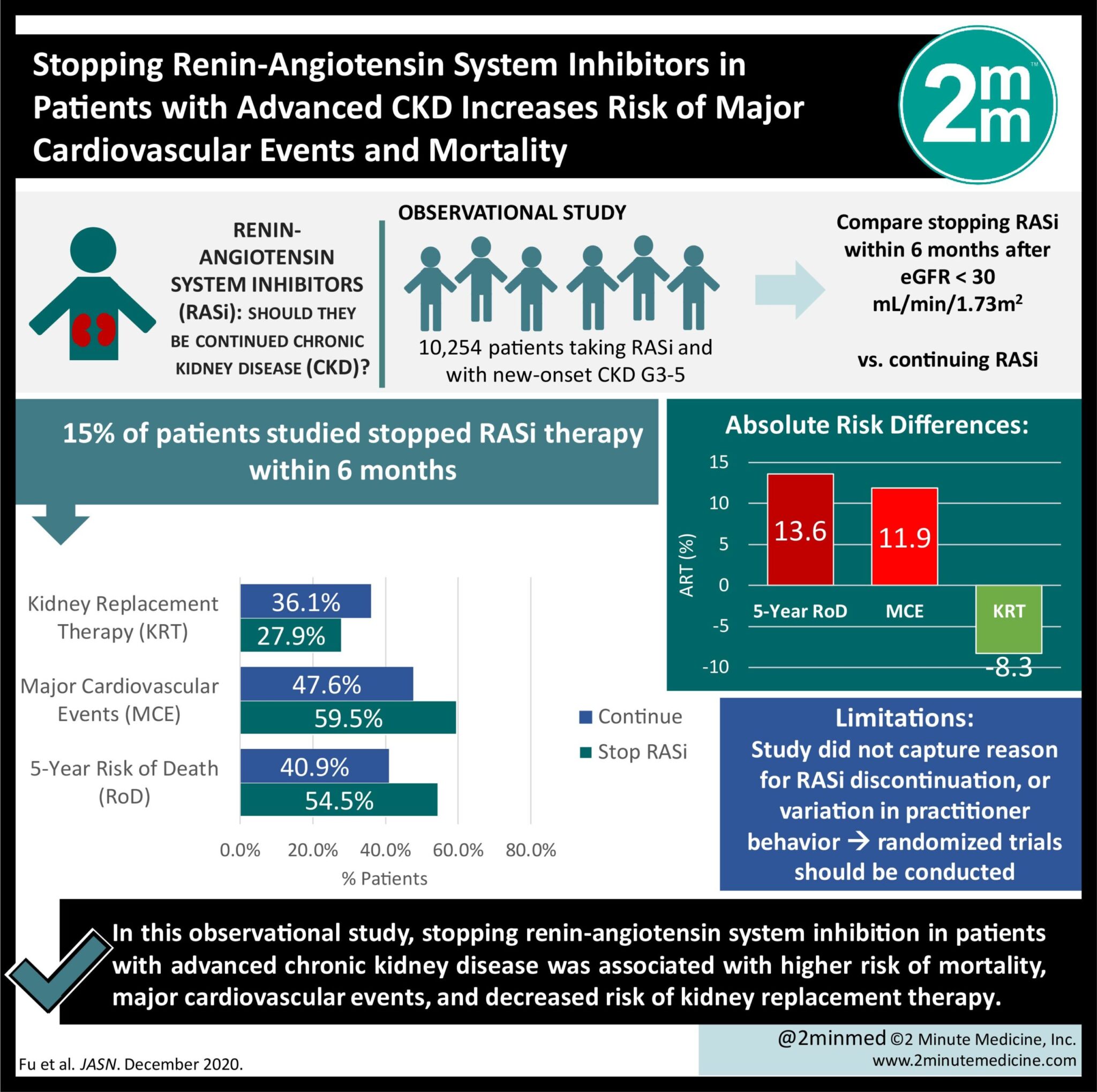
1. Stopping renin-angiotensin system inhibition in patients with advanced chronic kidney disease was associated with higher risk of mortality, major cardiovascular events, and lower risk of kidney replacement therapy.

Evidence Rating Level: 2 (Good)

Studies have shown that renin-angiotensin system inhibitors (RASi) are effective in delaying chronic kidney disease (CKD) progression. Angiotensin-converting enzyme inhibitors (ACEis) and angiotensin II receptor blockers (ARBs) are integral to treating proteinuric CKD. However, it is unknown whether RASi are safe and effective in patients with advanced CKD, or with eGFR <30mL/min/1.73m2. While continuing RASi could accelerate the need for kidney replacement therapy (KRT), stopping RASi may impact its cardioprotective and mortality benefits. In this observational study, 10 254 patients from the Swedish Renal Registry, taking RASi for more than 80% of the 2 years before January 1, 2007 and with new-onset CKD G3-5, were included. Researchers emulated a target trial with a 5 year follow-up, using techniques such as cloning, censoring, and weighting, to compare the effects of stopping RASi within 6 months after eGFR dropped below 30mL/min/1.73m2 compared to continuing RASi. From this cohort (median age 72 years, median eGFR 23mL/min/1.73m2), 15% stopped RASi therapy within 6 months. RASi discontinuation was associated with an increase in both absolute 5-year risk of death (54.5% vs 40.9%, ARD 13.6) and in major adverse cardiovascular events (59.5% vs 47.6%, ARD 11.9) over those who continued RASi treatment. However, stopping RASi therapy was also associated with a lower risk of KRT (27.9% vs 36.1%, ARD -8.3). These results remained consistent regardless of whether patients stopped RASi at an eGFR higher or below 20mL/min/1.73m2, after adjusting and stratifying for albuminuria and potassium, and after modelling RAS inhibition as a time-dependent exposure on a marginal structural model. This study supports that the decision to stop RAS inhibition in patients with advanced CKD should be made after evaluating cardiovascular and KRT risk. Variables not captured in this trial include the reason for RASi discontinuation, such as patient frailty, and variation in practitioner behaviour: for example, the initiation of KRT itself is a treatment decision. Further study, especially randomized trials, should be conducted in order to support these observational findings.

Click to read the study in JASN

Image: PD

©2020 2 Minute Medicine, Inc. All rights reserved. No works may be reproduced without expressed written consent from 2 Minute Medicine, Inc. Inquire about licensing here. No article should be construed as medical advice and is not intended as such by the authors or by 2 Minute Medicine, Inc.
RELATED REPORTS

Pairing cardiac magnetic resonance with electrocardiograms (ECGs) improved artificial intelligence (AI) assessments of cardiovascular diseases

Apixaban (Eliquis) is associated with reduced rates of ischemic stroke and bleeding in patients with atrial fibrillation and advanced chronic kidney disease compared with warfarin (Coumadin)

Tags: cardiovascularchronic kidney diseasechronic kidney disease (CKD)CKDRASi
Previous Post

Every-other-day dosing of oral rimegepant is effective for preventive treatment of migraines

Next Post

Local block with liposomal bupivacaine does not reduce postoperative opioid use for patients undergoing open abdominal wall reconstruction

RelatedReports

A depiction of a heart, a vaccine vial, and a COVID-19 virus, with an ECG waveform in the background.
Artificial Intelligence

Pairing cardiac magnetic resonance with electrocardiograms (ECGs) improved artificial intelligence (AI) assessments of cardiovascular diseases

October 9, 2026
A detailed illustration of a kidney and glomeruli, with a pill depicted, representing treatment for kidney-related conditions. It suggests a focus on chronic kidney disease.
Nephrology

Apixaban (Eliquis) is associated with reduced rates of ischemic stroke and bleeding in patients with atrial fibrillation and advanced chronic kidney disease compared with warfarin (Coumadin)

September 9, 2026
Long-term outcomes for off-pump and on-pump CABG are similar
Weekly Rewinds

2 Minute Medicine Rewind September 7, 2026

September 7, 2026
Fish oil and aspirin did not reduce arteriovenous fistula failure: The FAVOURED trail
Chronic Disease

An intradialytic exercise intervention did not improve dialysis adequacy

May 18, 2026
Next Post
Quick Take: Intravenous patient-controlled analgesia versus thoracic epidural analgesia after open liver surgery

Local block with liposomal bupivacaine does not reduce postoperative opioid use for patients undergoing open abdominal wall reconstruction

Thirty minutes of moderate physical activity associated with significantly improved outcomes for patients with obesity and metabolic syndrome

#VisualAbstract: Everolimus plus leuprorelin and letrozole improves  progression-free survival in HR⁺, HER2⁻ metastatic breast cancer patients with visceral metastases

#VisualAbstract: Everolimus plus leuprorelin and letrozole improves progression-free survival in HR⁺, HER2⁻ metastatic breast cancer patients with visceral metastases

EvidencePulse™ by 2 Minute Medicine 2026 evidence scan 3 reports You asked top stroke trials 2026 Synthesizing medical evidence... Top 2026 stroke trial results: OCEANIC — ischemic stroke: 6.2% vs 8.4% OPTION* — mRS 0–1: 43.6% vs 34.2% ORIENTAL* — mRS 0–2: 58.6% vs 46.6% *Higher sICH in intervention arms Participants randomizedN OCEANIC 12,327 OPTION 570 ORIENTAL 564 Ask about guidelines or landmark trials... ↑ Try EvidencePulse™ Get the signal. Try it now → Physician-trained medical AI by 2 Minute Medicine

2MM+ All Access

Full details →
$4.99 /month

3-day free trial · cancel anytime

  • ✓100+ physician-written reports
  • ✓EvidencePulse™ + HypeCheck™
  • ✓Ad-free reading + newsletters
Start 3-day free trial

Then $4.99/month. Manage renewal in your account.

NPI Lookup · Free

Look up any US clinician

Search by name or NPI number, live from the CMS NPI Registry.

  • OIG exclusion check
  • Licenses and specialties
  • No account needed
Open NPI Lookup →

2 Minute Medicine® is an award winning, physician-run, expert medical media company. Our content is curated, written and edited by practicing health professionals who have clinical and scientific expertise in their field of reporting. Our editorial management team is comprised of highly-trained MD physicians. Join numerous brands, companies, and hospitals who trust our licensed content.

Recent Reports

  • Low-pressure pneumoperitoneum does not reduce pain after laporoscopic cholecystectomy
  • A reduced length protocol for peripheral magnetic stimulation may be as effective compared to standard length protocol for upper trapezius myofascial pain syndrome
  • Preoperative self-preparation for total knee arthroplasty is multifactorial and can be optimized by targeting external support and internal motivation
License Content
Terms of Use | Disclaimer
Cookie Policy
2MM+ All Access Full details →

The medical literature, distilled daily.

Monthly plan selected: $4.99 /month.

$4.99/month

3-day free trial · cancel anytime

Start 3-day free trial

Then $4.99/month. Manage renewal in your account.

Yearly plan selected: $49.90 /year.

$49.90/year

2 months free

Start 3-day free trial

Then $49.90/year.

Membership benefits

  • ✓100+ physician-written reports
  • ✓AI EvidencePulse™ + HypeCheck™
  • ✓Limited-time Deep research trial
  • ✓Ad-free reading + newsletters
  • ✓NPI watchlist + bulk NPI verification

Already a member? Sign in

  • About
  • Specialties
    • All Specialties, All Recent Reports
    • Cardiology
    • Chronic Disease
    • Dermatology
    • Emergency
    • Endocrinology
    • Gastroenterology
    • Imaging and Intervention
    • Infectious Disease
    • Nephrology
    • Neurology
    • Obstetrics
    • Oncology
    • Ophthalmology
    • Pediatrics
    • Pharma
    • Preclinical
    • Psychiatry
    • Public Health
    • Pulmonology
    • Rheumatology
    • Surgery
  • Tools
    • EvidencePulse™
    • HypeCheck™
    • NPI Registry Lookup
    • RVU Search
  • Pharma
  • AI Roundup
  • The Scan
  • Classics™
    • 2MM+ Online Access
    • Paperback and Ebook
  • Rewinds
  • Partners
    • License Content
    • Advertise with Us
No Result
View All Result

© 2026 2 Minute Medicine, Inc. - Physician-written medical news.