
• About
  • Masthead
  • License Content
  • Advertise
  • Press Releases
  • Newsroom
  • RSS/Email List
  • 2MM Podcast
  • Write for us
  • Contact Us
2 Minute Medicine
No Result
View All Result

No products in the cart.

Sign in
SUBSCRIBE
  • About
  • Specialties
    • All Specialties, All Recent Reports
    • Cardiology
    • Chronic Disease
    • Dermatology
    • Emergency
    • Endocrinology
    • Gastroenterology
    • Imaging and Intervention
    • Infectious Disease
    • Nephrology
    • Neurology
    • Obstetrics
    • Oncology
    • Ophthalmology
    • Pediatrics
    • Pharma
    • Preclinical
    • Psychiatry
    • Public Health
    • Pulmonology
    • Rheumatology
    • Surgery
    • Rewinds
    • The Scan
  • EvidencePulse™
  • HypeCheck™
  • AI News
  • Classics™
    • 2MM+ Online Access
    • Paperback and Ebook
  • Tools
    • Medical Calculators
    • Clinical Guidelines
    • Physician Pay by Specialty
    • FDA Drug Approvals
    • RVU Search
    • ICD-10 Code Lookup
    • Drug Safety for Breastfeeding/Pregnancy
    • ECG Reference
      • QTc Calculator
      • Sgarbossa Criteria
      • ECG Axis Calculator
      • AV Block Helper
    • NPI Registry Lookup
  • Rankings
    • Medical School Rankings
    • Residency Rankings
  • Partners
    • License Content
    • Advertise with Us
2 Minute Medicine
  • About
  • Specialties
    • All Specialties, All Recent Reports
    • Cardiology
    • Chronic Disease
    • Dermatology
    • Emergency
    • Endocrinology
    • Gastroenterology
    • Imaging and Intervention
    • Infectious Disease
    • Nephrology
    • Neurology
    • Obstetrics
    • Oncology
    • Ophthalmology
    • Pediatrics
    • Pharma
    • Preclinical
    • Psychiatry
    • Public Health
    • Pulmonology
    • Rheumatology
    • Surgery
    • Rewinds
    • The Scan
  • EvidencePulse™
  • HypeCheck™
  • AI News
  • Classics™
    • 2MM+ Online Access
    • Paperback and Ebook
  • Tools
    • Medical Calculators
    • Clinical Guidelines
    • Physician Pay by Specialty
    • FDA Drug Approvals
    • RVU Search
    • ICD-10 Code Lookup
    • Drug Safety for Breastfeeding/Pregnancy
    • ECG Reference
      • QTc Calculator
      • Sgarbossa Criteria
      • ECG Axis Calculator
      • AV Block Helper
    • NPI Registry Lookup
  • Rankings
    • Medical School Rankings
    • Residency Rankings
  • Partners
    • License Content
    • Advertise with Us
Sign in
SUBSCRIBE
2 Minute Medicine
Sign in
Subscribe
2 Minute MedicineFree on Google PlayGet
✦EvidencePulse™by 2 Minute Medicine3 reportsYou askedtop stroke trials 2026Synthesizing medical evidence...Top 2026 stroke trial results:OCEANIC — ischemic stroke: 6.2% vs 8.4%OPTION* — mRS 0–1: 43.6% vs 34.2%ORIENTAL* — mRS 0–2: 58.6% vs 46.6%*Higher sICH in intervention armsParticipants randomizedNOCEANIC12,327OPTION570ORIENTAL564Ask about guidelines or landmark trials...↑Try EvidencePulse™Ask the evidence. Get the signal.Try it now →
Home Health A to Z

Patient Basics: Core Needle Biopsy of the Breast (Large Core Needle Biopsy)
by2 Minute Medicine
October 30, 2026
in Health A to Z
Reading Time: 5 mins read
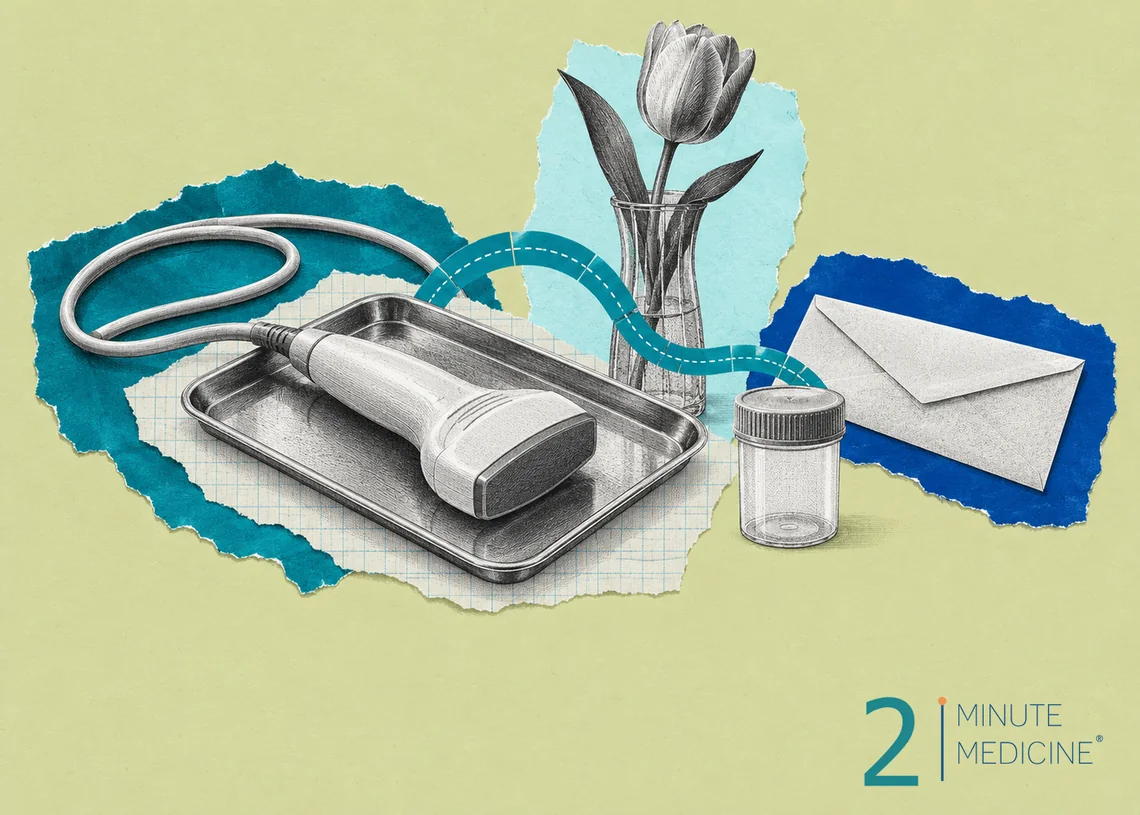
Core needle biopsy collage: an ultrasound probe on a tray, a small sample jar, a tulip in a vase and a sealed envelope
Share on FacebookShare on TwitterShare on LinkedIn

A core needle biopsy of the breast uses a hollow needle to remove a few thin strips of tissue from an area that looks unusual on a mammogram, ultrasound or MRI, or from a lump. A doctor who specializes in reading scans usually does it, guided by imaging, with numbing medicine. It takes less than an hour, and you go home the same day. Most breast biopsies do not find cancer.

Key points

  • It is the standard way to check a breast lump or a suspicious area on imaging without surgery.
  • The needle is guided by ultrasound, mammogram (stereotactic biopsy) or MRI, depending on how the area shows up best.
  • A tiny metal marker is usually left in the breast to mark the spot. It is safe and you won’t feel it.
  • Expect mild soreness and bruising for a few days.
  • Results usually take a few days to a week.

Why a core needle biopsy is done

Imaging can show that something in the breast needs a closer look, but it can’t always tell what it is. A biopsy gives a pathologist (a doctor who studies tissue under a microscope) real tissue to examine. It is often done for:

  • A lump you or your doctor can feel
  • A solid mass found on ultrasound
  • Tiny calcium deposits (calcifications) on a mammogram in a pattern that needs checking
  • An area of distorted tissue or a change from earlier mammograms
  • An area that lights up on a breast MRI

A core needle biopsy (sometimes called a large core or thick needle biopsy) removes more tissue than a fine-needle biopsy, so it gives a clearer answer. In most cases it also avoids the need for a surgical biopsy.

Before the biopsy

  • Tell your care team if you take blood thinners, aspirin or other medicines that affect bleeding. They will tell you whether to pause any of them. Don’t stop a blood thinner without asking the doctor who prescribed it.
  • Tell them about allergies, especially to numbing medicine or latex, and if you could be pregnant, are breastfeeding or have breast implants.
  • You can usually eat and drink normally.
  • On the day, skip deodorant, powder and lotion on your chest and underarms. They can show up on images.
  • Wear a two-piece outfit, and bring a snug sports bra to wear afterward for support.
  • Write down your questions. You may want someone with you for support.

During the biopsy

How you’re positioned depends on the type of guidance:

  • Ultrasound-guided. You lie on your back or slightly turned, with your arm above your head.
  • Stereotactic (mammogram-guided). You lie face down on a padded table with an opening for the breast, or sit up. The breast is gently held in place between plates, as in a mammogram, while X-ray pictures pinpoint the spot.
  • MRI-guided. You lie face down inside the MRI scanner.

The skin is cleaned and numbed with an injection, which stings for a few seconds. The doctor makes a tiny nick, about the width of a pencil tip, and guides the needle to the area using the images. The device takes several samples. You may hear a click or feel pressure each time, but it shouldn’t be painful. Tell the team if you feel pain, and they can add more numbing medicine. Some centers use a vacuum-assisted needle that collects samples through a single insertion.

Next, the doctor places the small marker clip through the needle. The team presses on the area to limit bleeding, closes the nick with thin adhesive strips and puts on a bandage. You may have a quick mammogram to check where the clip sits. The whole visit usually takes 30 to 60 minutes.

RELATED REPORTS

#VisualAbstract: Navigational Bronchoscopy is Noninferior to Transthoracic Needle Biopsy for Diagnostic Accuracy in Lung Nodules

Surgeon-level decisions may impact needle biopsy use in breast cancer

After a core needle biopsy

  • Use an ice pack, wrapped in a cloth, for 15 to 20 minutes at a time to ease swelling.
  • Take acetaminophen for soreness. Ask before using aspirin or ibuprofen, which can increase bruising.
  • Wear a supportive bra, including at night for the first day or two.
  • Avoid heavy lifting, vigorous exercise and swimming for a day or two, or as advised.
  • Keep the bandage dry. You can usually shower after a day. The adhesive strips fall off on their own within a week.

Bruising and a small firm area under the skin are common and fade over a week or two. The marker clip stays in place for good. It doesn’t set off airport scanners and is safe for MRI.

Possible risks

Serious problems are uncommon. Possible risks include:

  • Bruising or a pocket of blood under the skin (hematoma)
  • Infection at the needle site
  • A small scar, usually hard to see
  • A sample that doesn’t give a clear answer, meaning you need another biopsy or surgery
  • Rarely, the marker clip shifts slightly from the target area

Your results

Your doctor will call you or go over the results at a visit, usually within a few days to a week. The radiologist also checks that the result fits what the images showed. Results fall into three main groups:

  • Benign (not cancer). Common findings include fibroadenomas (smooth, solid lumps) and fibrocystic changes. You may need a follow-up scan in 6 to 12 months or simply return to routine screening.
  • High-risk or uncertain. Some findings, such as atypical cells or certain growths, are not cancer but may sit near cancer or raise your future risk. Your doctor may suggest removing the area with surgery or watching it closely.
  • Cancer. The report will say whether the cancer is still inside the milk ducts (ductal carcinoma in situ, or DCIS) or has spread into nearby tissue (invasive). Lab tests on the same sample check for hormone receptors and a protein called HER2, which helps guide treatment. You will be referred to a breast surgeon and cancer team.

Waiting for results can be stressful. Ask when and how you’ll hear, and who to call if you haven’t heard by then.

When to call your doctor

  • Fever or chills
  • Redness, warmth or swelling that is spreading
  • Pus or a bad smell from the site
  • Bleeding that soaks through the bandage, or a swelling that grows quickly
  • Pain that gets worse instead of better

Common questions about core needle biopsy

Does a core needle biopsy leave a scar?

Usually only a tiny one. The skin nick is a few millimeters long and often fades to a small dot over several months, though it may stay darker on darker skin. Scar tissue inside the breast can show on later mammograms, and the marker clip helps radiologists recognize it.

How big is the needle for a breast biopsy?

Most core needles are about 2 to 4 millimeters wide, with vacuum-assisted needles at the larger end. The numbing shot uses a much thinner needle, so the biopsy needle goes into skin that is already numb. Each sample is a thin strip of tissue less than an inch long.

How much does a breast biopsy cost?

The cost depends on the type of guidance, the facility and your insurance. Ultrasound-guided biopsies usually cost less than mammogram- or MRI-guided ones. Ask the imaging center and your insurer for an estimate before the visit, since diagnostic tests can carry copays or deductibles even when screening mammograms are free.

Questions to ask your doctor

  • Why do I need a biopsy, and what type will I have?
  • Should I stop any of my medicines beforehand?
  • When and how will I get my results?
  • What happens next if the results are unclear?
  • Will I need any follow-up imaging?

Learn more

  • Breast biopsy (MedlinePlus, U.S. National Library of Medicine)

This guide is general information and doesn’t replace advice from your own doctor. Last updated October 2026.
Tags: needle biopsy
Previous Post

Patient Basics: Foot X-Ray

Next Post

Patient Basics: Coronary Artery Bypass Surgery (CABG)

RelatedReports

#VisualAbstract: Navigational Bronchoscopy is Noninferior to Transthoracic Needle Biopsy for Diagnostic Accuracy in Lung Nodules
StudyGraphics

#VisualAbstract: Navigational Bronchoscopy is Noninferior to Transthoracic Needle Biopsy for Diagnostic Accuracy in Lung Nodules

June 2, 2025
Oncology

Surgeon-level decisions may impact needle biopsy use in breast cancer

June 15, 2014
Next Post
Bypass surgery collage: an older man, a heart with a teal graft ribbon around a narrowed artery, and a heart pillow

Patient Basics: Coronary Artery Bypass Surgery (CABG)

Abdominal ultrasound collage: liver, gallbladder and kidneys under fanned sound waves, a gel bottle, towel and empty plate

Patient Basics: Abdominal Ultrasound

Heart-lung transplant collage: a donor heart and lungs joined as one unit, a transport cooler and a teal ribbon

Patient Basics: Heart-Lung Transplant

✦ EvidencePulse™ by 2 Minute Medicine 3 reports You asked top stroke trials 2026 Synthesizing medical evidence... Top 2026 stroke trial results: OCEANIC — ischemic stroke: 6.2% vs 8.4% OPTION* — mRS 0–1: 43.6% vs 34.2% ORIENTAL* — mRS 0–2: 58.6% vs 46.6% *Higher sICH in intervention arms Participants randomizedN OCEANIC 12,327 OPTION 570 ORIENTAL 564 Ask about guidelines or landmark trials... Try EvidencePulse™ Get the signal. Try it now → Physician-trained medical AI by 2 Minute Medicine

2MM+ All Access

Full details →
$4.99 /month

3-day free trial · cancel anytime

  • ✓100+ physician-written reports
  • ✓EvidencePulse™ + HypeCheck™
  • ✓Ad-free reading + newsletters
Start 3-day free trial

Then $4.99/month. Manage renewal in your account.

2 Minute Medicine® is an award winning, physician-run, expert medical media company. Our content is curated, written and edited by practicing health professionals who have clinical and scientific expertise in their field of reporting. Our editorial management team is comprised of highly-trained MD physicians. Join numerous brands, companies, and hospitals who trust our licensed content.

Recent Reports

  • Long-term use of mometasone (Asmanex) in adults with sickle cell disease without formal diagnosis of asthma may worsen disease activity
  • Few patients had ED lumbar CT or MRI within 30 days after low-acuity back-pain radiography at urgent care centers
  • A 34-circular RNA blood signature predicted Alzheimer’s disease progression and improved prediction when combined with pTau217
License Content
Terms of Use | Disclaimer
Cookie Policy

Get the app

Read 2 Minute Medicine on iPhone, iPad and Android.

Download on the App StoreGet it on Google Play
QR code for www.2minutemedicine.com/app
On a computer? Scan this with your phone’s camera.
2MM+ All Access Full details →

The medical literature, distilled daily.

Monthly plan selected: $4.99 /month.

$4.99/month

3-day free trial · cancel anytime

Start 3-day free trial

Then $4.99/month. Manage renewal in your account.

Yearly plan selected: $49.90 /year.

$49.90/year

2 months free

Start 3-day free trial

Then $49.90/year.

Membership benefits

  • ✓100+ new physician-written study summaries monthly, 12,000+ searchable
  • ✓AI EvidencePulse™ + HypeCheck™
  • ✓Ad-free reading + newsletters
  • ✓FDA drug approvals + clinical calculators

Already a member? Sign in

  • Get the app
  • About
  • Specialties
    • All Specialties, All Recent Reports
    • Cardiology
    • Chronic Disease
    • Dermatology
    • Emergency
    • Endocrinology
    • Gastroenterology
    • Imaging and Intervention
    • Infectious Disease
    • Nephrology
    • Neurology
    • Obstetrics
    • Oncology
    • Ophthalmology
    • Pediatrics
    • Pharma
    • Preclinical
    • Psychiatry
    • Public Health
    • Pulmonology
    • Rheumatology
    • Surgery
    • Rewinds
    • The Scan
  • EvidencePulse™
  • HypeCheck™
  • AI News
  • Classics™
    • 2MM+ Online Access
    • Paperback and Ebook
  • Tools
    • Medical Calculators
    • Clinical Guidelines
    • Physician Pay by Specialty
    • FDA Drug Approvals
    • RVU Search
    • ICD-10 Code Lookup
    • Drug Safety for Breastfeeding/Pregnancy
    • ECG Reference
      • QTc Calculator
      • Sgarbossa Criteria
      • ECG Axis Calculator
      • AV Block Helper
    • NPI Registry Lookup
  • Rankings
    • Medical School Rankings
    • Residency Rankings
  • Partners
    • License Content
    • Advertise with Us
No Result
View All Result

© 2026 2 Minute Medicine, Inc. - Physician-written medical news.


