• About
  • Masthead
  • License Content
  • Advertise
  • Press Releases
  • Newsroom
  • RSS/Email List
  • 2MM Podcast
  • Write for us
  • Contact Us
2 Minute Medicine
No Result
View All Result

No products in the cart.

Sign in
SUBSCRIBE
  • About
  • Specialties
    • All Specialties, All Recent Reports
    • Cardiology
    • Chronic Disease
    • Dermatology
    • Emergency
    • Endocrinology
    • Gastroenterology
    • Imaging and Intervention
    • Infectious Disease
    • Nephrology
    • Neurology
    • Obstetrics
    • Oncology
    • Ophthalmology
    • Pediatrics
    • Pharma
    • Preclinical
    • Psychiatry
    • Public Health
    • Pulmonology
    • Rheumatology
    • Surgery
    • Rewinds
    • The Scan
  • EvidencePulse™
  • HypeCheck™
  • AI News
  • Classics™
    • 2MM+ Online Access
    • Paperback and Ebook
  • Tools
    • NPI Registry Lookup
    • RVU Search
    • Physician Pay by Specialty
    • ICD-10 Code Lookup
    • FDA Drug Approvals
    • Drug Safety for Breastfeeding/Pregnancy
    • Clinical Guidelines
    • Medical Calculators
    • ECG Reference
      • QTc Calculator
      • Sgarbossa Criteria
      • ECG Axis Calculator
      • AV Block Helper
  • Rankings
    • Medical School Rankings
    • Residency Rankings
  • Partners
    • License Content
    • Advertise with Us
2 Minute Medicine
  • About
  • Specialties
    • All Specialties, All Recent Reports
    • Cardiology
    • Chronic Disease
    • Dermatology
    • Emergency
    • Endocrinology
    • Gastroenterology
    • Imaging and Intervention
    • Infectious Disease
    • Nephrology
    • Neurology
    • Obstetrics
    • Oncology
    • Ophthalmology
    • Pediatrics
    • Pharma
    • Preclinical
    • Psychiatry
    • Public Health
    • Pulmonology
    • Rheumatology
    • Surgery
    • Rewinds
    • The Scan
  • EvidencePulse™
  • HypeCheck™
  • AI News
  • Classics™
    • 2MM+ Online Access
    • Paperback and Ebook
  • Tools
    • NPI Registry Lookup
    • RVU Search
    • Physician Pay by Specialty
    • ICD-10 Code Lookup
    • FDA Drug Approvals
    • Drug Safety for Breastfeeding/Pregnancy
    • Clinical Guidelines
    • Medical Calculators
    • ECG Reference
      • QTc Calculator
      • Sgarbossa Criteria
      • ECG Axis Calculator
      • AV Block Helper
  • Rankings
    • Medical School Rankings
    • Residency Rankings
  • Partners
    • License Content
    • Advertise with Us
Sign in
SUBSCRIBE
2 Minute Medicine
Sign in
Subscribe
2 Minute MedicineFree on Google PlayGet
✦EvidencePulse™by 2 Minute Medicine3 reportsYou askedtop stroke trials 2026Synthesizing medical evidence...Top 2026 stroke trial results:OCEANIC — ischemic stroke: 6.2% vs 8.4%OPTION* — mRS 0–1: 43.6% vs 34.2%ORIENTAL* — mRS 0–2: 58.6% vs 46.6%*Higher sICH in intervention armsParticipants randomizedNOCEANIC12,327OPTION570ORIENTAL564Ask about guidelines or landmark trials...↑Try EvidencePulse™Ask the evidence. Get the signal.Try it now →
Home Health A to Z

Patient Basics: Mammography
by2 Minute Medicine
October 30, 2026
in Health A to Z
Reading Time: 5 mins read
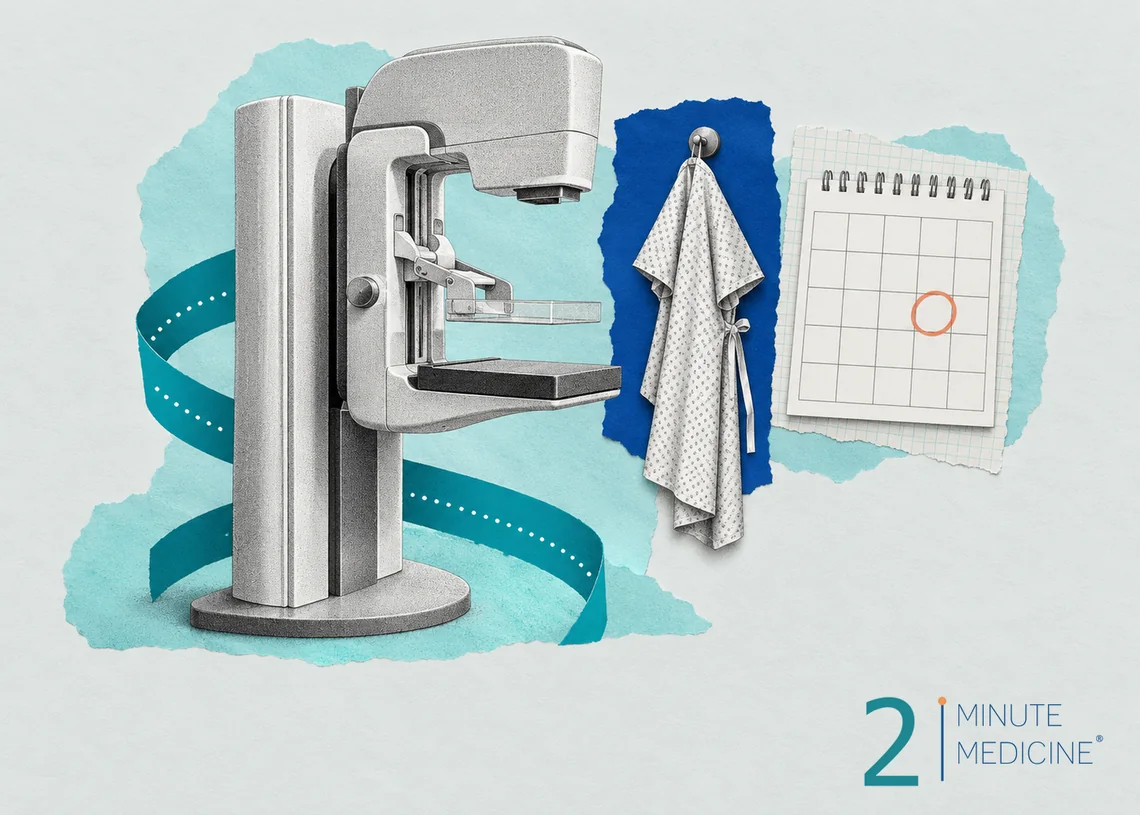
Mammogram collage: an empty mammography machine, a clinic gown on a hook, a teal ribbon and a blank calendar
Share on FacebookShare on TwitterShare on LinkedIn

A mammogram is a low-dose X-ray picture of the breast. Mammography is the main way to find breast cancer early, often years before a lump can be felt, when it is easiest to treat. The test takes about 20 minutes. Pressing the breast flat for a few seconds can be uncomfortable, but the pressure doesn’t last long.

Key points

  • A screening mammogram checks for breast cancer in women with no symptoms. A diagnostic mammogram looks into a lump, other changes, or an unclear screening result.
  • The US Preventive Services Task Force advises a mammogram every two years for women ages 40 to 74.
  • About 1 in 10 women is called back for more pictures after a screening mammogram. Most of them do not have cancer.
  • The radiation dose is very small.
  • Your report will say whether you have dense breasts, which can hide cancers and raise your risk.

Types of mammogram

  • Screening mammogram. For women with no breast symptoms. Usually two pictures of each breast are taken, one from above and one from the side.
  • Diagnostic mammogram. For a lump, breast pain in one spot, nipple discharge, skin changes, or a callback after a screening test. More pictures are taken, sometimes zoomed in on one area, and an ultrasound is often done the same day.
  • 3D mammogram (breast tomosynthesis). The machine moves in an arc and takes many pictures from different angles. It finds a few more cancers and leads to fewer callbacks than standard 2D pictures, especially in dense breasts. Many centers now use it for screening.

Who should get a screening mammogram

Most women should start at age 40 and have one every two years until age 74. Some medical groups advise a mammogram every year. After 75, the choice depends on your health. Talk with your doctor about what’s right for you.

You may need to start earlier, or add a breast MRI, if you have a strong family history of breast cancer, a gene change such as BRCA1 or BRCA2, or radiation to the chest at a young age. Transgender people and men at high risk should ask their doctor about screening too.

Getting ready for your mammogram

  • If your breasts get tender before your period, book the test for the week after your period.
  • That morning, don’t put deodorant, antiperspirant, powder or lotion on your underarms or breasts. They can show up as white spots on the pictures.
  • Wear a top with pants or a skirt, so you only need to undress from the waist up.
  • If your past mammograms were done somewhere else, arrange for those images to be sent. Comparing them helps the radiologist.
  • Tell the staff if you could be pregnant, are breastfeeding, have breast implants or have any breast symptoms.
  • If you find mammograms painful, ask your doctor whether you can take a pain reliever about an hour before.

How a mammogram is done

You change into a gown and stand in front of the machine. A technologist, usually a woman, places one breast at a time on a flat plate. A clear plastic paddle then presses the breast flat for a few seconds while the picture is taken. Hold still and briefly hold your breath when asked. Flattening the breast spreads its tissue thin, so the picture is clearer and needs less radiation.

Most people feel firm pressure. Some feel pain for a few seconds. Tell the technologist if it hurts too much, since small adjustments often help. The whole visit usually takes about 20 minutes, with only a few seconds of pressing for each picture.

Women with implants have extra pictures, with the implant gently pushed back so more breast tissue shows.

RELATED REPORTS

Historical redlining associated with lower breast cancer screening across urban neighborhoods

Susie Wiles’ breast cancer diagnosis drives national screening surge

Possible risks

  • Radiation. The dose from a screening mammogram is about the same as the natural background radiation you get from your surroundings over several weeks.
  • False alarms. A callback or biopsy for something that turns out not to be cancer can cause worry.
  • Missed cancers. A mammogram can miss some cancers, especially in dense breasts.
  • Overdiagnosis. Some cancers found by screening grow so slowly they would never have caused harm, but they still get treated.
  • Soreness. The breasts may feel tender for a short time afterward.

Your mammogram results

A radiologist reads the pictures. You usually get results within a few days, or the same day for a diagnostic mammogram. Reports use a scale called BI-RADS:

  • 0: More pictures are needed.
  • 1 or 2: No sign of cancer, or only harmless findings.
  • 3: Probably harmless. A follow-up mammogram is usually done in about 6 months.
  • 4 or 5: Suspicious. A biopsy is recommended.
  • 6: Cancer already confirmed by biopsy.

Since 2024, US law requires your mammogram report to say whether your breasts are dense. Dense breasts are common, affecting nearly half of women over 40. If yours are dense, ask whether an ultrasound or MRI would help.

When to call your doctor

  • You haven’t received your results within two weeks
  • You were asked to come back for more pictures or a biopsy
  • You notice a lump, nipple discharge, skin dimpling or other breast change, even after a normal mammogram

Common questions about mammograms

What is the purpose of mammography?

The main purpose of mammography is to detect breast cancer early, before it can be felt or causes symptoms. It does not treat or prevent breast cancer. Finding cancer at an early stage means treatment is usually simpler and more likely to cure it.

Do mammograms hurt?

Mammograms can be uncomfortable, and some people feel brief pain while the breast is pressed. The pressure lasts only a few seconds for each picture. Scheduling the test after your period and telling the technologist if it hurts can make it easier. Most people say the discomfort is milder than they expected.

Can you get a mammogram if you have small breasts?

Yes. Mammograms work on breasts of every size, including very small breasts. The technologist may take a little more time to position the breast so the tissue near the chest wall is included. Small breasts don’t make the test less accurate.

What is the difference between a screening and a diagnostic mammogram?

A screening mammogram is a routine check for women with no symptoms. A diagnostic mammogram is done when there is a breast change or an unclear screening result. It takes more pictures, often adds an ultrasound, and the radiologist usually reviews the results while you wait.

Questions to ask your doctor

  • When should I start mammograms, and how often should I have them?
  • Am I at higher than average risk for breast cancer?
  • Do I have dense breasts, and do I need other tests?
  • Should I have a 3D mammogram?
  • What happens if I’m called back?

Learn more

  • Mammograms (National Cancer Institute)
  • Mammography (MedlinePlus, U.S. National Library of Medicine)

This guide is general information and doesn’t replace advice from your own doctor. Last updated October 2026.

Tags: mammography
Previous Post

Patient Basics: Magnetic Resonance Imaging (MRI)

Next Post

Patient Basics: Hernia Repair

RelatedReports

A middle-aged woman looks thoughtfully at an abstract representation of cells and a statin pill, symbolizing breast cancer and medication usage.
Oncology

Historical redlining associated with lower breast cancer screening across urban neighborhoods

September 13, 2026
Breast cancer genetics collage: a pair of X-shaped chromosomes, an empty hospital gown on a hook and a leafy twig
All Specialties

Susie Wiles’ breast cancer diagnosis drives national screening surge

September 4, 2026
Dense breast tissue collage: a calm woman with a gray-streaked bob in a linen shirt, a sealed envelope and a cloudy blue disc
Chronic Disease

Notification of breast density is associated with increased anxiety and confusion

January 13, 2026
Chronic Disease

Abbreviated MRI is superior to whole-breast ultrasound for detection of cancer in dense breasts

June 25, 2025
Next Post
Hernia repair collage of an engraved belly wall diagram with a small mesh patch, a soft pillow and a pair of walking shoes

Patient Basics: Hernia Repair

ICD collage of an older man in calm profile, a small rounded defibrillator with a thin lead curving to an engraved heart

Patient Basics: Implantable Cardioverter Defibrillator (ICD)

Hysterectomy collage: a middle-aged woman in profile, a drawing of the uterus and ovaries, and a clinic gown on a hook

Patient Basics: Hysterectomy

✦ EvidencePulse™ by 2 Minute Medicine 3 reports You asked top stroke trials 2026 Synthesizing medical evidence... Top 2026 stroke trial results: OCEANIC — ischemic stroke: 6.2% vs 8.4% OPTION* — mRS 0–1: 43.6% vs 34.2% ORIENTAL* — mRS 0–2: 58.6% vs 46.6% *Higher sICH in intervention arms Participants randomizedN OCEANIC 12,327 OPTION 570 ORIENTAL 564 Ask about guidelines or landmark trials... Try EvidencePulse™ Get the signal. Try it now → Physician-trained medical AI by 2 Minute Medicine

2MM+ All Access

Full details →
$4.99 /month

3-day free trial · cancel anytime

  • ✓100+ physician-written reports
  • ✓EvidencePulse™ + HypeCheck™
  • ✓Ad-free reading + newsletters
Start 3-day free trial

Then $4.99/month. Manage renewal in your account.

2 Minute Medicine® is an award winning, physician-run, expert medical media company. Our content is curated, written and edited by practicing health professionals who have clinical and scientific expertise in their field of reporting. Our editorial management team is comprised of highly-trained MD physicians. Join numerous brands, companies, and hospitals who trust our licensed content.

Recent Reports

  • Nipocalimab patient interviews identify mouth dryness as the most important symptom to improve in phase 2 Sjögren’s disease data
  • CDC reports 5,182 confirmed measles cases in the United States in 2026
  • In selected patients with anterior-circulation large-vessel stroke 24-72 hours after onset, thrombectomy improved 90-day function but increased hemorrhage and death
License Content
Terms of Use | Disclaimer
Cookie Policy

Get the app

Read 2 Minute Medicine on iPhone, iPad and Android.

Download on the App StoreGet it on Google Play
QR code for www.2minutemedicine.com/app
On a computer? Scan this with your phone’s camera.
2MM+ All Access Full details →

The medical literature, distilled daily.

Monthly plan selected: $4.99 /month.

$4.99/month

3-day free trial · cancel anytime

Start 3-day free trial

Then $4.99/month. Manage renewal in your account.

Yearly plan selected: $49.90 /year.

$49.90/year

2 months free

Start 3-day free trial

Then $49.90/year.

Membership benefits

  • ✓100+ physician-written reports
  • ✓AI EvidencePulse™ + HypeCheck™
  • ✓Ad-free reading + newsletters
  • ✓FDA drug approvals + clinical calculators

Already a member? Sign in

  • Get the app
  • About
  • Specialties
    • All Specialties, All Recent Reports
    • Cardiology
    • Chronic Disease
    • Dermatology
    • Emergency
    • Endocrinology
    • Gastroenterology
    • Imaging and Intervention
    • Infectious Disease
    • Nephrology
    • Neurology
    • Obstetrics
    • Oncology
    • Ophthalmology
    • Pediatrics
    • Pharma
    • Preclinical
    • Psychiatry
    • Public Health
    • Pulmonology
    • Rheumatology
    • Surgery
    • Rewinds
    • The Scan
  • EvidencePulse™
  • HypeCheck™
  • AI News
  • Classics™
    • 2MM+ Online Access
    • Paperback and Ebook
  • Tools
    • NPI Registry Lookup
    • RVU Search
    • Physician Pay by Specialty
    • ICD-10 Code Lookup
    • FDA Drug Approvals
    • Drug Safety for Breastfeeding/Pregnancy
    • Clinical Guidelines
    • Medical Calculators
    • ECG Reference
      • QTc Calculator
      • Sgarbossa Criteria
      • ECG Axis Calculator
      • AV Block Helper
  • Rankings
    • Medical School Rankings
    • Residency Rankings
  • Partners
    • License Content
    • Advertise with Us
No Result
View All Result

© 2026 2 Minute Medicine, Inc. - Physician-written medical news.