• About
  • Masthead
  • License Content
  • Advertise
  • Submit Press Release
  • RSS/Email List
  • 2MM Podcast
  • Write for us
  • Contact Us
2 Minute Medicine
No Result
View All Result

No products in the cart.

SUBSCRIBE
  • About
  • Specialties
    • All Specialties, All Recent Reports
    • Cardiology
    • Chronic Disease
    • Dermatology
    • Emergency
    • Endocrinology
    • Gastroenterology
    • Imaging and Intervention
    • Infectious Disease
    • Nephrology
    • Neurology
    • Obstetrics
    • Oncology
    • Ophthalmology
    • Pediatrics
    • Pharma
    • Preclinical
    • Psychiatry
    • Public Health
    • Pulmonology
    • Rheumatology
    • Surgery
  • Tools+
    • EvidencePulse™
    • HypeCheck™
    • NPI Registry Lookup
    • RVU Search
  • Pharma
  • AI Roundup
  • The Scan+
  • Classics™+
    • 2MM+ Online Access
    • Paperback and Ebook
  • Rewinds
  • Partners
    • License Content
    • Submit Press Release
    • Advertise with Us
  • Account
    • Subscribe
    • My account
    • Cart
    • Sign-in
2 Minute Medicine
  • About
  • Specialties
    • All Specialties, All Recent Reports
    • Cardiology
    • Chronic Disease
    • Dermatology
    • Emergency
    • Endocrinology
    • Gastroenterology
    • Imaging and Intervention
    • Infectious Disease
    • Nephrology
    • Neurology
    • Obstetrics
    • Oncology
    • Ophthalmology
    • Pediatrics
    • Pharma
    • Preclinical
    • Psychiatry
    • Public Health
    • Pulmonology
    • Rheumatology
    • Surgery
  • Tools+
    • EvidencePulse™
    • HypeCheck™
    • NPI Registry Lookup
    • RVU Search
  • Pharma
  • AI Roundup
  • The Scan+
  • Classics™+
    • 2MM+ Online Access
    • Paperback and Ebook
  • Rewinds
  • Partners
    • License Content
    • Submit Press Release
    • Advertise with Us
  • Account
    • Subscribe
    • My account
    • Cart
    • Sign-in
SUBSCRIBE
2 Minute Medicine
Subscribe
EvidencePulse™ by 2 Minute Medicine 2026 evidence scan 3 reports You asked top stroke trials 2026 Synthesizing medical evidence... Top 2026 stroke trial results: OCEANIC — ischemic stroke: 6.2% vs 8.4% OPTION* — mRS 0–1: 43.6% vs 34.2% ORIENTAL* — mRS 0–2: 58.6% vs 46.6% *Higher sICH in intervention arms Participants randomizedN OCEANIC 12,327 OPTION 570 ORIENTAL 564 Ask about guidelines or landmark trials... ↑ Try EvidencePulse™ Ask the evidence.
Get the signal.
Try it now → Physician-trained medical AI by 2 Minute Medicine
Home The 2MM Team

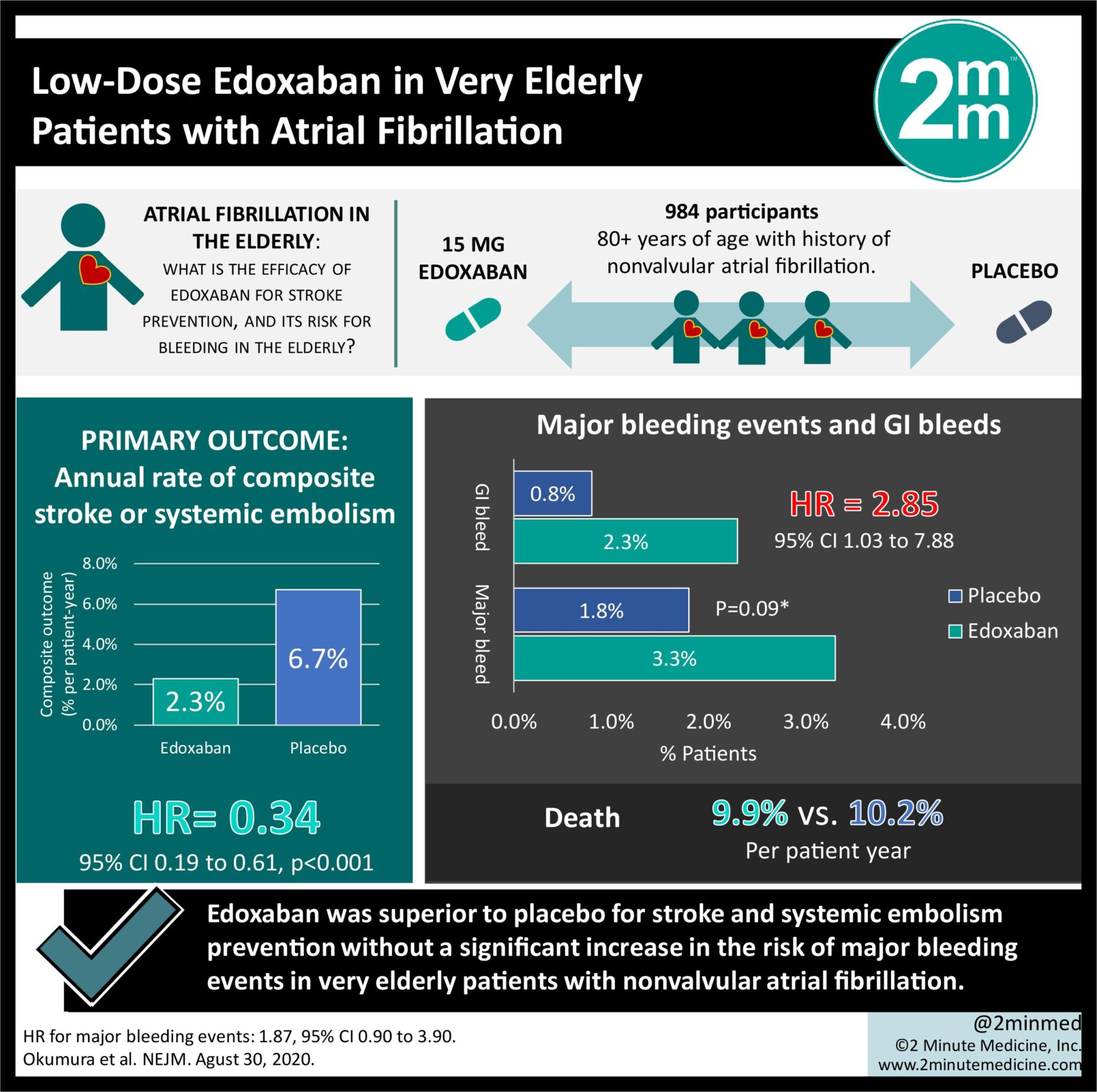
#VisualAbstract: Low dose edoxaban prevents stroke in elderly patients with atrial fibrillation
byConstance Wu
October 22, 2020
in The 2MM Team
Reading Time: 3 mins read
#VisualAbstract: Low dose edoxaban prevents stroke in elderly patients with atrial fibrillation
Share on FacebookShare on Twitter

1. Low dose edoxaban was superior to placebo in preventing stroke or systemic embolism for very elderly patients with nonvalvular atrial fibrillation at risk of bleeding.

2. Edoxaban did not significantly increase the incidence of major bleeding compared to placebo.

Evidence Rating Level: 1 (Excellent)

Study Rundown: Atrial fibrillation and age are independent risk factors for stroke, and atrial fibrillation prevalence increases with age. Clinical guidelines for stroke prevention in patients with atrial fibrillation state the use of direct oral anticoagulants. However, physicians are unwilling to prescribe direct oral anticoagulants to elderly patients due to the perceived risk factors for bleeding such as renal failure and previous falls. As such, this study assessed low dose edoxaban for stroke prevention and the risk of bleeding in very elderly patients with nonvalvular atrial fibrillation. The results of the study demonstrated that a once-daily, 15 milligram dose of edoxaban was superior to the placebo with respect to preventing strokes without significantly increasing the incidence of major bleeding. This randomized trial was limited by study adherence. A large number of participants discontinued the trial due to adverse events unrelated to bleeding or were unable to continue their participation, with equal number withdrawing in both groups. Nonetheless, this study’s results are significant and its findings highlight the effects of the medication on participants with high-risk backgrounds.

Click to read the study in NEJM

Relevant Reading: Antithrombotic Therapy for Atrial Fibrillation with Stable Coronary Disease

RELATED REPORTS

Apixaban (Eliquis) is associated with reduced rates of ischemic stroke and bleeding in patients with atrial fibrillation and advanced chronic kidney disease compared with warfarin (Coumadin)

2 Minute Medicine Rewind September 7, 2026

2 Minute Medicine Rewind August 31, 2026

In-Depth [randomized controlled trial]: This randomized control trial enrolled 984 participants in a multicenter study at 164 institutions in Japan. Participants included in the study were at least 80 years of age and had a history of nonvalvular atrial fibrillation. Participants with a CHAD2 score of 1 were excluded from this study. The participants were randomized in a 1:1 ratio to receive a once-daily, 15 milligram dose of edoxaban or placebo, respectively. The primary efficacy end point was the composite of stroke or systemic embolism. The mean (±SD) age of the participants was 86.6±4.2 years. Stroke or system embolism occurred in 15 participants (2.3% per patient-year) in the edoxaban group compared to 44 participants (6.7% per patient-year) in the control group (hazard ratio, 0.34; 95% confidence interval [CI], 0.19 to 0.61; P<0.001). Furthermore, there were 66 reported deaths from any cause in the edoxaban group (9.9% per patient-year) compared to 69 deaths in the control group (10.2% per patient-year; hazard ratio, 0.997; 95% CI, 0.69 to 1.36). The annualized rate of major cardiovascular events was 7.7% in the edoxaban group compared to 11.0% in the control group (hazard ratio, 0.70; 95% CI, 0.49 to 1.01). In regard to safety, there were 20 major bleeding events (3.3% per patient-year) in the edoxaban group compared to 11 events (1.8% per patient-year) in the control group (hazard ratio, 1.87; 95% CI, 0.90 to 3.89; P=0.09). More events of gastrointestinal bleeding occurred in the edoxaban group (14 events; 2.3% per patient-year) compared to the control group (5 events; 0.8% per patient-year; hazard ratio, 2.85; 95% CI, 1.03 to 7.88). Finally, there were no fatal bleeding events in the edoxaban group compared to the two events in the control group. Taken together, a once-daily, 15 milligram dose of edoxaban was superior to the placebo for stroke and systemic embolism prevention without significantly increasing the risk of major bleeding events in very elderly patients with nonvalvular atrial fibrillation.

©2020 2 Minute Medicine, Inc. All rights reserved. No works may be reproduced without expressed written consent from 2 Minute Medicine, Inc. Inquire about licensing here. No article should be construed as medical advice and is not intended as such by the authors or by 2 Minute Medicine, Inc.
Tags: afibatrial fibrillationbleedingedoxabanembolismgeriatricsstrokesystemic embolism
Previous Post

Postpartum plasma metabolomic profile among women with preeclampsia and preterm delivery: implications for long-term health

Next Post

Incidence, risk factors, and in-hospital mortality of post-operative AKI following aortic dissection repair

RelatedReports

Nephrology

Apixaban (Eliquis) is associated with reduced rates of ischemic stroke and bleeding in patients with atrial fibrillation and advanced chronic kidney disease compared with warfarin (Coumadin)

September 9, 2026
Long-term outcomes for off-pump and on-pump CABG are similar
Weekly Rewinds

2 Minute Medicine Rewind September 7, 2026

September 7, 2026
Rivaroxaban likely reduces risk of recurrent stroke in specific subgroup of patients with embolic stroke of undetermined source
Weekly Rewinds

2 Minute Medicine Rewind August 31, 2026

August 31, 2026
Rivaroxaban likely reduces risk of recurrent stroke in specific subgroup of patients with embolic stroke of undetermined source
Cardiology

Catheter ablation within 1 year of atrial fibrillation diagnosis is associated with reduced risk of recurrence

July 24, 2026
Next Post
Survival greater in cervical cancer patients undergoing abdominal hysterectomy compared to minimally invasive techniques: the LACC trial

Incidence, risk factors, and in-hospital mortality of post-operative AKI following aortic dissection repair

Postextubation administration of high-flow oxygen leads to reduced reintubation and respiratory failure

Outcomes of COVID-19-related ARDS patients on extracorporeal membrane oxygenation

Thrombophilia-associated stillbirth risk appears limited to factor V Leiden

Drug-eluting stents for saphenous vein grafts associated with better outcomes than bare-metal stents

EvidencePulse™ by 2 Minute Medicine 2026 evidence scan 3 reports You asked top stroke trials 2026 Synthesizing medical evidence... Top 2026 stroke trial results: OCEANIC — ischemic stroke: 6.2% vs 8.4% OPTION* — mRS 0–1: 43.6% vs 34.2% ORIENTAL* — mRS 0–2: 58.6% vs 46.6% *Higher sICH in intervention arms Participants randomizedN OCEANIC 12,327 OPTION 570 ORIENTAL 564 Ask about guidelines or landmark trials... ↑ Try EvidencePulse™ Ask the evidence.
Get the signal.
Try it now → Physician-trained medical AI by 2 Minute Medicine

2MM+ All Access

Full details →
$4.99 /month

5-day free trial · cancel anytime

  • ✓100+ physician-written reports
  • ✓EvidencePulse™ + HypeCheck™
  • ✓Ad-free reading + newsletters
Start 5-day free trial

Then $4.99/month. Manage renewal in your account.

2 Minute Medicine® is an award winning, physician-run, expert medical media company. Our content is curated, written and edited by practicing health professionals who have clinical and scientific expertise in their field of reporting. Our editorial management team is comprised of highly-trained MD physicians. Join numerous brands, companies, and hospitals who trust our licensed content.

Recent Reports

  • Transanastomotic tubes not linked to anastomotic stricture after esophageal atresia repair
  • Artificial intelligence (AI) chatbot reduced depression, anxiety, and eating disorder risk symptoms
  • Real-time AI guidance enters live brain tumor surgery
License Content
Terms of Use | Disclaimer
Cookie Policy
Cleantalk Pixel
2MM+ All Access Full details →

The medical literature, distilled daily.

Monthly plan selected: $4.99 /month.

$4.99/month

5-day free trial · cancel anytime

Start 5-day free trial

Then $4.99/month. Manage renewal in your account.

Yearly plan selected: $49.90 /year.

$49.90/year

2 months free · only $4.16/month

Start 5-day free trial

Then $49.90/year. Manage renewal in your account.

Membership benefits

  • ✓100+ physician-written reports
  • ✓AI EvidencePulse™ + HypeCheck™
  • ✓Ad-free reading + newsletters

Already a member? Sign in

  • About
  • Specialties
    • All Specialties, All Recent Reports
    • Cardiology
    • Chronic Disease
    • Dermatology
    • Emergency
    • Endocrinology
    • Gastroenterology
    • Imaging and Intervention
    • Infectious Disease
    • Nephrology
    • Neurology
    • Obstetrics
    • Oncology
    • Ophthalmology
    • Pediatrics
    • Pharma
    • Preclinical
    • Psychiatry
    • Public Health
    • Pulmonology
    • Rheumatology
    • Surgery
  • Tools
    • EvidencePulse™
    • HypeCheck™
    • NPI Registry Lookup
    • RVU Search
  • Pharma
  • AI Roundup
  • The Scan
  • Classics™
    • 2MM+ Online Access
    • Paperback and Ebook
  • Rewinds
  • Partners
    • License Content
    • Submit Press Release
    • Advertise with Us
  • Account
    • Subscribe
    • My account
    • Cart
    • Sign-in
No Result
View All Result

© 2026 2 Minute Medicine, Inc. - Physician-written medical news.