• About
  • Masthead
  • License Content
  • Advertise
  • Press Releases
  • Newsroom
  • RSS/Email List
  • 2MM Podcast
  • Write for us
  • Contact Us
2 Minute Medicine
No Result
View All Result

No products in the cart.

Sign in
SUBSCRIBE
  • About
  • Specialties
    • All Specialties, All Recent Reports
    • Cardiology
    • Chronic Disease
    • Dermatology
    • Emergency
    • Endocrinology
    • Gastroenterology
    • Imaging and Intervention
    • Infectious Disease
    • Nephrology
    • Neurology
    • Obstetrics
    • Oncology
    • Ophthalmology
    • Pediatrics
    • Pharma
    • Preclinical
    • Psychiatry
    • Public Health
    • Pulmonology
    • Rheumatology
    • Surgery
    • Rewinds
    • The Scan
  • EvidencePulse™
  • HypeCheck™
  • AI News
  • Classics™
    • 2MM+ Online Access
    • Paperback and Ebook
  • Tools
    • NPI Registry Lookup
    • RVU Search
    • Physician Pay by Specialty
    • ICD-10 Code Lookup
    • FDA Drug Approvals
    • Drug Safety for Breastfeeding/Pregnancy
    • Clinical Guidelines
    • Medical Calculators
    • ECG Reference
      • QTc Calculator
      • Sgarbossa Criteria
      • ECG Axis Calculator
      • AV Block Helper
  • Rankings
    • Medical School Rankings
    • Residency Rankings
  • Partners
    • License Content
    • Advertise with Us
2 Minute Medicine
  • About
  • Specialties
    • All Specialties, All Recent Reports
    • Cardiology
    • Chronic Disease
    • Dermatology
    • Emergency
    • Endocrinology
    • Gastroenterology
    • Imaging and Intervention
    • Infectious Disease
    • Nephrology
    • Neurology
    • Obstetrics
    • Oncology
    • Ophthalmology
    • Pediatrics
    • Pharma
    • Preclinical
    • Psychiatry
    • Public Health
    • Pulmonology
    • Rheumatology
    • Surgery
    • Rewinds
    • The Scan
  • EvidencePulse™
  • HypeCheck™
  • AI News
  • Classics™
    • 2MM+ Online Access
    • Paperback and Ebook
  • Tools
    • NPI Registry Lookup
    • RVU Search
    • Physician Pay by Specialty
    • ICD-10 Code Lookup
    • FDA Drug Approvals
    • Drug Safety for Breastfeeding/Pregnancy
    • Clinical Guidelines
    • Medical Calculators
    • ECG Reference
      • QTc Calculator
      • Sgarbossa Criteria
      • ECG Axis Calculator
      • AV Block Helper
  • Rankings
    • Medical School Rankings
    • Residency Rankings
  • Partners
    • License Content
    • Advertise with Us
Sign in
SUBSCRIBE
2 Minute Medicine
Sign in
Subscribe
2 Minute MedicineFree on Google PlayGet
✦EvidencePulse™by 2 Minute Medicine3 reportsYou askedtop stroke trials 2026Synthesizing medical evidence...Top 2026 stroke trial results:OCEANIC — ischemic stroke: 6.2% vs 8.4%OPTION* — mRS 0–1: 43.6% vs 34.2%ORIENTAL* — mRS 0–2: 58.6% vs 46.6%*Higher sICH in intervention armsParticipants randomizedNOCEANIC12,327OPTION570ORIENTAL564Ask about guidelines or landmark trials...↑Try EvidencePulse™Ask the evidence. Get the signal.Try it now →
Home All Specialties Emergency

In selected patients with anterior-circulation large-vessel stroke 24-72 hours after onset, thrombectomy improved 90-day function but increased hemorrhage and death
byChristian ShannonandMarc Succi, MD
November 7, 2026
in Emergency, Imaging and Intervention, Neurology, Surgery
Reading Time: 3 mins read
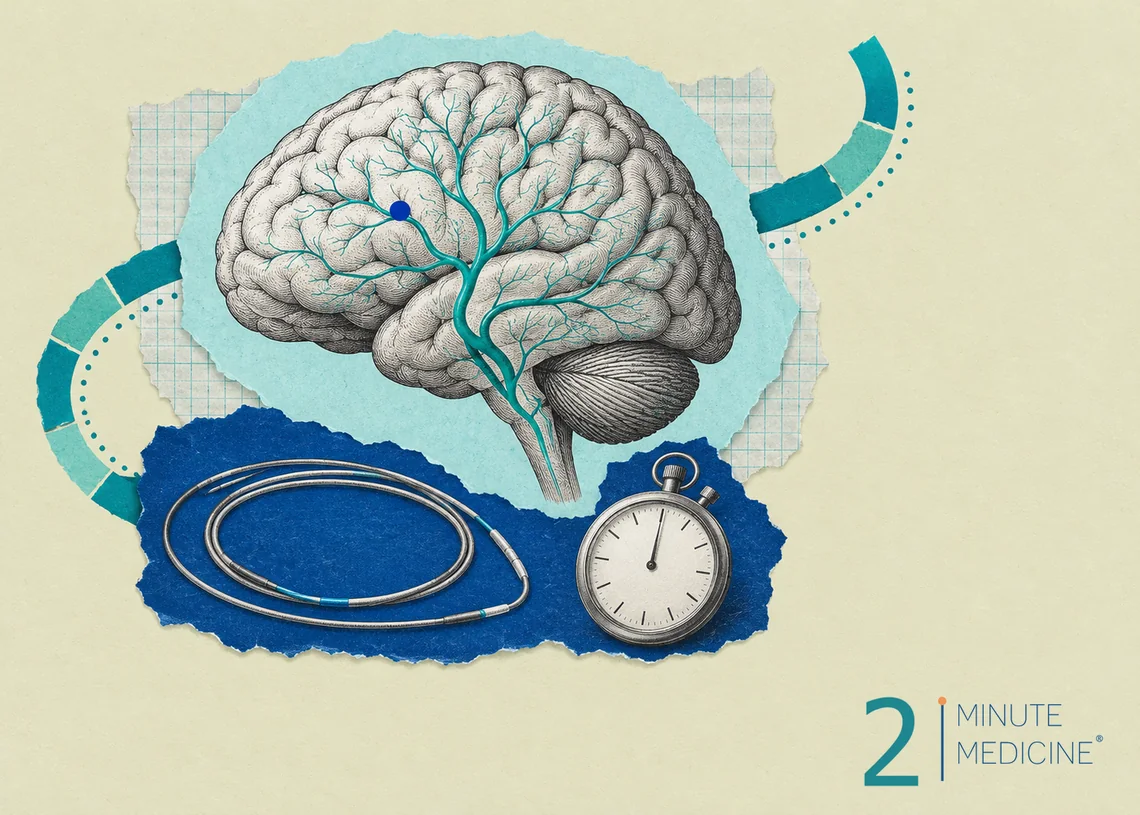
Stroke treatment collage: an engraved brain with teal arteries and one blocked branch, a coiled catheter and a stopwatch
Share on FacebookShare on TwitterShare on LinkedIn

1. Results from a large, open-label, multi-site study in China suggest there is benefit for long-term functional outcome, lower rates of disability for mechanical thrombectomy in patients 24 to 72 hours after symptom onset or last known well following an acute ischemic stroke. Standard of care to this point has emphasized the utility of mechanical thrombectomy only within 24 hours of symptom onset or last well known.

2. Patients who were randomized to the mechanical thrombectomy group were found to have a better functional outcomes compared to the control group as well as lower rates of disability in those who survived. However, there were higher percentages of death, intracranial hemorrhage, and overall serious adverse events in the intervention group compared to the control group.

Evidence Rating Level: 1 (Excellent)

Study Rundown: An open-label, multi-site, randomized trial conducted at stroke centers across China compared endovascular therapy in combination with standard medical care (intervention group) versus medical care alone (control group) in patients 24 to 72 hours after symptom onset or last known well following an acute ischemic stroke that was confirmed on computed tomographic (CT) or magnetic resonance angiography. A total of 336 patients were ultimately included in the intention-to-treat population. The median time from symptom onset or from the point when the patient was last known to be well was 38.5 hours, and the median time from randomization to arterial puncture in the intervention group was 1 hour. Successful reperfusion was achieved in 94.6% of the intervention group for which data was available. The  primary outcome was the distribution of modified Rankin Scale scores at 90 days. Of note, more patients in the intervention group than the control group were admitted to the intensive care, received glucocorticoids, were intubated and mechanically ventilated, and received nasogastric feeding. At 90-day follow-up, the intervention group was found to have a statistically significant better functional outcome as measured by the modified Rankin scale. The treatment benefit was most pronounced in those with occlusion of the internal carotid artery as well as those with non-large-artery atherosclerosis. In addition, the rate of disability among surviving patients was lower in the intervention group compared to the control group. However, there was a higher rate of death in the intervention group compared to the control group, as well as higher rates of intracranial hemorrhage and overall serious adverse events.

Click here to read the study in the NEJM (New England Journal of Medicine)

Relevant Reading: Clinical Outcomes and Identification of Patients With Persistent Penumbral Profiles Beyond 24 Hours From Last Known Well | Stroke

RELATED REPORTS

Cannabis use, including smoked or edible, linked to higher stroke risk

Low-pressure pneumoperitoneum does not reduce pain after laporoscopic cholecystectomy

In-Depth [randomized controlled trial]: This was an open-label, prospective, randomized trial with blinded outcome assessment conducted at 35 comprehensive stroke centers across China that included adult patients with acute ischemic stroke caused by large-vessel occlusion of the anterior circulation confirmed by imaging (either CT or MRI). Patients were eligible if they were within 24 to 72 hours after symptom onset or last known well following an acute ischemic stroke. They must have exhibited evidence of a neurologic deficit as indicated by a validated scoring system (National Institutes of Health Stroke Scale) and had evidence of salvageable brain tissue on imaging. Patients were randomized to either receive endovascular therapy in addition to standard medical care or standard medical care alone. The patients assigned to the intervention group underwent endovascular therapy within 60 minutes after randomization, and the choice of thrombectomy device, approach, and other adjunctive techniques as determined by the treating physician. Both groups received the standardized Chinese guideline-recommended medical care. The mean duration of hospitalization was 2.4 days longer (95% CI, 0.6 to 4.2) in the intervention group than in the control group. The modified Rankin scale at 90 days, used to assess functional outcome, favored endovascular therapy over standard medical care alone (common odds ratio for a better functional outcome, 1.74; 95% confidence interval [CI], 1.19 to 2.55; P=0.005). Disability among surviving patients was less common in the intervention group than in the control group (48.4% vs. 64.0%; odds ratio, 0.53 [95% CI, 0.34 to 0.82]). However, death within 90 days occurred in 10 of 167 patients (6.0%) in the intervention group, and in 3 of 167 patients (1.8%) in the control group (odds ratio, 3.48; 95% CI, 0.94 to 12.89). An intracranial hemorrhage occurred in 47 of 166 patients (28.3%) in the intervention group and in 9 of 164 patients (5.5%) in the control group (odds ratio, 6.82; 95% CI, 3.21 to 14.47). More patients in the intervention group than in the control group had a serious adverse event (22.0% vs. 13.1%).

Citation: Yang P, Shen H, Yi T, Xing P, Su J, Wen C, et al. Mechanical Thrombectomy 24 to 72 Hours after Large-Vessel Ischemic Stroke. N Engl J Med. 2026 Oct 23. doi: 10.1056/nejmoa2609362. Epub ahead of print. PMID: 42929656.

© 2026 2 Minute Medicine, Inc. All rights reserved. No part of this article may be reproduced, distributed or transmitted in any form or by any means without the prior written permission of 2 Minute Medicine, Inc. To license this content, contact 2 Minute Medicine, Inc. This article is for informational and educational purposes only; it is not medical advice and does not replace the judgment of a qualified healthcare professional.
Image: © 2 Minute Medicine

Tags: ischemic strokemechanical thrombectomystrokethrombectomytrial
Previous Post

Mavacamten reduced left ventricular outflow tract obstruction more than placebo in adolescents with symptomatic obstructive hypertrophic cardiomyopathy

RelatedReports

Cannabis and mental health collage: a thoughtful young man with curly hair, a flat cannabis leaf and three blank shopfronts
Cardiology

Cannabis use, including smoked or edible, linked to higher stroke risk

November 6, 2026
A surgical tray with instruments, balanced scales indicating cost, and monetary coins, symbolizing the economics of surgery and complication management.
Gastroenterology

Low-pressure pneumoperitoneum does not reduce pain after laporoscopic cholecystectomy

October 19, 2026
Robotic surgical instruments with surgical mesh and sutures, indicating a procedure for hernia repair.
Imaging and Intervention

The rate of urethrocutaneous fistula formation may be similar between caudal and penile blocks

October 12, 2026
A graphic featuring a heart, kidney, bladder, stethoscope, and an ultrasound machine, arranged in a flower-like design on a light blue background.
Weekly Rewinds

2 Minute Medicine Rewind October 12, 2026

October 17, 2026
✦ EvidencePulse™ by 2 Minute Medicine 3 reports You asked top stroke trials 2026 Synthesizing medical evidence... Top 2026 stroke trial results: OCEANIC — ischemic stroke: 6.2% vs 8.4% OPTION* — mRS 0–1: 43.6% vs 34.2% ORIENTAL* — mRS 0–2: 58.6% vs 46.6% *Higher sICH in intervention arms Participants randomizedN OCEANIC 12,327 OPTION 570 ORIENTAL 564 Ask about guidelines or landmark trials... Try EvidencePulse™ Get the signal. Try it now → Physician-trained medical AI by 2 Minute Medicine

2MM+ All Access

Full details →
$4.99 /month

3-day free trial · cancel anytime

  • ✓100+ physician-written reports
  • ✓EvidencePulse™ + HypeCheck™
  • ✓Ad-free reading + newsletters
Start 3-day free trial

Then $4.99/month. Manage renewal in your account.

2 Minute Medicine® is an award winning, physician-run, expert medical media company. Our content is curated, written and edited by practicing health professionals who have clinical and scientific expertise in their field of reporting. Our editorial management team is comprised of highly-trained MD physicians. Join numerous brands, companies, and hospitals who trust our licensed content.

Recent Reports

  • In selected patients with anterior-circulation large-vessel stroke 24-72 hours after onset, thrombectomy improved 90-day function but increased hemorrhage and death
  • Mavacamten reduced left ventricular outflow tract obstruction more than placebo in adolescents with symptomatic obstructive hypertrophic cardiomyopathy
  • Zavegepant (Zavzpret) may be effective for the management of migraine symptoms in Asian adults
License Content
Terms of Use | Disclaimer
Cookie Policy

Get the app

Read 2 Minute Medicine on iPhone, iPad and Android.

Download on the App StoreGet it on Google Play
QR code for www.2minutemedicine.com/app
On a computer? Scan this with your phone’s camera.
2MM+ All Access Full details →

The medical literature, distilled daily.

Monthly plan selected: $4.99 /month.

$4.99/month

3-day free trial · cancel anytime

Start 3-day free trial

Then $4.99/month. Manage renewal in your account.

Yearly plan selected: $49.90 /year.

$49.90/year

2 months free

Start 3-day free trial

Then $49.90/year.

Membership benefits

  • ✓100+ physician-written reports
  • ✓AI EvidencePulse™ + HypeCheck™
  • ✓Ad-free reading + newsletters
  • ✓FDA drug approvals + clinical calculators

Already a member? Sign in

  • Get the app
  • About
  • Specialties
    • All Specialties, All Recent Reports
    • Cardiology
    • Chronic Disease
    • Dermatology
    • Emergency
    • Endocrinology
    • Gastroenterology
    • Imaging and Intervention
    • Infectious Disease
    • Nephrology
    • Neurology
    • Obstetrics
    • Oncology
    • Ophthalmology
    • Pediatrics
    • Pharma
    • Preclinical
    • Psychiatry
    • Public Health
    • Pulmonology
    • Rheumatology
    • Surgery
    • Rewinds
    • The Scan
  • EvidencePulse™
  • HypeCheck™
  • AI News
  • Classics™
    • 2MM+ Online Access
    • Paperback and Ebook
  • Tools
    • NPI Registry Lookup
    • RVU Search
    • Physician Pay by Specialty
    • ICD-10 Code Lookup
    • FDA Drug Approvals
    • Drug Safety for Breastfeeding/Pregnancy
    • Clinical Guidelines
    • Medical Calculators
    • ECG Reference
      • QTc Calculator
      • Sgarbossa Criteria
      • ECG Axis Calculator
      • AV Block Helper
  • Rankings
    • Medical School Rankings
    • Residency Rankings
  • Partners
    • License Content
    • Advertise with Us
No Result
View All Result

© 2026 2 Minute Medicine, Inc. - Physician-written medical news.