
• About
  • Masthead
  • License Content
  • Advertise
  • Press Releases
  • Newsroom
  • RSS/Email List
  • 2MM Podcast
  • Write for us
  • Contact Us
2 Minute Medicine
No Result
View All Result

No products in the cart.

Sign in
SUBSCRIBE
  • About
  • Specialties
    • All Specialties, All Recent Reports
    • Cardiology
    • Chronic Disease
    • Dermatology
    • Emergency
    • Endocrinology
    • Gastroenterology
    • Imaging and Intervention
    • Infectious Disease
    • Nephrology
    • Neurology
    • Obstetrics
    • Oncology
    • Ophthalmology
    • Pediatrics
    • Pharma
    • Preclinical
    • Psychiatry
    • Public Health
    • Pulmonology
    • Rheumatology
    • Surgery
    • Rewinds
    • The Scan
  • EvidencePulse™
  • HypeCheck™
  • AI News
  • Classics™
    • 2MM+ Online Access
    • Paperback and Ebook
  • Tools
    • NPI Registry Lookup
    • RVU Search
    • Physician Pay by Specialty
    • ICD-10 Code Lookup
    • FDA Drug Approvals
    • Drug Safety for Breastfeeding/Pregnancy
    • Clinical Guidelines
    • Medical Calculators
    • ECG Reference
      • QTc Calculator
      • Sgarbossa Criteria
      • ECG Axis Calculator
      • AV Block Helper
  • Rankings
    • Medical School Rankings
    • Residency Rankings
  • Partners
    • License Content
    • Advertise with Us
2 Minute Medicine
  • About
  • Specialties
    • All Specialties, All Recent Reports
    • Cardiology
    • Chronic Disease
    • Dermatology
    • Emergency
    • Endocrinology
    • Gastroenterology
    • Imaging and Intervention
    • Infectious Disease
    • Nephrology
    • Neurology
    • Obstetrics
    • Oncology
    • Ophthalmology
    • Pediatrics
    • Pharma
    • Preclinical
    • Psychiatry
    • Public Health
    • Pulmonology
    • Rheumatology
    • Surgery
    • Rewinds
    • The Scan
  • EvidencePulse™
  • HypeCheck™
  • AI News
  • Classics™
    • 2MM+ Online Access
    • Paperback and Ebook
  • Tools
    • NPI Registry Lookup
    • RVU Search
    • Physician Pay by Specialty
    • ICD-10 Code Lookup
    • FDA Drug Approvals
    • Drug Safety for Breastfeeding/Pregnancy
    • Clinical Guidelines
    • Medical Calculators
    • ECG Reference
      • QTc Calculator
      • Sgarbossa Criteria
      • ECG Axis Calculator
      • AV Block Helper
  • Rankings
    • Medical School Rankings
    • Residency Rankings
  • Partners
    • License Content
    • Advertise with Us
Sign in
SUBSCRIBE
2 Minute Medicine
Sign in
Subscribe
2 Minute MedicineFree on Google PlayGet
✦EvidencePulse™by 2 Minute Medicine3 reportsYou askedtop stroke trials 2026Synthesizing medical evidence...Top 2026 stroke trial results:OCEANIC — ischemic stroke: 6.2% vs 8.4%OPTION* — mRS 0–1: 43.6% vs 34.2%ORIENTAL* — mRS 0–2: 58.6% vs 46.6%*Higher sICH in intervention armsParticipants randomizedNOCEANIC12,327OPTION570ORIENTAL564Ask about guidelines or landmark trials...↑Try EvidencePulse™Ask the evidence. Get the signal.Try it now →
Home Health A to Z

Patient Basics: Contact Dermatitis
by2 Minute Medicine
October 30, 2026
in Health A to Z
Reading Time: 5 mins read
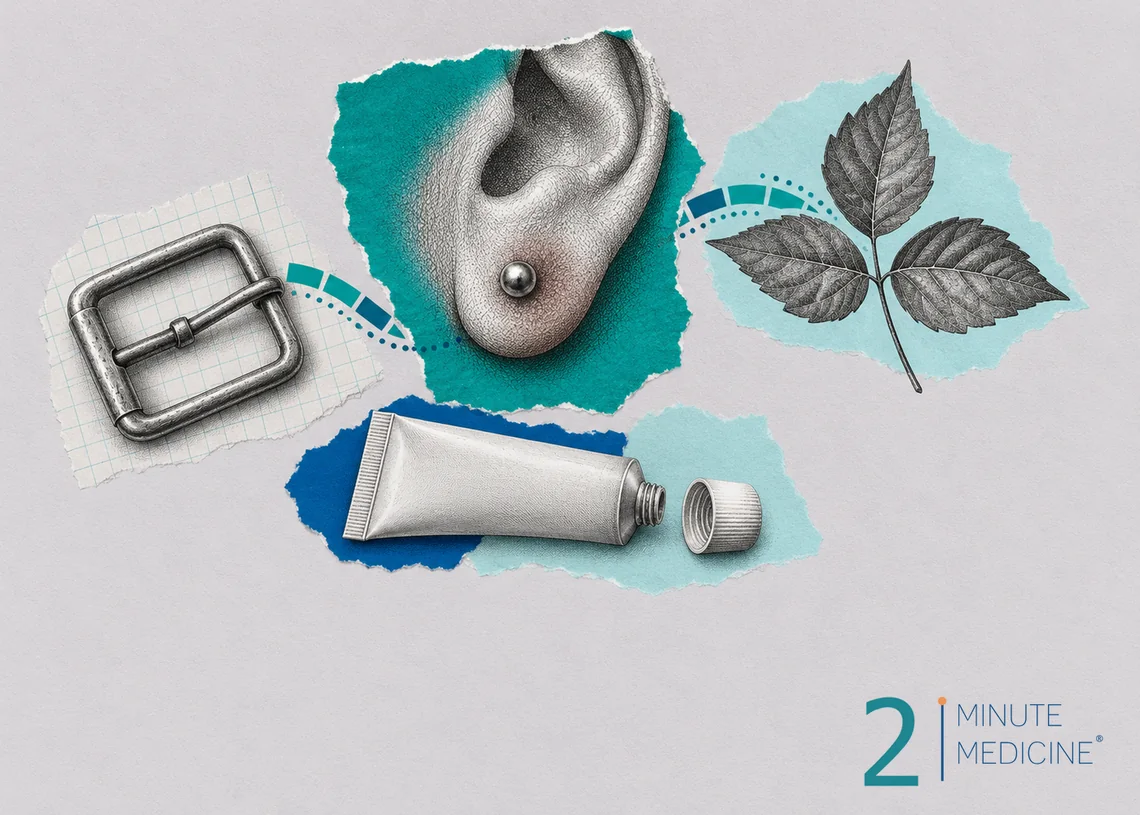
Contact dermatitis collage: an earlobe with a metal stud, a poison ivy sprig, a belt buckle and a plain cream tube
Share on FacebookShare on TwitterShare on LinkedIn

Contact dermatitis is an itchy or sore skin rash caused by something that touches the skin. It can come from a harsh substance that wears down the skin, or from an allergy to a material such as nickel, poison ivy or a fragrance. The rash usually clears once you find and avoid the cause, and soothing care and steroid creams help in the meantime.

Key points

  • Irritant contact dermatitis is the most common type. Soaps, detergents, frequent hand washing and chemicals are typical causes.
  • Allergic contact dermatitis is an immune reaction. Common triggers are nickel, poison ivy, fragrances, preservatives, hair dye and rubber.
  • The rash often shows the shape of what touched the skin, like a line under a watch strap or streaks from a plant.
  • A patch test can find the cause of allergic contact dermatitis.
  • Contact dermatitis isn’t contagious.

Types of contact dermatitis

Irritant contact dermatitis

This happens when something damages the skin’s outer layer faster than it can repair. Anyone can get it with enough exposure. Common causes are:

  • Water, soap and hand sanitizer, especially with frequent washing
  • Cleaning products, solvents, bleach and detergents
  • Saliva, sweat, urine and stool held against the skin
  • Rubbing from clothing or tight gear

Health care workers, cleaners, hairdressers, cooks, mechanics and parents of young children are often affected, mostly on the hands.

Allergic contact dermatitis

Here the immune system learns to react to a substance. The first contacts cause no rash. Later contacts set off a rash, usually 1 to 3 days after exposure. Common triggers include:

  • Nickel in jewelry, belt buckles, jeans buttons and phones
  • Poison ivy, oak and sumac
  • Fragrances and preservatives in lotions, shampoos, cosmetics and baby wipes
  • Hair dye and black henna tattoos
  • Rubber chemicals in gloves and shoes
  • Antibiotic ointments such as neomycin and bacitracin
  • Acrylates in gel nails and adhesives

Contact dermatitis symptoms

  • A red rash on lighter skin. On brown and Black skin, it may look purple, dark brown or gray and can be harder to see.
  • Itching, which is often strong in allergic contact dermatitis
  • Burning, stinging or tenderness, more typical of irritant dermatitis
  • Dry, cracked or scaly skin
  • Bumps and blisters that may ooze and crust
  • A sharp edge or pattern that matches what touched the skin

Mild irritant dermatitis can look like dry, rough skin that barely itches. On darker skin, the rash can leave darker or lighter patches for weeks to months after it heals.

Common places

  • Around the mouth. Lip licker’s dermatitis is a red, chapped ring caused by saliva from licking the lips, common in children and in cold weather.
  • Armpits. Fragrances in deodorants, antiperspirants and clothing dyes can trigger it.
  • The vulva. Scented soaps, wipes, pads, spermicides and latex can cause itching and burning. Yeast and other conditions look similar, so see a doctor rather than guessing.
  • Babies. Diaper rash is irritant contact dermatitis from urine and stool. Drool rash on the chin and cheeks is another example.

How it’s diagnosed

A doctor can often tell from the rash and your history. They’ll ask about your job, hobbies, products you use and where the rash began. If an allergy is suspected and the trigger isn’t clear, a dermatologist may do patch testing. Small amounts of common allergens are taped to your back for 2 days and checked again a few days later. A skin scraping may be checked for fungus, because antifungal creams won’t help contact dermatitis.

RELATED REPORTS

Severe atopic dermatitis associated with symptoms of depression and internalizing behaviors in children

#VisualAbstract New RCT (JADE TEEN) shows efficacy and safety of abrocitinib in combination with topical therapy in adolescents with moderate-to-severe atopic dermatitis

How contact dermatitis is treated

  • Avoid the trigger. This is the most important step. After contact with poison ivy, wash your skin with soap and water as soon as you can, and wash clothes, tools and pets that touched it.
  • Steroid creams. Over-the-counter hydrocortisone helps mild rashes. Stronger prescription creams work better on thick or blistered skin. Use only mild ones on the face, genitals and skin folds unless told otherwise.
  • Non-steroid creams such as tacrolimus or pimecrolimus are useful for the eyelids and face.
  • Steroid pills. For a severe or widespread rash, such as bad poison ivy, a doctor may prescribe prednisone, usually tapered over 2 to 3 weeks so the rash doesn’t flare back.
  • Moisturizers. Thick, fragrance-free ointments such as petroleum jelly help the skin barrier heal, especially for hand and lip dermatitis.

Home care

  • Apply cool, wet cloths for 15 to 30 minutes a few times a day.
  • Soak in a lukewarm bath with colloidal oatmeal.
  • Use calamine lotion on poison ivy rashes.
  • Don’t scratch. Keep nails short.
  • Skip creams with diphenhydramine, benzocaine or neomycin, and “natural” remedies such as tea tree oil. They can cause their own allergic rash.

Recovery

Once the trigger is gone, irritant dermatitis often improves within days to a couple of weeks. An allergic rash usually takes 2 to 4 weeks to clear. If the rash keeps coming back, something you touch is probably still causing it.

Lowering your risk

  • Wear gloves for wet work and cleaning. Cotton liners under vinyl or nitrile gloves help if rubber is a problem.
  • Moisturize your hands after each wash.
  • Choose fragrance-free products, and check ingredient lists for allergens you know about.
  • Pick nickel-free jewelry, and cover metal buttons that touch your skin.
  • Learn to spot poison ivy (“leaves of three”), and wear long sleeves and pants outdoors.

When to see a doctor

  • The rash is on your face, eyelids or genitals, or covers a large area
  • Signs of infection, such as pus, yellow crusts, spreading warmth or fever
  • No improvement after a week or two of home care
  • It keeps coming back or affects your work

Get emergency care for swelling of the face, lips or throat, or trouble breathing, including after breathing smoke from burning poison ivy.

Common questions about contact dermatitis

How long does contact dermatitis last?

Most rashes clear within 1 to 4 weeks once the trigger is avoided. Irritant dermatitis tends to settle faster, while allergic rashes such as poison ivy often last 2 to 3 weeks. A rash that lasts longer usually means the cause is still around or the diagnosis is different.

Do antihistamines help contact dermatitis?

Only a little. Antihistamine pills don’t treat the rash itself, but a drowsy one at bedtime can help you sleep through the itch. Steroid creams and avoiding the trigger work better. Avoid antihistamine creams, which can cause their own allergic rash.

Is contact dermatitis contagious?

No, you can’t catch it from another person, even if the rash oozes. With poison ivy, though, the plant oil can spread from unwashed skin, clothes or pet fur. Once the oil is washed off, the rash itself doesn’t spread to others.

Questions to ask your doctor

  • Is this irritant or allergic contact dermatitis?
  • Should I have patch testing?
  • Which steroid cream should I use, where, and for how long?
  • Which soaps and lotions should I use instead?
  • How can I protect my skin at work?

Learn more

  • Contact dermatitis (DermNet)
  • Contact dermatitis (MedlinePlus, U.S. National Library of Medicine)

This guide is general information and doesn’t replace advice from your own doctor. Last updated October 2026.

Tags: dermatitis
Previous Post

Patient Basics: Scleritis

Next Post

Patient Basics: Functional Neurological Disorder (Conversion Disorder)

RelatedReports

Dermatology

Severe atopic dermatitis associated with symptoms of depression and internalizing behaviors in children

September 6, 2021
#VisualAbstract New RCT (JADE TEEN) shows efficacy and safety of abrocitinib in combination with topical therapy in adolescents with moderate-to-severe atopic dermatitis
StudyGraphics

#VisualAbstract New RCT (JADE TEEN) shows efficacy and safety of abrocitinib in combination with topical therapy in adolescents with moderate-to-severe atopic dermatitis

August 26, 2021
#VisualAbstract: Annual screening for ovarian cancer does not significantly reduce mortality
StudyGraphics

#VisualAbstract: Upadacitinib plus topical corticosteroids is safe and effective for moderate-to-severe atopic dermatitis;

June 24, 2021
#VisualAbstract Cutaneous reactions in children treated with MEK and/or BRAF inhibitors are common and often lead to interruptions or alterations in chemotherapy
StudyGraphics

#VisualAbstract Cutaneous reactions in children treated with MEK and/or BRAF inhibitors are common and often lead to interruptions or alterations in chemotherapy

June 10, 2021
Next Post
Pink eye collage: an engraved eye with a pink-tinted white, a folded damp washcloth, a dropper bottle and a pillowcase

Patient Basics: Pink Eye (Conjunctivitis)

Collage of an engraved colon with a teal ribbon, prunes for constipation, a glass of water and an older woman smiling softly

Patient Basics: Constipation and Impaction

Collage on viral rhinitis: an older man in a wool scarf, a steaming mug, a jar of honey and an engraved cold virus

Patient Basics: Common Cold (Viral Rhinitis)

✦ EvidencePulse™ by 2 Minute Medicine 3 reports You asked top stroke trials 2026 Synthesizing medical evidence... Top 2026 stroke trial results: OCEANIC — ischemic stroke: 6.2% vs 8.4% OPTION* — mRS 0–1: 43.6% vs 34.2% ORIENTAL* — mRS 0–2: 58.6% vs 46.6% *Higher sICH in intervention arms Participants randomizedN OCEANIC 12,327 OPTION 570 ORIENTAL 564 Ask about guidelines or landmark trials... Try EvidencePulse™ Get the signal. Try it now → Physician-trained medical AI by 2 Minute Medicine

2MM+ All Access

Full details →
$4.99 /month

3-day free trial · cancel anytime

  • ✓100+ physician-written reports
  • ✓EvidencePulse™ + HypeCheck™
  • ✓Ad-free reading + newsletters
Start 3-day free trial

Then $4.99/month. Manage renewal in your account.

NPI Lookup · Free

Look up any US clinician

Search by name or NPI number, live from the CMS NPI Registry.

  • OIG exclusion check
  • Licenses and specialties
  • No account needed
Open NPI Lookup →

2 Minute Medicine® is an award winning, physician-run, expert medical media company. Our content is curated, written and edited by practicing health professionals who have clinical and scientific expertise in their field of reporting. Our editorial management team is comprised of highly-trained MD physicians. Join numerous brands, companies, and hospitals who trust our licensed content.

Recent Reports

  • Midline catheters may reduce catheter-related bloodstream infections compared with peripherally inserted central catheters in intensive care unit patients
  • AI scribe use associated with reduced documentation time but longer clinical notes
  • Once-monthly bofanglutide maintained weight loss over 24 weeks in topline phase 3 results
License Content
Terms of Use | Disclaimer
Cookie Policy

Get the app

Read 2 Minute Medicine on iPhone, iPad and Android.

Download on the App StoreGet it on Google Play
QR code for www.2minutemedicine.com/app
On a computer? Scan this with your phone’s camera.
2MM+ All Access Full details →

The medical literature, distilled daily.

Monthly plan selected: $4.99 /month.

$4.99/month

3-day free trial · cancel anytime

Start 3-day free trial

Then $4.99/month. Manage renewal in your account.

Yearly plan selected: $49.90 /year.

$49.90/year

2 months free

Start 3-day free trial

Then $49.90/year.

Membership benefits

  • ✓100+ physician-written reports
  • ✓AI EvidencePulse™ + HypeCheck™
  • ✓Ad-free reading + newsletters
  • ✓FDA drug approvals + clinical calculators

Already a member? Sign in

  • Get the app
  • About
  • Specialties
    • All Specialties, All Recent Reports
    • Cardiology
    • Chronic Disease
    • Dermatology
    • Emergency
    • Endocrinology
    • Gastroenterology
    • Imaging and Intervention
    • Infectious Disease
    • Nephrology
    • Neurology
    • Obstetrics
    • Oncology
    • Ophthalmology
    • Pediatrics
    • Pharma
    • Preclinical
    • Psychiatry
    • Public Health
    • Pulmonology
    • Rheumatology
    • Surgery
    • Rewinds
    • The Scan
  • EvidencePulse™
  • HypeCheck™
  • AI News
  • Classics™
    • 2MM+ Online Access
    • Paperback and Ebook
  • Tools
    • NPI Registry Lookup
    • RVU Search
    • Physician Pay by Specialty
    • ICD-10 Code Lookup
    • FDA Drug Approvals
    • Drug Safety for Breastfeeding/Pregnancy
    • Clinical Guidelines
    • Medical Calculators
    • ECG Reference
      • QTc Calculator
      • Sgarbossa Criteria
      • ECG Axis Calculator
      • AV Block Helper
  • Rankings
    • Medical School Rankings
    • Residency Rankings
  • Partners
    • License Content
    • Advertise with Us
No Result
View All Result

© 2026 2 Minute Medicine, Inc. - Physician-written medical news.


