Patient Basics: Gout
Originally published by Harvard Health.
What Is It?
Gout is a disorder characterized by too much uric acid in the blood and tissues. In gout, crystals of uric acid are deposited in the joints, where they cause a type of arthritis called gouty arthritis. They also can be deposited in the kidneys, where they can cause kidney stones.
There are three main causes of the high levels of uric acid that lead to gout:
- A diet rich in chemicals called purines, because purines are broken down by the body into uric acid. Foods that contain purines include anchovies; nuts; and organ foods such as liver, kidney and sweetbreads.
- High production of uric acid by the body. This can happen for unknown reasons. It can also occur in certain inherited genetic metabolic disorders, leukemia and during chemotherapy for cancer.
- The kidneys do not excrete enough uric acid. This can be caused by kidney disease; starvation; and alcohol use, especially binge drinking. This also can occur in people taking medications called thiazide diuretics, which are used to treat high blood pressure.
Obesity or sudden weight gain can cause high uric acid levels because the body’s tissues break down more purines.
In some people, gout is caused by a combination of these factors. People with a family history of gout are more likely to develop the condition.
About 90% of patients with gout are men older than 40. Gout is quite rare in younger women and typically occurs in women many years after menopause.
Symptoms
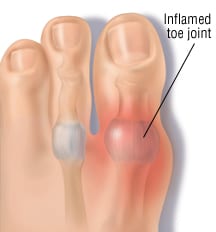
The first attack of gouty arthritis usually involves only one joint, most commonly the big toe. However, it sometimes affects other joints, such as a knee, ankle, wrist, foot or finger. In gouty arthritis, the joint can become red, swollen and extremely tender to the touch. Typically, even a bed sheet brushing against the joint will trigger intense pain. After the first attack of gout, later episodes are more likely to involve several joints. Sometimes, if gout lasts for many years, uric acid crystals can collect in the joints or tendons, under the skin, or on the outside the ears, forming a whitish deposit called a tophus.
Diagnosis
Your doctor will ask you about your medications, diet, alcohol use and about any family history of gout. Your doctor will examine you, and he or she will look at your painful joints and search your skin for tophi.
Your doctor may use a sterile needle to remove a sample of fluid from your inflamed joint. This joint fluid will be examined in a laboratory for microscopic uric acid crystals, which confirm the diagnosis of gouty arthritis. Your doctor also may order blood tests to measure the level of uric acid in your blood. Depending on your history and symptoms, you may need additional blood tests and urine tests to check how well your kidneys are working.
Expected Duration
Without treatment, the pain of gouty arthritis usually lasts for several days, but it is most intense during the first 24 to 36 hours. The interval between attacks varies a lot. Some people have them every few weeks, while others go years between attacks. After several gout attacks, a joint may take longer to improve or stay inflamed and painful.
Prevention
To help prevent gout:
- Follow a healthy diet.
- Avoid alcohol use, especially binge drinking.
- Avoid dehydration.
- Lose weight if you are obese.
- Avoid diuretics (water pills) if possible.
For most people with gout, dietary restrictions do not seem to help much, but you should avoid any foods that seem to trigger gout attacks.
Treatment
To treat an attack of gouty arthritis, your doctor usually will begin by prescribing a nonsteroidal anti-inflammatory drug (NSAID), such as indomethacin (Indocin), ibuprofen (Advil, Motrin and others) or naproxen (Aleve, Anaprox, Naprosyn and others). Aspirin should be avoided because it can raise the level of uric acid in your blood (although low dose aspirin for prevention of heart disease or stroke has little effect on gout).
If you cannot tolerate an NSAID, or if these drugs don’t work for you, your doctor may suggest a corticosteroid. Corticosteroids can be given orally or injected directly into the affected joint. Another option is an injection of a compound called adrenocorticotrophic hormone, which directs your adrenal gland to make more cortisone.
A drug called colchicine sometimes is used, but it often causes unpleasant side effects (such as nausea, vomiting, cramps, diarrhea) before it helps the arthritis.
To prevent attacks of gout, your doctor may prescribe allopurinol (Aloprim, Zyloprim) or febuxostat (Uloric) to make your body produce less uric acid. If attacks are rare and respond well to treatment, this may not be necessary. It is usually recommended when:
- Gout attacks are frequent.
- Gout attacks do not respond promptly to treatment.
- Gout attacks affect more than one joint at a time.
- There is a history of kidney stones and previous gout.
- A tophus has developed.
The level of uric acid in your blood usually begins to drop within days of the first dose of allopurinol or febuxostat. It may take weeks of daily treatment for the full effect to occur. Another treatment approach is to take a medication (such as Probenecid) that makes your kidneys excrete more uric than usual. These drugs work well in 70% to 80% of people with gout. But they should not be taken by people who have significant kidney disease or who have had a kidney stone.
A more recently approved medication to lower uric acid is pegloticase (Krystexxa). Because of its expense and side effects (especially allergic reactions) and because it can only be taken intravenously, this medication will likely be recommended only when other treatments don’t work.
Medications to lower uric acid levels (such as allopurinol, febuxostat, or probenecid) are usually taken indefinitely. If discontinued, the uric acid level will usually rise again and attacks of gout are likely to resume.
When your doctor prescribes a medication to reduce uric acid in your blood, he or she also should prescribe a second medication to prevent a gout attack. That’s because any change in uric acid levels, up or down, can trigger an attack. These preventive medications include a low dose of colchicine or a low dose of an NSAID. Once the uric acid is lowered enough for a prolonged period (about 6 months), the preventive medication can be stopped.
When To Call a Professional
Call your doctor whenever you have pain and swelling in a joint. If you have had gout in the past, your doctor may suggest you have NSAIDs available so you can take them at the earliest sign of an attack.
Prognosis
More than 50% of people who have had one attack of gouty arthritis will have a second, usually within six months to two years. For people with more severe disease, long-term preventive medication is highly effective at lowering uric acid, which can prevent attacks and, over months to years, cause tophi to resolve.
Additional Info
Arthritis Foundation
P.O. Box 7669
Atlanta, GA 30357-0669
Phone: 404-872-7100
Toll-Free: 1-800-283-7800
http://www.arthritis.org/
American College of Rheumatology
2200 Lake Boulevard NE
Atlanta, GA 30319
Phone: (404) 633-3777
Fax: (404) 633-1870
http://www.rheumatology.org/