
• About
  • Masthead
  • License Content
  • Advertise
  • Press Releases
  • Newsroom
  • RSS/Email List
  • 2MM Podcast
  • Write for us
  • Contact Us
2 Minute Medicine
No Result
View All Result

No products in the cart.

Sign in
SUBSCRIBE
  • About
  • Specialties
    • All Specialties, All Recent Reports
    • Cardiology
    • Chronic Disease
    • Dermatology
    • Emergency
    • Endocrinology
    • Gastroenterology
    • Imaging and Intervention
    • Infectious Disease
    • Nephrology
    • Neurology
    • Obstetrics
    • Oncology
    • Ophthalmology
    • Pediatrics
    • Pharma
    • Preclinical
    • Psychiatry
    • Public Health
    • Pulmonology
    • Rheumatology
    • Surgery
    • Rewinds
    • The Scan
  • EvidencePulse™
  • HypeCheck™
  • AI News
  • Classics™
    • 2MM+ Online Access
    • Paperback and Ebook
  • Tools
    • NPI Registry Lookup
    • RVU Search
    • ICD-10 Code Lookup
    • Medical School Rankings
    • FDA Drug Approvals
    • Drug Safety for Breastfeeding/Pregnancy
    • Clinical Guidelines
    • Medical Calculators
  • Partners
    • License Content
    • Advertise with Us
2 Minute Medicine
  • About
  • Specialties
    • All Specialties, All Recent Reports
    • Cardiology
    • Chronic Disease
    • Dermatology
    • Emergency
    • Endocrinology
    • Gastroenterology
    • Imaging and Intervention
    • Infectious Disease
    • Nephrology
    • Neurology
    • Obstetrics
    • Oncology
    • Ophthalmology
    • Pediatrics
    • Pharma
    • Preclinical
    • Psychiatry
    • Public Health
    • Pulmonology
    • Rheumatology
    • Surgery
    • Rewinds
    • The Scan
  • EvidencePulse™
  • HypeCheck™
  • AI News
  • Classics™
    • 2MM+ Online Access
    • Paperback and Ebook
  • Tools
    • NPI Registry Lookup
    • RVU Search
    • ICD-10 Code Lookup
    • Medical School Rankings
    • FDA Drug Approvals
    • Drug Safety for Breastfeeding/Pregnancy
    • Clinical Guidelines
    • Medical Calculators
  • Partners
    • License Content
    • Advertise with Us
Sign in
SUBSCRIBE
2 Minute Medicine
Sign in
Subscribe
2 Minute MedicineFree on Google PlayGet
✦EvidencePulse™by 2 Minute Medicine3 reportsYou askedtop stroke trials 2026Synthesizing medical evidence...Top 2026 stroke trial results:OCEANIC — ischemic stroke: 6.2% vs 8.4%OPTION* — mRS 0–1: 43.6% vs 34.2%ORIENTAL* — mRS 0–2: 58.6% vs 46.6%*Higher sICH in intervention armsParticipants randomizedNOCEANIC12,327OPTION570ORIENTAL564Ask about guidelines or landmark trials...↑Try EvidencePulse™Ask the evidence. Get the signal.Try it now →
Home Health A to Z

Patient Basics: Hysterosalpingogram
by2 Minute Medicine
October 30, 2026
in Health A to Z
Reading Time: 5 mins read
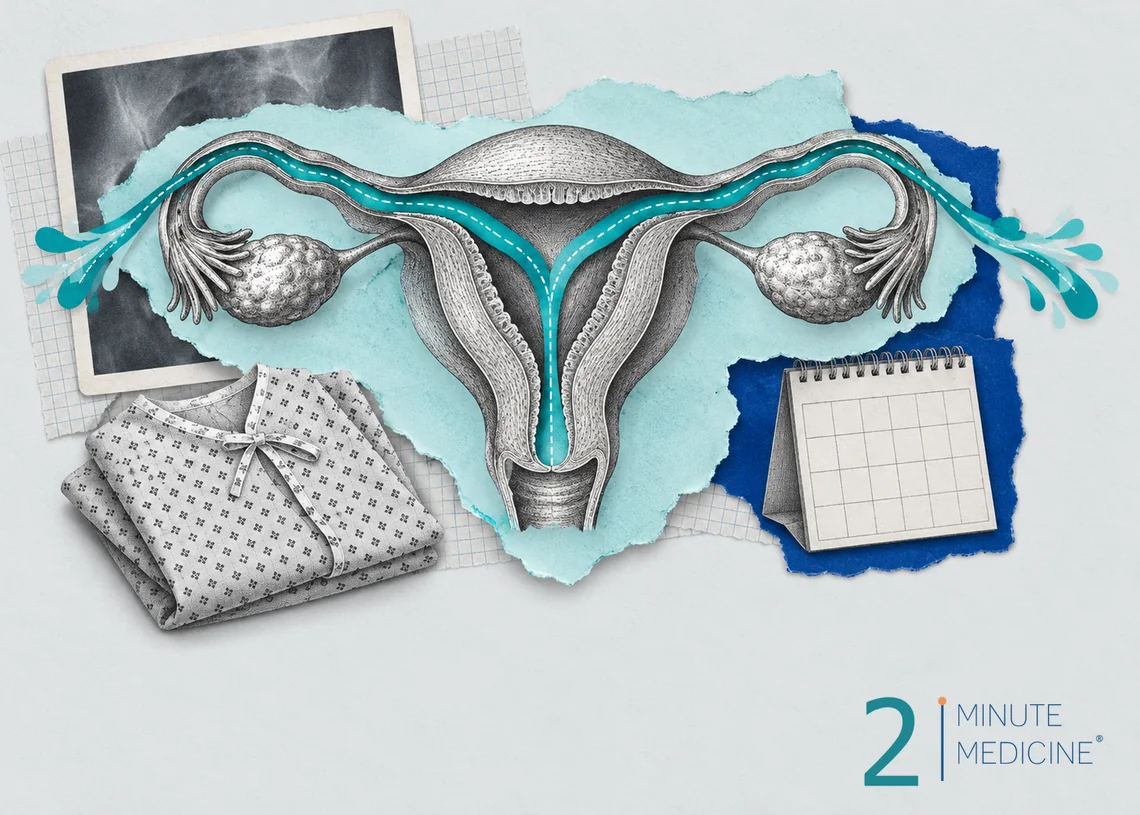
Hysterosalpingogram collage: a uterus and fallopian tubes with a dotted teal line for dye flow, a blank X-ray film
Share on FacebookShare on TwitterShare on LinkedIn

A hysterosalpingogram (HSG) is an X-ray test that shows the inside of the uterus (womb) and whether the fallopian tubes are open. A thin tube passes through the cervix, and a liquid that shows up on X-rays (contrast dye) is gently pushed in. The test is quick, often done as part of a fertility checkup, and timed for the days just after your period ends.

Key points

  • An HSG checks for blocked fallopian tubes and for problems with the shape of the uterus, such as polyps, fibroids or scar tissue.
  • It is usually done between the end of your period and the time you ovulate, so there is no chance of an early pregnancy.
  • Most people feel cramps like period cramps for a few minutes. Taking ibuprofen beforehand often helps.
  • Serious problems are rare. Infection is the main risk.
  • You can often see the first results on the screen while the test is being done.

Why a hysterosalpingogram is done

Each month, an egg travels from the ovary through a fallopian tube toward the uterus. Sperm must get through the same tube to reach the egg. If a tube is blocked or damaged, pregnancy is harder, and the risk of a pregnancy growing in the tube (ectopic pregnancy) goes up. An HSG can help:

  • Find a cause of trouble getting pregnant
  • Look for causes of repeated miscarriage, such as a wall of tissue dividing the uterus (septum)
  • Check the tubes before choosing between treatments, such as medicine to help you ovulate, insemination or IVF
  • Show whether surgery to reopen the tubes, or to reverse a tubal ligation, has worked
  • Confirm the tubes are closed after some types of permanent birth control

Common reasons for blocked tubes include past pelvic infections such as chlamydia or gonorrhea, endometriosis, and scar tissue from surgery on the belly or pelvis.

Getting ready for a hysterosalpingogram

  • Timing. The office will book the test for a few days after your bleeding stops and before you ovulate. Call them on the first day of your period so they can schedule it.
  • Pregnancy. You may be asked to avoid sex or use condoms from the start of your period until the test. Some offices do a pregnancy test that day.
  • Pain relief. Ask whether to take ibuprofen or naproxen about an hour before.
  • Health history. Tell the team if you have had a pelvic infection, an allergy to X-ray dye or iodine, or a reaction to past tests. If you have had an infection, you may get an antibiotic.
  • What to bring. Bring a pad for the sticky discharge afterward. Most people can drive themselves home.

What happens during an HSG

  1. You lie on your back on an X-ray table with your knees bent, as you would for a Pap test.
  2. A doctor places a speculum in the vagina and cleans the cervix.
  3. A thin, soft tube (catheter) is passed into the opening of the cervix. Some have a tiny balloon that holds them in place.
  4. Contrast dye flows slowly into the uterus. A live X-ray (fluoroscopy) shows it filling the uterus, moving out along the tubes and spilling into the belly. You may be asked to turn a little to the side.
  5. The tube and speculum come out.

The part with the dye lasts only a few minutes. The whole visit takes about 30 minutes. The dye left in your belly is absorbed by your body or passes out of the vagina.

Afterward

  • Mild cramps can last a few hours. Ibuprofen and a heating pad usually help.
  • A sticky, watery discharge and light spotting for a day or two are normal. Use pads, not tampons, until the spotting stops.
  • You can return to normal activities the same day. Some people feel dizzy or faint right after, so rest for a few minutes before you stand.

Possible risks

  • Pelvic infection. This is uncommon. The risk is higher if a tube is swollen with fluid (hydrosalpinx) or you have had pelvic infections before.
  • Allergic reaction to the dye, which is rare
  • Fainting during or just after the test
  • Radiation. The dose is small, and the test is timed so you can’t be pregnant.

Your results

A radiologist or fertility doctor studies the images. You may hear some results the same day, with a written report in a few days.

  • Normal. The uterus has a smooth, even shape, and dye spills freely from the ends of both tubes.
  • Blocked tube. The dye stops partway along one or both tubes. A tube that is swollen with dye at the end suggests a hydrosalpinx.
  • Uterus problems. Gaps or odd outlines in the dye can point to polyps, fibroids, scar tissue or a septum.

A tube can tighten for a moment during the test (spasm) and look blocked when it isn’t. If one tube looks blocked, your doctor may repeat the test or use another one, such as a laparoscopy (surgery through tiny cuts), before deciding on treatment.

RELATED REPORTS

No Content Available

When to call your doctor

  • Fever of 100.4°F (38°C) or higher in the days after the test
  • Pain that gets worse instead of better
  • Bad-smelling discharge from the vagina
  • Heavy bleeding that soaks a pad in an hour
  • Hives, swelling or trouble breathing (call 911 for trouble breathing)

Common questions about a hysterosalpingogram

Does an HSG hurt?

Most people feel cramping that is mild to moderate, a lot like period cramps, and it fades within minutes after the dye stops. A blocked tube can cause stronger cramps while the dye is pushed in. Taking ibuprofen an hour before the test and breathing slowly during it can help.

Can an HSG help you get pregnant?

Possibly. Some studies found slightly higher pregnancy rates in the few months after an HSG, especially when an oil-based dye was used. The dye may flush out mucus or debris from the tubes. An HSG is not a treatment for blocked tubes, though.

Is there an HSG test without X-rays?

Yes. An ultrasound version uses a foam or saline solution in place of X-ray dye to check the tubes. It is called HyFoSy or HyCoSy. Not every clinic offers it, and results depend on the skill of the person doing the scan, so ask which test your clinic recommends.

How soon after an HSG can I try to get pregnant?

Most people can try in the same cycle, once any spotting has stopped. The test is done before ovulation, so no pregnancy is exposed to the X-rays, and the dose reaching the ovaries is small. Ask your doctor first if you had a fever, an infection or another procedure at the same visit.

Questions to ask your doctor

  • Why do you recommend this test for me?
  • When in my cycle should I book it?
  • Should I take an antibiotic or pain medicine first?
  • What will we do if a tube looks blocked?
  • Who will explain the results to me, and when?

Learn more

  • Hysterosalpingography (MedlinePlus, U.S. National Library of Medicine)
  • Infertility (MedlinePlus, U.S. National Library of Medicine)

This guide is general information and doesn’t replace advice from your own doctor. Last updated October 2026.

Tags: Hysterosalpingogram
Previous Post

Patient Basics: Holter Monitor and Event Monitor

Next Post

Patient Basics: Hysteroscopy

RelatedReports

No Content Available
Next Post
Fetal ultrasound collage: a textbook drawing of a baby curled in the womb, curved sound-wave lines and knitted baby booties

Patient Basics: Fetal Ultrasound

Fine-needle aspiration of the breast collage: a clinic gown on a hook, a microscope, a glass slide and a vase of flowers

Patient Basics: Fine-Needle Aspiration (FNA) of the Breast

Fluorescein angiography collage: a retina with branching vessels in teal, a camera lens, an eye drop bottle and sunglasses

Patient Basics: Fluorescein Angiography (Test for Diabetic Retinopathy)

✦ EvidencePulse™ by 2 Minute Medicine 3 reports You asked top stroke trials 2026 Synthesizing medical evidence... Top 2026 stroke trial results: OCEANIC — ischemic stroke: 6.2% vs 8.4% OPTION* — mRS 0–1: 43.6% vs 34.2% ORIENTAL* — mRS 0–2: 58.6% vs 46.6% *Higher sICH in intervention arms Participants randomizedN OCEANIC 12,327 OPTION 570 ORIENTAL 564 Ask about guidelines or landmark trials... Try EvidencePulse™ Get the signal. Try it now → Physician-trained medical AI by 2 Minute Medicine

2MM+ All Access

Full details →
$4.99 /month

3-day free trial · cancel anytime

  • ✓100+ physician-written reports
  • ✓EvidencePulse™ + HypeCheck™
  • ✓Ad-free reading + newsletters
Start 3-day free trial

Then $4.99/month. Manage renewal in your account.

NPI Lookup · Free

Look up any US clinician

Search by name or NPI number, live from the CMS NPI Registry.

  • OIG exclusion check
  • Licenses and specialties
  • No account needed
Open NPI Lookup →

2 Minute Medicine® is an award winning, physician-run, expert medical media company. Our content is curated, written and edited by practicing health professionals who have clinical and scientific expertise in their field of reporting. Our editorial management team is comprised of highly-trained MD physicians. Join numerous brands, companies, and hospitals who trust our licensed content.

Recent Reports

  • Early mitral valve surgery may improve long-term survival in asymptomatic severe mitral regurgitation
  • CDC reports increasing early-season influenza activity and at least 900 deaths nationwide
  • A concentrated exposure therapy intervention may be more effective than digital cognitive behavioural therapy in obsessive-compulsive disorder
License Content
Terms of Use | Disclaimer
Cookie Policy

Get the app

Read 2 Minute Medicine on iPhone, iPad and Android.

Download on the App StoreGet it on Google Play
QR code for www.2minutemedicine.com/app
On a computer? Scan this with your phone’s camera.
2MM+ All Access Full details →

The medical literature, distilled daily.

Monthly plan selected: $4.99 /month.

$4.99/month

3-day free trial · cancel anytime

Start 3-day free trial

Then $4.99/month. Manage renewal in your account.

Yearly plan selected: $49.90 /year.

$49.90/year

2 months free

Start 3-day free trial

Then $49.90/year.

Membership benefits

  • ✓100+ physician-written reports
  • ✓AI EvidencePulse™ + HypeCheck™
  • ✓Ad-free reading + newsletters
  • ✓NPI watchlist + bulk NPI verification

Already a member? Sign in

  • Get the app
  • About
  • Specialties
    • All Specialties, All Recent Reports
    • Cardiology
    • Chronic Disease
    • Dermatology
    • Emergency
    • Endocrinology
    • Gastroenterology
    • Imaging and Intervention
    • Infectious Disease
    • Nephrology
    • Neurology
    • Obstetrics
    • Oncology
    • Ophthalmology
    • Pediatrics
    • Pharma
    • Preclinical
    • Psychiatry
    • Public Health
    • Pulmonology
    • Rheumatology
    • Surgery
    • Rewinds
    • The Scan
  • EvidencePulse™
  • HypeCheck™
  • AI News
  • Classics™
    • 2MM+ Online Access
    • Paperback and Ebook
  • Tools
    • NPI Registry Lookup
    • RVU Search
    • ICD-10 Code Lookup
    • Medical School Rankings
    • FDA Drug Approvals
    • Drug Safety for Breastfeeding/Pregnancy
    • Clinical Guidelines
    • Medical Calculators
  • Partners
    • License Content
    • Advertise with Us
No Result
View All Result

© 2026 2 Minute Medicine, Inc. - Physician-written medical news.


