
• About
  • Masthead
  • License Content
  • Advertise
  • Press Releases
  • Newsroom
  • RSS/Email List
  • 2MM Podcast
  • Write for us
  • Contact Us
2 Minute Medicine
No Result
View All Result

No products in the cart.

Sign in
SUBSCRIBE
  • About
  • Specialties
    • All Specialties, All Recent Reports
    • Cardiology
    • Chronic Disease
    • Dermatology
    • Emergency
    • Endocrinology
    • Gastroenterology
    • Imaging and Intervention
    • Infectious Disease
    • Nephrology
    • Neurology
    • Obstetrics
    • Oncology
    • Ophthalmology
    • Pediatrics
    • Pharma
    • Preclinical
    • Psychiatry
    • Public Health
    • Pulmonology
    • Rheumatology
    • Surgery
    • Rewinds
    • The Scan
  • EvidencePulse™
  • HypeCheck™
  • AI News
  • Classics™
    • 2MM+ Online Access
    • Paperback and Ebook
  • Tools
    • NPI Registry Lookup
    • RVU Search
    • Physician Pay by Specialty
    • ICD-10 Code Lookup
    • FDA Drug Approvals
    • Drug Safety for Breastfeeding/Pregnancy
    • Clinical Guidelines
    • Medical Calculators
    • ECG Reference
      • QTc Calculator
      • Sgarbossa Criteria
      • ECG Axis Calculator
      • AV Block Helper
  • Rankings
    • Medical School Rankings
    • Residency Rankings
  • Partners
    • License Content
    • Advertise with Us
2 Minute Medicine
  • About
  • Specialties
    • All Specialties, All Recent Reports
    • Cardiology
    • Chronic Disease
    • Dermatology
    • Emergency
    • Endocrinology
    • Gastroenterology
    • Imaging and Intervention
    • Infectious Disease
    • Nephrology
    • Neurology
    • Obstetrics
    • Oncology
    • Ophthalmology
    • Pediatrics
    • Pharma
    • Preclinical
    • Psychiatry
    • Public Health
    • Pulmonology
    • Rheumatology
    • Surgery
    • Rewinds
    • The Scan
  • EvidencePulse™
  • HypeCheck™
  • AI News
  • Classics™
    • 2MM+ Online Access
    • Paperback and Ebook
  • Tools
    • NPI Registry Lookup
    • RVU Search
    • Physician Pay by Specialty
    • ICD-10 Code Lookup
    • FDA Drug Approvals
    • Drug Safety for Breastfeeding/Pregnancy
    • Clinical Guidelines
    • Medical Calculators
    • ECG Reference
      • QTc Calculator
      • Sgarbossa Criteria
      • ECG Axis Calculator
      • AV Block Helper
  • Rankings
    • Medical School Rankings
    • Residency Rankings
  • Partners
    • License Content
    • Advertise with Us
Sign in
SUBSCRIBE
2 Minute Medicine
Sign in
Subscribe
2 Minute MedicineFree on Google PlayGet
✦EvidencePulse™by 2 Minute Medicine3 reportsYou askedtop stroke trials 2026Synthesizing medical evidence...Top 2026 stroke trial results:OCEANIC — ischemic stroke: 6.2% vs 8.4%OPTION* — mRS 0–1: 43.6% vs 34.2%ORIENTAL* — mRS 0–2: 58.6% vs 46.6%*Higher sICH in intervention armsParticipants randomizedNOCEANIC12,327OPTION570ORIENTAL564Ask about guidelines or landmark trials...↑Try EvidencePulse™Ask the evidence. Get the signal.Try it now →
Home Health A to Z

Patient Basics: Ingrown Toenail
by2 Minute Medicine
October 30, 2026
in Health A to Z
Reading Time: 5 mins read
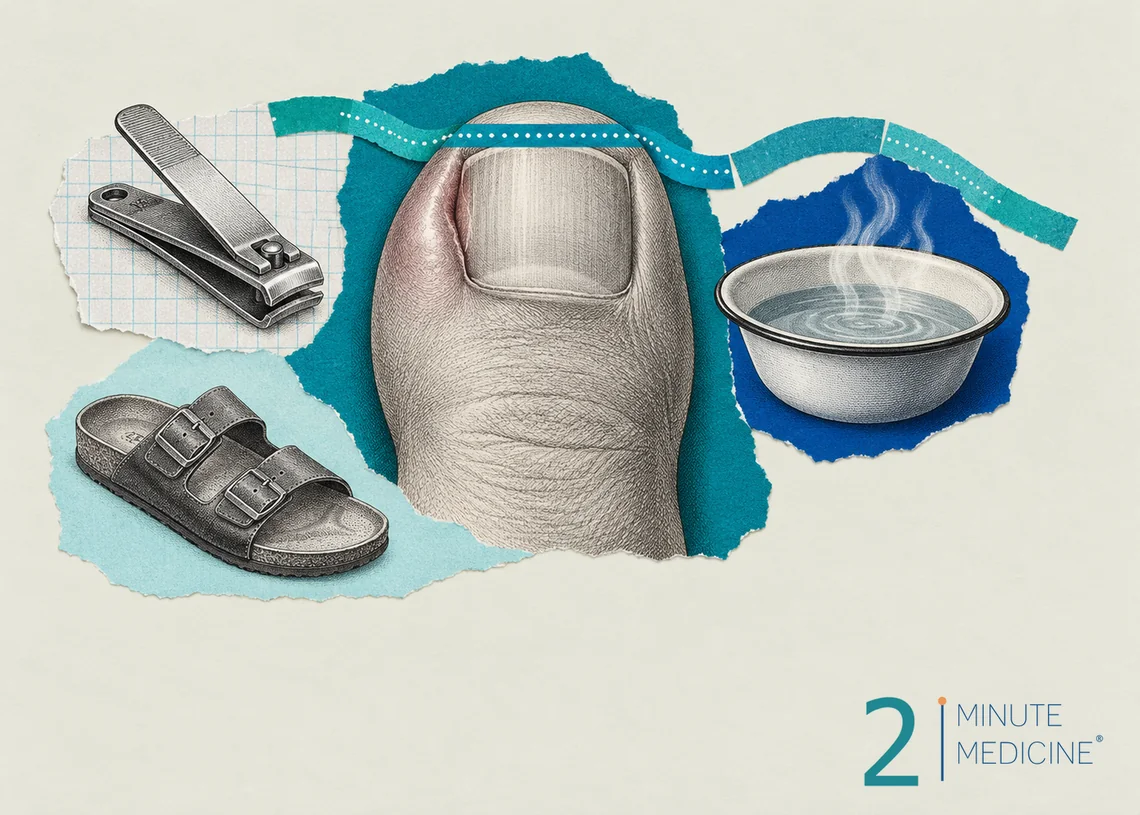
Ingrown toenail collage: a big toe with the nail edge curving into skin, straight nail clippers, a warm basin and a sandal
Share on FacebookShare on TwitterShare on LinkedIn

An ingrown toenail happens when the edge of a nail, usually on the big toe, curls or grows into the skin beside it. The skin turns red, swollen and sore, and it can get infected. Mild cases often heal with home care. If the problem keeps coming back, a doctor can remove the edge of the nail so it no longer digs in.

Key points

  • Cutting nails too short or rounding the corners, tight shoes and stubbing a toe are common causes.
  • Warm soaks, roomy shoes and keeping the area clean help mild cases.
  • Pus, spreading redness, warmth or worse pain are signs of infection.
  • If you have diabetes, poor blood flow or numb feet, see a doctor instead of treating it yourself.
  • A quick office procedure can remove the ingrown edge and stop it from growing back.

What causes an ingrown toenail

  • How nails are cut. Trimming nails very short, or curving the corners down, lets the skin fold over the edge. As the nail grows, it pushes into that skin.
  • Shoes and socks. Tight or pointed shoes, high heels and snug socks squeeze the toes together.
  • Injury. Stubbing a toe, having it stepped on, or repeated pressure from soccer, running or dance.
  • Nail shape. Some people inherit nails that curve sharply downward at the sides.
  • Thick nails. A fungal infection or aging can thicken nails and change their shape.
  • Sweaty feet. Damp skin softens and lets the nail press in more easily. This is one reason ingrown nails are common in teens.
  • Some medicines, such as isotretinoin for acne and certain cancer drugs, can make ingrown nails more likely.

Symptoms

  • Pain and tenderness along one side of the nail, worse with pressure or shoes
  • Redness and swelling of the skin fold next to the nail
  • If infected, a white or yellow spot of pus, drainage, warmth or a bad smell
  • A soft, bright red bump of extra tissue (granulation tissue) that grows over the nail edge and bleeds easily

How it’s diagnosed

A doctor or podiatrist (foot doctor) can tell by looking at the toe. An X-ray is needed only if there was a hard injury or the doctor is worried that infection has reached the bone.

Home care for an ingrown toenail

If the toe is only a little red and sore, and you are otherwise healthy, try these steps for a few days:

  • Soak your foot in warm water for 10 to 20 minutes, 2 or 3 times a day. This softens the skin and eases pain.
  • Dry the foot well afterward.
  • Gently lift the edge of the nail and tuck a small wisp of cotton or a strand of dental floss under it. Replace it each day. This helps the nail grow out above the skin.
  • Put a thin layer of petroleum jelly on the sore skin and cover it with a bandage.
  • Wear sandals or roomy shoes until it heals.
  • Take acetaminophen or ibuprofen for pain if you need it.

Don’t cut a notch in the nail or dig out the corner yourself. This often makes the problem worse and can lead to infection.

Treatment by a doctor

Lifting or splinting the nail

For mild to moderate cases, the doctor may lift the nail edge and place cotton or a thin plastic tube under it, so the nail grows out without cutting into the skin.

Removing part of the nail

For painful, infected or repeat ingrown nails, the doctor removes the strip of nail that is digging in. First, an injection at the base of the toe numbs the whole toe. Then a narrow strip of nail is trimmed away from the side, root and all. Often a chemical such as phenol is applied to the root of that strip so it doesn’t grow back. The rest of the nail stays in place and looks narrower once healed. If a red bump of extra tissue has formed, the doctor can remove it at the same time or shrink it with a chemical called silver nitrate.

RELATED REPORTS

No Content Available

Afterward, the toe is bandaged. Expect some soreness for a few days and a little drainage for up to a few weeks. Most people walk out of the office and go back to school or work within a day or two. Soaks and clean dressings help it heal. If the root wasn’t treated, the nail edge may grow back and become ingrown again.

Antibiotics

Once the ingrown edge is removed, a mild infection usually clears without antibiotics. You may need antibiotic pills if redness spreads up the foot, or if you have diabetes or a weak immune system.

Lowering your risk

  • Cut toenails straight across, and leave them a little longer than the tip of the toe.
  • Don’t round off or dig into the corners.
  • Wear shoes with plenty of room for your toes, and wear safety shoes if your work puts your feet at risk.
  • Keep feet clean and dry, and change damp socks.
  • If you have diabetes or numb feet, check your feet daily and ask a podiatrist to trim your nails.

When to see a doctor

  • Pus, warmth or redness that spreads, or red streaks going up the foot
  • Fever
  • Pain that is severe or not better after 2 to 3 days of home care
  • An ingrown nail that keeps coming back
  • Any ingrown nail if you have diabetes, poor circulation, nerve damage in your feet or a weak immune system

Common questions about ingrown toenails

Can I remove an ingrown toenail myself?

It’s safer not to. Cutting or pulling out the ingrown edge at home often leaves a sharp spike that digs in again, and it can cause infection or bleeding. Trim the nail straight across, and let a doctor remove the edge with numbing medicine if home care doesn’t help within a few days.

Can you get an ingrown fingernail?

Yes, though it’s less common than with toenails. Biting nails, picking at cuticles or cutting nails too short can let the skin fold over the edge. A red, swollen, painful spot beside a fingernail is often an infection of the nail fold called paronychia. Warm soaks help, but see a doctor if pus forms.

How long does an ingrown toenail take to heal?

A mild ingrown toenail often improves within a few days to a week of home care. After a doctor removes part of the nail, soreness usually eases in a few days, and the skin heals fully in about 2 to 4 weeks. Once the nail edge no longer digs in, the pain should stop.

Questions to ask your doctor

  • Can this heal with home care, or does part of the nail need to come out?
  • Is the toe infected, and do I need antibiotics?
  • Should the nail root be treated so it doesn’t come back?
  • How should I care for my toe after the procedure?
  • When can I go back to sports and normal shoes?

Learn more

  • Ingrown toenail (MedlinePlus, U.S. National Library of Medicine)
  • Ingrown toenail (NHS)

This guide is general information and doesn’t replace advice from your own doctor. Last updated October 2026.

Tags: Ingrown Toenail
Previous Post

Patient Basics: Fever

Next Post

Patient Basics: Hydrocephalus (Water on the Brain)

RelatedReports

No Content Available
Next Post
Hydrocephalus collage: a brain with enlarged teal ventricles, a thin shunt tube with a valve, and a blank measuring tape

Patient Basics: Hydrocephalus (Water on the Brain)

Iron deficiency collage: pale red blood cells, a cast-iron skillet, lentils and spinach, and a young woman

Patient Basics: Iron Deficiency

HIV/AIDS collage of engraved immune cells, a looped awareness ribbon, a weekly pill organizer and a mouth swab test kit

Patient Basics: HIV/AIDS

✦ EvidencePulse™ by 2 Minute Medicine 3 reports You asked top stroke trials 2026 Synthesizing medical evidence... Top 2026 stroke trial results: OCEANIC — ischemic stroke: 6.2% vs 8.4% OPTION* — mRS 0–1: 43.6% vs 34.2% ORIENTAL* — mRS 0–2: 58.6% vs 46.6% *Higher sICH in intervention arms Participants randomizedN OCEANIC 12,327 OPTION 570 ORIENTAL 564 Ask about guidelines or landmark trials... Try EvidencePulse™ Get the signal. Try it now → Physician-trained medical AI by 2 Minute Medicine

2MM+ All Access

Full details →
$4.99 /month

3-day free trial · cancel anytime

  • ✓100+ physician-written reports
  • ✓EvidencePulse™ + HypeCheck™
  • ✓Ad-free reading + newsletters
Start 3-day free trial

Then $4.99/month. Manage renewal in your account.

2 Minute Medicine® is an award winning, physician-run, expert medical media company. Our content is curated, written and edited by practicing health professionals who have clinical and scientific expertise in their field of reporting. Our editorial management team is comprised of highly-trained MD physicians. Join numerous brands, companies, and hospitals who trust our licensed content.

Recent Reports

  • Zavegepant (Zavzpret) may be effective for the management of migraine symptoms in Asian adults
  • Routine postdilation improves transcatheter heart valve geometry in patients with severe aortic stenosis
  • Percutaneous nephrolithotomy and flexible ureteroscopy may have similar outcomes in pediatric nephrolithiasis
License Content
Terms of Use | Disclaimer
Cookie Policy

Get the app

Read 2 Minute Medicine on iPhone, iPad and Android.

Download on the App StoreGet it on Google Play
QR code for www.2minutemedicine.com/app
On a computer? Scan this with your phone’s camera.
2MM+ All Access Full details →

The medical literature, distilled daily.

Monthly plan selected: $4.99 /month.

$4.99/month

3-day free trial · cancel anytime

Start 3-day free trial

Then $4.99/month. Manage renewal in your account.

Yearly plan selected: $49.90 /year.

$49.90/year

2 months free

Start 3-day free trial

Then $49.90/year.

Membership benefits

  • ✓100+ physician-written reports
  • ✓AI EvidencePulse™ + HypeCheck™
  • ✓Ad-free reading + newsletters
  • ✓FDA drug approvals + clinical calculators

Already a member? Sign in

  • Get the app
  • About
  • Specialties
    • All Specialties, All Recent Reports
    • Cardiology
    • Chronic Disease
    • Dermatology
    • Emergency
    • Endocrinology
    • Gastroenterology
    • Imaging and Intervention
    • Infectious Disease
    • Nephrology
    • Neurology
    • Obstetrics
    • Oncology
    • Ophthalmology
    • Pediatrics
    • Pharma
    • Preclinical
    • Psychiatry
    • Public Health
    • Pulmonology
    • Rheumatology
    • Surgery
    • Rewinds
    • The Scan
  • EvidencePulse™
  • HypeCheck™
  • AI News
  • Classics™
    • 2MM+ Online Access
    • Paperback and Ebook
  • Tools
    • NPI Registry Lookup
    • RVU Search
    • Physician Pay by Specialty
    • ICD-10 Code Lookup
    • FDA Drug Approvals
    • Drug Safety for Breastfeeding/Pregnancy
    • Clinical Guidelines
    • Medical Calculators
    • ECG Reference
      • QTc Calculator
      • Sgarbossa Criteria
      • ECG Axis Calculator
      • AV Block Helper
  • Rankings
    • Medical School Rankings
    • Residency Rankings
  • Partners
    • License Content
    • Advertise with Us
No Result
View All Result

© 2026 2 Minute Medicine, Inc. - Physician-written medical news.


