
• About
  • Masthead
  • License Content
  • Advertise
  • Press Releases
  • Newsroom
  • RSS/Email List
  • 2MM Podcast
  • Write for us
  • Contact Us
2 Minute Medicine
No Result
View All Result

No products in the cart.

Sign in
SUBSCRIBE
  • About
  • Specialties
    • All Specialties, All Recent Reports
    • Cardiology
    • Chronic Disease
    • Dermatology
    • Emergency
    • Endocrinology
    • Gastroenterology
    • Imaging and Intervention
    • Infectious Disease
    • Nephrology
    • Neurology
    • Obstetrics
    • Oncology
    • Ophthalmology
    • Pediatrics
    • Pharma
    • Preclinical
    • Psychiatry
    • Public Health
    • Pulmonology
    • Rheumatology
    • Surgery
    • Rewinds
    • The Scan
  • EvidencePulse™
  • HypeCheck™
  • AI News
  • Classics™
    • 2MM+ Online Access
    • Paperback and Ebook
  • Tools
    • NPI Registry Lookup
    • RVU Search
    • Physician Pay by Specialty
    • ICD-10 Code Lookup
    • FDA Drug Approvals
    • Drug Safety for Breastfeeding/Pregnancy
    • Clinical Guidelines
    • Medical Calculators
    • ECG Reference
      • QTc Calculator
      • Sgarbossa Criteria
      • ECG Axis Calculator
      • AV Block Helper
  • Rankings
    • Medical School Rankings
    • Residency Rankings
  • Partners
    • License Content
    • Advertise with Us
2 Minute Medicine
  • About
  • Specialties
    • All Specialties, All Recent Reports
    • Cardiology
    • Chronic Disease
    • Dermatology
    • Emergency
    • Endocrinology
    • Gastroenterology
    • Imaging and Intervention
    • Infectious Disease
    • Nephrology
    • Neurology
    • Obstetrics
    • Oncology
    • Ophthalmology
    • Pediatrics
    • Pharma
    • Preclinical
    • Psychiatry
    • Public Health
    • Pulmonology
    • Rheumatology
    • Surgery
    • Rewinds
    • The Scan
  • EvidencePulse™
  • HypeCheck™
  • AI News
  • Classics™
    • 2MM+ Online Access
    • Paperback and Ebook
  • Tools
    • NPI Registry Lookup
    • RVU Search
    • Physician Pay by Specialty
    • ICD-10 Code Lookup
    • FDA Drug Approvals
    • Drug Safety for Breastfeeding/Pregnancy
    • Clinical Guidelines
    • Medical Calculators
    • ECG Reference
      • QTc Calculator
      • Sgarbossa Criteria
      • ECG Axis Calculator
      • AV Block Helper
  • Rankings
    • Medical School Rankings
    • Residency Rankings
  • Partners
    • License Content
    • Advertise with Us
Sign in
SUBSCRIBE
2 Minute Medicine
Sign in
Subscribe
2 Minute MedicineFree on Google PlayGet
✦EvidencePulse™by 2 Minute Medicine3 reportsYou askedtop stroke trials 2026Synthesizing medical evidence...Top 2026 stroke trial results:OCEANIC — ischemic stroke: 6.2% vs 8.4%OPTION* — mRS 0–1: 43.6% vs 34.2%ORIENTAL* — mRS 0–2: 58.6% vs 46.6%*Higher sICH in intervention armsParticipants randomizedNOCEANIC12,327OPTION570ORIENTAL564Ask about guidelines or landmark trials...↑Try EvidencePulse™Ask the evidence. Get the signal.Try it now →
Home Health A to Z

Patient Basics: Leg Strain
by2 Minute Medicine
October 30, 2026
in Health A to Z
Reading Time: 5 mins read
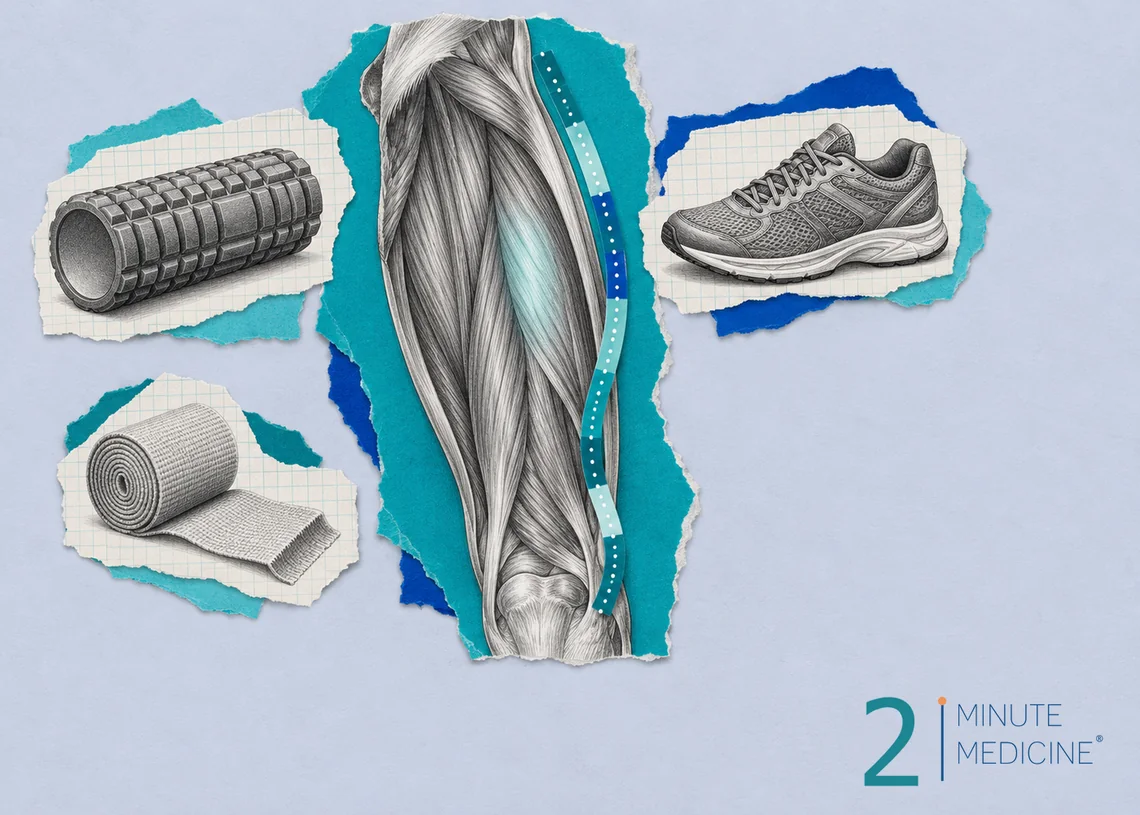
Leg strain collage of an engraved hamstring at the back of the thigh, a foam roller, an elastic wrap and a running shoe
Share on FacebookShare on TwitterShare on LinkedIn

A leg strain, often called a pulled muscle in the leg, happens when a muscle in the thigh or calf is overstretched and some of its fibers tear. It usually comes on suddenly during a sprint, jump or quick change of direction. Most strains heal with rest, ice and a gradual return to activity, but going back too soon is the main reason they come back.

Key points

  • The hamstrings (back of the thigh), quadriceps (front of the thigh), groin muscles and calf muscles are strained most often.
  • Strains range from mild overstretching to a complete tear of a muscle or tendon.
  • For the first few days, protect the leg, use ice and keep it raised. Then start gentle movement.
  • Strengthening exercises speed recovery and help prevent another strain.
  • Calf pain and swelling without an injury can be a blood clot. Get it checked.

What causes a leg strain

A strain happens when a muscle is stretched while it is working hard. This often occurs when the muscle tightens to slow the leg down, such as the hamstring at the end of a running stride. Common settings include:

  • Sprinting, especially in soccer, football, track and basketball
  • Kicking, jumping and fast starts
  • Sudden pushing off, such as a lunge in tennis, which can strain the calf
  • Slipping or doing a split

You are more likely to strain a muscle if you’ve strained it before, if you’re tired, if you skip a warm-up, if your muscles are tight or weak, or if you’re older. Weekend athletes who suddenly do more than usual are at higher risk.

Leg strain symptoms

  • Sudden sharp pain, sometimes with a popping or pulling feeling
  • Pain when you use, stretch or press on the muscle
  • Swelling and, a day or two later, bruising that may spread down the leg
  • Weakness, muscle spasms or a limp
  • A dent in the muscle with a severe tear

Doctors grade strains by how much damage there is:

  • Grade 1 (mild): a few fibers are torn. It’s sore, but strength is normal.
  • Grade 2 (moderate): more fibers are torn. There is clear weakness, swelling and pain with walking.
  • Grade 3 (severe): the muscle or tendon tears all the way through. Walking may be very hard.

How it’s diagnosed

A doctor will ask how the injury happened and check where it hurts, how far you can move the leg and how strong the muscle is. Most strains don’t need scans. An ultrasound or MRI may be used for a severe strain, when an athlete needs a timeline for return, or when the doctor suspects the tendon has pulled off the bone. This can happen at the top of the hamstring, near the sitting bone, and may need surgery. An X-ray can rule out a broken bone.

Treatment

The first few days

  • Protect and rest. Stop the activity that caused the strain and avoid anything that causes sharp pain. Crutches can help if walking is painful.
  • Ice. Apply a cold pack wrapped in a thin towel for 15 to 20 minutes every few hours.
  • Compression. An elastic wrap can limit swelling. Loosen it if your foot tingles, turns pale or feels cold.
  • Elevation. Raise the leg above the level of your heart when you can.
  • Pain medicine. Acetaminophen, ibuprofen or naproxen can ease pain. Ask your doctor first if you have kidney, stomach or heart problems or take a blood thinner.

Avoid heat, massage and alcohol for the first two days, since they can increase swelling.

RELATED REPORTS

No Content Available

Getting moving again

After a few days, start gentle stretching and walking as pain allows. Mild discomfort is fine; sharp pain means back off. Add strengthening exercises as the muscle heals. A physical therapist can guide you, especially after a moderate or severe strain or a strain that keeps coming back. For hamstring strains, exercises that work the muscle as it lengthens, such as Nordic hamstring curls, are often part of the plan.

Return to sports in stages: walking, jogging, then running, then sprinting and cutting. You’re ready when you have full strength and range of motion and can run at full speed without pain.

Healing time

A mild strain usually heals in one to three weeks. A moderate strain can take four to eight weeks. A complete tear can take several months, and some need surgery to reattach the tendon.

Lowering your risk

  • Warm up with light jogging and moving stretches before sports.
  • Build strength in your thighs, hips, core and calves. Stretching alone isn’t enough.
  • Increase training gradually.
  • Stop when you’re very tired or a muscle feels tight.
  • Finish rehab fully after a strain before going back to full play.

When to see a doctor

  • You can’t walk or put weight on the leg
  • You heard a pop and the muscle feels very weak, or you see a dent or lump
  • Pain or bruising is severe, or isn’t improving after a week
  • You’ve strained the same muscle more than once
  • Calf pain, swelling or warmth comes on without a clear injury, or after a long trip, surgery or bed rest. This can be a blood clot.

Get emergency care for severe pain with a tight, swollen leg and numbness or tingling, or for leg swelling along with chest pain or shortness of breath.

Common questions about leg strain

Why does the front of my thigh hurt?

In active people, a strained quadriceps, the big muscle at the front of the thigh, is a common cause, often after kicking or sprinting. A hard knock can bruise the muscle deep down. Burning or numbness on the outer thigh can come from a pinched nerve, and pain there can also spread from the hip or lower back.

How do I know if I pulled my calf muscle?

A pulled calf muscle usually causes a sudden sharp pain in the back of the lower leg as you push off, as if someone kicked you. Rising onto your toes hurts. A tear of the plantaris, a thin muscle in the calf, feels much the same. If you can’t push off at all, have your Achilles tendon checked.

Can you walk on a pulled leg muscle?

With a mild strain, yes, as long as walking doesn’t cause sharp pain. Short, easy walks help the muscle heal. If you can’t take a few steps without limping badly, use crutches and see a doctor, since a bad tear or a broken bone may be the cause.

Questions to ask your doctor

  • Which muscle did I strain, and how bad is it?
  • Do I need a scan?
  • Should I see a physical therapist?
  • When can I start running or playing again?
  • What can I do to keep this from happening again?

Learn more

  • Sprains and strains (MedlinePlus, U.S. National Library of Medicine)

This guide is general information and doesn’t replace advice from your own doctor. Last updated October 2026.

Tags: Leg Strain
Previous Post

Patient Basics: Latex Allergy

Next Post

Patient Basics: Lymphedema

RelatedReports

No Content Available
Next Post
Major depression collage of a thoughtful man by a window with soft light, a cup of tea and a small potted plant

Patient Basics: Major Depression

Jet lag collage: a sleepy young man, a globe, a small airplane on a dotted teal flight path and a rising sun

Patient Basics: Jet Lag

Kaposi sarcoma collage: a foot with small flat dark patches, a magnifying glass, a pill organizer and a blood vessel

Patient Basics: Kaposi Sarcoma (Kaposi's Sarcoma)

✦ EvidencePulse™ by 2 Minute Medicine 3 reports You asked top stroke trials 2026 Synthesizing medical evidence... Top 2026 stroke trial results: OCEANIC — ischemic stroke: 6.2% vs 8.4% OPTION* — mRS 0–1: 43.6% vs 34.2% ORIENTAL* — mRS 0–2: 58.6% vs 46.6% *Higher sICH in intervention arms Participants randomizedN OCEANIC 12,327 OPTION 570 ORIENTAL 564 Ask about guidelines or landmark trials... Try EvidencePulse™ Get the signal. Try it now → Physician-trained medical AI by 2 Minute Medicine

2MM+ All Access

Full details →
$4.99 /month

3-day free trial · cancel anytime

  • ✓100+ physician-written reports
  • ✓EvidencePulse™ + HypeCheck™
  • ✓Ad-free reading + newsletters
Start 3-day free trial

Then $4.99/month. Manage renewal in your account.

2 Minute Medicine® is an award winning, physician-run, expert medical media company. Our content is curated, written and edited by practicing health professionals who have clinical and scientific expertise in their field of reporting. Our editorial management team is comprised of highly-trained MD physicians. Join numerous brands, companies, and hospitals who trust our licensed content.

Recent Reports

  • CDC reports 5,182 confirmed measles cases in the United States in 2026
  • In selected patients with anterior-circulation large-vessel stroke 24-72 hours after onset, thrombectomy improved 90-day function but increased hemorrhage and death
  • Mavacamten reduced left ventricular outflow tract obstruction more than placebo in adolescents with symptomatic obstructive hypertrophic cardiomyopathy
License Content
Terms of Use | Disclaimer
Cookie Policy

Get the app

Read 2 Minute Medicine on iPhone, iPad and Android.

Download on the App StoreGet it on Google Play
QR code for www.2minutemedicine.com/app
On a computer? Scan this with your phone’s camera.
2MM+ All Access Full details →

The medical literature, distilled daily.

Monthly plan selected: $4.99 /month.

$4.99/month

3-day free trial · cancel anytime

Start 3-day free trial

Then $4.99/month. Manage renewal in your account.

Yearly plan selected: $49.90 /year.

$49.90/year

2 months free

Start 3-day free trial

Then $49.90/year.

Membership benefits

  • ✓100+ physician-written reports
  • ✓AI EvidencePulse™ + HypeCheck™
  • ✓Ad-free reading + newsletters
  • ✓FDA drug approvals + clinical calculators

Already a member? Sign in

  • Get the app
  • About
  • Specialties
    • All Specialties, All Recent Reports
    • Cardiology
    • Chronic Disease
    • Dermatology
    • Emergency
    • Endocrinology
    • Gastroenterology
    • Imaging and Intervention
    • Infectious Disease
    • Nephrology
    • Neurology
    • Obstetrics
    • Oncology
    • Ophthalmology
    • Pediatrics
    • Pharma
    • Preclinical
    • Psychiatry
    • Public Health
    • Pulmonology
    • Rheumatology
    • Surgery
    • Rewinds
    • The Scan
  • EvidencePulse™
  • HypeCheck™
  • AI News
  • Classics™
    • 2MM+ Online Access
    • Paperback and Ebook
  • Tools
    • NPI Registry Lookup
    • RVU Search
    • Physician Pay by Specialty
    • ICD-10 Code Lookup
    • FDA Drug Approvals
    • Drug Safety for Breastfeeding/Pregnancy
    • Clinical Guidelines
    • Medical Calculators
    • ECG Reference
      • QTc Calculator
      • Sgarbossa Criteria
      • ECG Axis Calculator
      • AV Block Helper
  • Rankings
    • Medical School Rankings
    • Residency Rankings
  • Partners
    • License Content
    • Advertise with Us
No Result
View All Result

© 2026 2 Minute Medicine, Inc. - Physician-written medical news.


