• About
  • Masthead
  • License Content
  • Advertise
  • Press Releases
  • Newsroom
  • RSS/Email List
  • 2MM Podcast
  • Write for us
  • Contact Us
2 Minute Medicine
No Result
View All Result

No products in the cart.

Sign in
SUBSCRIBE
  • About
  • Specialties
    • All Specialties, All Recent Reports
    • Cardiology
    • Chronic Disease
    • Dermatology
    • Emergency
    • Endocrinology
    • Gastroenterology
    • Imaging and Intervention
    • Infectious Disease
    • Nephrology
    • Neurology
    • Obstetrics
    • Oncology
    • Ophthalmology
    • Pediatrics
    • Pharma
    • Preclinical
    • Psychiatry
    • Public Health
    • Pulmonology
    • Rheumatology
    • Surgery
    • Rewinds
    • The Scan
  • EvidencePulse™
  • HypeCheck™
  • AI News
  • Classics™
    • 2MM+ Online Access
    • Paperback and Ebook
  • Tools
    • NPI Registry Lookup
    • RVU Search
    • Physician Pay by Specialty
    • ICD-10 Code Lookup
    • FDA Drug Approvals
    • Drug Safety for Breastfeeding/Pregnancy
    • Clinical Guidelines
    • Medical Calculators
    • ECG Reference
      • QTc Calculator
      • Sgarbossa Criteria
      • ECG Axis Calculator
      • AV Block Helper
  • Rankings
    • Medical School Rankings
    • Residency Rankings
  • Partners
    • License Content
    • Advertise with Us
2 Minute Medicine
  • About
  • Specialties
    • All Specialties, All Recent Reports
    • Cardiology
    • Chronic Disease
    • Dermatology
    • Emergency
    • Endocrinology
    • Gastroenterology
    • Imaging and Intervention
    • Infectious Disease
    • Nephrology
    • Neurology
    • Obstetrics
    • Oncology
    • Ophthalmology
    • Pediatrics
    • Pharma
    • Preclinical
    • Psychiatry
    • Public Health
    • Pulmonology
    • Rheumatology
    • Surgery
    • Rewinds
    • The Scan
  • EvidencePulse™
  • HypeCheck™
  • AI News
  • Classics™
    • 2MM+ Online Access
    • Paperback and Ebook
  • Tools
    • NPI Registry Lookup
    • RVU Search
    • Physician Pay by Specialty
    • ICD-10 Code Lookup
    • FDA Drug Approvals
    • Drug Safety for Breastfeeding/Pregnancy
    • Clinical Guidelines
    • Medical Calculators
    • ECG Reference
      • QTc Calculator
      • Sgarbossa Criteria
      • ECG Axis Calculator
      • AV Block Helper
  • Rankings
    • Medical School Rankings
    • Residency Rankings
  • Partners
    • License Content
    • Advertise with Us
Sign in
SUBSCRIBE
2 Minute Medicine
Sign in
Subscribe
2 Minute MedicineFree on Google PlayGet
✦EvidencePulse™by 2 Minute Medicine3 reportsYou askedtop stroke trials 2026Synthesizing medical evidence...Top 2026 stroke trial results:OCEANIC — ischemic stroke: 6.2% vs 8.4%OPTION* — mRS 0–1: 43.6% vs 34.2%ORIENTAL* — mRS 0–2: 58.6% vs 46.6%*Higher sICH in intervention armsParticipants randomizedNOCEANIC12,327OPTION570ORIENTAL564Ask about guidelines or landmark trials...↑Try EvidencePulse™Ask the evidence. Get the signal.Try it now →
Home All Specialties Cardiology

Routine postdilation improves transcatheter heart valve geometry in patients with severe aortic stenosis
byAllen RyuandDeepti Shroff
November 6, 2026
in Cardiology, Chronic Disease, Imaging and Intervention, Surgery
Reading Time: 3 mins read
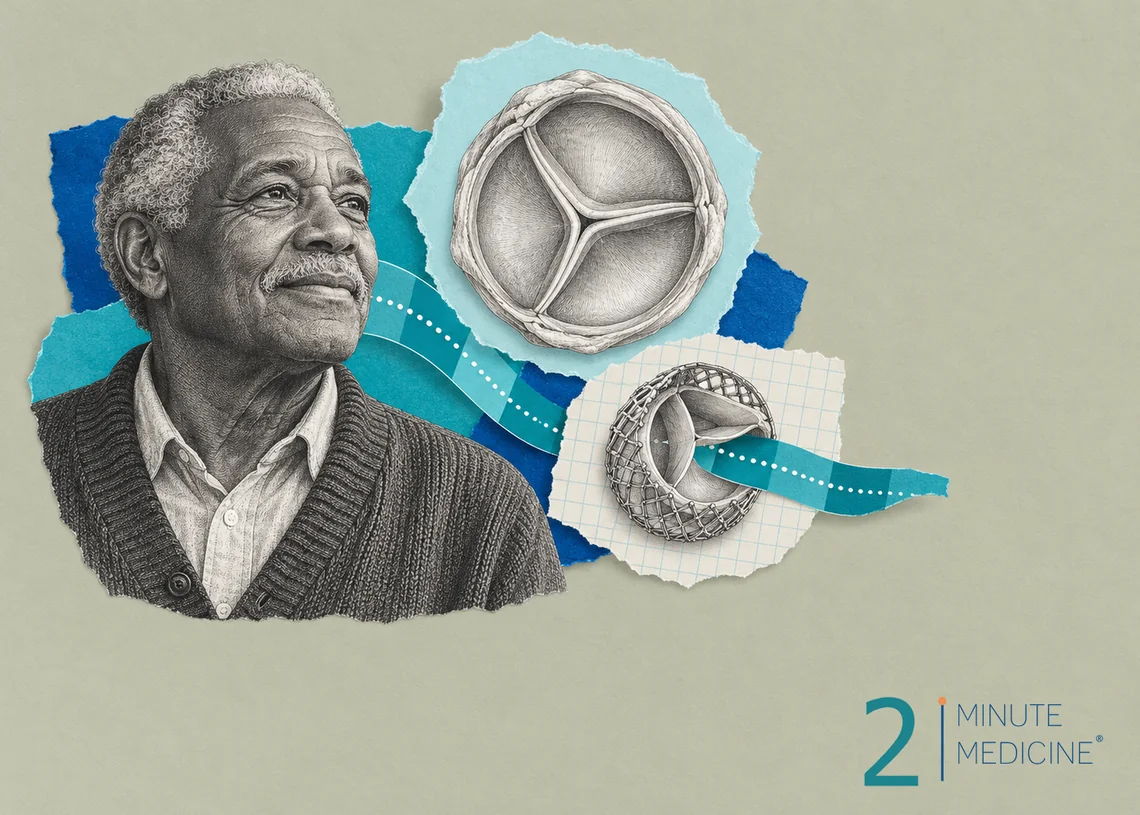
Heart valve problems collage: older man in profile, an engraved three-leaflet valve and a replacement valve on a mesh frame
Share on FacebookShare on TwitterShare on LinkedIn

1. In this randomized clinical trial of patients with aortic stenosis (AS),routine postdilation yielded a significantly lower transcatheter heart valve (THV) asymmetry index compared with no postdilation, consistent across prespecified subgroups.

2. Routine postdilation intervention resulted in numerically larger THV diameters on fluoroscopy at the inflow, midframe, and outflow levels on CT scan.

Evidence Rating Level: 1 (Excellent)

Study Rundown: Transcatheter aortic valve implantation (TAVI) emerged as a treatment option for severe aortic stenosis. Postdilation of THVs following THV implantation during TAVI is a promising but underexplored management strategy to optimize prosthesis geometry, which is a strong determinant of valve function and hemodynamics. The DUOTAP study aimed to evaluate the efficacy and safety of routine postdilation, specifically in terms of optimizing THV geometry and hemodynamic performance. Among 148 severe AS patients who received TAVI in 2025 and 2026, the results of the study showed that routine postdilation resulted in markedly improved symmetry in THV geometry, which was found to be consistent across stratified subgroups. In addition, patients who received routine postdilation showed improvements across several measures of hemodynamic function including significantly larger THV areas at the inflow, midframe, and outflow level on CT, lower frequency of hypo-attenuated leaflet thickening and mild or worse paravalvular leak, and a higher Doppler Velocity Index. Despite concerns for potential adverse events associated with postdilation, there was no statistically significant difference in the frequency of adverse events between groups.The results of this study should be interpreted in light of the study’s limitations, particularly its single-center design, which may limit the generalizability of the findings. Additionally, the trial did not assess long term clinical outcomes. As such, while the results of this study suggest that regular postdilation should be a routine post-operative management strategy in AS patients who have received TAVI, further long terms studies are needed to further explore the whether improvements in valve geometry and hemodynamic performance can translate into improved clinical outcomes

Click here to read the study in JAMA (Journal of the American Medical Association).

Relevant Reading: Routine post-dilatation at nominal volume to optimise the expansion of balloon-expandable valves: the DOUBLE-TAP study

RELATED REPORTS

Artificial intelligence-generated pre-visit summaries improved communication outcomes in neurosurgical consultations

AI scribe use associated with reduced documentation time but longer clinical notes

In-Depth [randomized controlled trial]: This study, DUOTAP, was a single-center single-blinded randomized clinical trial at the Medical University of Vienna in Austria. Recruitment of participants occurred from January 2025 to April 2026; eligible patients had severe AS suitable for transfemoral TAVI with a balloon-expandable THV and had no high-risk features on preprocedural CT or coronary angiography. Patients were randomized in a 1:1 ratio to routine postdilation vs no postdilation, stratified by THV size. Endpoints were analyzed periprocedurally, at 30 days, and at 3 months.

The study included 148 patients (median age, 81 [77-85] years; 79 male [53.4%], 69 female [46.6%]; median EuroSCORE-II, 2.3%) who were randomized (74 intervention group, 74 control group). The primary endpoint was the THV asymmetry index assessed on fluoroscopy after THV implantation. Postdilation resulted in a lower THV asymmetry index compared with no postdilation (median [IQR], 1.2% [0.5%-2.4%] vs 2.8% [1.8%-5.1%]), showing a 70% reduction in valve asymmetry (geometric mean ratio, 0.30; 95% CI, 0.18-0.47; p<0.001). Results remain consistent when adjusted for valve size (95% CI 0.19-0.48, p<0.001), in the as-treated analyses (95% CI 0.18-0.45, p<0.001), and when assessed in the cusp-overlap view (95% CI 0.25-0.58, p<0.001). Secondary endpoints included THV heights across the inner and outer curves, THV diameters at the inflow, midframe, and outflow levels, CT-derived cross-sectional THV area and presence of hypo-attenuated leaflet thickening (HALT), and hemodynamic endpoints such as transprosthetic mean pressure gradient (mPG), Doppler Velocity Index (DVI), and the presence and severity of PVL. Among these, THV height across the outer curve (p=0.03), cross-sectional THV areas across the inflow (p=0.01), midframe (p=0.005), outflow (p=0.009), HALT frequency (p=0.04), DVI (p=0.001), and prevalence/severity of PVL (p=0.05) differed significantly between the intervention and control groups.. In terms of safety risk assessment, the VARC-3 safety endpoint frequency was not statistically significant across the two groups (p=0.36).

Citation: Autherith M, Singer K, Hauptmann L, Torrefranca C, Jantsch C, Koschatko S, et al. Efficacy and Safety of Routine Postdilation in Balloon-Expandable Transcatheter Aortic Valve Implantation Platform: The DUOTAP Randomized Clinical Trial. JAMA Cardiol. 2026 Nov 3. doi: 10.1001/jamacardio.2026.5260. Epub ahead of print. PMID: 42976368; PMCID: PMC13732541.

© 2026 2 Minute Medicine, Inc. All rights reserved. No part of this article may be reproduced, distributed or transmitted in any form or by any means without the prior written permission of 2 Minute Medicine, Inc. To license this content, contact 2 Minute Medicine, Inc. This article is for informational and educational purposes only; it is not medical advice and does not replace the judgment of a qualified healthcare professional.
Image: © 2 Minute Medicine

Tags: aortic stenosisheartoutcomesstenosisstudy
Previous Post

Percutaneous nephrolithotomy and flexible ureteroscopy may have similar outcomes in pediatric nephrolithiasis

RelatedReports

AI in health care collage: a smiling older man in a collared shirt beside a tablet with a blank screen and a dot network
Artificial Intelligence

Artificial intelligence-generated pre-visit summaries improved communication outcomes in neurosurgical consultations

November 5, 2026
AI scribes collage: a wide vintage microphone under three blank speech bubbles, with an empty clinic chair and exam table
Artificial Intelligence

AI scribe use associated with reduced documentation time but longer clinical notes

November 6, 2026
Emergency care collage: an empty hospital stretcher with a pillow and sheet before blue double doors with round windows
Chronic Disease

Non-inpatient care settings may offer alternatives to inpatient beds for select patients

November 6, 2026
Mitral valve prolapse collage of an engraved heart with a parachute-like valve, a stethoscope and a calm woman
Cardiology

Early mitral valve surgery may improve long-term survival in asymptomatic severe mitral regurgitation

October 31, 2026
✦ EvidencePulse™ by 2 Minute Medicine 3 reports You asked top stroke trials 2026 Synthesizing medical evidence... Top 2026 stroke trial results: OCEANIC — ischemic stroke: 6.2% vs 8.4% OPTION* — mRS 0–1: 43.6% vs 34.2% ORIENTAL* — mRS 0–2: 58.6% vs 46.6% *Higher sICH in intervention arms Participants randomizedN OCEANIC 12,327 OPTION 570 ORIENTAL 564 Ask about guidelines or landmark trials... Try EvidencePulse™ Get the signal. Try it now → Physician-trained medical AI by 2 Minute Medicine

2MM+ All Access

Full details →
$4.99 /month

3-day free trial · cancel anytime

  • ✓100+ physician-written reports
  • ✓EvidencePulse™ + HypeCheck™
  • ✓Ad-free reading + newsletters
Start 3-day free trial

Then $4.99/month. Manage renewal in your account.

2 Minute Medicine® is an award winning, physician-run, expert medical media company. Our content is curated, written and edited by practicing health professionals who have clinical and scientific expertise in their field of reporting. Our editorial management team is comprised of highly-trained MD physicians. Join numerous brands, companies, and hospitals who trust our licensed content.

Recent Reports

  • Routine postdilation improves transcatheter heart valve geometry in patients with severe aortic stenosis
  • Percutaneous nephrolithotomy and flexible ureteroscopy may have similar outcomes in pediatric nephrolithiasis
  • Cannabis use, including smoked or edible, linked to higher stroke risk
License Content
Terms of Use | Disclaimer
Cookie Policy

Get the app

Read 2 Minute Medicine on iPhone, iPad and Android.

Download on the App StoreGet it on Google Play
QR code for www.2minutemedicine.com/app
On a computer? Scan this with your phone’s camera.
2MM+ All Access Full details →

The medical literature, distilled daily.

Monthly plan selected: $4.99 /month.

$4.99/month

3-day free trial · cancel anytime

Start 3-day free trial

Then $4.99/month. Manage renewal in your account.

Yearly plan selected: $49.90 /year.

$49.90/year

2 months free

Start 3-day free trial

Then $49.90/year.

Membership benefits

  • ✓100+ physician-written reports
  • ✓AI EvidencePulse™ + HypeCheck™
  • ✓Ad-free reading + newsletters
  • ✓FDA drug approvals + clinical calculators

Already a member? Sign in

  • Get the app
  • About
  • Specialties
    • All Specialties, All Recent Reports
    • Cardiology
    • Chronic Disease
    • Dermatology
    • Emergency
    • Endocrinology
    • Gastroenterology
    • Imaging and Intervention
    • Infectious Disease
    • Nephrology
    • Neurology
    • Obstetrics
    • Oncology
    • Ophthalmology
    • Pediatrics
    • Pharma
    • Preclinical
    • Psychiatry
    • Public Health
    • Pulmonology
    • Rheumatology
    • Surgery
    • Rewinds
    • The Scan
  • EvidencePulse™
  • HypeCheck™
  • AI News
  • Classics™
    • 2MM+ Online Access
    • Paperback and Ebook
  • Tools
    • NPI Registry Lookup
    • RVU Search
    • Physician Pay by Specialty
    • ICD-10 Code Lookup
    • FDA Drug Approvals
    • Drug Safety for Breastfeeding/Pregnancy
    • Clinical Guidelines
    • Medical Calculators
    • ECG Reference
      • QTc Calculator
      • Sgarbossa Criteria
      • ECG Axis Calculator
      • AV Block Helper
  • Rankings
    • Medical School Rankings
    • Residency Rankings
  • Partners
    • License Content
    • Advertise with Us
No Result
View All Result

© 2026 2 Minute Medicine, Inc. - Physician-written medical news.