• About
  • Masthead
  • License Content
  • Advertise
  • Press Releases
  • Newsroom
  • RSS/Email List
  • 2MM Podcast
  • Write for us
  • Contact Us
2 Minute Medicine
No Result
View All Result

No products in the cart.

Sign in
SUBSCRIBE
  • About
  • Specialties
    • All Specialties, All Recent Reports
    • Cardiology
    • Chronic Disease
    • Dermatology
    • Emergency
    • Endocrinology
    • Gastroenterology
    • Imaging and Intervention
    • Infectious Disease
    • Nephrology
    • Neurology
    • Obstetrics
    • Oncology
    • Ophthalmology
    • Pediatrics
    • Pharma
    • Preclinical
    • Psychiatry
    • Public Health
    • Pulmonology
    • Rheumatology
    • Surgery
    • Rewinds
    • The Scan
  • EvidencePulse™
  • HypeCheck™
  • AI News
  • Classics™
    • 2MM+ Online Access
    • Paperback and Ebook
  • Tools
    • NPI Registry Lookup
    • RVU Search
    • Physician Pay by Specialty
    • ICD-10 Code Lookup
    • FDA Drug Approvals
    • Drug Safety for Breastfeeding/Pregnancy
    • Clinical Guidelines
    • Medical Calculators
    • ECG Reference
      • QTc Calculator
      • Sgarbossa Criteria
      • ECG Axis Calculator
      • AV Block Helper
  • Rankings
    • Medical School Rankings
    • Residency Rankings
  • Partners
    • License Content
    • Advertise with Us
2 Minute Medicine
  • About
  • Specialties
    • All Specialties, All Recent Reports
    • Cardiology
    • Chronic Disease
    • Dermatology
    • Emergency
    • Endocrinology
    • Gastroenterology
    • Imaging and Intervention
    • Infectious Disease
    • Nephrology
    • Neurology
    • Obstetrics
    • Oncology
    • Ophthalmology
    • Pediatrics
    • Pharma
    • Preclinical
    • Psychiatry
    • Public Health
    • Pulmonology
    • Rheumatology
    • Surgery
    • Rewinds
    • The Scan
  • EvidencePulse™
  • HypeCheck™
  • AI News
  • Classics™
    • 2MM+ Online Access
    • Paperback and Ebook
  • Tools
    • NPI Registry Lookup
    • RVU Search
    • Physician Pay by Specialty
    • ICD-10 Code Lookup
    • FDA Drug Approvals
    • Drug Safety for Breastfeeding/Pregnancy
    • Clinical Guidelines
    • Medical Calculators
    • ECG Reference
      • QTc Calculator
      • Sgarbossa Criteria
      • ECG Axis Calculator
      • AV Block Helper
  • Rankings
    • Medical School Rankings
    • Residency Rankings
  • Partners
    • License Content
    • Advertise with Us
Sign in
SUBSCRIBE
2 Minute Medicine
Sign in
Subscribe
2 Minute MedicineFree on Google PlayGet
✦EvidencePulse™by 2 Minute Medicine3 reportsYou askedtop stroke trials 2026Synthesizing medical evidence...Top 2026 stroke trial results:OCEANIC — ischemic stroke: 6.2% vs 8.4%OPTION* — mRS 0–1: 43.6% vs 34.2%ORIENTAL* — mRS 0–2: 58.6% vs 46.6%*Higher sICH in intervention armsParticipants randomizedNOCEANIC12,327OPTION570ORIENTAL564Ask about guidelines or landmark trials...↑Try EvidencePulse™Ask the evidence. Get the signal.Try it now →
Home All Specialties Emergency

An intervention to train emergency department physicians in point-of-care ultrasound-guided regional anesthesia may reduce risk of delirium in patients with hip fractures
byAlex XiangandSimon Pan
January 13, 2026
in Emergency, Imaging and Intervention
Reading Time: 2 mins read
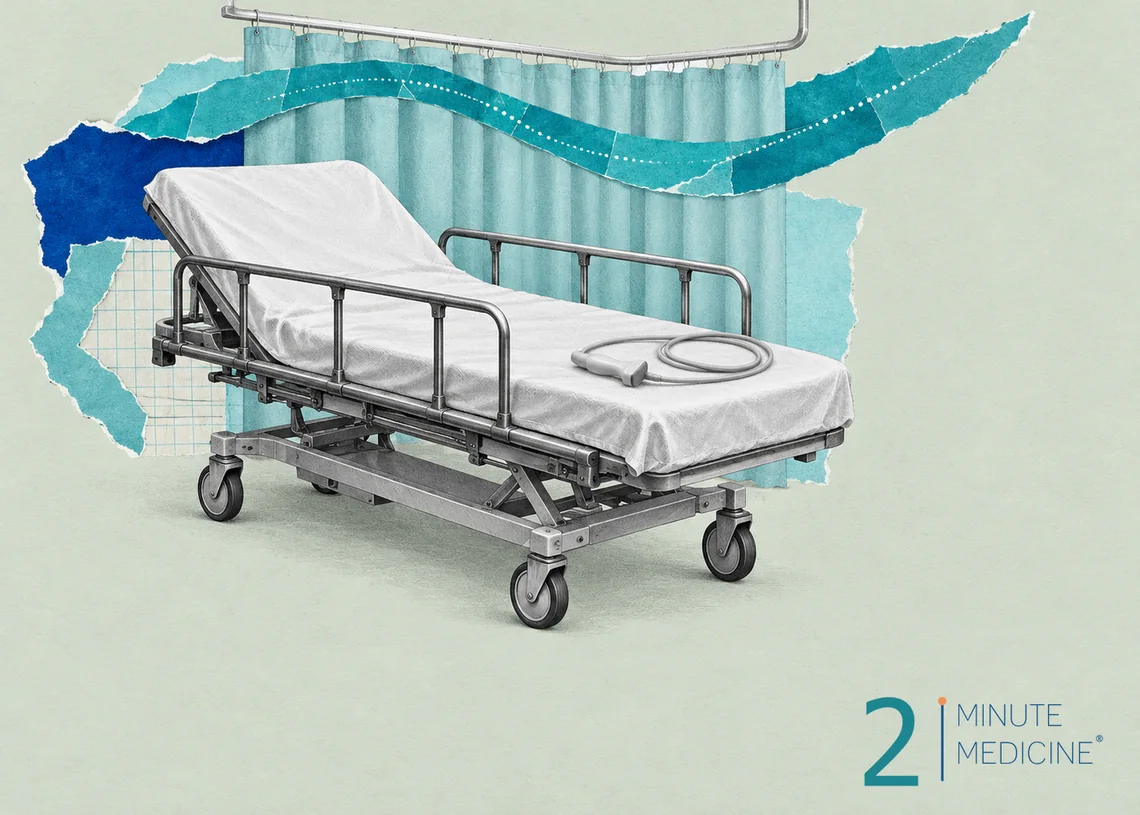
Emergency department collage: a made-up hospital stretcher with side rails, a privacy curtain and an ultrasound probe
Share on FacebookShare on TwitterShare on LinkedIn

1. An intervention to increase point-of-care ultrasound-guided regional anesthesia (POCUS-GRA) uptake by emergency physicians was safe, effective, and significantly reduced the odds of delirium.

Evidence Rating Level: 1 (Excellent)

Delirium complicates 20-62% of hip fractures, prolonging hospital stay and increasing mortality. Previous studies have shown that regional anesthesia provides better pain management than parenteral opioid analgesics in hip fractures, and is associated with reduced delirium risk. This study sought to train emergency department (ED) physicians in POCUS-GRA and assess whether this intervention reduces the incidence and duration of delirium in patients with hip fractures. This randomized, stepped-wedge cluster design study randomized the order of ED physician training. Patients treated by an ED physician prior to training were assigned to the control group; patients treated after training were assigned to the intervention group. 732 patients were randomly allocated to the intervention (n = 446; median [IQR] age, 81.0 (73.0-88.0) years; 32.7% male) and control (n = 248; median [IQR] age, 82.0 (75.0-88.0) years; 26.2% male) groups. Once trained, ED physicians completed nerve blocks on 236 participants (52.9%) in the intervention group (compared with 6 of 24 participants before the intervention [2.2%], a 51.7% improvement). The failure rate among trained treating physicians was 1 of 237 attempts (0.4%) vs 3 of 9 attempts (33.3%) among untrained treating physicians. No serious complications and one minor complication occurred. Patients in the intervention group had significantly lower odds of delirium compared to those in the control group (odds ratio, 0.72; 95% CI, 0.57-0.93). There was no significant reduction in the duration of delirium (incident rate ratio, 0.92; 95% CI, 0.67-1.25). Overall, POCUS-GRA training was safe and effectively increased nerve block uptake in the ED. These results also suggest POCUS-GRA is effective at reducing delirium risk. Future studies are required to further establish this finding and identify strategies to improve POCUS-GRA uptake.

Click here to read this study in JAMA Network Open

Image: PD

©2025 2 Minute Medicine, Inc. All rights reserved. No works may be reproduced without expressed written consent from 2 Minute Medicine, Inc. Inquire about licensing here. No article should be construed as medical advice and is not intended as such by the authors or by 2 Minute Medicine, Inc.

RELATED REPORTS

Induction with remimazolam (Byfavo) for patients undergoing laparoscopic gastrointestinal surgery may reduce post-operative delirium compared with propofol

Emergency department triaging decisions supported by artificial intelligence (AI) led to improved triaging accuracy and patient flow

Tags: deliriumemergency medicinepocusregional anesthesia
Previous Post

Etomidate is associated with higher in-hospital mortality compared with ketamine in rapid sequence intubation for severely ill patients

Next Post

2 Minute Medicine Rewind December 29th, 2025

RelatedReports

Two pieces of fabric showing stitching techniques with surgical tools in the foreground, indicating procedures for hernia repair.
Gastroenterology

Induction with remimazolam (Byfavo) for patients undergoing laparoscopic gastrointestinal surgery may reduce post-operative delirium compared with propofol

October 20, 2026
An illustration showing a healthcare worker looking towards a hospital entrance with a microchip, symbolizing the use of AI in emergency department triaging.
Artificial Intelligence

Emergency department triaging decisions supported by artificial intelligence (AI) led to improved triaging accuracy and patient flow

September 21, 2026
Kidney stones collage: a halved kidney holding three small stones, a halved lemon, a teal water drop and smooth pebbles
Emergency

Renal point-of-care ultrasound may be effective at identifying patients with nephrolithiasis

April 13, 2026
Surgical care collage: an operating light over a draped table, a tray with a surgical cap and mask, and a closed case
Neurology

Apolipoprotein E mimetic peptide CN-105 may be safe and feasible for delirium prevention in older surgical patients

April 6, 2026
Next Post
Admission may not be needed following sleep apnea surgery

2 Minute Medicine Rewind December 29th, 2025

Chronic conditions collage: a smiling older man in a plaid shirt with small teal dots along his cheek and a cup of coffee

Machine learning models effectively screened for Parkinson’s disease using smile videos

Breast cancer survival collage: a calm Black woman in a turtleneck before teal hills, a winding road and a rising sun

The addition of a carboplatin to standard of care adjuvant chemotherapy improves survival outcomes in patients with high-risk, early-stage triple-negative breast cancer

✦ EvidencePulse™ by 2 Minute Medicine 3 reports You asked top stroke trials 2026 Synthesizing medical evidence... Top 2026 stroke trial results: OCEANIC — ischemic stroke: 6.2% vs 8.4% OPTION* — mRS 0–1: 43.6% vs 34.2% ORIENTAL* — mRS 0–2: 58.6% vs 46.6% *Higher sICH in intervention arms Participants randomizedN OCEANIC 12,327 OPTION 570 ORIENTAL 564 Ask about guidelines or landmark trials... Try EvidencePulse™ Get the signal. Try it now → Physician-trained medical AI by 2 Minute Medicine

2MM+ All Access

Full details →
$4.99 /month

3-day free trial · cancel anytime

  • ✓100+ physician-written reports
  • ✓EvidencePulse™ + HypeCheck™
  • ✓Ad-free reading + newsletters
Start 3-day free trial

Then $4.99/month. Manage renewal in your account.

NPI Lookup · Free

Look up any US clinician

Search by name or NPI number, live from the CMS NPI Registry.

  • OIG exclusion check
  • Licenses and specialties
  • No account needed
Open NPI Lookup →

2 Minute Medicine® is an award winning, physician-run, expert medical media company. Our content is curated, written and edited by practicing health professionals who have clinical and scientific expertise in their field of reporting. Our editorial management team is comprised of highly-trained MD physicians. Join numerous brands, companies, and hospitals who trust our licensed content.

Recent Reports

  • Non-inpatient care settings may offer alternatives to inpatient beds for select patients
  • Pirtobrutinib improves progression-free survival versus bendamustine plus rituximab in previously untreated CLL/SLL
  • Angiography-derived vessel fractional flow reserve (vFFR) was noninferior to pressure wire–based fractional flow reserve (FFR) for guiding revascularization in intermediate coronary stenoses
License Content
Terms of Use | Disclaimer
Cookie Policy

Get the app

Read 2 Minute Medicine on iPhone, iPad and Android.

Download on the App StoreGet it on Google Play
QR code for www.2minutemedicine.com/app
On a computer? Scan this with your phone’s camera.
2MM+ All Access Full details →

The medical literature, distilled daily.

Monthly plan selected: $4.99 /month.

$4.99/month

3-day free trial · cancel anytime

Start 3-day free trial

Then $4.99/month. Manage renewal in your account.

Yearly plan selected: $49.90 /year.

$49.90/year

2 months free

Start 3-day free trial

Then $49.90/year.

Membership benefits

  • ✓100+ physician-written reports
  • ✓AI EvidencePulse™ + HypeCheck™
  • ✓Ad-free reading + newsletters
  • ✓FDA drug approvals + clinical calculators

Already a member? Sign in

  • Get the app
  • About
  • Specialties
    • All Specialties, All Recent Reports
    • Cardiology
    • Chronic Disease
    • Dermatology
    • Emergency
    • Endocrinology
    • Gastroenterology
    • Imaging and Intervention
    • Infectious Disease
    • Nephrology
    • Neurology
    • Obstetrics
    • Oncology
    • Ophthalmology
    • Pediatrics
    • Pharma
    • Preclinical
    • Psychiatry
    • Public Health
    • Pulmonology
    • Rheumatology
    • Surgery
    • Rewinds
    • The Scan
  • EvidencePulse™
  • HypeCheck™
  • AI News
  • Classics™
    • 2MM+ Online Access
    • Paperback and Ebook
  • Tools
    • NPI Registry Lookup
    • RVU Search
    • Physician Pay by Specialty
    • ICD-10 Code Lookup
    • FDA Drug Approvals
    • Drug Safety for Breastfeeding/Pregnancy
    • Clinical Guidelines
    • Medical Calculators
    • ECG Reference
      • QTc Calculator
      • Sgarbossa Criteria
      • ECG Axis Calculator
      • AV Block Helper
  • Rankings
    • Medical School Rankings
    • Residency Rankings
  • Partners
    • License Content
    • Advertise with Us
No Result
View All Result

© 2026 2 Minute Medicine, Inc. - Physician-written medical news.