• About
  • Masthead
  • License Content
  • Advertise
  • Submit Press Release
  • RSS/Email List
  • 2MM Podcast
  • Write for us
  • Contact Us
2 Minute Medicine
No Result
View All Result

No products in the cart.


SUBSCRIBE
  • Specialties
    • All Specialties, All Recent Reports
    • Cardiology
    • Chronic Disease
    • Dermatology
    • Emergency
    • Endocrinology
    • Gastroenterology
    • Imaging and Intervention
    • Infectious Disease
    • Nephrology
    • Neurology
    • Obstetrics
    • Oncology
    • Ophthalmology
    • Pediatrics
    • Pharma
    • Preclinical
    • Psychiatry
    • Public Health
    • Pulmonology
    • Rheumatology
    • Surgery
  • Tools
    • EvidencePulse™
    • RVU Search
    • NPI Registry Lookup
  • Pharma
  • AI News
  • The Scan+
  • Classics™+
    • 2MM+ Online Access
    • Paperback and Ebook
  • Rewinds
  • Partners
    • License Content
    • Submit Press Release
    • Advertise with Us
  • Account
    • Subscribe
    • Sign-in
    • My account
2 Minute Medicine
  • Specialties
    • All Specialties, All Recent Reports
    • Cardiology
    • Chronic Disease
    • Dermatology
    • Emergency
    • Endocrinology
    • Gastroenterology
    • Imaging and Intervention
    • Infectious Disease
    • Nephrology
    • Neurology
    • Obstetrics
    • Oncology
    • Ophthalmology
    • Pediatrics
    • Pharma
    • Preclinical
    • Psychiatry
    • Public Health
    • Pulmonology
    • Rheumatology
    • Surgery
  • Tools
    • EvidencePulse™
    • RVU Search
    • NPI Registry Lookup
  • Pharma
  • AI News
  • The Scan+
  • Classics™+
    • 2MM+ Online Access
    • Paperback and Ebook
  • Rewinds
  • Partners
    • License Content
    • Submit Press Release
    • Advertise with Us
  • Account
    • Subscribe
    • Sign-in
    • My account
SUBSCRIBE
2 Minute Medicine
Subscribe
Home StudyGraphics

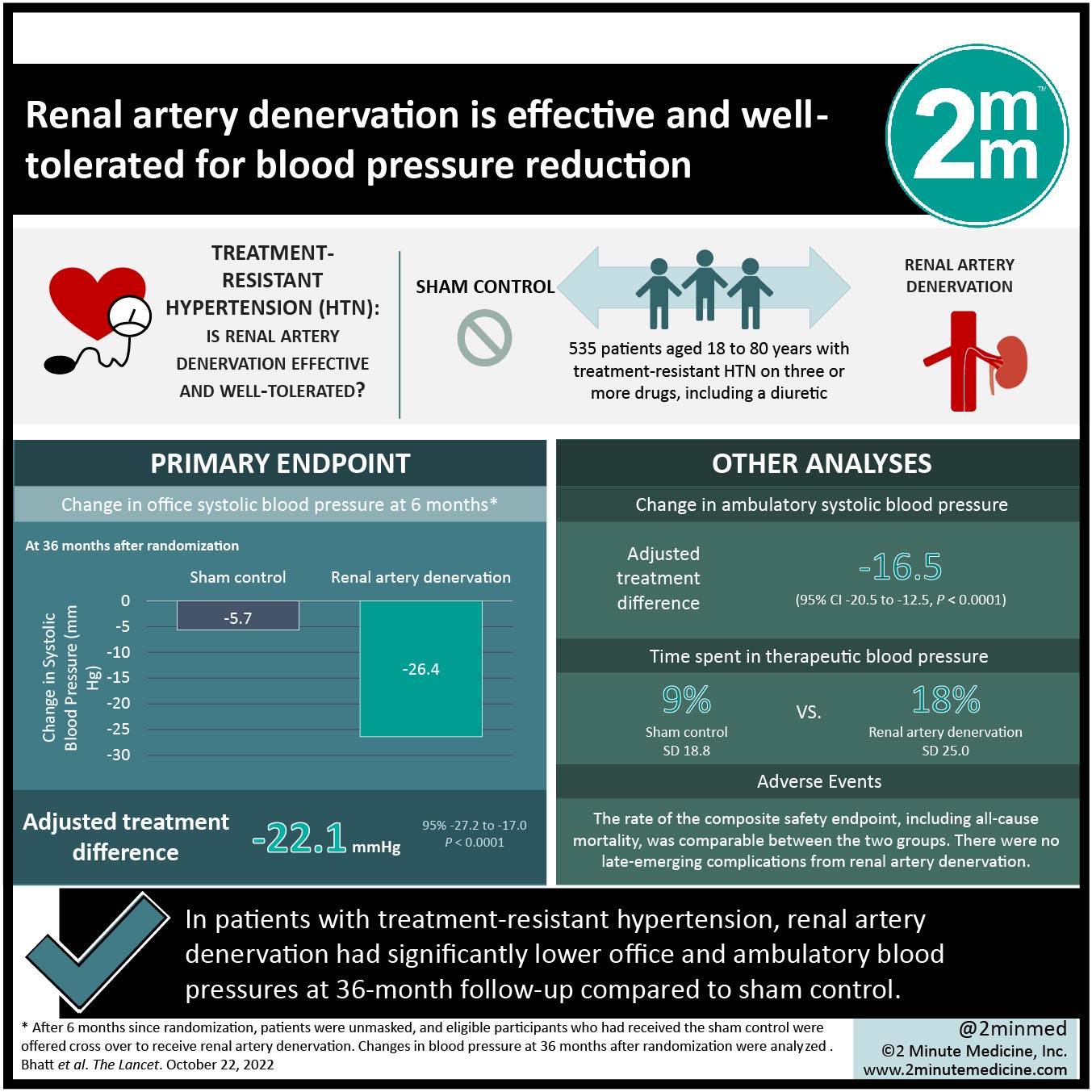
#VisualAbstract: Renal artery denervation is effective and well-tolerated for blood pressure reduction
byMinjee Kim
November 16, 2022
in StudyGraphics
Reading Time: 3 mins read
0
Share on FacebookShare on Twitter

1. Patients assigned to renal artery denervation had significantly lower office and ambulatory blood pressures at 36-month follow-up compared to sham control.

2. Renal artery denervation was well-tolerated with similar rates of the composite safety endpoint at 48 months between treatment groups.

Evidence Rating Level: 1 (Excellent)

Study Rundown: Hypertension is a medical condition that significantly increases the risk of other diseases, including those of the heart, brain and kidney. The SYMPLICITY HTN-3 trial evaluated the use of renal artery denervation for the management of treatment-resistant hypertension. Participants were randomly assigned to either treatment (renal artery denervation) or sham control, with the option of being included in a crossover group after 6 months. After 36 months, renal artery denervation significantly reduced systolic blood pressure, both in-office and ambulatory, compared to sham control. Renal artery denervation additionally significantly increased time in the therapeutic window compared to sham control. The rate of the composite safety endpoint, including all-cause mortality, was comparable between the two groups. Limitations of this study include the smaller sham control group size considering the number of patients that crossed over. Nonetheless, this study supports the use of renal artery denervation as an effective treatment for patients sub-optimally controlled on medication.

Click to read the study in The Lancet

RELATED REPORTS

2 Minute Medicine Rewind

The preoperative combination of evolocumab and rosuvastatin may not reduce major adverse cardiovascular events

Late ventricular fibrillation following myocardial infarction is associated with increased risk of 1-year mortality

Relevant Reading: Assessment of long-term benefit of intensive blood pressure control on residual life span: secondary analysis of the systolic blood pressure intervention trial (SPRINT)

In-Depth [randomized controlled trial]: SYMPLICITY HTN-3 was a randomized controlled trial conducted across 88 centres in the USA. Eligible patients were aged 18 to 80 years with treatment-resistant hypertension (office systolic blood pressure > 160 mm Hg or 24 h ambulatory systolic blood pressure > 135 mm Hg) on three or more drugs including a diuretic. A total of 535 enrolled patients were randomly assigned 2:1 to receive either renal artery denervation or sham control. The mean age of the participants was 57.9 years and 61% were men. The primary endpoint was the change in office systolic blood pressure at 6 months. After 6 months, patients were unmasked, and eligible participants who had received the sham control were offered cross over to receive renal artery denervation. After 36 months, the change in office systolic blood pressure was -26.4 mm Hg in the treatment group and -5.7 mm Hg in the sham control group (adjusted treatment difference -22.1 mm Hg [95% CI -27.2 to -17.0]; p < 0.0001). At the same time point, the change in ambulatory systolic blood pressure was -15.6 mm Hg in the treatment group and -0.3 mm Hg in the sham control group (adjusted treatment difference -16.5 mm Hg [-20.5 to -12.5]; p < 0.0001). Time spent in therapeutic blood pressure range was also significantly higher in the treatment group compared to control (p < 0.0001). There were no late-emerging complications from renal artery denervation. The rate of the composite safety endpoint at 48 months was 15% for the treatment group, 14% for the crossover group, and 14% for the non-crossover group.

©2022 2 Minute Medicine, Inc. All rights reserved. No works may be reproduced without expressed written consent from 2 Minute Medicine, Inc. Inquire about licensing here. No article should be construed as medical advice and is not intended as such by the authors or by 2 Minute Medicine, Inc.

Tags: blood pressureblood pressure controlcardiologycardiovascular diseaseHigh Blood Pressurehypertensionrenal artery denervationrenal denervationtreatment-resistant hypretension
Previous Post

Comparable outcomes amongst three different types of drug-eluting stents in BIO-RESORT Trial

Next Post

Triple mRNA vaccination and previous COVID-19 exposure provide protection against the omicron variant

RelatedReports

Remote patient monitoring did not reduce heart failure readmissions: The BEAT-HF trial
Weekly Rewinds

2 Minute Medicine Rewind

January 13, 2026
Using HEART score to risk stratify patients with chest pain is safe but underutilized in the ED
Cardiology

The preoperative combination of evolocumab and rosuvastatin may not reduce major adverse cardiovascular events

January 12, 2026
Using HEART score to risk stratify patients with chest pain is safe but underutilized in the ED
Cardiology

Late ventricular fibrillation following myocardial infarction is associated with increased risk of 1-year mortality

January 12, 2026
Using HEART score to risk stratify patients with chest pain is safe but underutilized in the ED
Weekly Rewinds

2 Minute Medicine Rewind January 5, 2026

January 13, 2026
Next Post
Combined immunotherapy may improve survival in metastatic pancreatic cancer

Triple mRNA vaccination and previous COVID-19 exposure provide protection against the omicron variant

Moderna mRNA COVID-19 vaccine is safe in children six months to five years of age

Ultrasound enhances gastrointestinal absorption of drugs at low frequencies

Heliobacter pylori eradication significantly reduces the risk of short-term hospitalization in patients taking low dose aspirin

2 Minute Medicine® is an award winning, physician-run, expert medical media company. Our content is curated, written and edited by practicing health professionals who have clinical and scientific expertise in their field of reporting. Our editorial management team is comprised of highly-trained MD physicians. Join numerous brands, companies, and hospitals who trust our licensed content.

Recent Reports

  • 2MM: AI Roundup – Lilly and NVIDIA’s $1B AI lab, Illumina’s Billion Cell Atlas, AstraZeneca’s Modella deal, and Claude for Healthcare [Jan 19th, 2026]
  • 2 Minute Medicine Rewind January 19, 2026
  • Ethosuximide may not be effective for the treatment of abdominal pain in irritable bowel syndrome
License Content
Terms of Use | Disclaimer
Cookie Policy
Privacy Statement (EU)
Disclaimer

© 2025 2 Minute Medicine, Inc. - Physician-written medical news.

  • Specialties
    • All Specialties, All Recent Reports
    • Cardiology
    • Chronic Disease
    • Dermatology
    • Emergency
    • Endocrinology
    • Gastroenterology
    • Imaging and Intervention
    • Infectious Disease
    • Nephrology
    • Neurology
    • Obstetrics
    • Oncology
    • Ophthalmology
    • Pediatrics
    • Pharma
    • Preclinical
    • Psychiatry
    • Public Health
    • Pulmonology
    • Rheumatology
    • Surgery
  • Tools
    • EvidencePulse™
    • RVU Search
    • NPI Registry Lookup
  • Pharma
  • AI News
  • The Scan
  • Classics™
    • 2MM+ Online Access
    • Paperback and Ebook
  • Rewinds
  • Partners
    • License Content
    • Submit Press Release
    • Advertise with Us
  • Account
    • Subscribe
    • Sign-in
    • My account
No Result
View All Result

© 2025 2 Minute Medicine, Inc. - Physician-written medical news.